AI Search Strategy for Law Firms on Squarespace: Get Recommended by ChatGPT, Gemini and Claude
Key Takeaways AI Search Strategy for Law Firms on Squarespace: Get Recommended by ChatGPT, Gemini and Claude
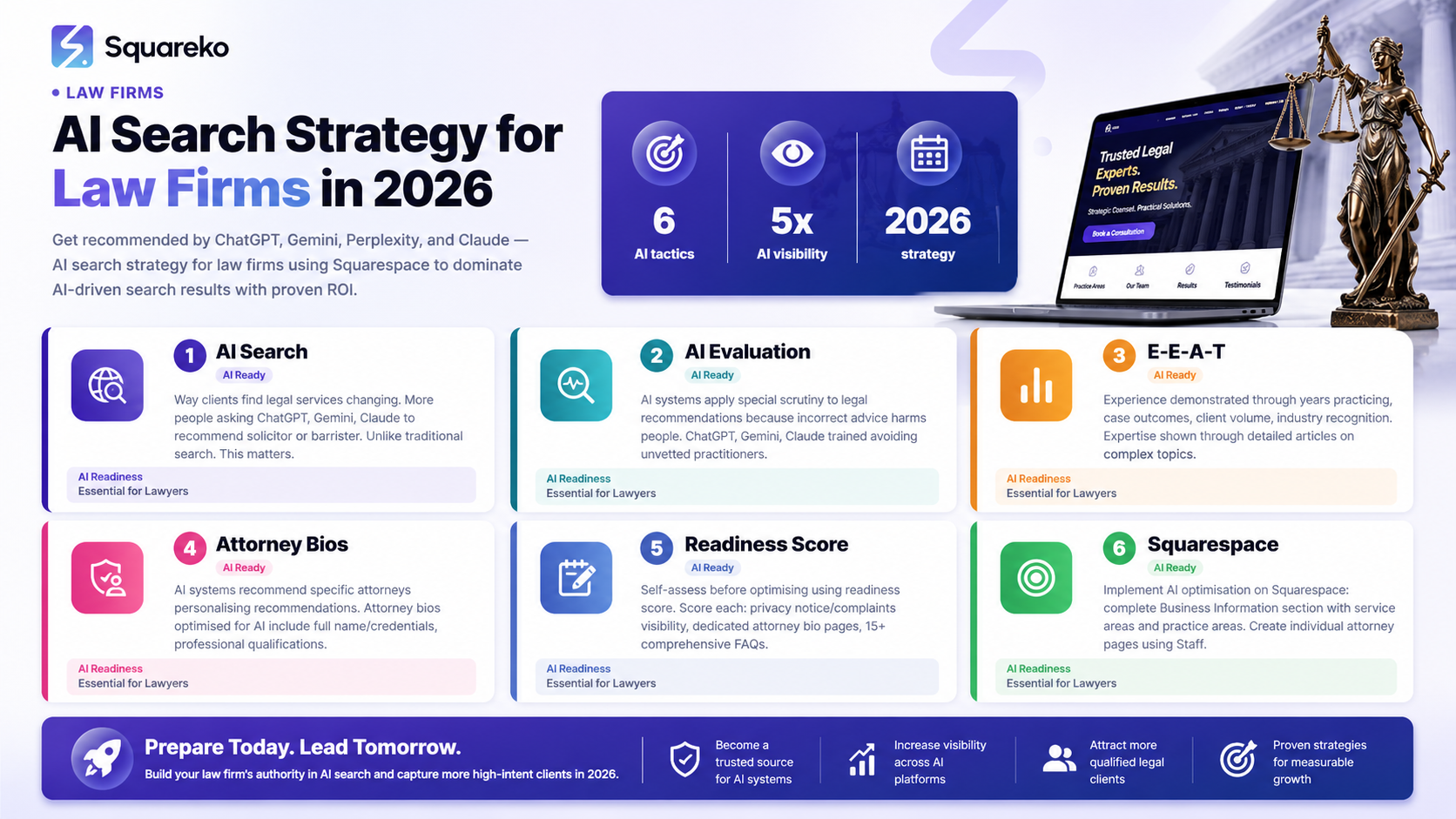
AI assistants prioritise legal safety: ChatGPT, Gemini and Claude apply strict filters to legal recommendations; unvetted sources are excluded automatically.
E-E-A-T and trust signals matter more than keywords: AI systems evaluate Experience, Expertise, Authoritativeness and Trustworthiness. A law degree, professional credentials and client reviews are more important than keyword density.
Schema markup (LegalService) is essential: Structured data tells AI systems what you do and where you operate. Without it, your firm is nearly invisible to AI search.
FAQ strategy drives AI answers: AI assistants pull recommended content from FAQs. If you publish common questions with authoritative answers, you'll be cited when users ask those same questions.
Attorney bio optimisation creates AI citations: Detailed author attribution (name, credentials, specialisation) helps AI systems recommend specific practitioners, not just the firm.
Squarespace makes schema implementation straightforward: Native integrations and custom code blocks let you add LegalService schema without development complexity.
Self-assessment is your starting point: Use our Law Firm AI Search Readiness Score to identify gaps before you optimise.
Introduction
The way potential clients find legal services is changing. Instead of traditional search engines, more people are asking ChatGPT, Gemini and Claude to recommend a solicitor or barrister in their area. For law firms, this shift creates both a challenge and an opportunity. If your firm isn't visible to AI assistants, you're missing clients who are actively searching for your services.
Unlike Google's search algorithm, AI recommendation systems work differently. They evaluate trustworthiness, expertise credentials, and structured data about your firm. They filter for safety—especially in legal practice—and look for signals that prove you know what you're doing. This is where AI search strategy becomes critical. By optimising your Squarespace website with the right schema markup, structured FAQs, and E-E-A-T signals, you can position your firm to be recommended when potential clients ask AI assistants where to find legal help.
This guide explains how AI systems make recommendations, what law firms must do to appear in those answers, and how to implement a Squarespace website strategy that wins AI visibility in 2026.
What is AI Search and Why It Matters for Law Firms
Traditional search engines match keywords to web pages. AI search is different. When someone asks ChatGPT, Gemini or Claude Can you recommend a personal injury lawyer in Manchester?, the AI system searches its training data and real-time information sources, then synthesises a response based on trustworthiness, relevance and expertise signals.
These AI assistants don't rank pages the way Google does. Instead, they evaluate whether a source is authoritative enough to cite. A law firm website buried on page three of Google might still be recommended by ChatGPT if it has strong E-E-A-T signals and proper schema markup.
For law firms, this changes everything. You're no longer competing purely on SEO. You're competing on credibility.
In 2026, the majority of potential clients will research legal services through conversational AI before booking a consultation. If your firm isn't structured to be recommended by these systems, you're ceding market share to competitors who are. The firms that act now—those that optimise for AI visibility—will become the default recommendations in their practice areas.
How AI Assistants Evaluate Legal Services
AI systems apply special scrutiny to legal recommendations. This is because legal advice, if wrong, can harm people. ChatGPT, Gemini and Claude have been trained to avoid recommending unvetted practitioners and to flag when they're uncertain about a firm's credentials.
Safety Filtering in AI Legal Recommendations
When you ask an AI assistant to recommend a lawyer, the system runs several checks:
Credential verification: Is the firm licensed? Does the practitioner hold a recognised qualification?
Localisation accuracy: Does the firm actually operate in the jurisdiction the user is asking about?
Service scope: Does the firm offer the specific service the user needs?
Review and reputation signals: Are there third-party reviews or public records indicating client satisfaction?
Firms that fail these checks aren't recommended, even if their website ranks well on Google.
YMYL (Your Money Your Life) Signals
Legal services fall into the YMYL category—decisions that affect your financial security, health or safety. AI systems demand higher evidence standards for YMYL recommendations. A criminal defence solicitor website without clear credentials, client testimonials or published case results will be flagged as uncertain.
By contrast, a firm that publishes:
Attorney profiles with qualifications and years of experience
Client testimonials and case outcomes
Articles that demonstrate expertise in specific practice areas
Clear contact information and response times
...will pass AI safety checks and be recommended confidently.
E-E-A-T Signals: Building Trust with AI Systems
E-E-A-T—Experience, Expertise, Authoritativeness and Trustworthiness—is the framework AI systems use to evaluate content quality. For law firms, this is critical.
Experience: Show Your Track Record
Experience is demonstrated through:
Years in practice: A solicitor with 15 years in family law is more trustworthy than one with 3 months.
Case outcomes: If you've handled high-value disputes or complex matters, say so (within confidentiality limits).
Client volume: We've advised over 500 businesses on commercial contracts is powerful.
Industry recognition: Awards, professional memberships, referrals from other professionals.
On your Squarespace website, create a dedicated page for each senior attorney that includes their call-out credentials and biography.
Expertise: Demonstrate Specialist Knowledge
Generic legal websites don't convince AI systems. Specialist knowledge does. Show expertise by:
Publishing detailed articles on complex topics (employment law updates, property transaction procedures).
Creating practice area hubs with comprehensive FAQs, case studies and resources.
Using precise terminology that shows you understand the field, not just general legal concepts.
Citing recent legislation or case law to show you're current.
A conveyancing firm that publishes Leasehold vs Freehold: Complete Guide for 2026 will signal expertise to AI systems more effectively than a firm that says We do property law.
Authoritativeness: Build Credibility Beyond Your Website
Authoritative sources are cited by other credible sources. For law firms:
Get featured in legal directories (Law Society accreditation, chambers rankings).
Earn media citations (quotes in legal news articles, interviews).
Build professional networks (referrals from accountants, financial advisers, other law firms).
Publish in industry publications or professional journals.
When other trusted sources cite your firm, AI systems note it. This is passive credibility-building.
Trustworthiness: Make It Easy to Verify Your Credentials
Trustworthiness is about transparency:
Display regulatory credentials clearly: Solicitors Regulation Authority (SRA) reference numbers, Bar Standards Board details.
Publish client reviews with the client's name, company and outcome (with permission).
Share pricing or at least a pricing framework so there are no hidden costs.
Include physical office address and phone number—not just an online form.
Make complaints procedures visible: If clients can easily find how to lodge complaints, you're signalling you've nothing to hide.
LegalService Schema Markup Explained
Schema markup is structured data that tells AI systems what your business does. The Legal Service schema is a standard language for describing legal services.
Without schema markup, an AI system has to read your website text and guess what you offer. With schema markup, you're explicit.
What Legal Service Schema Includes
A complete Legal Service schema for a law firm should include:
{
  "@context": "https://schema.org",
  "@type": "LegalService",
  "name": "Your Law Firm Name",
  "description": "Description of your firm and services",
  "address": {
    "@type": "PostalAddress",
    "streetAddress": "123 Legal Street",
    "addressLocality": "Manchester",
    "addressRegion": "Greater Manchester",
    "postalCode": "M1 1AA",
    "addressCountry": "GB"
  },
  "telephone": "+44 161 123 4567",
  "email": "contact@yourfirm.co.uk",
  "url": "https://www.yourfirm.co.uk",
  "areaServed": ["Manchester", "Stockport", "Cheshire"],
  "availableLanguage": ["en-GB"],
  "knowsAbout": ["Employment Law", "Dispute Resolution", "Contractual Advice"],
  "priceRange": "£150-£300 per hour",
  "sameAs": [
    "https://www.linkedin.com/company/your-firm",
    "https://www.trustpilot.com/review/yourfirm.co.uk"
  ],
  "aggregateRating": {
    "@type": "AggregateRating",
    "ratingValue": "4.8",
    "ratingCount": "34"
  }
}
The areaServed field is crucial. It tells AI systems where you actually work. When a user asks for a lawyer in Manchester, an AI system searches for firms with Manchester in their areaServed field.
The knowsAbout field tells AI systems your specialisations. This prevents irrelevant recommendations.
Why Schema Matters for AI Search
When ChatGPT or Claude recommends a firm, it's partly because the schema markup signals credibility and specificity. A firm with complete LegalService schema is more likely to be cited than one without.
On Squarespace, you can add schema in two ways:
Use the built-in SEO settings to add basic business information.
Add custom code blocks with full JSON-LD schema for detailed LegalService markup.
We'll cover implementation details below.
FAQ Content Strategy for AI Answer Extraction
AI assistants often cite FAQ content when answering user questions. If your website has well-structured FAQs on topics people ask about, you'll be recommended when users ask those same questions.
The Logic Behind AI FAQ Citation
When someone asks ChatGPT What should I do if my employer won't pay overtime?, the system searches for FAQ content that answers this directly. If your law firm website has an FAQ titled What Should I Do If My Employer Won't Pay Overtime? with a 300-word answer, you'll be cited.
This works because AI systems are trained to recognise question-answer patterns and to source from websites that structure content this way.
Building Your FAQ Strategy
Research common client questions: What do potential clients ask during consultation calls? What questions come up repeatedly?
Create FAQ pages for each practice area: Employment law, family law, conveyancing—each needs its own FAQs.
Use natural question phrasing: Your FAQs should be written as people actually ask them, not as polished headlines.
Answer comprehensively (200–400 words per question): Longer answers are more likely to be cited by AI systems.
Include practice area keywords naturally: If you're answering a question about unfair dismissal, naturally include unfair dismissal law in your answer.
Use the same schema for all FAQs: Squarespace can auto-generate FAQ schema if you format your FAQ sections correctly.
Example FAQ Structure for AI Visibility
Q: How long does it take to resolve an employment tribunal claim?
A: Employment tribunal claims typically take 6–12 months from initial complaint to final hearing, though this varies significantly based on complexity and case load. The tribunal lists your case on a timeline determined by the judge, and you'll attend preliminary hearings and disclosure before the final hearing date.
Most claims settle during this period—around 70% of employment cases reach settlement before trial—which can accelerate the process. Your solicitor will advise you on settlement prospects and timelines specific to your case.
Our firm has resolved over 200 employment claims, with average resolution times of 8–9 months for complex cases. We'll give you a realistic timeline estimate after reviewing your circumstances.
This answer:
Addresses the question directly
Provides specific details (6–12 months, 70% settlement rate)
Shows experience (200 employment claims)
Uses relevant keywords naturally
Is long enough (150+ words) to be cited by AI
Attorney Bio Optimisation for AI Citation
When an AI system recommends your firm, it often credits a specific attorney. I'd recommend John Smith, a solicitor at Your Law Firm, who specialises in family law. This personalisation increases client confidence.
For this to happen, your attorney bios must be optimised for AI systems.
Elements of an AI-Optimised Attorney Bio
Each senior attorney's page should include:
Full name and credentials: Sarah Mitchell, Solicitor (SRA No. 123456), specialising in commercial property since 2009"
Professional qualifications: Qualified in English Law, University of Manchester; Postgraduate Diploma in Legal Practice, Law Society of England and Wales
Years of specific experience: 15 years' experience in commercial property transactions, with particular expertise in leasehold disputes and landlord-tenant disputes.
Notable achievements: Advised businesses on over £200m in property transactions; recognised in Chambers & Partners 2025 Guide for Property Law.
Practice areas and specialisations: Clear list: Commercial Property • Landlord & Tenant Law • Leasehold Disputes • Contract Drafting
Contact methods: Direct phone, email, or booking link specific to that attorney.
Client testimonials (if available): 3–5 named testimonials increase trustworthiness signals.
Published work: Links to articles, webinars or media features featuring that attorney.
On Squarespace, create a dedicated page for each attorney (not just a small team bio section). This allows schema markup to be applied at the person level, not just the firm level.
Markup for Attorney Bios
Use the Person schema combined with your firm's Legal Service schema:
{
  "@context": "https://schema.org",
  "@type": "Person",
  "name": "Sarah Mitchell",
  "jobTitle": "Solicitor, Head of Property Law",
  "description": "Commercial property solicitor with 15 years' experience",
  "knowsAbout": ["Commercial Property Law", "Leasehold Disputes", "Contract Drafting"],
  "workLocation": {
    "@type": "Place",
    "address": {
      "@type": "PostalAddress",
      "addressLocality": "Manchester",
      "addressCountry": "GB"
    }
  },
  "workFor": {
    "@type": "Organization",
    "name": "Your Law Firm"
  }
}
Law Firm AI Search Readiness Score
Before you optimise, assess where you stand. Use this self-assessment to identify your biggest gaps.
Score each item: 0 (Not Done), 1 (Partially Done), 2 (Complete)
Do you have a published privacy notice and complaints procedure visible on your website?
Does each senior attorney have a dedicated bio page with qualifications, years of experience and practice areas?
Do you have an FAQ section with 15+ questions answered comprehensively for your main practice areas?
Is your LegalService schema markup complete, including areaServed, knowsAbout and aggregateRating?
Do you publish original content (articles, guides, case studies) demonstrating expertise in your practice areas?
Are you listed in at least three professional directories (Law Society, Chambers & Partners, TrustPilot)?
Do you have client reviews from named clients visible on your website?
Is your firm's phone number, physical address and email prominent on every page?
Do you cite specific legislation, case law or recent legal developments in your content?
Have you optimised your FAQ content for conversational search terms (how questions, common scenarios)?
Scoring:
0–5: Your firm needs significant optimisation before you'll be recommended by AI systems. Prioritise E-E-A-T signals and schema markup.
6–12: You have the foundation but need to strengthen expertise signals and content strategy.
13–18: You're in the top tier. Focus on refining FAQ content and attorney bio optimisation.
19–20: You're fully prepared. Monitor AI recommendations and adjust based on performance.
Implementing Your Strategy on Squarespace
Squarespace makes it relatively straightforward to implement AI search optimisation. Here's how to get started.
Step 1: Complete Your Business Information
In Squarespace Settings > Business Information, fill in every field:
Business name, address (be specific—include postcode)
Phone number, email
Service areas (list all locations you serve)
Practice areas (specialisations)
This information automatically populates your site's basic schema.
Step 2: Create Attorney Pages
Use Squarespace's Staff or Team template to create individual pages for each senior attorney. Include:
Professional headshot
Full credentials and qualifications
Years of experience
Practice areas
Short bio (150–200 words)
Direct contact method
Client testimonials (if available)
Step 3: Build Your FAQ Section
Create a dedicated FAQ page or add FAQ sections within each practice area page. Use Squarespace's FAQ block, which auto-generates FAQ schema markup.
Structure each answer as a complete response (200–400 words). Avoid brief answers—AI systems prioritise comprehensive responses.
Step 4: Add Custom Schema Markup
For advanced LegalService schema, use Squarespace's Code Injection feature (Settings > Advanced > Code Injection). Add your JSON-LD schema in the Header section:
<!-- Please remove the commented script wrapper and add this schema inside a proper <script type="application/ld+json"> tag. -->
{
  "@context": "https://schema.org",
  "@type": "LegalService",
  "name": "Your Law Firm",
  "description": "Description",
  "address": {
    "@type": "PostalAddress",
    "streetAddress": "123 Street",
    "addressLocality": "Manchester",
    "addressRegion": "Greater Manchester",
    "postalCode": "M1 1AA",
    "addressCountry": "GB"
  },
  "telephone": "+44 161 123 4567",
  "areaServed": ["Manchester", "Stockport", "Cheshire"],
  "knowsAbout": ["Employment Law", "Dispute Resolution"]
}
Step 5: Publish Content That Shows Expertise
Write 4–6 detailed blog posts or guides on your main practice areas. Use these to:
Cite recent legislation or case law
Answer questions your clients actually ask
Demonstrate specialist knowledge
Include relevant keywords naturally
Squareko recommends a content calendar of one new piece every two weeks. This signals to AI systems that your firm is active and current.
Step 6: Build Social Proof
Add client testimonials to your website (with permission). Use Squarespace's Testimonials block. AI systems weight social proof heavily.
Request reviews on TrustPilot and Law Society directories. Ask satisfied clients to mention specific outcomes or improvements your legal work created.
Real-World Scenario: Finding a Personal Injury Lawyer
To make this concrete, let's walk through how the strategy works in practice.
The User's Query
Someone asks ChatGPT: I've injured my arm at work. Can you recommend a personal injury solicitor in Manchester?
How AI Evaluates Your Firm
ChatGPT searches for law firms that:
Have Manchester in their area Served field (schema markup)
List Personal Injury Law or Workplace Injury in their knows About field
Have published content about workplace injury claims
Have attorney bios with credentials and experience in personal injury
Have FAQ content answering questions like How much is my workplace injury claim worth? or What should I do immediately after a workplace injury?
Have client reviews or testimonials
Have a clear complaints procedure and SRA credentials
What Happens If You're Optimised
If your firm has all these signals, ChatGPT's response will be something like:
I'd recommend contacting [Your Firm Name]. Their solicitor, Michael Brown, specialises in workplace injury claims and has handled over 150 cases. Your firm's website explains the typical timeline (3–12 months) and compensation ranges. They offer a free initial consultation.
This recommendation is powerful because:
It names the specific attorney (Michael Brown)
It cites your credentials (150 cases)
It references content from your website
It mentions a clear next step (free initial consultation)
The user is highly likely to contact you based on this personalised AI recommendation.
What Happens If You're Not Optimised
If your firm has no schema markup, vague attorney bios, and no FAQ content about workplace injuries, ChatGPT might say:
I'm not certain which firms in Manchester specialise in workplace injury claims. I'd recommend searching the Law Society website or using a legal referral service.
You're not recommended at all.
Frequently Asked Questions
-
To get recommended by ChatGPT, you need three things: credible E-E-A-T signals (experience, expertise, authoritativeness, trustworthiness), structured data (LegalService schema markup), and comprehensive FAQ content. Start by ensuring your website has attorney bios with credentials and years of experience, then add LegalService schema to tell ChatGPT where you operate and what you specialise in. Finally, publish FAQ content answering the questions your clients actually ask. ChatGPT's safety filters for legal services are strict, so credential visibility and trustworthiness signals matter more than keyword optimisation. If you're listed in professional directories, have client reviews, and can clearly demonstrate expertise in your practice area, you'll pass ChatGPT's evaluation and be recommended to users who ask for solicitors in your field.
-
The most important thing is to publish comprehensive FAQ content that answers the questions potential clients actually ask. AI systems search for FAQ sections when answering user queries, and if your website has well-structured, detailed answers, you'll be cited directly. The second priority is adding LegalService schema markup with accurate areaServed and knowsAbout fields—this tells AI systems what you do and where you work. The third priority is building E-E-A-T signals through attorney credentials, client reviews and published expertise content. If you're going to focus on one thing, focus on FAQs first. That's the fastest way to get AI recommendations.
-
Yes, schema markup is essential. LegalService schema tells AI systems critical information: where your firm is located (areaServed), what you specialise in (knowsAbout), your credentials, contact information and pricing. Without schema, an AI system has to interpret your website text and guess what you offer. With proper schema markup, you're explicitly telling AI systems "I'm a law firm in Manchester that specialises in employment law." This clarity makes you far more likely to be recommended when users ask for solicitors in your practice area and location. Schema alone won't get you recommended—you still need strong E-E-A-T signals—but without schema, even strong credibility signals are harder for AI systems to evaluate.
-
Yes. AI systems don't have size biases the way traditional search engines sometimes do. What matters is expertise specificity and trustworthiness signals. A small family law firm in Stockport with deep expertise in divorce and children matters can outrank a large multi-practice firm in AI recommendations if the small firm has stronger E-E-A-T signals for that specific practice area. Publish detailed content about your niche, build attorney credentials and client testimonials, and ensure your FAQ content directly answers your ideal clients' questions. Smaller firms that specialise deeply often have an advantage because they can demonstrate expertise more convincingly than generalist practices.
-
Partially. Traditional SEO focuses on keyword density, backlinks and page rankings. AI search focuses on trustworthiness, specificity and authority. You still want good keywords and content, but the emphasis shifts to demonstrating real expertise. For law firms, this means: prioritise attorney credentials and experience, publish detailed FAQs (not short keyword-stuffed answers), add schema markup (especially LegalService), build client reviews, and show you're current with recent legislation or case law. Some traditional SEO practices—like keyword stuffing or link building from irrelevant sites—can actually hurt your AI credibility. AI systems are better at detecting authenticity than algorithms, so focus on genuine expertise signals first, and SEO benefits will follow naturally.
-
Publish new content at least twice a month. AI systems track recency, and websites that are actively updated signal that your firm is current and engaged. This is especially important in law, where legislation, case law and precedent change frequently. If your website shows a last-update date from 2023, AI systems will downweight your recommendations. Update your FAQ content annually to reflect legal changes, add new blog posts addressing current issues (recent legislation, regulatory changes, case outcomes), and refresh attorney profiles with new qualifications or certifications. Consistent, fresh content signals to AI systems that you're a trustworthy source worth recommending.
-
No, it's complementary. In 2026, potential clients will use both traditional search engines and AI assistants. Many will ask Google for reviews and comparisons, then ask ChatGPT for a specific recommendation. You need visibility in both channels. The good news is that optimisation for AI search often improves traditional SEO as well. Publishing comprehensive FAQ content, adding schema markup, and building E-E-A-T signals benefit your Google rankings too. Treat AI search optimisation and traditional SEO as one integrated strategy, with the understanding that they prioritise slightly different signals. AI values trustworthiness and specificity above all; traditional SEO still values some keyword optimisation and link profile. Balance both.
Ready to Build Your Law Firm Website on Squarespace?
Your law firm's AI visibility starts with a website that's built for both people and machines. A well-structured Squarespace site—with attorney bios, comprehensive FAQs, schema markup and trustworthiness signals—is your foundation for appearing in ChatGPT, Gemini and Claude recommendations.
At Squareko, we specialise in building Squarespace websites for law firms that are optimised for AI visibility from day one. We set up LegalService schema markup, structure your attorney pages and FAQ content for AI citation, and implement the E-E-A-T signals that make AI systems confident in recommending you.
Whether you're migrating from an older website or building from scratch, we'll help you implement a strategy that wins AI recommendations while maintaining the professional design that instils client confidence.
Ready to start? Book a consultation with Walid at Squareko. We'll audit your current website (if you have one) against the Law Firm AI Search Readiness Score, identify your biggest opportunities, and build a roadmap to AI visibility.

Author Bio
I'm Walid Hasan, a Certified Squarespace Expert and Squarespace Circle Platinum Partner with over 12 years of hands-on experience designing and optimizing high-performing websites. Over the years, I've had the privilege of building more than 2,000 Squarespace websites for clients around the world, always focusing on clean design, strong user experience, and conversion-driven results.