How to Use Squarespace to Build Trust and Authority for Your Law Firm Online
Introduction
In an increasingly digital world, your law firm's website is often the first impression potential clients have of your practice. Trust is the currency of the legal profession—clients must feel confident in your expertise, credentials, and integrity before they'll retain your services. Building genuine authority online requires more than polished design; it demands strategic displays of your qualifications, proven track record, and professional standing.
Squarespace offers law firms the tools to showcase trust signals effectively whilst maintaining full compliance with bar association advertising rules. Whether you're a solo practitioner or managing a multi-attorney firm, creating a website that communicates credibility is essential in today's competitive legal marketplace. This guide explores how to use Squarespace's features to build the trust and authority your ideal clients are seeking.
Key Takeaways How to Use Squarespace to Build Trust and Authority for Your Law Firm Online
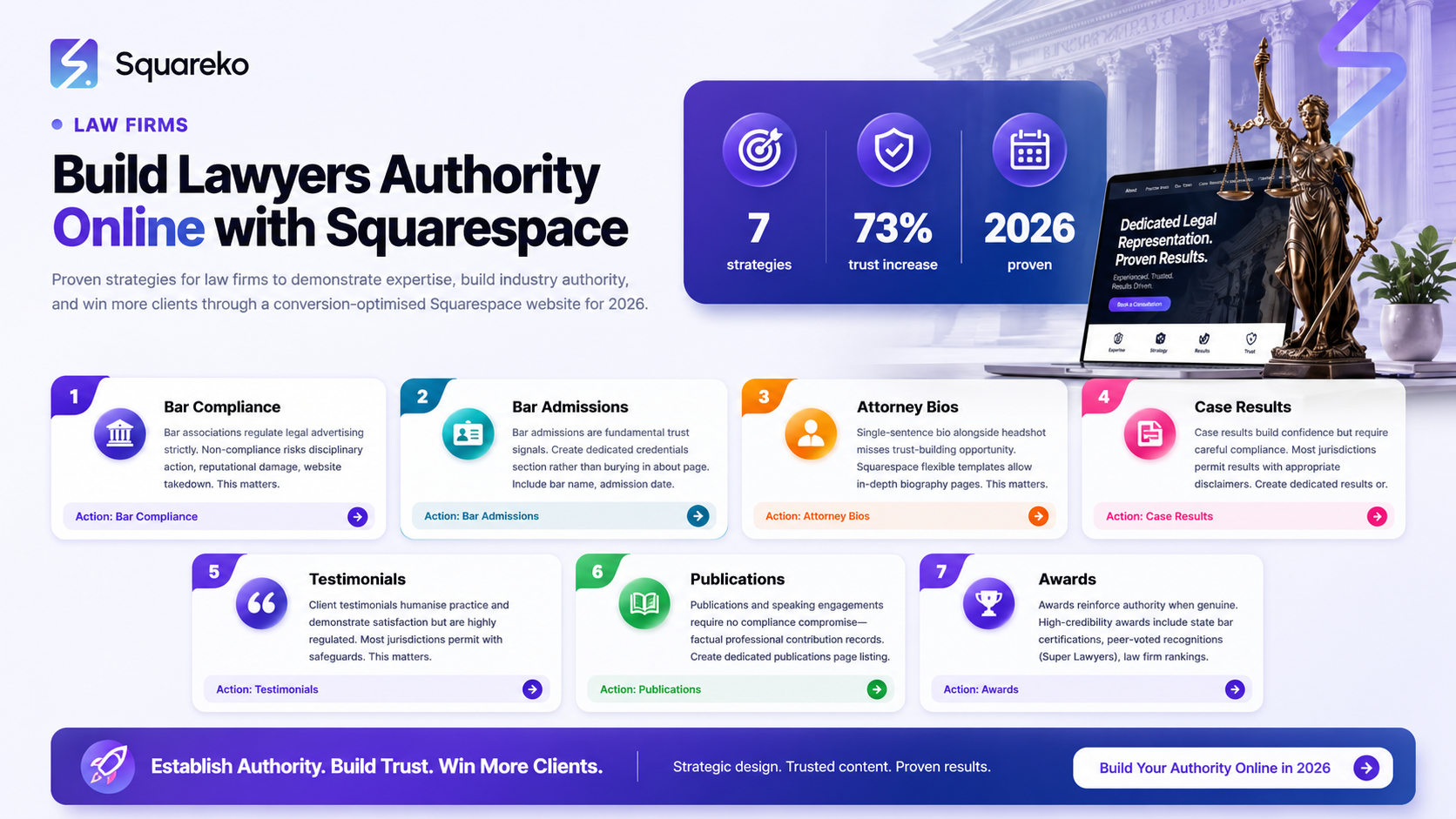
Display bar admissions, certifications, and disciplinary status transparently to establish immediate credibility
Showcase case outcomes and client results in compliance with your jurisdiction's advertising rules
Feature attorney biographies with professional accomplishments, published work, and speaking engagements
Build social proof through client testimonials where permitted by your bar association
Incorporate awards, recognitions, media mentions, and published articles into your website architecture
Use professional imagery, clear credentials sections, and accessibility features to reinforce authority
Create dedicated pages for practice areas, publications, and professional involvement to demonstrate expertise depth
Why Trust and Authority Matter for Law Firms
Unlike retail commerce, where customers can trial products and leave easily if dissatisfied, legal services demand commitment before delivery. Prospective clients cannot sample your work. They must make a calculated decision to trust you with sensitive matters, often during vulnerable or high-stakes moments in their lives.
Your website serves as a persuasion tool. Research from Casetext and other legal marketing studies consistently shows that 70–80% of potential clients research law firms online before initiating contact. During this research phase, visitors assess:
Professional standing: Are you qualified to handle this matter?
Track record: Have you successfully resolved similar cases?
Specialisation depth: Do you focus on this practice area?
Responsiveness: Will you take my calls and communicate clearly?
Trustworthiness: Will you act in my best interest?
A Squarespace website allows you to address each concern systematically through strategic content placement and transparent credential display.
The Psychology of Trust Signals
Trust signals reduce perceived risk. When a prospective client sees that you're admitted to multiple bar jurisdictions, hold particular certifications, have published in legal journals, and have spoken at industry conferences, their confidence grows. Each credential operates independently—and collectively, they create a portrait of expertise.
Squarespace's flexible template system makes it straightforward to design pages that highlight these signals without appearing self-promotional or boastful. The key is authenticity and compliance.
Bar Association Compliance: Before You Publish Anything
Before designing any trust-building elements on your website, familiarise yourself with your jurisdiction's rules of professional conduct regarding advertising and client testimonials.
American Bar Association Model Rules (and Jurisdiction Variations)
Most US state bar associations model their rules on the ABA Model Rules of Professional Conduct. Rule 7.1 governs advertising and requires that all advertising communications comply with these principles:
Not false or misleading: Claims must be accurate and capable of substantiation
Identified as advertisements: If required by local rule, advertising must be clearly identified as such
Archived: Some jurisdictions require retention of advertising materials for a set period (often 3 years)
Client Testimonials (Rule 7.4 and local variants): Many jurisdictions permit client testimonials on websites with conditions:
Testimonials must not contain unsubstantiated claims about results
They should include disclaimers where required
Some jurisdictions require that testimonials be typical or state that results vary
Certain jurisdictions restrict testimonials entirely in certain practice areas
Case Results: Displaying case outcomes is permissible in most jurisdictions, but:
Results must not be misleading about the likelihood of similar outcomes
You must include appropriate disclaimers
Some jurisdictions prohibit displaying results as average or typical without extensive disclaimers
Publications about cases must include necessary disclaimers
Disciplinary History: Many jurisdictions require that any disciplinary sanctions, suspensions, or disbarment be disclosed on your website or made available upon request.
Action Items
Review your state bar's advertising rules (often found under Rule 7.1–7.4 of Professional Conduct or equivalent)
Check whether your bar has issued guidance on website advertising and testimonials
Consult with a local bar ethics counsel if uncertain
Document your compliance strategy in writing
Archive all website content and versions for regulatory review
Displaying Bar Admissions and Professional Credentials
Your bar admissions are fundamental trust signals. Squarespace makes it simple to display them prominently.
Best Practices for Bar Admission Display
Create a Dedicated Credentials Section
Rather than burying admissions in an About page, create a prominent section on your homepage or a dedicated Credentials & Admissions page. Include:
Bar(s) admitted: State bar name, admission date, and bar number
Disciplinary status: No disciplinary record (if true) or transparent disclosure of any disciplinary history as required by your jurisdiction
Federal court admissions: Admitted to the U.S. District Court for the Southern District of New York
Speciality certifications: Board Certified in Family Law by the Florida Bar (if applicable)
Squarespace Implementation
Add a standalone page titled Credentials & Admissions or incorporate credentials into an About the Firm page
Use a table or structured layout to list admissions chronologically or by jurisdiction
Include official bar logos (where the bar permits) alongside admission details
Add verification links where applicable (link to your state bar's lawyer directory)
Ensure mobile responsiveness so credentials display clearly on all devices
Example structure:
Admissions & Credentials
- State Bar of California (Admitted 2012, Member in Good Standing, No Disciplinary History)
- State Bar of New York (Admitted 2010)
- U.S. District Court, Northern District of California (Admitted 2013)
- Board Certified in Immigration Law by the State Bar of California (Certified 2018–Present)
Certifications Worth Displaying
Law-related certifications that strengthen authority include:
Board certifications in your practice area (where issued by your state bar)
Advanced training: Completion of ABA programs, law school-sponsored advanced courses
Peer recognition programs: AVVO rating, Super Lawyers, Best Lawyers in America (where permitted and accurate)
Professional memberships: Bar association memberships, practice-specific associations
Continuing education: Highlighted if you've pursued substantial additional training in your focus area
Attorney Biography Pages: More Than Just Names
A single-sentence bio alongside a headshot misses an opportunity to build authority. Squarespace's flexible template system allows you to create in-depth attorney biography pages.
What to Include in Attorney Biographies
Professional Background
Years of practice experience in your specific practice area
Previous roles (in-house counsel, government attorney, etc.)
Education: Law school, undergraduate, relevant diploma programmes
Track Record
High-profile cases or matters (without violating confidentiality)
Notable achievements or milestones
Practice area expertise summary
Publications and Speaking
Law review articles, journal contributions, blog posts
Authored books or chapters
Speaking engagements: conferences, CLE programmes, university lectures
Media appearances or expert commentary
Professional Involvement
Bar association positions (committee member, section chair, etc.)
Volunteer and pro bono work
Industry association memberships
Teaching or adjunct positions
Personal Touch (Where Appropriate)
Bar membership date and journey to law
Personal interests or values that demonstrate character
Community involvement beyond law
Squarespace Design Recommendations
Dedicate full pages to each attorney (rather than small profiles buried in a directory)
Use professional photography: Headshots should be current, high-quality, and consistent in style across the team
Employ clear hierarchy: Use H2 and H3 headings to structure education, experience, and accomplishments
Link to publications: Embed or link to published articles, books, or speaking videos where available
Include contact details: Make it easy for visitors to reach a specific attorney
Showcasing Case Results Compliantly
Prospective clients want to know: Can you win cases like mine? Displaying case results builds confidence, but it must be done carefully.
The Compliance Minefield
Bar rules differ significantly regarding case result disclosure:
Some jurisdictions permit detailed results with specific damages/settlement amounts
Others require blanket disclaimers such as Results vary based on individual circumstances
Still others restrict results marketing in certain practice areas ( personal injury) or require that results be typical only if backed by statistical evidence
A few jurisdictions prohibit results claims entirely in advertising
Steps to Comply
Step 1: Verify Your Jurisdiction's Rules
Consult Rule 7.1 of your state's Professional Conduct rules, or contact your bar's ethics hotline.
Step 2: Develop a Disclaimer Strategy
Common compliant disclaimers include:
The outcome of any case depends on many factors. Past results do not guarantee similar outcomes in future matters.
Or, for jurisdictions with stricter rules:
These results are illustrative of the types of matters we handle. Actual results vary significantly based on case-specific facts, applicable law, and jurisdiction. Prior results do not guarantee or suggest a likelihood of similar outcomes in any future matter.
Step 3: Curate Representative Cases
Avoid cherry-picking only your highest verdicts or settlements. Instead, select cases that:
Represent your core practice areas accurately
Demonstrate range and breadth of your experience
Are genuinely significant but not outliers
Step 4: Structure the Display
On Squarespace, create a dedicated Case Results or Verdicts & Settlements page with:
Case name (or anonymised title if confidentiality required)
Practice area / case type
Outcome (verdict, settlement, award)
Year
Brief description of key facts (without identifying information)
The required disclaimer, prominently displayed
Example Format:
Commercial Breach of Contract Matter
Recovered $2.3 million in settlement
(2023)
Represented a technology company in a commercial contract dispute.
Recovered substantial settlement through negotiation and threat of trial.
Disclaimer: Results vary based on individual case facts, jurisdiction, and applicable law.
What NOT to Claim
Avoid:
We win 95% of cases (unless you can substantiate this with documented statistics)
We obtained the largest settlement in the county (unless verifiable)
Similar cases typically settle for $X (unless statistically accurate and fully disclosed)
Photos of courtroom or specific judges (can imply a special relationship)
Building Social Proof Through Client Testimonials
Client testimonials humanise your practice and demonstrate satisfaction. However, they're highly regulated.
Legal Considerations
Jurisdiction Variance: Before displaying any testimonial, confirm your bar permits them and under what conditions. The American Bar Association permits testimonials with safeguards; however, individual state bars may be stricter.
Key Compliance Points:
Accuracy: Testimonials must be accurate and reflect the client's genuine statement
Representativeness: Some jurisdictions require that testimonials not imply they're typical results unless you can substantiate this claim
Identification: Some bars require the client's full name and case outcome be disclosed; others permit anonymisation
No Compensation: The client must not be paid for the testimonial (payment can invalidate compliance)
Archiving: Retain a copy of the original testimonial and the client's consent for regulatory review
Best Practices for Squarespace Implementation
If Your Jurisdiction Permits Testimonials:
Obtain Written Consent: Email the client a request to quote them, specifying what will be published. Retain their response
Include Full Identification: Use the client's full name and (where appropriate) case outcome, unless your bar permits anonymisation
Avoid Editing for Exaggeration: Quotes should be genuine; light editing for grammar is acceptable, but do not alter meaning or embellish
Add Disclaimers: Where required by your jurisdiction, add: Client testimonials reflect individual experiences and results may vary.
Feature on Dedicated Pages: Create a Client Testimonials or Client Reviews page rather than scattering them across your site
Use Multimedia: Consider video testimonials (with client consent) for enhanced credibility
Sample Testimonial Structure on Squarespace:
Sarah was incredibly responsive throughout my case. She explained
complex legal concepts clearly and advocated fiercely on my behalf.
I felt heard and supported every step of the way.
— Jennifer M., Family Law Matter (2023)
[Optional disclaimer]: Results and client experiences vary. Testimonial
reflects individual matter outcome.
If Your Jurisdiction Prohibits or Restricts Testimonials
If testimonials are prohibited or heavily restricted in your jurisdiction:
Omit them entirely or display only with substantial disclaimers
Consider alternative trust signals: case results, awards, publications, speaking engagements
Focus on service guarantees, response time commitments, or service descriptions instead
Featuring Publications, Speaking Engagements, and Media Mentions
Publications and speaking engagements are trust signals that require no compliance compromise—they're factual records of professional contribution.
Create a Publications Page
What to Include:
Law Review Articles: Author, publication name, year, and—where permitted—a link to the article
Books and Chapters: Title, publisher, year, ISBN (if applicable)
Blog Posts or Articles: If substantial and on a recognised legal platform
White Papers: Detailed research or guides you've authored
Contributions to Industry Publications: Law firm publications, legal technology blogs, bar association journals
Squarespace Implementation:
Create a dedicated Publications or Thought Leadership page
Organise chronologically (newest first) or by category (articles, books, chapters)
Include publication name, date, and—where possible—a direct link to the article
Add brief descriptions of complex topics so visitors understand the content
Use a professional layout with clear hierarchy
Create a Speaking Engagements Page
What to Include:
Event name and date
Topic of presentation
Audience (CLE programme, bar association conference, university, etc.)
Description of key themes (1–2 sentences)
Example:
The Evolution of Data Privacy in Corporate M&A
American Bar Association Annual Conference, New York
August 2023
Presented alongside two senior partners on how recent privacy regulations
affect due diligence in mergers and acquisitions. Covered GDPR compliance,
state privacy laws, and practical frameworks for deal teams.
Feature Media Mentions
If you've been quoted in reputable publications (news outlets, legal journals, industry publications), create a Media or Press page featuring:
Publication name and date
Article headline and link
Brief context of your contribution
Example:
Why Corporate Boards Need to Prioritise Cybersecurity Now
Featured in Financial Times, March 2024
Q&A discussing corporate governance obligations in response to
rising cybersecurity breaches.
Compliance Note: Ensure all media mentions are factually accurate and link to the original source. Misrepresenting media coverage violates advertising rules.
Awards, Recognitions, and Professional Memberships
Awards and recognitions—when genuine—reinforce authority and expertise.
Which Awards Matter
High-Credibility Awards:
State bar certifications (Board Certified in Family Law, etc.)
Super Lawyers or Best Lawyers in America(where these are awarded based on peer evaluation)
Law firm rankings: Legal 500, Chambers & Partners, etc. (for firms)
Bar association honours: Fellow of the American College of Trial Lawyers, recognition as a bar leader
Medium-Credibility Awards:
Industry association recognitions: Practice area-specific awards
Client choice awards: When issued by credible third parties
Speaking invitations to prestigious events: CLE programs, bar conferences
Lower-Credibility Awards (Use Cautiously):
Self-reported ratings: AVVO, Nolo, and similar platforms where any attorney can be rated (be transparent about how these work)
Directory listings: Simply being listed in a directory is not an achievement
Compliance Considerations
When displaying awards:
Verify accuracy: Ensure the award is genuine and the organisation is legitimate
Disclose methodology: If a rating comes from a directory, explain how the rating is assigned (AVVO rates attorneys on a scale determined by their website completeness and client reviews)
Avoid implied endorsement: Do not imply that listing in a directory constitutes formal recognition or board certification if it doesn't
Squarespace Display Options
Homepage Badge Section: Feature top 3–4 awards prominently on the homepage
Dedicated Awards Page: Create a comprehensive awards, recognitions, and memberships page
Attorney Profiles: Include relevant awards on individual attorney biography pages
Footer: Add a small Recognised by section with logos
The Legal Trust Signals Checklist
Use this checklist to audit your website's trust-building elements:
Credentials & Professional Standing
☐ Bar admissions clearly displayed (all jurisdictions)
☐ Disciplinary status disclosed (where required)
☐ Federal court admissions listed
☐ Speciality certifications or board certifications featured
☐ Continuing education or advanced training highlighted
☐ Professional licence numbers or bar numbers included
☐ About the Firm or About Our Attorneys pages detail experience
☐ Years of practice experience stated clearly
Track Record & Results
☐ Case results page created with appropriate disclaimers
☐ Verdicts and settlements displayed (where compliant)
☐ Practice area descriptions include success indicators
☐ Problem-solving approach explained clearly
☐ Client results mentioned (with compliance safeguards)
Publications & Thought Leadership
☐ Publications page lists articles, books, white papers
☐ Speaking engagements documented
☐ Conference presentations listed
☐ Teaching or adjunct positions mentioned
☐ Media mentions and expert commentary featured
☐ Blog or resource section demonstrates expertise
Social Proof
☐ Client testimonials (if permitted in your jurisdiction) with written consent
☐ Testimonials displayed with full client identification and results
☐ Appropriate disclaimers included with testimonials
☐ Video testimonials considered (with consent)
Awards & Recognition
☐ Bar association awards and honors listed
☐ Super Lawyers, Best Lawyers, or similar recognitions shown
☐ Legal rankings or directory listings disclosed
☐ Awards displayed with methodology transparency
☐ Client choice awards featured (where credible)
Professional Involvement
☐ Bar association positions and committee memberships listed
☐ Pro bono work and volunteer service highlighted
☐ Industry association memberships displayed
☐ Leadership roles in professional organisations featured
Design & Accessibility
☐ Credentials sections easy to find and read
☐ Attorney photos professional and current
☐ Trust signal content mobile-responsive
☐ Trust information accessible to screen readers
☐ Credentials regularly updated
Frequently Asked Questions
-
In most US jurisdictions, yes, but with important conditions. The American Bar Association permits client testimonials on websites so long as they comply with Rule 7.1 (advertising rules) and are not false or misleading. However, individual state bars have varying rules. Some jurisdictions permit testimonials freely; others require disclaimers; a few restrict them entirely in certain practice areas (e.g., family law in some states).
Before publishing any testimonial, verify your state bar's rules. Obtain written consent from the client, retain documentation of their agreement, and—where required by your jurisdiction—include disclaimers such as "Client testimonials reflect individual experiences and results may vary." If you're uncertain, consult your state bar ethics hotline or a legal ethics specialist. The risk of non-compliance far outweighs the benefit of a testimonial.
-
Displaying case results compliantly requires understanding your jurisdiction's specific rules. Most states permit results with appropriate disclaimers, but some have stricter standards. Start by reviewing your state bar's Rule 7.1 on advertising and any formal opinions on results claims. Create a dedicated "Case Results" or "Verdicts & Settlements" page on Squarespace featuring cases that represent your practice accurately (not just your highest awards). Include case type, outcome, year, brief facts, and a clear disclaimer such as "Prior results do not guarantee similar outcomes in future matters. Results vary based on case-specific facts, jurisdiction, and applicable law."
Avoid claiming that results are "typical" unless you can substantiate this with documented statistics. Never link your results to advertising guarantees or imply causation between your firm and every successful outcome. Consider consulting a legal marketing specialist or ethics counsel to audit your results presentation before publishing. -
Display awards and recognitions that genuinely reflect your expertise and credibility. High-credibility awards include state bar board certifications (e.g., "Board Certified in Family Law"), peer-voted recognitions like Super Lawyers or Best Lawyers in America, and bar association honours (e.g., Fellow of the American College of Trial Lawyers). Mid-tier awards include industry-specific recognitions, prestigious speaking invitations, and client choice awards from credible organisations.
Be transparent about how awards are assigned. If you're listed in AVVO, Nolo, or similar directories, explain that these are self-reporting platforms where methodology may vary. Avoid displaying trivial or self-created awards, as they can undermine credibility rather than enhance it. Feature your most impressive, legitimate recognitions prominently, and update this information annually to reflect current status. -
Effective attorney biographies go beyond name and credentials. On Squarespace, create dedicated pages for each attorney that include professional background (years of practice, education, previous roles), track record and accomplishments, publications and speaking engagements, professional involvement (bar positions, volunteer work), and personal elements that build character and trustworthiness. Use clear headings and professional photography. Link to published articles, speaking videos, or media appearances where possible.
Avoid generic, boilerplate bios. Instead, write personally about each attorney's journey into law, their specialisation depth, and what drives their practice. Prospective clients want to know if they'll work with a lawyer who understands their situation and will communicate clearly. A biography of 800–1,200 words can accomplish this far more effectively than a paragraph. -
Board certifications are the gold standard of legal credentials. In the US, board certifications are typically issued by state bar associations, have rigorous requirements (often years of practice experience, continuing education, and examination), and are regularly reviewed. For example, the State Bar of California issues board certifications in 16 practice areas. Being "Board Certified in Family Law" means you've met these strict standards and are recognised by your state bar as a specialist.
In contrast, other credentials vary widely. Advanced training from accredited institutions (like ABA programs) is valuable but less stringent than board certification. Speciality listings in directories (like AVVO) are self-reported and unverified. Peer-voted recognitions (Super Lawyers) are credible but typically not equivalent to board certification. When displaying credentials, clarify what each designation means. Board certifications should be prominent; other credentials should be explained transparently. -
This depends on your jurisdiction and whether you have a disciplinary history. Many states require that any disciplinary sanctions, suspensions, disbarment, or public reprimands be disclosed. Some jurisdictions require this to be stated on your website; others require disclosure upon request or when applying to a specific case or court. If you have no disciplinary history, stating "No disciplinary record" or "Member in Good Standing" is powerful and transparent.
If you do have a disciplinary history, transparency is essential. Attempting to hide disciplinary matters damages your credibility far more than addressing them openly. Consult your state bar's rules or an ethics specialist to determine what disclosure is required and how to present it in the most professionally appropriate way. Many attorneys have experienced minor disciplinary matters; how you acknowledge and explain them matters more than their existence. -
Squarespace's content management system makes it straightforward to maintain trust signal pages. You can create dedicated pages for credentials, publications, case results, testimonials, and awards, then update them as new achievements occur. Squarespace's template library includes professional designs suitable for law firms, and the platform's mobile responsiveness ensures your credentials display well on all devices.
Use Squarespace's built-in SEO tools to optimise your credentials and trust signal pages for search visibility. Additionally, archive all content versions (particularly advertising materials, testimonials, and case results) in compliance with your bar's record-keeping requirements. Squareko.com can help you design and optimise your Squarespace website to ensure trust signals are displayed strategically and compliantly.
Ready to Build Your Law Firm Website on Squarespace?
Building trust and authority online is not a one-time project—it's an ongoing commitment to transparent, compliant representation of your expertise. Your website should communicate the credentials, accomplishments, and integrity that differentiate your practice.
Squarespace provides the design flexibility and technical features law firms need to showcase their expertise whilst maintaining full compliance with bar association advertising rules. From attorney biography pages and case result displays to publications sections and client testimonials, Squarespace makes it simple to build a website that attracts qualified clients and establishes your firm as a trusted authority in your practice area.
If you're ready to build or redesign your law firm website on Squarespace, the team at Squareko specialises in creating professional, trust-focused websites for legal practices. We understand the nuanced compliance requirements of legal advertising, and we design websites that balance aesthetic appeal with regulatory precision.
Ready to get started? Contact Squareko today to discuss your law firm's website strategy. Let's build a digital presence that reflects your expertise and attracts the clients who value your services.

From custom website design to SEO strategy, we help businesses launch a site that looks professional and performs better.

Author Bio
I'm Walid Hasan, a Certified Squarespace Expert and Squarespace Circle Platinum Partner with over 12 years of hands-on experience designing and optimizing high-performing websites. Over the years, I've had the privilege of building more than 2,000 Squarespace websites for clients around the world, always focusing on clean design, strong user experience, and conversion-driven results.