Local SEO for Technology Consulting Firms on Squarespace: Win Enterprise Contracts in Your Region
Key Takeaways Local SEO for Technology Consulting Firms
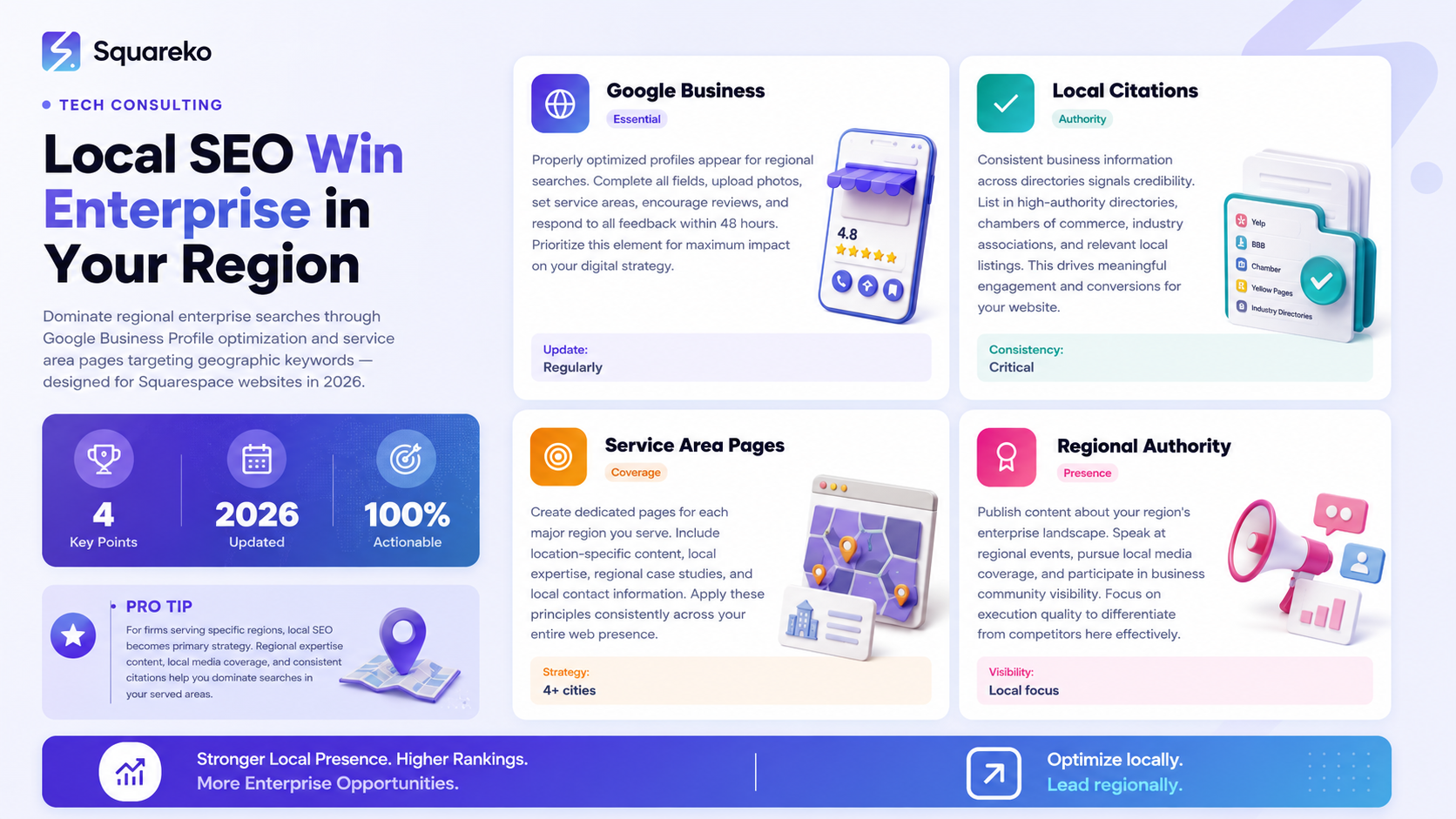
Google Business Profile is essential infrastructure: Properly optimized, it appears for regional consultant searches and builds local trust signals
Service area pages extend your geographic reach: Create pages for each region or city you serve, optimizing for local keywords
Local citations build authority: Consistent business information across directories signals credibility to search engines and potential clients
Regional expertise content attracts local prospects: Demonstrate deep knowledge of regional enterprise challenges and opportunities
Multi-office strategy requires coordinated SEO: Each office location needs optimized presence while maintaining firm-level authority
If your technology consulting firm serves specific geographic regions or has multiple local offices, local SEO is your opportunity to dominate enterprise searches in those areas. Enterprise buyers often search for digital transformation consulting in [city] or [state] cloud migration services, and local SEO ensures you appear prominently when they do.
Local SEO for consulting firms differs from local SEO for restaurants or retail businesses. Enterprise consulting local SEO focuses on regional authority, office visibility, and regional service expertise rather than walk-in traffic.
This guide covers local SEO strategy specifically for technology consulting firms on Squarespace, including Google Business Profile optimization, local content strategy, and how to win regional enterprise contracts through search visibility.
Local SEO Fundamentals for Consulting Firms
Local SEO is the practice of optimizing your online presence to rank well for location-based searches. For consulting firms, this typically means dominating searches like:
Digital transformation consulting in [city]
[State] managed IT services
Enterprise cloud migration services near me
IT consulting firms in [region]
Who Searches for Local Consulting?
Enterprise prospects searching for local consulting typically include:
Regional procurement teams: Evaluating local consulting options for accessibility and relationship
Mid-market companies: Often prefer local or regional consultants they can meet with in person
Multi-location enterprises: Searching for regional consultants for specific locations
Relationship-focused buyers: Prefer local consultants they can build ongoing relationships with
Time-zone considerations: Companies searching for consultants in compatible time zones
Local vs. National Consulting SEO
If your firm serves enterprises nationally, local SEO is supplementary to national SEO strategy. However, if you have:
A strong regional presence
Multiple local offices
Concentrated regional enterprise client base
Regional expertise or specialization
Then local SEO becomes a primary strategy.
Google Business Profile Optimization
Google Business Profile (formerly Google My Business) is the foundation of local SEO. It appears in Google Search results and Google Maps, both critical for enterprise consulting searches.
Creating and Claiming Your Profile
If you haven't created a profile:
Visit Google Business Profile
Sign in with your Google account
Click Manage now or Create a business
Enter your business information
Verify your business location
If you have an existing profile:
Sign in and claim the profile
Complete verification process
Update all information
Profile Completion and Optimization
Business information (critical):
Business name: Your official business name (not a branded variant)
Category: Management Consulting or IT Consulting (choose primary category that fits)
Location: Full, accurate address (if you have a physical office)
Phone: Direct business phone
Website: Your Squarespace site
Hours of operation:
Accurate business hours
Note if you work by appointment only
Include holiday hours
Business description (250-750 characters):
Clear description of services
Include primary keywords naturally
Focus on what you do and who you serve
Example: Enterprise digital transformation consulting serving Fortune 500 companies across the Midwest. Specializing in cloud migration, enterprise architecture, and digital strategy. 20+ years of proven results.
Services section:
List primary service offerings
Edit service area for each service if needed (cloud migration serves regional clients, advisory serves national)
Business attributes:
Check relevant attributes (wheelchair accessible if applicable)
Select relevant attributes for your service type
Photos and Visual Elements
Upload professional photos:
Business photo: Professional photo of your office or team
Service photos: Photos of your team, office, or past projects
Logo: Your firm's logo
Google rewards profiles with multiple, high-quality photos. Include 3-5 professional photos total.
Service Area Setup
For service-based businesses like consulting, Google Business Profile lets you define your service area:
Add service area:
Go to Service area in your profile
Select I deliver goods and services to my customers
Add service areas (cities, regions, or geographic radius)
Regional strategy:
If you serve a specific region (Midwest), add all cities in that region
If you serve specific states, add those states
If national, add major regions or select Serves the entire United States
Ongoing Profile Management
Maintain your profile with:
Regular updates: Post new updates about services, special offerings, or firm news
Q&A responses: Answer common questions about your services
Review management: Monitor and respond to reviews (see below)
Performance monitoring: Check which searches drive impressions and clicks
Review Management and Reputation
Reviews on Google Business Profile significantly impact local search rankings. Actively manage your review reputation:
Encourage reviews:
Ask satisfied clients to review you on Google
Include link to your Google review page in email signature and follow-ups
Mention Google reviews in client conversations
Make review process easy (direct link, clear instructions)
Respond to reviews:
Respond to all reviews within 48 hours
Be professional and appreciative
For negative reviews, respond professionally and offer to address concerns offline
Responses should be brief but personalized
Quality over quantity:
For consulting, even 3-5 high-quality reviews is valuable
A few detailed, genuine reviews outweigh many generic reviews
Local Citations and Directory Strategy
Local citations (mentions of your business name, address, and phone number) signal credibility to search engines. Consistent citations improve local search rankings.
High-Priority Directories for Consulting Firms
Industry-specific directories:
Consultant directories relevant to your specialty
Technology and IT consulting directories
Management consulting directories
Professional association directories:
Association memberships often include directory listings
Ensure accuracy across all association member lists
National business directories:
Google Business Profile (priority)
Bing Places for Business
Apple Maps
Industry-specific directories
Chamber of Commerce directory (if applicable)
Citation Consistency
Maintain consistency across all citations:
Business name: Use official legal name consistently
Address: Use exact same format everywhere
Phone: Consistent phone number format
Website: Consistent URL format
Inconsistencies signal to search engines that information may be unreliable.
Building Local Citations
For new directories:
Research directory and verify legitimacy
Create profile with consistent information
Include business description and keywords naturally
Add professional logo and photos if available
Include link back to your website when possible
Prioritize:
High-authority directories (Google, Bing, Apple Maps)
Industry-specific directories
Local chamber of commerce or business associations
Directories your target clients use
Service Area Pages and Regional Content
If you serve multiple regions, create service area pages that rank for location-specific searches.
Service Area Page Structure
Create dedicated pages for each major region or city you serve:
URL structure: /services/digital-transformation/[city] or /digital-transformation-consulting-[city]
Page structure:
Headline: [Service] in [City] or [Service] for [City] Enterprises
Introduction: Explain your presence and expertise in that region
Regional expertise: Specific knowledge of that region's enterprise landscape
Local case studies: Case studies from clients in that region (if available)
Local team members: Highlight consultants based in that region
Regional approach: How you approach work in that specific region
Local resources: Local industry associations, events, or initiatives you participate in
Contact: Local office address (if you have one) and local contact phone
Regional customization:
Research each region's enterprise landscape and challenges
Customize content to address region-specific opportunities and issues
Feature regional clients or case studies
Highlight local expertise and relationships
Multi-City Strategy
For consulting firms serving multiple cities:
Single service area page (better for small coverage area):
Create one page optimized for your entire service region
List all served cities
Use region name in title (Midwest Digital Transformation Consulting)
Individual city pages (better for multiple cities):
Create separate page for each major city
Optimize each page for that city's keywords
Link between pages showing your regional coverage
Recommended approach:
For 2-3 cities: Single service area page
For 4+ cities: Individual city pages linked together
Local Content and Regional Authority
Build regional authority through content that demonstrates deep knowledge of your local market.
Regional Expertise Content
Publish content about your region's enterprise landscape:
Digital Transformation Trends for [State] Enterprises
How [City] Manufacturing Companies Are Modernizing
Enterprise Cloud Migration: Considerations for [Region]
Healthcare Digital Transformation in [Region]
These content pieces should:
Address region-specific challenges and opportunities
Reference regional companies and industries (with proper attribution)
Discuss local regulatory or market conditions
Demonstrate deep knowledge of that region's business environment
Link to service area pages for that region
Local Event Participation
Build visibility through local events:
Speak at regional industry conferences and associations
Sponsor local enterprise or IT professional groups
Host or co-host webinars for local business leaders
Participate in chamber of commerce or business association events
Write about local events you attend or speak at
Local Media and Press Coverage
Pursue regional media coverage:
Pitch stories to local business publications
Provide expert commentary on local business trends
Highlight your involvement in local business community
Get coverage in regional business journals and publications
Multi-Office Coordination Strategy
If you have multiple physical locations, coordinate SEO across all offices.
Multi-Location Google Business Profile Setup
For firms with multiple offices:
Primary profile: Main firm profile at headquarters
Location profiles: Individual profiles for each office location
Each office should have:
Its own Google Business Profile
Dedicated address and phone
Local manager responsible for maintenance
Consistent brand information
Website Structure for Multi-Office Firms
Hierarchical structure:
Homepage
├── Offices/Locations
│ ├── New York Office
│ ├── Los Angeles Office
│ ├── Chicago Office
│ └── etc.
├── Services
│ ├── Digital Transformation
│ ├── Cloud Migration
│ └── etc.
└── Contact
Office pages should include:
Office address and directions
Office phone and local contact person
Team members at that location
Local expertise and specialization
Office-specific content (local case studies, events, news)
Maintaining Multi-Office SEO Health
Consistency: Ensure all locations have consistent branding and messaging
Coordination: Prevent conflicting SEO efforts between offices
Support: Each office maintains its own social media and local presence
Tracking: Monitor rankings and leads by location
Content sharing: Share best practices between locations
Local Link Building for Consultants
Links from local sources help with local search rankings.
Local Link Building Opportunities
Local business associations:
Chamber of commerce membership and directory listing
Industry association membership links
Business group directory listings
Local media and press:
Local business journal coverage
Regional publication interviews
Local news mentions
Local partnerships:
Client links to your firm
Partner organization links
Technology partner and vendor links
Supplier links
Local speaking and events:
Conference and event websites
Local association directories
University or educational links
Local directory and listing:
Industry-specific local directories
Regional business directories
Local service provider listings
Focus on quality over quantity. A few links from authoritative local sources outweigh many from low-quality directories.
Local Keyword Strategy
Effective local SEO requires understanding your region's search behavior.
Local Keyword Research
Identify keywords your regional prospects search:
Service + location keywords:
Digital transformation consulting in Chicago
Cloud migration services in California
Enterprise IT consulting in Massachusetts
Problem + location keywords:
How to modernize legacy systems in healthcare (your region)
Enterprise security consulting in (your region)
Industry vertical + location:
Healthcare digital transformation in New England
Manufacturing IT consulting in Midwest
Comparison keywords (local):
Best consulting firms in (city)
Top enterprise consultants in (region)
Local Keyword Implementation
Homepage optimization:
Include city or region in your headline or value prop
Mention service areas naturally
Include local keywords in meta description
Service area pages:
Include city/region in page title and headings
Use location keywords naturally throughout content
Build internal links from location pages to services
Blog content:
Write about local business trends
Address region-specific challenges
Include local keywords naturally
Google Business Profile:
Include region or city in business description
Include primary keywords in services section
Squarespace Local SEO Implementation
Implement local SEO within Squarespace's platform:
Site Settings for Local SEO
Business information:
Go to Settings > Business Information
Enter your business name, address, phone (matching Google Business Profile)
Include business description
Add business categories
This information automatically appears in site code and helps search engines understand your location.
Service Area Pages on Squarespace
Create location-specific pages:
Using custom pages:
Create new page with location-specific title (Digital Transformation in Chicago)
Use clear URL structure (/services/digital-transformation-chicago)
Customize page with location-specific content
Include location keywords in heading, introduction, and body
Link to Google Business Profile or maps (if applicable)
Include local CTA (Contact our Chicago office)
Using page metadata:
Edit each location page's metadata
Set unique title tag including location
Write meta description including location
Ensure location keywords appear naturally in content
Google Business Profile Integration
Link your Squarespace site with Google Business Profile:
Create/claim Google Business Profile (separate from Squarespace)
Add your Squarespace website URL to profile
Keep profile information updated
Monitor Google Business Profile in Search Console
Local Schema Markup
Add schema markup for local business information:
Organization schema (in site code):
Automatically included if you complete business information in settings
Includes name, address, phone, website
LocalBusiness schema (for location pages):
Can be added via custom code for location-specific pages
Helps search engines understand location-specific content
Squarespace automatically includes basic organization schema when you complete business information.
Local Link Building in Squarespace
Create linkable assets within your Squarespace site:
Research reports: Original research attractive to local media
Local guides: Comprehensive guides about your region or industry
Case studies: Feature local client success stories
Event coverage: Blog about local events you speak at or attend
These assets are more likely to be linked to by local sources.
Frequently Asked Questions
-
Yes, particularly if you have a physical presence, serve specific regions, or prefer in-person client relationships. Even national firms benefit from regional authority and Google Business Profile optimization. Enterprise buyers often search for local options before considering national firms.
-
Create pages for cities or regions where you have significant presence or do substantial business (5+ clients). Better to have 3-5 high-quality location pages than 20 thin pages. Quality and customization matter more than quantity.
-
Pages on the main site (with location-specific sections) are better for most consulting firms. This maintains firm-level authority while providing location-specific content. Separate office websites create SEO conflicts and duplicate content issues.
-
Very important. Google Business Profile is designed for businesses with physical locations. If you work entirely remotely, create a profile with your service area but understand your local search visibility will be lower. Consider using a virtual office address or registered agent address if you don't have a physical office.
-
Local search results can appear relatively quickly. Your Google Business Profile can rank for local searches within weeks if optimized. Service area pages and broader local SEO efforts typically show results within 3-6 months.
-
Yes. "Near me" searches return businesses with verified Google Business Profiles in the user's geographic area. Proper Google Business Profile optimization is essential for these searches.
-
Create anonymized case studies that describe the challenge, approach, and results without naming the client. Use location and industry instead of company name. This allows you to showcase local work while respecting client confidentiality.
-
Only if you have distinct team presence or office in specific neighborhoods. For consulting firms, city-level and region-level keywords typically provide more value than neighborhood-specific keywords.
Call to Action
If your technology consulting firm serves specific regions, local SEO is your opportunity to dominate search results and win enterprise contracts from prospects actively looking for your services. At Squareko.com, we help technology consulting firms optimize their local presence across Google Business Profile, Squarespace websites, and regional content strategy.
Ready to dominate local search in your region? Schedule a consultation to discuss your local SEO strategy and opportunities.

Author Bio
I'm Walid Hasan, a Certified Squarespace Expert and Squarespace Circle Platinum Partner with over 12 years of hands-on experience designing and optimizing high-performing websites. Over the years, I've had the privilege of building more than 2,000 Squarespace websites for clients around the world, always focusing on clean design, strong user experience, and conversion-driven results.