How to Create a Technology Consulting Case Study Page That Wins New Contracts
Key Takeaways Create a Technology Consulting Case Study Page
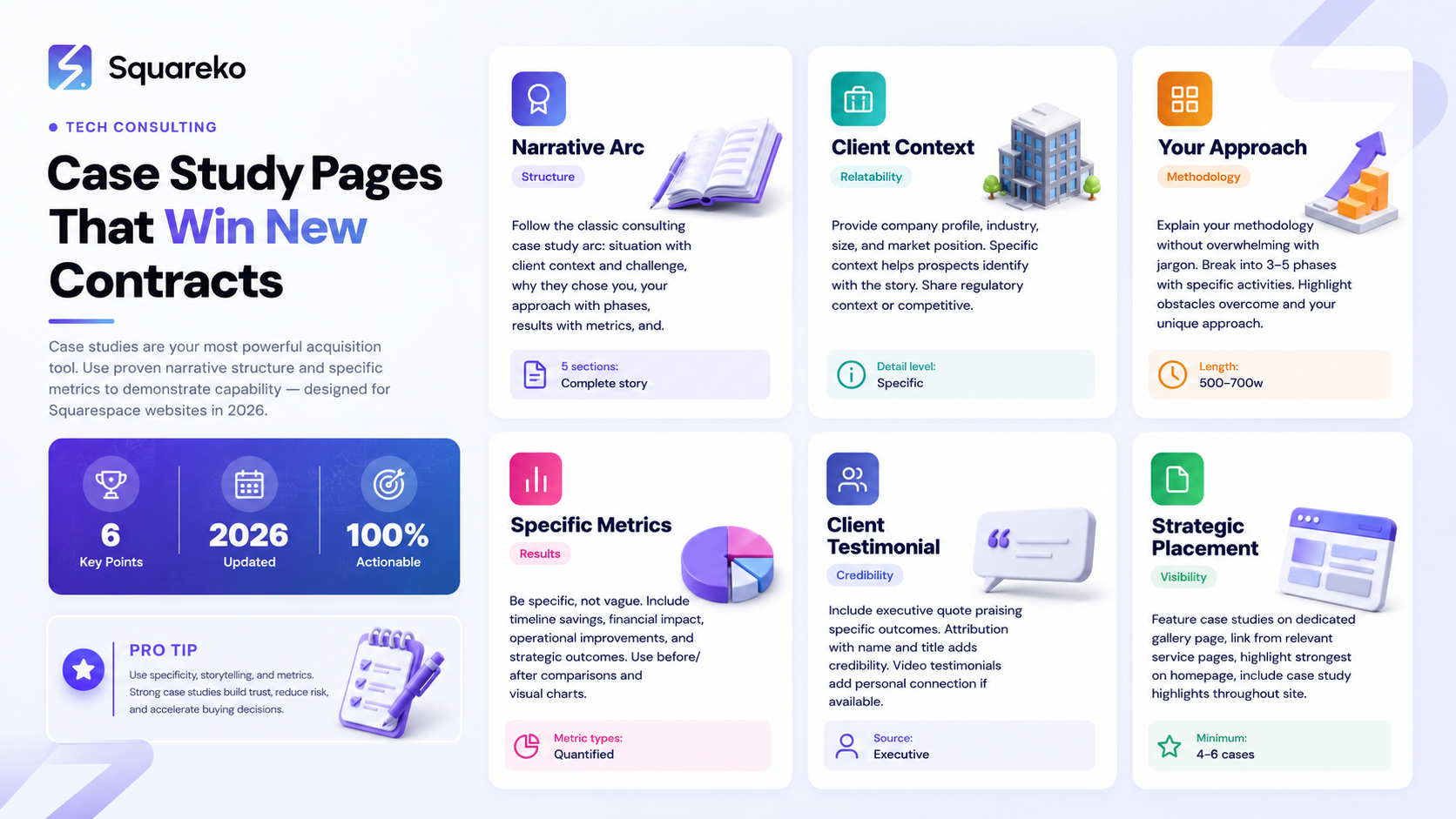
Strong case studies follow a clear narrative arc: Challenge, approach, results, impact—prospects follow this story naturally
Specific metrics and numbers matter more than vague claims: Reduced operational costs by $2.3M converts better than Significantly improved efficiency
Client context and background establish credibility: Sharing company size, industry, and challenge scope helps prospects identify with the story
Anonymization strategies allow case study publication: Protect client relationships while showcasing your work through strategic anonymization
Multiple case study formats serve different prospects: Short case study summaries for quick research, detailed pages for deep evaluation, video cases for personal connection
Case studies are your most powerful client acquisition tool. While service pages describe what you do, case studies prove you do it well. Enterprise buyers evaluate consulting firms primarily through case studies—proof that you've solved similar challenges successfully.
Yet many consulting firms publish weak case studies that fail to convert. They're vague about results, unclear about methodology, light on metrics, and written like internal documents rather than marketing assets. A strong case study captures the prospect's attention, addresses their concerns, and positions your firm as the obvious choice.
This guide walks through creating case studies on Squarespace that convert prospects into clients, from initial structure and storytelling through metric presentation and call-to-action optimization.
Why Case Studies Drive Client Acquisition
Case studies outperform almost any other content format for professional services acquisition. Here's why:
Enterprise Buyers Use Case Studies for Decision-Making
Enterprise procurement is risk-averse. Decision-makers want proof before committing significant budget. Case studies provide that proof:
Social proof: Other similar companies have engaged you successfully
Risk reduction: Your past work demonstrates you can handle their challenge
Capability proof: You explain your approach and show results
Comparison material: They evaluate you against competitors using case studies as primary comparison
Case Studies Address Objections and Concerns
As prospects evaluate your firm, they develop objections and concerns. Case studies preemptively address these:
Can you handle our company size? → Case study with similar-size company
Do you understand our industry? → Case study from same industry
How long will this take? → Case study showing timeline and phases
What's the ROI? → Case study with quantified financial impact
Case Studies Improve SEO and Content Authority
Detailed case studies:
Rank for company-specific keywords
Provide internal linking opportunities
Establish topical authority
Generate backlinks from clients and partners
Case Study Narrative Framework
Strong case studies follow a proven narrative structure that mirrors how prospects think about their own challenges.
The Classic Consulting Case Study Arc
1. The Situation: Client Context and Challenge
Introduce the client and their situation:
Client profile: Company name (or anonymized), industry, size, location
Business context: Market position, growth stage, strategic priorities
The challenge: Specific problem or pain point they faced
Business impact: Why this challenge mattered to their organization
Previous attempts: What they'd tried before (if applicable)
Example opening: A Fortune 500 financial services company with 50,000+ employees across 30 countries faced a critical challenge: their legacy core banking system, built on 20-year-old technology, couldn't support real-time transaction processing that competitors offered. This put them at competitive disadvantage and limited their ability to launch new products.
2. Why They Chose Us: Your Differentiation
Explain why they selected your firm:
Your unique approach: How you differentiate from other consultants
Key capabilities: What specifically you brought to the project
Team qualifications: Who led the engagement
Timeline and scope: Project size and duration
Example: They selected our firm because of our proven methodology for legacy system modernization without disrupting operations. Our approach—phased replacement with parallel systems—meant they could continue operations while gradually modernizing.
3. Our Approach: Methodology and Phases
Detail your approach without overwhelming with jargon:
Overall strategy: High-level approach to solving the challenge
Project phases: Key phases or milestones (typically 3-5 phases)
Key activities: What happened in each phase
Challenges overcome: Obstacles you navigated
Team and resources: Who was involved on both sides
Example: Phase 1: Discovery and Planning (3 months) - We assessed their current systems, identified modernization priorities, and designed the target architecture. Phase 2: Pilot Development (6 months) - We built a pilot system for one major function. Phase 3: Full Rollout (12 months) - We rolled out the modernized platform systematically.
4. The Results: Metrics and Impact
Present quantified outcomes:
Timeline impact: Faster delivery, reduced project duration
Financial impact: Cost savings, revenue increase, efficiency gains
Operational impact: Improved processes, reduced manual work
Strategic impact: New capabilities enabled, competitive advantage gained
Long-term value: Ongoing benefits after project completion
Example: Results: Reduced transaction processing time from 24 hours to real-time. Saved $1.8M annually in operational costs. Enabled three new product launches within first year. Improved customer satisfaction by 34% through faster service delivery.
5. Client Perspective: Testimonial or Quote
Include client perspective:
Executive quote: Statement from client stakeholder (CEO, CFO, CTO)
Specific praise: What they valued most
Recommendation: Would they recommend you?
Example quote: Working with [Your Firm] transformed our technical infrastructure and competitive position. The phased approach meant we avoided disruption, and we saw results faster than we projected. I'd strongly recommend them for similar transformations. — Chief Technology Officer
6. The Takeaway: What This Teaches Prospects
Conclude with key lessons:
Approach highlights: What your methodology enables
Expertise signals: This demonstrates your specific capabilities
Applicability: How this might apply to prospects' situations
Structuring Your Case Study Page
Translate the narrative framework into page structure.
Case Study Page Layout
Header Section (above the fold)
Case study title/headline: [Client] Case Study: [Challenge to Result]
Client logo: If client is publicly comfortable with visibility
Key metrics callout: Most impressive result in large, visible text
Brief overview: 1-2 sentences setting up the story
Challenge Section (H2: The Challenge)
Client background: Company, industry, size
Business problem: Specific challenge
Why it mattered: Business impact
Previous attempts: Context
Length: 300-400 words
Approach Section (H2: Our Approach)
Overall strategy: How you attacked the problem
Key phases: Major project phases (formatted as H3 subheadings)
Methodology: Your unique approach
Key decisions: Important choices made
Length: 500-700 words
Results Section (H2: Results and Impact)
Timeline results: Duration, speed improvements
Financial results: Savings, revenue, cost impact
Operational results: Efficiency, capacity, capability improvements
Strategic results: Competitive advantage, new capabilities
Use visuals: Charts, infographics showing before/after
Length: 400-500 words
Client Testimonial Section (H2: Client Perspective)
Executive quote: 2-3 sentences from key stakeholder
Name, title, company: Attribution
Photo of quote provider (if available): Adds credibility
Specific praise: What they valued
Key Takeaways Section (H2: Key Takeaways)
What this case study demonstrates
Methodology insights
Lessons learned
Why this matters to prospects
3-5 key points
Related Services (bottom of page)
Links to services demonstrated in this case study
Suggest related engagements or services
Clear CTA Section (before footer)
Schedule a Consultation button
Download the Full Case Study (if you have detailed version)
See Similar Projects
Content Formatting for Readability
Short paragraphs (2-4 sentences): Easier to scan
Subheadings (H3s): Break up dense sections
Bullet points: Lists of features, results, or deliverables
Visuals: Charts, screenshots, diagrams where relevant
Callout boxes: Highlight key results or metrics
Emphasis: Bold key metrics and results
Metrics and Results Presentation
Numbers are what make case studies credible and memorable. Present them strategically.
Types of Metrics to Include
Timeline metrics:
Project duration
Time to value/ROI achievement
Speed improvements
Reduced project timeline vs. industry standard
Financial metrics:
Cost savings (annual, total project)
Revenue impact
ROI percentage
Payback period
Operational metrics:
Efficiency improvements (% reduction in manual work)
Capacity increases (% throughput improvement)
Error reduction
Automation percentage
Quality metrics:
Customer satisfaction improvement
Error reduction rates
System uptime improvements
Performance improvements
Growth metrics:
New products launched
New markets entered
Customer base expansion
Employee productivity improvements
Metric Presentation Best Practices
Be specific, not vague:
Good: Reduced operational costs by $2.3M annually
Bad: Significantly reduced operational costs
Include context when useful:
Good: Reduced transaction processing time from 24 hours to real-time
Bad: Improved transaction processing speed
Use visuals for complex metrics:
Before/after comparison chart
Timeline showing phased implementation and result realization
Financial impact visualization (cost savings growth over time)
Key metric callout boxes
Focus on business outcomes, not technical metrics:
Good: Enabled three new product launches resulting in $15M revenue
Bad: Improved system architecture to support 10,000 concurrent transactions
Quantify when possible:
Percentages: Reduced manual data entry by 87%
Actual numbers: $2.3M annual savings (better than 7-figure savings)
Timeline: Reduced implementation timeline from 18 months to 8 months
Storytelling and Client Context
Numbers prove capability, but storytelling makes the case study memorable and relatable.
Client Context and Relatability
Enterprise prospects need to see themselves in the case study. Provide context they identify with:
Company profile:
Industry (healthcare, financial services, manufacturing, etc.)
Company size (employees, revenue, customer base)
Market position (startup, established, market leader)
Geographic presence (regional, national, global)
Industry-specific context:
Regulatory environment (if relevant)
Competitive landscape
Industry trends affecting the client
Customer expectations
Challenge specificity:
What was unique about their situation?
How was their challenge different from generic versions of the problem?
What was at stake if they didn't solve it?
Example that provides good context: A mid-market healthcare provider with 15 hospitals and 5,000 employees faced HIPAA compliance challenges related to their legacy EMR system. Patient data was stored across incompatible systems, making compliance audits difficult and putting the organization at regulatory risk. The healthcare market's shift toward value-based care also required more integrated patient data across facilities.
Narrative Tension and Resolution
Create a story arc that keeps readers engaged:
The tension:
What was the danger or cost of not solving this?
What was at stake?
What challenges stood in the way?
Example: Without modernization, they faced three risks: HIPAA compliance violations could result in fines up to $1.5M; inability to access integrated patient data limited their ability to compete in value-based care; and increasing operational costs from manual data reconciliation across systems.
The turning point:
What was the key insight or decision that changed direction?
What did you bring that was different?
Example: We proposed a phased modernization approach rather than a risky 'big bang' replacement. This meant implementing new systems for high-priority functions first, proving value quickly while maintaining ongoing operations.
The resolution:
How did the story end?
What changed from the challenge to the results?
Example: Within 12 months, they had integrated patient records across three hospitals, achieved full HIPAA compliance, and launched value-based care programs for three major patient populations. The phased approach meant they saw ROI from early phases while completing later implementation.
Anonymization and Confidentiality
Not all clients want to be publicly named in case studies. Use strategic anonymization to publish more case studies while respecting confidentiality.
Anonymized Case Study Strategy
When you can name the client:
Client explicitly approves public case study
Client benefits from public visibility
Client is recognizable and provides credibility (Fortune 500 company, well-known brand)
Include full client name and logo
When you should anonymize:
Client prefers confidentiality but approves case study description
Client is a competitor's client and confidentiality is critical
Client is a publicly traded company with disclosure concerns
Anonymization Techniques
Replace company name with category:
A Fortune 500 financial services company
A mid-market healthcare provider
A publicly traded manufacturing company
Provide industry and company size details:
Keep specific enough that prospects can identify with the situation
Include specific metrics and results (these are harder to identify individual companies from)
Use specific locations (if not identifying):
A major financial services company in the Northeast
A manufacturing company with global operations
Include logo without company name:
Some clients approve logo visibility but not name mention
Logo provides recognition credibility without full public attribution
Create comparison visibility:
Similar to [recognizable company in same industry] (if accurate)
Comparable in scale to [industry benchmark]
Getting Client Approval
Approach:
Draft case study with anonymization approach
Send to client with explanation of publication plans
Ask for specific approval: Is this description accurate and acceptable?
Document approval for legal protection
Include in engagement contracts:
Address case study rights in your engagement agreement
Specify whether client will be named or anonymized
Get approval for specific metrics and description
Squarespace Case Study Page Setup
Create case study pages on Squarespace using best practices.
URL Structure
Use descriptive, keyword-friendly URLs:
/case-studies/fortune-500-digital-transformation (include industry/challenge)
/case-studies/retail-omnichannel-platform (industry + outcome)
Not: /case-studies/cs-123 or /portfolio/project-abc
Page Layout in Squarespace
Using sections:
Hero section: Case study title, key metric, client logo
Text section: Challenge overview
Text section: Approach description
Quote section: Client testimonial (Squarespace has quote block)
Text section: Results and metrics
Image/gallery section: Visual results (charts, screenshots)
Text section: Key takeaways
Buttons section: Related services and CTAs
Using Squarespace's portfolio/gallery feature:
If you have multiple case studies, use the portfolio gallery
Create case study collection
Add cover images for each case study
Use portfolio filters by industry/service/challenge type
Metadata Optimization
For each case study page:
Title tag (60 characters):
Include primary challenge or service
Include client industry if relevant
Example: Digital Transformation Case Study | Financial Services | [Your Firm]
Meta description (160 characters):
Brief challenge-result description
Include primary metric or outcome
Compelling language that encourages click
Example: How we helped a Fortune 500 financial company achieve real-time transaction processing, saving $1.8M annually. Full case study with methodology and results.
Case Study Gallery and Organization
Organize multiple case studies for easy navigation and discovery.
Case Study Gallery Structure
Filtering options:
By industry (healthcare, financial services, manufacturing, etc.)
By service/challenge type (digital transformation, cloud migration, etc.)
By company size (enterprise, mid-market, etc.)
By result type (cost savings, new capability, speed improvement)
Gallery page:
Overview of all case studies
Visual gallery with case study images/summaries
Filter options for visitors to find relevant case studies
Each case study thumbnail includes: title, industry, key metric, link to full page
Featured case studies:
Highlight 2-3 strongest case studies on homepage
Link to full case study gallery
Create case study of the month or featured case study section
Case Study Repository Strategy
Develop a pipeline of case studies:
Minimum target: 4-6 comprehensive case studies
Different industries (show breadth)
Different company sizes (show scalability)
Different challenges/services (show depth)
Mix of named and anonymized (respect confidentiality)
Ongoing development:
Add new case study every 6-12 months
Update existing case studies with follow-up results (if applicable)
Remove case studies that become dated
Keep case studies aligned with your current positioning
Optimizing for Conversion
Case studies should convert prospects into leads and conversations.
Strategic CTAs in Case Studies
CTA placement:
After challenge section: See how we solve this type of challenge
After approach section: Schedule a consultation to discuss your situation
After results section: Ready to achieve similar results?
At bottom: Request a consultation / Download detailed case study
CTA variation:
Consultation request: Schedule your consultation
Resource download: Download the full case study (with additional metrics)
Service page: Explore our [service] offering
Contact form: Let's discuss your situation
Conversion-Focused Case Study Features
Downloadable PDF version:
Create PDF version of case study
Include download form (captures lead information)
Useful for prospects who prefer to share internally
Related case studies:
At bottom, suggest related case studies
See similar engagements in [industry]
Explore case studies for [related service]
Keeps prospects exploring your work
Social sharing buttons:
Enable case study sharing
Helps case studies reach wider audience
Useful for prospects sharing internally
Contact information:
Make it easy to contact you after reading
Multiple contact options (form, email, phone)
Clear about response time
Frequently Asked Questions
-
Start with 3-4 strong case studies before launching a full case study section. Publishing weak or generic case studies hurts credibility more than publishing no case studies. Better to have three exceptional case studies than ten mediocre ones.
-
No. Always get client approval before publishing any case study, even anonymized versions. Include case study rights in your engagement agreements. This protects you legally and maintains client relationships.
-
Focus on projects that demonstrate your key services and approach. Biggest projects aren't always best case studies if they don't show your typical approach or if the metrics are less impressive. Choose case studies that would appeal to your target prospects.
-
Detailed enough to demonstrate your expertise, but not so detailed that it reads like an internal project document. Explain your approach in language that business stakeholders (not just technologists) understand. Focus on why you made certain choices, not technical implementation details.
-
Emphasize metrics that matter to your prospect audience. For CFOs, financial impact. For CTOs, technical capability and performance. For CEOs, strategic impact and competitive advantage. Strong case studies address multiple perspectives.
-
Review case studies annually. Update with follow-up results or long-term impact if applicable. Refresh dates and metrics if circumstances have changed. Remove case studies that become outdated or no longer represent your current approach.
-
Video testimonials are valuable but not required. Written quotes are easier to obtain and still very effective. If you can secure video testimonials, those do add credibility and personal connection.
-
With caution. You can reference relevant project experience, but the case study should focus on outcomes you directly achieved and problems you personally solved. Current case studies from your firm are more credible than historical case studies from previous positions.
Call to Action
Case studies are your most powerful tool for winning enterprise consulting contracts. Well-crafted case studies that tell compelling stories and showcase quantified results convert prospects at rates far exceeding other content types.
At Squareko, we help technology consulting firms develop and present case studies on Squarespace that capture prospects' attention and drive conversions. From narrative development and metric presentation to Squarespace implementation and optimization, we ensure your case studies win contracts.
Ready to create case studies that convert? Schedule a consultation with our team to discuss your case study strategy.

From custom website design to SEO strategy, we help businesses launch a site that looks professional and performs better.

Author Bio
I'm Walid Hasan, a Certified Squarespace Expert and Squarespace Circle Platinum Partner with over 12 years of hands-on experience designing and optimizing high-performing websites. Over the years, I've had the privilege of building more than 2,000 Squarespace websites for clients around the world, always focusing on clean design, strong user experience, and conversion-driven results.