AI Search Strategy for Technology Consulting Firms: Get Recommended by Enterprise Buyers
Key Takeaways AI Search Strategy for Technology Consulting Firms
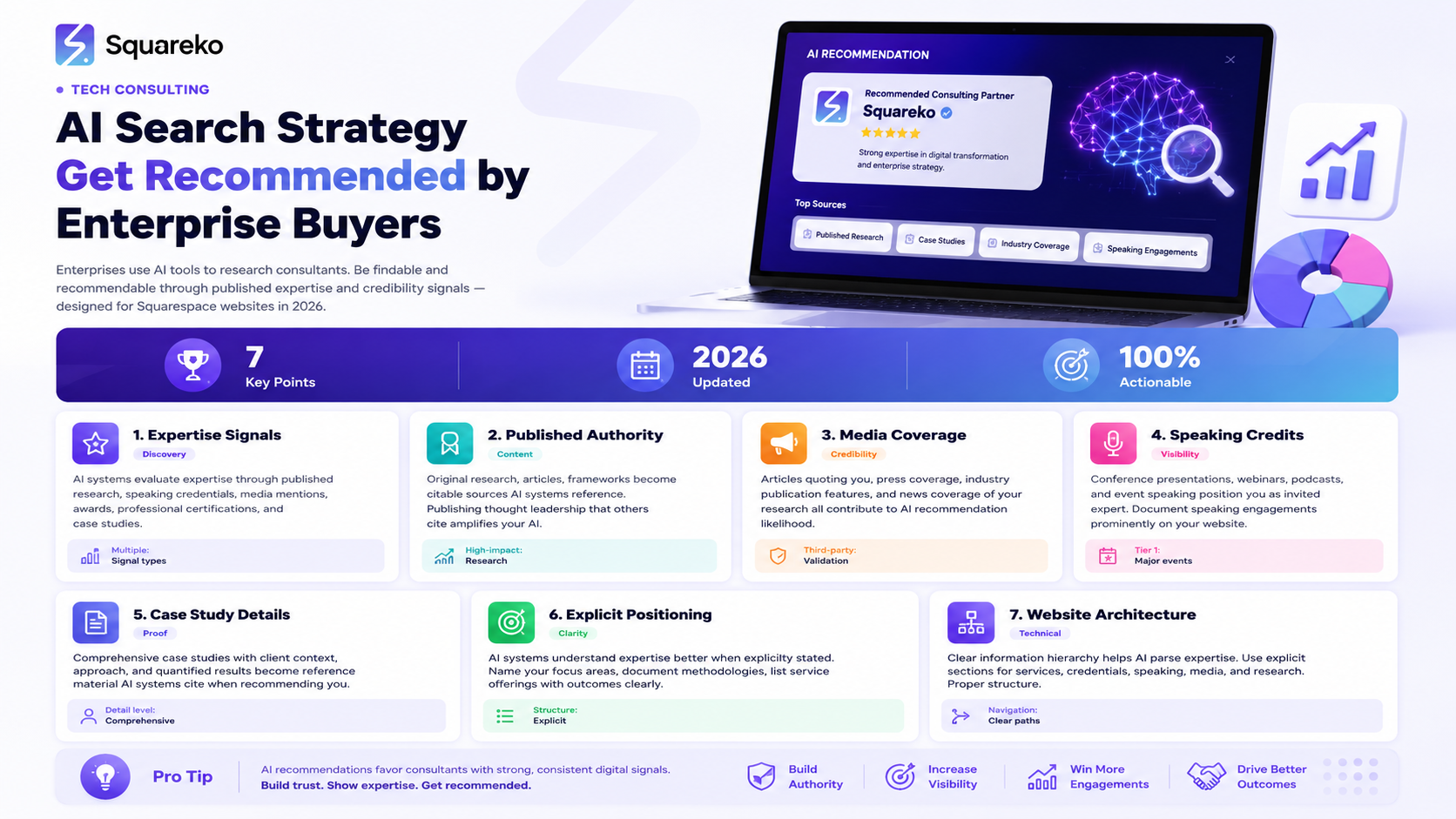
AI systems recommend firms they find referenced in training data and current web sources: Published expertise, media mentions, and authority signals make you findable
Expertise signals must be explicit and structured: Clear positioning of your focus areas, methodologies, and client results helps AI systems understand and recommend you
Original research and thought leadership fuel AI recommendations: Published insights that AI systems can cite and reference establish authority
Credibility signals matter more than ever: Awards, recognitions, media mentions, and client testimonials all contribute to AI recommendation likelihood
Website structure and content clarity impact AI findability: Clear information architecture and explicit expertise signals help AI systems parse and recommend your firm
Enterprise buyers increasingly use AI tools—ChatGPT, Claude, Gemini, and others—to research and evaluate consulting partners. Rather than conducting traditional searches, they ask AI systems Find me a digital transformation consultant or Recommend cloud migration firms. These AI systems then reference and recommend firms they find in their training data and accessible web sources.
This shift means consulting firm visibility depends not just on traditional SEO, but on being findable and recommendable by AI systems. Firms that structure their expertise signals clearly, publish thought leadership that AI systems can reference, and position themselves as recognized experts will dominate AI-powered discovery.
This guide covers AI search strategy for consulting firms on Squarespace, including how AI systems evaluate and recommend consultants, what signals matter most, and how to optimize your visibility for AI-powered discovery.
How AI Search Works for Consulting Recommendations
Understanding how AI systems make recommendations is essential for positioning your firm.
AI Training Data and Current Web Access
AI language models are trained on vast amounts of text data (up to a knowledge cutoff date). They also have access to real-time information through web search when needed. When someone asks an AI system for consulting recommendations:
Query interpretation: The AI understands what type of consultant is being sought
Knowledge recall: It searches its training data for relevant firms and expertise
Web search (if needed): For current information, it may search the web for recent information
Synthesis: It combines information from multiple sources into a recommendation
Response generation: It provides recommendations with citations and reasoning
Why AI Might Not Recommend You
If AI systems don't recommend your firm:
You're not in training data: Your firm isn't well-known or well-covered
Your positioning is unclear: The AI can't determine what you specialize in
You lack credibility signals: No media coverage, publications, or recognized authority
Your expertise isn't documented: You don't publish your thinking or expertise
You're not findable online: Poor SEO means AI can't discover current information about you
Why AI Might Recommend You
You'll be recommended if:
You're published and referenced: Your articles, research, and thought leadership are available online
You have explicit positioning: Clear about what you specialize in and who you serve
You have credibility evidence: Media mentions, publications, awards, speaking credits
You're cited by others: Other sources reference your work, frameworks, or expertise
Your website is clear and accessible: AI can easily parse your expertise from your site
AI vs. Traditional Search: Key Differences
AI-powered search differs fundamentally from traditional search engine optimization in ways that affect your strategy.
Traditional Search Optimization
Traditional SEO focuses on:
Keyword matching
Ranking position
Click-through from search results
Link authority and relevance
Content volume and depth
How it works:
User searches specific keyword
Search engine returns ranked results
User clicks top result matching their needs
Optimization approach:
Target specific keywords with optimized pages
Build authority through links
Create comprehensive content on specific topics
AI-Powered Discovery
AI search focuses on:
Expertise demonstration
Credibility and authority signals
Referenced expertise
Thought leadership
Relational context (firms like this one.)
How it works:
User asks AI for recommendation (not specific search)
AI synthesizes information from multiple sources
AI generates recommendation with reasoning
AI cites sources supporting recommendation
Optimization approach:
Demonstrate expertise broadly
Build credibility through publications and media
Publish thought leadership that can be cited
Establish recognized authority in your space
Complementary Strategies
The best approach for consulting firms: optimize for both traditional and AI search. Traditional SEO brings traffic from specific keyword searches. AI search positioning brings recommendations from prospects actively evaluating firms. Both are valuable.
Expertise Signals AI Systems Look For
AI systems evaluate whether to recommend your firm based on multiple expertise signals.
Explicit Expertise Positioning
Clear statement of focus areas:
Your website should clearly state what you specialize in
Not just we do consulting but specific areas of expertise
Example: Digital transformation consulting for enterprise manufacturers is clearer than enterprise consulting
Documented methodologies:
If you have proprietary approaches or frameworks, publish them
Named methodologies are easier for AI to recognize and cite
Example: Our 6-Phase Digital Transformation Methodology is more citable than our approach
Service specialization:
Document specific services you provide
Include outcomes associated with each service
Clarity helps AI understand what you do
Published Expertise and Thought Leadership
Original research and publications:
Your own research or reports
Articles published under your name
Industry analysis and forecasts
Frameworks and methodologies you've developed
Guest articles and bylined content:
Articles in industry publications
Bylined pieces in business journals
Expert commentary and analysis
Blog posts and articles
Speaking and presentation credentials:
Conference presentations
Webinar appearances
Podcast interviews
Industry event speaking
Credibility and Authority Evidence
Media mentions and coverage:
Articles quoting you as expert
Press coverage of your firm
Industry publication features
News coverage of your research
Awards and recognition:
Industry awards
Analyst firm recognition
Association recognition
Professional credentials:
Relevant certifications
Educational background
Professional affiliations
Association memberships and leadership
Client Success Evidence
Case studies and client results:
Published case studies
Success metrics
Long-term client relationships
Client visibility:
Well-known client logos
Press coverage mentioning you helped clients
Client references
Published case studies with client permission
Structuring Your Expertise for AI Findability
How you organize and present expertise impacts AI findability.
Website Structure for AI Parsing
Clear information hierarchy:
About/Expertise Section
├── Focus Areas (explicitly listed)
├── Core Services (specifically named)
├── Methodologies (documented approaches)
├── Team/Credentials (visible expertise)
└── Results/Outcomes (documented success)
Thought Leadership
├── Original Research
├── Published Articles
├── Frameworks and Methodologies
└── Industry Commentary
Credentials and Authority
├── Media Mentions
├── Speaking Engagements
├── Awards and Recognition
└── Client Testimonials
This structure helps AI systems parse and understand your expertise.
Explicit Expertise Statements
Rather than vague positioning, use explicit statements:
Vague: We help companies with technology challenges Explicit: We specialize in digital transformation consulting for enterprise financial services firms, with particular expertise in core banking system modernization
Vague: Our proven approach delivers results Explicit: Our 6-Phase Digital Transformation Methodology has delivered $12M+ in average client ROI and reduced implementation timelines by 40%
Vague: We have extensive experience Explicit: 20+ years experience in enterprise digital transformation, with successfully implemented projects at 150+ Fortune 1000 companies
Schema Markup and Structured Data
Use schema markup to explicitly state expertise:
{
  "@context": "https://schema.org",
  "@type": "LocalBusiness",
  "name": "[Your Firm]",
  "description": "Enterprise digital transformation consulting for financial services and healthcare organizations",
  "expertise": ["Digital Transformation", "Cloud Migration", "Enterprise Architecture"],
  "areaServed": ["United States", "North America"]
}
Squarespace automatically includes basic schema markup. For consulting firms, ensure your:
Business description clearly states your expertise
Service offerings are explicitly listed
Geographic service areas are documented
Content Strategy for AI Recommendation
What content you publish directly impacts AI recommendation likelihood.
Original Research and Proprietary Insights
Publish research that AI systems cite:
Annual reports: 2024 Enterprise Digital Transformation Report Benchmarking studies: Digital Transformation Maturity Benchmarks Across Industries Proprietary frameworks: The 5-Phase Digital Transformation Maturity Model Original analysis: Why 70% of Digital Transformations Exceed Budget (And How to Avoid It)
These become citable sources that AI systems reference when recommending your firm.
Thought Leadership Articles
Publish articles that establish perspective:
Industry trend analysis:
Why AI Implementation Will Differ from Previous Technology Adoption Cycles
The Future of Enterprise Architecture in Post-Cloud Era
Why Legacy System Modernization Matters More Than Ever
Problem exploration:
Digital Transformation Failures: Root Causes and How to Avoid Them
The Hidden Costs of Technical Debt and Delayed Modernization
Why Your Cloud Migration Is More Complex Than You Think
Best practice guidance:
How to Plan a Successful Enterprise Digital Transformation
The Right Way to Approach Legacy System Modernization
Building an Effective Cloud Migration Strategy
Expert Commentary and Analysis
Position yourself as commentator:
Respond to industry news with expert analysis
Provide commentary on emerging technologies
Analyze competitor moves and market shifts
Publish reactions to research and reports
These position you as expert source that AI systems can cite.
Case Studies with Detailed Metrics
Publish detailed case studies with:
Specific client context and challenge
Detailed approach and methodology
Quantified results and impact
Long-term outcomes and benefits
Detailed case studies become reference material that AI systems cite when recommending you.
Thought Leadership and Referenced Authority
Being cited and referenced by others amplifies your AI visibility.
Getting Your Expertise Referenced
Syndication and republication:
Allow your articles to be republished on industry platforms
Includes backlinks and citations
Extends reach of your expertise
Quote extraction and citation:
Journalists and writers cite your expertise
Other firms reference your research
Industry observers mention your insights
Framework adoption:
If you publish frameworks, encourage others to use them
Attribution builds your visibility as originator
References from others signal authority
Building Citation and Attribution
Make your expertise citable:
Publish with clear attribution (byline with credentials)
Include author bio explaining expertise
Use consistent author name across publications
Build clear link from author to company website
Track citations and references:
Monitor where your work is referenced
Request attribution if missing
Build relationships with those citing you
Contribute to industry knowledge:
Participate in industry forums
Share insights in discussion groups
Comment on industry trends
Be visible as participating expert
Credibility Signals for AI Systems
AI systems evaluate credibility through multiple signals.
Media Presence and Press Coverage
Maximize media visibility:
Seek press coverage for your research and insights
Respond to journalist requests for expert commentary
Build relationships with industry reporters
Pitch newsworthy perspectives and findings
Organize media mentions on your website:
Create press or media section
Link to published coverage
Feature recent press mentions on homepage
Awards and Industry Recognition
Pursue relevant awards:
Industry awards for consulting expertise
Best consultant/firm awards
Analyst firm recognition (Gartner, Forrester, etc.)
Association awards and recognition
Highlight recognition prominently:
Feature awards on homepage
List in about/credentials section
Reference in firm descriptions
Include logos of recognizing organizations
Speaking and Event Presence
Build speaking visibility:
Speak at major industry conferences
Present at association events
Appear on relevant podcasts
Participate in webinar panels
Lead webinars on your expertise
Document speaking credentials:
List speaking engagements on website
Include links to conference pages
Feature upcoming speaking appearances
Include speaker video samples
Professional Certifications and Credentials
Maintain relevant credentials:
Relevant industry certifications
Advanced degrees and education
Professional association memberships
Board positions and leadership roles
Display credentials prominently:
Team bios include credentials
Logo certifications on homepage
Association memberships listed
Professional affiliations visible
Technical Implementation on Squarespace
Implement AI search optimization on your Squarespace site.
Expertise Section Structure
Create clear expertise sections:
Primary expertise page (often About page):
List your core focus areas
Explain what makes you different
Document years of experience
Highlight key credentials
Service pages (for each major service):
Explicit description of service
Methodologies you use for this service
Examples of client success
Related expertise areas
Team/credentials page:
Individual credentials and expertise
Speaking history
Publications and articles
Professional certifications
Content Organization for AI Clarity
Use heading hierarchy clearly:
H1 for page title
H2 for main sections
H3 for subsections
Helps AI parse content structure
Use bullet lists for expertise areas:
Our Core Expertise Areas:
- Digital Transformation Consulting
- Enterprise Cloud Migration
- Legacy System Modernization
- Enterprise Architecture
Lists are easier for AI systems to parse than narrative text.
Create clear service descriptions:
Define each service explicitly
Include outcomes associated with service
Link to case studies demonstrating service
Schema Markup Implementation
Enhance schema markup in Squarespace settings:
Go to Settings > Business Information
Complete all fields thoroughly:
Business name and description
Service areas
Contact information
Categories (select primary category)
Consider adding custom schema via code injection (if you're comfortable with code):
Service schema for each major service
Organization schema with expertise details
Internal Linking Strategy
Link strategically to establish topical authority:
Link from homepage to key expertise areas
Link service pages to related case studies
Link thought leadership to relevant services
Link to foundational content from specific articles
Linking helps both users and AI systems understand your expertise relationships.
Monitoring AI Visibility
Track how your firm appears in AI recommendations.
Testing AI Visibility
Periodically test how you're recommended:
Prompts to test:
Recommend digital transformation consultants
Find cloud migration firms specializing in healthcare
Who are leading enterprise architecture consultants?
Recommend technology consulting firms for [your specialization]
Observe:
Are you mentioned in recommendations?
How are you described?
What expertise is highlighted?
What sources does the AI cite for you?
How do you compare to competitors?
Responding to AI Recommendations
When recommended:
Screenshot recommendation
Note what was cited or referenced
Identify what helped you get recommended
Replicate what worked
When not recommended:
Identify gaps in your positioning
Note what competitors did differently
Determine what signals you're missing
Develop plan to address gaps
Gathering Feedback
Monitor indirect signals:
Client mentions of finding you through AI
Inquiries mentioning specific aspects of your expertise
Questions referencing your publications or research
References to your methodologies or frameworks
Use this feedback to understand how you're being positioned.
Frequently Asked Questions
-
Yes, increasingly. When prospects ask "Find me a digital transformation consultant" or "Recommend cloud migration firms," AI systems reference firms in their training data and accessible web sources. As AI tools become primary research channels, visibility in AI recommendations matters more.
-
Indirectly, yes. You can't directly optimize for AI algorithms like you can for Google. But you can publish expertise, build credibility signals, create referenced thought leadership, and maintain clear website structure. This makes you more likely to be recommended.
-
Both matter. Traditional SEO brings targeted traffic from specific searches. AI search positioning brings recommendations from prospects actively evaluating firms. The best strategy: do both. Optimize for traditional search while building thought leadership and credibility for AI recommendations.
-
Very important. Published articles, research, and frameworks are citable sources that AI systems reference. The more published expertise you have, the more likely you'll be recommended and cited when prospects ask about your specialty.
-
Original research and proprietary frameworks matter most because they're specifically citable. Articles analyzing trends and best practices also help. Aim for content that other sources would reference or cite, not just content for direct reader consumption.
-
Publish with clear attribution and author credentials. Syndicate broadly across relevant platforms. Promote through your network. Make frameworks easy to understand and use (they'll be adopted and referenced more). Build relationships with industry commentators and analysts who might reference your work.
-
Less important than for traditional SEO, but credibility signals help. Strong client testimonials, awards, and media mentions matter more than individual reviews. Focus on building recognized authority rather than review volume.
-
AI landscape is evolving rapidly. Review your positioning quarterly. Update thought leadership regularly. Test AI recommendations monthly to see how you're being positioned. Adjust strategy based on what you observe about how AI recommends you versus competitors.
Call to Action
As enterprise buyers increasingly use AI tools to research consulting firms, positioning yourself for AI-powered discovery becomes essential. Your firm's visibility in AI recommendations depends on clear expertise positioning, published thought leadership, credibility signals, and accessible web presence.
At Squareko, we help technology consulting firms optimize their Squarespace websites for both traditional search and AI-powered discovery. From expertise structure and content strategy to credential visibility and thought leadership architecture, we ensure your firm gets recommended when prospects ask AI systems for consulting guidance.
Ready to become visible and recommendable through AI-powered discovery? Schedule a consultation with our team to discuss your AI search strategy.
From custom website design to SEO strategy, we help businesses launch a site that looks professional and performs better.

Author Bio
I'm Walid Hasan, a Certified Squarespace Expert and Squarespace Circle Platinum Partner with over 12 years of hands-on experience designing and optimizing high-performing websites. Over the years, I've had the privilege of building more than 2,000 Squarespace websites for clients around the world, always focusing on clean design, strong user experience, and conversion-driven results.