
How Technology Consultants Build Authority and Attract Premium Clients with Squarespace
Key Takeaways How Technology Consultants Build Authority and Attract Premium Clients
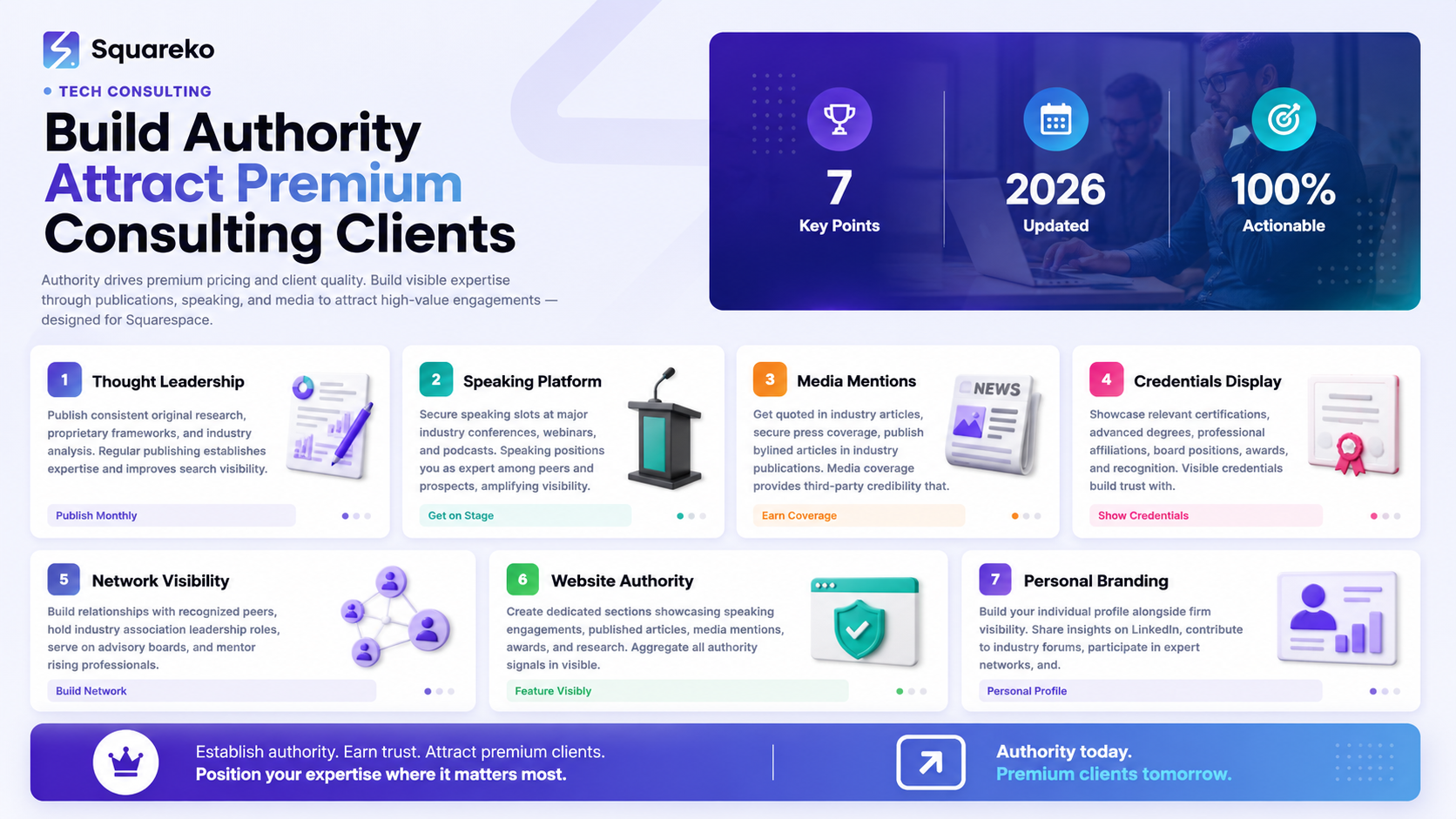
Authority is built through visible expertise, not claimed expertise: Publish your thinking, speak publicly, contribute to industry conversations
Speaking engagements are authority multipliers: Each conference, webinar, or panel appearance amplifies your visibility and credibility
Published thought leadership compounds over time: Regular content creation establishes expertise and improves your SEO visibility
Media mentions create third-party credibility: Press coverage and expert commentary provide validation beyond self-promotion
Your Squarespace website aggregates and showcases your authority: A well-designed authority section ties together your various credibility signals
In technology consulting, authority drives pricing and client caliber. Consultants with established authority can command premium rates, attract enterprise buyers, and choose their projects. Those without authority compete on price and react to opportunities.
Your Squarespace website is the hub of your authority strategy. It's where prospects verify your credentials, read your thought leadership, and decide whether you're worth engaging. Building genuine authority requires more than a nice website—it requires a comprehensive strategy that establishes you as an expert in your space through publications, speaking, research, and visible expertise.
This guide walks through building authority as a technology consultant using Squarespace, with strategies for thought leadership content, speaking platform visibility, media coverage, and positioning that attracts premium clients.
Understanding Consultant Authority
Authority isn't charisma, confidence, or marketing skill. In professional consulting, authority is the widespread recognition that you have genuine expertise and valuable perspective on a specific domain.
Authority manifests through:
Published expertise: Articles, research, books, guides that demonstrate your thinking
Speaking credentials: Conference presentations, webinars, panel appearances that show you're invited to speak
Media credibility: Quotations in major publications, interviews, expert commentary
Professional recognition: Industry awards, certifications, association leadership
Client results: Case studies and long-term client relationships that prove your capability
Network and relationships: Visibility among peers, other experts, and industry leaders
Premium clients seek consultants with authority because authority correlates with:
Reduced risk: Established experts are less likely to deliver poor results
Industry knowledge: Experienced consultants understand industry context and nuances
Problem-solving capability: Consultants who've navigated similar problems know what works
Network access: Connected consultants bring additional resources and introductions
Thought leadership: Experts stay current with industry evolution
Authority also enables premium pricing. Consultants with recognized expertise can charge 2-3x more than comparable consultants without authority, because clients recognize the value of expert guidance.
The Authority Building Blocks
Building authority requires multiple, reinforcing channels. No single tactic works alone.
Block 1: Consistent Thought Leadership Publication
Regular publishing—whether on your blog, in industry publications, or through owned media—establishes expertise and improves search visibility. Thought leadership comes in multiple forms:
Original research and perspectives: Publish findings, frameworks, methodologies, and insights unique to your thinking. This is the highest-value authority content.
Industry analysis and commentary: Analyze industry trends, regulatory changes, technology releases, and their implications. Show your ability to connect dots and provide perspective.
How-to guides and educational content: Help prospects understand how to evaluate problems, approach solutions, and understand options. Educational content builds trust and establishes you as a teacher, not just a seller.
Case study and lesson learning: Share specific examples (with appropriate confidentiality) of problems you've solved, approaches you've taken, and results you've achieved.
Block 2: Speaking Platform Visibility
Speaking engagements position you as expert and trusted resource:
Conference presentations: Speaking slots at major industry conferences position you as expert among peers and prospects. Larger conferences (500+ attendees) provide broader visibility.
Webinar hosting: Conduct your own webinars or present on industry platforms. Webinars generate leads and establish expertise.
Panel discussions: Panel appearances (especially as moderator) position you among recognized experts and build peer credibility.
Podcast appearances: Guest interviews on relevant podcasts reach engaged audiences and provide audio content distribution.
Workshops and training: Leading workshops at conferences or for client organizations demonstrates teaching ability and deep expertise.
Block 3: Media Mentions and Expert Commentary
Media coverage provides third-party credibility that self-promotion cannot:
Expert quotations: Get quoted in articles covering your industry or expertise area. Media outlets actively seek expert commentary.
Press coverage: Secure media coverage of your research, speaking, or notable projects.
Bylined articles: Publish articles under your name in industry publications, news outlets, and platforms.
Interview features: Be featured in industry publications, podcasts, YouTube channels, and other media.
Block 4: Published Credentials and Recognition
Visible credentials build trust:
Certifications: Relevant industry certifications (AWS, Google Cloud, Microsoft, security certifications, etc.)
Education: Advanced degrees, specialized training, educational achievements
Professional affiliations: Association memberships, board positions, committee leadership
Awards and recognition: Industry awards, best consultant lists, analyst firm recognition
Patents or intellectual property: If applicable to your domain
Block 5: Network and Association Visibility
Your professional network amplifies authority:
Peer recognition: Endorsements and introductions from recognized peers
Industry association leadership: Board positions, committee work, chapter leadership
Advisory positions: Board advisor, advisory board member, or strategic advisor roles
Mentorship visibility: Being recognized as mentor to rising professionals in your field
Thought Leadership Content Strategy
Publishing consistent thought leadership is the foundation of authority building.
Original Research and Insights
Publish research that is genuinely original and valuable:
Annual reports or benchmarking studies:
Survey or analyze data in your domain
Share quantified findings that professionals use as reference points
Examples: 2024 Enterprise Digital Transformation Report, AI Adoption Benchmarks for Financial Services
Proprietary frameworks and methodologies:
Develop and publish frameworks that become associated with your thinking
Make the framework valuable enough that others reference and use it
Examples: The 6-Phase Digital Transformation Maturity Model, Security Architecture Assessment Framework
Industry analysis and forecasts:
Analyze industry trends and predict implications
Publish predictions that get referenced and cited
Examples: Why Generative AI Implementation Will Differ from Previous Technology Adoption Cycles
Thought Leadership Article Series
Create regular article series on specific topics:
Monthly articles (12 per year) on your primary area of expertise:
Digital Transformation Case Studies (monthly case study analysis)
AI Implementation Reality Check (monthly AI adoption story)
Enterprise Architecture Thinking (monthly architecture topic)
Quarterly deep dives (4 per year) on emerging topics:
3000-5000 word comprehensive guides
Original research and perspective
Reference-worthy content that gets cited and shared
Content Syndication and Distribution
Publish content in multiple channels:
Your own platform (your website):
Primary publication location
Builds SEO authority for your domain
Captures audience on your site
Industry publications:
Guest articles in industry journals, magazines, newsletters
Provides credibility through association with established publications
Reaches audience already engaged with your industry
LinkedIn and professional networks:
Share articles, insights, and commentary
Participate in industry conversations
Build personal following alongside firm visibility
Medium, Substack, or owned newsletter:
Alternative publishing platforms with built-in audiences
Good for regular series or commentary
Builds direct subscriber relationship
Podcast and audio content:
Convert articles to podcast episodes
Guest appearances on industry podcasts
Audio content reaches commuters and distracted audiences
Guest Article Pitching Strategy
Identify target publications where your ideal clients read:
Publication research:
Which industry publications, trade journals, and news outlets cover your space?
Which have large, engaged readerships?
What is their typical article topic?
Pitch development:
Identify editorial calendars or upcoming topic areas
Develop 2-3 article ideas relevant to upcoming topics
Create compelling pitch explaining why your article helps their readers
Article placement:
Byline should include author bio and link to your website
Track publication and reach (audience size, shares, engagement)
Repurpose published articles on your website
Relationship building:
Build relationships with editors
Contribute multiple articles to same publication
Become go-to expert for specific topics at target publications
Building Your Speaking Platform
Speaking engagements amplify authority more effectively than almost any other tactic.
Identifying Speaking Opportunities
Tier 1 speaking opportunities (largest impact):
Major industry conferences (500+ attendees)
Keynote or featured session slots
Examples: Industry association annual conferences, major technology conferences, analyst firm events
Tier 2 speaking opportunities (good impact):
Regional conferences (100-500 attendees)
Local industry group meetings
University or business school speaking engagements
Large corporate events
Tier 3 speaking opportunities (building platform):
Webinars and online events
Podcasts and audio interviews
Panel discussions on LinkedIn or online platforms
Client or partner events
Getting Speaking Slots
Build speaker profile:
Create a professional speaker bio (100-200 words)
Develop a headshot (professional, current)
Prepare 2-3 talk abstracts and descriptions
Create a speaking samples video (5-10 minutes of you presenting)
Target conference selection:
Identify 5-10 conferences annually you want to speak at
Research their typical speaker selection process
Submit proposals 6-9 months before the conference
Pitch strategy:
Submit strong talk proposals (compelling title, clear value proposition)
Emphasize audience benefit, not your background
Example pitch: Beyond Digital Transformation Hype: Real Implementation Roadmaps That Work (not My Digital Transformation Experience)
Speaker relationships:
Build relationships with conference organizers
Volunteer to help recruit speakers
Provide valuable feedback after speaking
Aim to speak at same conference multiple years
Leveraging Speaking Engagements
Maximize the impact of each speaking appearance:
Before the presentation:
Promote your upcoming talk on social media
Share abstract and topic
Create anticipation among your network
During the presentation:
Deliver exceptional value and insights
Engage audience, don't just present
Collect contact information if possible
Photo/video of your presentation
After the presentation:
Share slides on your website
Publish article expanding on your key points
Request attendee feedback and testimonials
Add to your website's speaking section
Repurpose presentation into multiple content formats
Visibility and credibility:
Post speaking engagements on LinkedIn
Add to your bio and credentials
Feature in firm materials
Reference in media pitches (As I discussed at X conference.)
Earning Media Mentions and Coverage
Media coverage provides credibility that you cannot buy through advertising.
Getting Quoted in Articles
Journalists writing about your industry actively seek expert commentary. Make it easy to find and quote you:
Press release strategy:
Publish press releases about significant announcements, research, or thought leadership
Distribute through press release platforms (PRWeb, eNews Park)
Include newsworthy angle and expert quotes
Send directly to relevant journalists
Expert sourcing services:
Register on expert matching services (HARO, Quotes, SourceBottle)
Respond quickly and thoughtfully to journalist requests
Build relationship with journalists who regularly cover your space
Direct journalist outreach:
Identify journalists covering your industry
Follow their coverage
Reach out with specific story ideas relevant to their beat
Offer yourself as expert source for their upcoming stories
Interview preparation:
Develop 2-3 key points for any media appearance
Practice delivering points conversationally
Prepare specific examples to illustrate points
Know your audience (who is reading/watching this outlet?)
Securing Profile Features and Interviews
Move beyond quotations to featured coverage:
Personal profile features:
Pitch your story to industry publications
Emphasize unique angle (founder journey, methodology development, industry shift response)
Provide compelling narrative
Podcast interviews:
Identify podcasts in your industry and adjacent industries
Research host and typical guest profiles
Pitch yourself as interview guest
Podcast appearances reach engaged audiences and create audio content
Video interviews and features:
YouTube interviews and features
LinkedIn Live appearances
Industry event coverage
Company YouTube channel features
Positioning Your Credentials and Expertise
Your website should prominently display your authority signals.
Team and Leadership Pages
Create detailed bios for consultants and partners:
High-impact consultant bio (for your bio):
Professional photo (quality headshot)
Overview of focus areas and expertise
Professional background and experience
Education and certifications
Speaking and publishing credits
Notable clients or projects (if appropriate)
Unique perspective or philosophy
Contact information (email, LinkedIn)
Formatting for impact:
Clean, professional design
Multiple credibility signals visible at a glance
Links to published articles and speaking engagements
Social media links (LinkedIn especially)
Speaking and Media Sections
Create dedicated website sections showcasing:
Speaking engagements:
Upcoming speaking appearances with dates and event names
Past speaking history with links to slides or video
Topic areas you speak about
Speaker video sample
Published articles:
Links to all published thought leadership
Organized by topic or publication
Dates and publication names
Preview or summary of each article
Media mentions:
Press coverage and quotations
Links to published articles
Publication names and dates
Brief description of coverage
Awards and recognition:
Industry awards received
Best consultant listings
Analyst firm recognition
Certification and professional credentials
Research and Original Work
Dedicate website real estate to your original research:
Research section:
Latest annual reports or benchmarking studies
Executive summaries with download options
Visual data presentations
Links to related articles
Methodology section (if you have proprietary frameworks):
Detailed explanation of your frameworks
Visual representation of methodology
Case examples of framework application
Training or certification information
Squarespace Authority Architecture
Structure your Squarespace site to prominently showcase your authority.
Recommended Information Architecture
Homepage
├── About/Leadership
│ ├── Your Bio (primary)
│ ├── Credentials and Background
│ └── Core Philosophy/Approach
├── Thought Leadership/Resources
│ ├── Latest Research/Reports
│ ├── Articles/Insights
│ ├── Case Studies
│ └── Frameworks/Methodology
├── Speaking
│ ├── Upcoming Engagements
│ ├── Past Speaking History
│ ├── Topic Areas
│ └── Video Sample
├── Media/Press
│ ├── Recent Coverage
│ ├── Press Releases
│ ├── Quoted Articles
│ └── Interview Features
├── Publications
│ ├── Books (if applicable)
│ ├── Guest Articles
│ ├── Published Research
│ └── Media Appearances
└── Contact/Engagement
Homepage Authority Positioning
Your homepage should establish authority immediately:
Hero section:
Clear statement of your expertise and focus
Credibility signal (years of experience, notable clients, recognition)
Visual of you or your team (not stock photos)
Value proposition:
What perspectives or approaches are unique to your thinking?
What outcomes do you help clients achieve?
Why should clients trust your perspective?
Proof elements:
Speaking engagement highlights (upcoming or recent)
Media mentions or press coverage
Research highlights
Client testimonials or case studies
Thought leadership section:
Feature your latest article or research
Links to ongoing content series
Newsletter signup
Clear engagement pathway:
Schedule a consultation or Let's talk CTA
Direct contact information
Multiple engagement options
Publishing and Syndication Strategy
Develop a consistent publishing rhythm that builds momentum.
Content Calendar Planning
Recommended publishing frequency:
Monthly:
1 deep-dive thought leadership article (2000-3000 words)
2-4 shorter commentary or analysis pieces (500-1000 words)
Quarterly:
1 major research report or extensive guide (5000+ words)
As available:
Speaking engagement announcements
Media coverage features
Interview transcripts
Event recaps
Publishing Workflow
Content development:
Brainstorm topic (based on industry trends, client questions, personal insights)
Research and develop unique perspective
Write comprehensive article
Self-edit and refine
Have someone else review (editor, colleague, mentor)
Primary publication:
Publish on your website first
Optimize for SEO (title tag, meta description, heading structure)
Format for web readability (short paragraphs, subheadings, lists)
Include author bio and CTA
Syndication and distribution:
Identify 2-3 publication targets for guest placement
Adapt article if needed for different publication's style
Pitch to publication editors
Publish with author bio and backlink to original
Share on LinkedIn, Twitter, and email newsletter
Promotion and engagement:
Share on personal social media
Email to relevant contacts
Engage with comments and responses
Repurpose into other formats (video, infographic, podcast, presentation)
Personal Branding as a Consultant
Your personal brand is often as important as your firm's brand.
LinkedIn Profile Optimization
Your LinkedIn profile should reflect your authority:
Profile completeness:
Professional photo (quality headshot)
Clear headline (Digital Transformation Consultant | Enterprise Advisory | Speaker rather than job title)
Comprehensive summary showcasing expertise, philosophy, and focus areas
Complete experience history with descriptions
Education and certifications
Skills and endorsements (curate to show relevant expertise)
Recommendations and endorsements
Activity and engagement:
Regular posts sharing insights, articles, commentary
Engagement with industry conversations (comments, shares, discussion)
Newsletter or LinkedIn newsletter function for regular subscribers
Speaking engagement announcements
Social Media Presence
Maintain presence on platforms relevant to your industry:
LinkedIn (primary for B2B consulting):
Regular posts and commentary
Engagement with industry discussions
Articles and thought leadership sharing
Speaking and speaking engagement announcements
Twitter/X (for some industry segments):
Industry news commentary
Real-time conference updates
Link sharing to published articles
Engagement with industry conversations
YouTube (if you do video content):
Published presentation videos
Webinar recordings
Interview features
Explainer videos on key topics
Speaking Credentials Visibility
Make your speaking credentials visible:
Add speaking engagements to LinkedIn experience section
Include in email signature (I speak regularly on digital transformation and enterprise strategy)
Feature on your website prominently
Reference in media pitches and bios
Update social media when speaking at new events
Frequently Asked Questions
-
Building visible authority typically takes 18-36 months of consistent effort. Initial visibility (speaking engagements, published articles, media mentions) can happen within 6-12 months. Deep, recognized authority where you're a "go-to" expert takes longer. Start now and compound your efforts over time.
-
A book can boost authority, but it's not required. Speaking engagements, published articles in respected publications, original research, and media coverage build authority without a book. A book is valuable but requires significant time investment. Many highly respected consultants have never written one.
-
Both matter, but speaking provides faster visibility and direct audience engagement. Writing (thought leadership articles) builds SEO visibility and provides lasting reference material. Ideal strategy includes both: write regularly, speak when opportunities arise, and repurpose written content into speaking material.
-
You can generate significant media coverage yourself through relationships with journalists, press releases, and expert sourcing services. As you grow, PR agency support accelerates media coverage. Starting yourself is cost-effective; consider agency support once media is important to your strategy.
-
For independent consultants, personal brand is primary and firm name is secondary. For consulting firms, firm brand is primary, but individual consultant visibility (partners, senior consultants) amplifies firm authority. Develop both, with emphasis on the structure of your consulting business.
-
Niche authority is often more valuable than general authority. Being the recognized expert in "AI implementation for healthcare organizations" or "Zero trust architecture for financial services" is more powerful than general expertise. Pick a focused space and develop deep authority.
-
Thought leadership shares genuine insights and perspectives. Self-promotion talks about you and your capabilities. Prospects want thought leadership (which implicitly proves capability). Focus on sharing valuable perspective and insights; let your expertise be obvious from the quality of your thinking.
-
Measure through multiple channels: speaking engagement invitations, media mention increases, article sharing and engagement, speaking audience feedback, press coverage, new client inquiries mentioning your visibility, and ultimately new client acquisition. Track quarterly to see trend.
Call to Action
Building genuine authority as a technology consultant compounds over time and creates sustainable competitive advantage. Enterprise clients actively seek consultants with recognized expertise, and authority enables premium pricing and project selection.
At Squareko, we help technology consultants build authority-showcasing websites that leverage their expertise, speaking, publications, and thought leadership to attract premium clients. From architecture and design to optimization and integration with your authority-building efforts, we ensure your website reflects your true expertise.
Ready to position yourself as an authority in your space? Schedule a consultation to discuss how your website can better showcase your expertise and attract premium clients.
From custom website design to SEO strategy, we help businesses launch a site that looks professional and performs better.

Author Bio
I'm Walid Hasan, a Certified Squarespace Expert and Squarespace Circle Platinum Partner with over 12 years of hands-on experience designing and optimizing high-performing websites. Over the years, I've had the privilege of building more than 2,000 Squarespace websites for clients around the world, always focusing on clean design, strong user experience, and conversion-driven results.
