AI Search Strategy for Marketing Consultants on Squarespace: Get Recommended to Marketing Directors
Key Takeaways AI Search Strategy for Marketing Consultants on Squarespace: Get Recommended to Marketing Directors
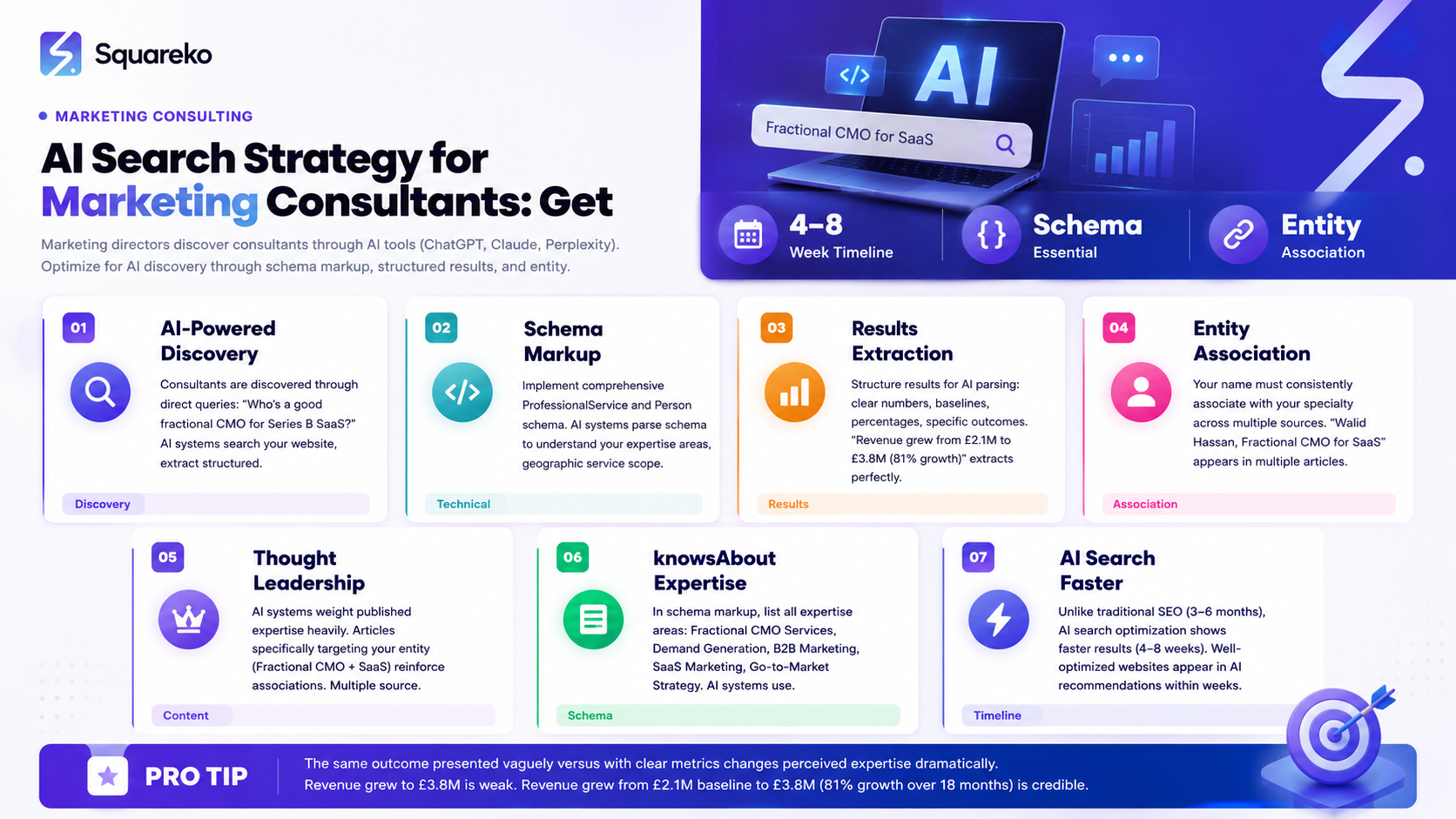
Marketing directors increasingly use AI tools (ChatGPT, Claude, Perplexity) to discover and evaluate consultants
AI systems extract structured information (schema markup), campaign results, and entity associations from your website
Campaign results are "AI-extractable entities"—clear metrics, baseline, attribution matter for AI recommendation
Thought leadership content directly supports AI recommendation through cited expertise and association
Marketing consultants who implement AI search optimisation correctly have inherent credibility advantage with AI systems
Marketing directors no longer discover consultants solely through Google search. They use ChatGPT, Claude, Perplexity, and other AI tools to find consultants quickly, ask specific questions, and get recommendations.
"Who's a good fractional CMO for Series B SaaS companies?" gets asked to Claude, not Googled.
This is a massive opportunity for marketing consultants because AI systems are largely unoptimised for consultant discovery. Whoever figures out AI search optimisation first will have a significant advantage.
The good news: marketing consultants with strong websites are inherently well-positioned for AI discovery because AI systems extract information from:
Structured data (schema markup) you control
Published thought leadership demonstrating expertise
Campaign results and metrics you share
Entity associations (your name + expertise + outcomes) you build
A marketing consultant whose website demonstrates expertise clearly, with proper schema implementation and visible results, will get recommended by AI tools to marketing directors searching for consultants.
How Marketing Directors Use AI to Find Consultants
AI-Powered Consultant Discovery Workflows
Marketing directors are developing new workflows for discovering consultants:
Workflow 1: Direct Query "Who are the best fractional CMOs for Series B SaaS companies in London?"
Claude or ChatGPT searches its training data, retrieves recent information from the web, and recommends consultants based on:
Explicit mentions in training data
Website content about the consultant
Schema markup and entity associations
Published thought leadership and speaking presence
Workflow 2: Comparative Evaluation "Compare three fractional CMOs for B2B SaaS. Show me their backgrounds, results, and engagement models."
AI systems extract structured information from consultant websites and present it in comparison format:
Background and credentials
Case study results and metrics
Engagement model and pricing
Thought leadership and expertise areas
Workflow 3: Capability Assessment "Does Consultant Name have experience with demand generation for marketplaces?"
AI searches the consultant's website, published articles, and case studies to assess specific capability match.
Workflow 4: Referral Strengthening "I've heard of Consultant Name. Tell me about them."
AI retrieves comprehensive information from their website and public profile to provide detailed background.
The Shift from SEO to AI Search
Traditional Google search optimization focuses on keyword matching and link authority. AI search optimization focuses on:
Structured information: Clear, extractable data about expertise, experience, results
Entity association: Your name strongly associated with specific expertise and outcomes
Comprehensive information: Detailed information about background, methodology, results
Multiple source validation: Information appearing across multiple sources (website, LinkedIn, publications, citations)
A consultant who ranks #1 on Google for "fractional CMO" but doesn't appear in AI tool recommendations is missing half the discovery channel.
How AI Systems Extract Consultant Information
Data Sources AI Systems Use
When a marketing director asks Claude "Who's a good fractional CMO for Series B SaaS?", Claude searches:
Training data (information up to knowledge cutoff date)
Real-time web search (current information from the web)
Structured data (schema markup from websites)
Published content (articles, press, websites)
Entity associations (mentions of consultant across multiple sources)
Your website feeds multiple of these sources.
What AI Systems Extract
AI systems extract and analyse:
Professional Information:
Background and credentials
Relevant experience and roles
Current positioning and services
Geographic service areas
Specific expertise areas (knowsAbout)
Capability Evidence:
Case studies and client outcomes
Specific metrics and results (revenue impact, lead growth, etc.)
Industries and company stages served
Methodologies and frameworks used
Published articles and thought leadership
Credibility Signals:
Speaking engagements and media mentions
Published articles and bylines
Client testimonials and reviews
Credentials and certifications
Years of experience
Entity Association:
How strongly your name is associated with your speciality
How often your name appears with specific keywords (fractional CMO, demand generation, SaaS)
How consistent this association is across sources
Schema Markup Extraction
Schema markup (structured data) is parsed by AI systems to extract:
{
  "@type": "ProfessionalService",
  "name": "Your Name - Fractional CMO",
  "description": "Description of your expertise",
  "areaServed": ["London", "Manchester"],
  "knowsAbout": ["Demand Generation", "SaaS Marketing", "B2B Strategy"],
  "priceRange": "££££"
}
AI systems read this structured data and extract:
You are a Professional providing services
Your name is [Your Name]
You specialise in fractional CMO services
You serve London and Manchester
Your expertise areas include demand generation, SaaS, B2B
Your pricing is premium
This structured extraction is more reliable than parsing unstructured text.
ProfessionalService Schema for AI Consultant Discovery
Enhanced Schema for AI Extraction
While schema helps traditional search, it's critical for AI systems. Implement comprehensive ProfessionalService schema:
{
  "@context": "https://schema.org",
  "@type": "ProfessionalService",
  "@id": "https://yoursite.com",
  "name": "Your Name - Fractional CMO & Marketing Consultant",
  "image": "https://yoursite.com/your-professional-photo.jpg",
  "description": "Fractional CMO and marketing strategy consultant for Series B-D SaaS companies. Specialise in demand generation strategy, marketing team building, and go-to-market repositioning. Based in London, serving London and South East companies.",
  "url": "https://yoursite.com",
  "telephone": "+44 (your number)",
  "email": "contact@yoursite.com",
  "address": {
    "@type": "PostalAddress",
    "addressLocality": "London",
    "addressRegion": "England",
    "postalCode": "Your Postcode",
    "addressCountry": "UK"
  },
  "areaServed": [
    {
      "@type": "City",
      "name": "London"
    },
    {
      "@type": "City",
      "name": "Manchester"
    }
  ],
  "knowsAbout": [
    "Fractional CMO Services",
    "Demand Generation Strategy",
    "Go-to-Market Strategy",
    "B2B SaaS Marketing",
    "Marketing Team Building",
    "Sales Enablement",
    "Revenue Attribution"
  ],
  "priceRange": "££££",
  "hasCredential": [
    {
      "@type": "EducationalOccupationalCredential",
      "name": "Your Relevant Credentials or Experience"
    }
  ],
  "hasOfferingDescription": {
    "@type": "Description",
    "name": "Fractional CMO Services",
    "description": "Strategic marketing leadership for Series B-D SaaS companies. Retainer-based engagement typically 15-20 hours/week. Focus on demand generation, team building, and strategic alignment."
  }
}
Additional Person Schema
Implement Person schema alongside ProfessionalService:
{
  "@context": "https://schema.org",
  "@type": "Person",
  "name": "Your Name",
  "jobTitle": "Fractional CMO & Marketing Consultant",
  "image": "https://yoursite.com/your-photo.jpg",
  "url": "https://yoursite.com",
  "sameAs": [
    "https://linkedin.com/in/yourprofile",
    "https://twitter.com/yourhandle"
  ],
  "workAddress": {
    "@type": "PostalAddress",
    "addressLocality": "London",
    "addressCountry": "UK"
  },
  "knowsAbout": [
    "Fractional CMO Services",
    "SaaS Marketing",
    "Demand Generation",
    "B2B Growth Strategy",
    "Revenue Attribution"
  ],
  "hasOccupation": {
    "@type": "Occupation",
    "name": "Fractional CMO & Marketing Consultant",
    "description": "Provides strategic marketing leadership to Series B-D SaaS companies"
  }
}
Key Schema Elements for AI
knowsAbout: This element is crucial. List all areas of expertise you want associated with your name. AI systems use this to match consultants to queries.
areaServed: AI systems use this to understand geographic scope. Geographic + expertise matching is how AI recommends relevant consultants.
description: Should be specific enough that AI systems understand exactly what you do, not generic marketing language.
hasCredential: Include relevant credentials, experience levels, or qualifications that build AI credibility assessment.
Campaign Results as Extractable Entities
Why Results Matter to AI
When a marketing director asks Claude "What kind of results can a fractional CMO deliver?", Claude searches for consultant websites with specific, extractable results.
Vague case studies ("improved revenue") don't extract well. Specific case studies with clear metrics extract perfectly.
Result Extraction Framework
Structure campaign results for AI extraction:
Extractable Format:
Client: Company Name or Industry
Engagement: Fractional CMO (18 months)
Starting Position: Revenue £2.1M ARR
Ending Position: Revenue £3.8M ARR
Revenue Growth: 81% (£1.7M increase)
Attributed to: Demand generation strategy repositioning and sales efficiency improvements
Key Metrics:
- Qualified monthly pipeline: £500k → £1.8M (260% increase)
- Sales cycle: 6.2 months → 3.4 months (45% reduction)
- Cost per acquisition: £12,500 → £8,125 (35% reduction)
- Close rate: 12% → 23% (92% improvement)
This is readable by humans and extractable by AI systems.
AI-Friendly Metrics
Use metrics that AI systems can:
Parse easily: Numbers with clear units (£, %, months)
Compare: Baseline and ending, allowing calculation of change
Validate: Specific enough that change is credible
AI-Friendly Metrics:
"Revenue grew from £2.1M to £3.8M" (parseable)
"Qualified pipeline increased 260%" (extractable percentage)
"Cost per acquisition decreased 35%" (clear metric)
"Sales cycle reduced from 6.2 months to 3.4 months" (specific timeline)
AI-Unfriendly Metrics:
"Significantly increased revenue" (not parseable)
"Greatly improved marketing efficiency" (vague)
"Generated substantial leads" (no numbers)
Case Study Structure for AI Extraction
Structure case studies consistently so AI systems can parse them reliably:
## Case Study: [Client Name/Industry]
### Engagement Details
- Client Type: [Series B SaaS company, e.g.]
- Engagement Model: Fractional CMO
- Duration: 18 months
- Hours/week: 15-20
### Starting Position
- Revenue: £2.1M ARR
- Qualified Pipeline: £500k/month
- Sales Cycle: 6.2 months average
### Strategic Challenge
[Specific business problem]
### Approach
[Strategic changes made]
### Results
- Revenue: £2.1M → £3.8M (81% growth)
- Qualified Pipeline: £500k → £1.8M (260% growth)
- Sales Cycle: 6.2 months → 3.4 months (45% reduction)
- Cost per Acquisition: £12,500 → £8,125 (35% reduction)
### Attribution
Estimated 55% of revenue growth attributed to demand generation strategy repositioning, 30% from sales efficiency improvements, 15% from brand repositioning enabling premium pricing.
### Sustained Impact
Results have been sustained 18 months post-engagement. Client has continued to use improved demand generation model.
This structure is consistent, parseable, and extractable.
Thought Leadership and Entity Association
Why Thought Leadership Matters for AI
When Claude researches "fractional CMO for SaaS," it searches for:
Websites with Fractional MO + SaaS association
Published articles by consultants discussing SaaS fractional CMO topics
Speaking engagements on SaaS marketing
Media mentions associating consultant with SaaS expertise
A consultant with published articles on "How to Scale Demand Generation for SaaS" builds strong entity association for AI systems.
Entity Association Building
Entity association means your name consistently appears with specific expertise:
Strong Entity Association:
"Walid Hassan, Fractional CMO for SaaS" (consistent association)
Your name appears in articles about "Fractional CMO for SaaS" (strong relevance)
Multiple sources mention you with "Fractional CMO" + "SaaS" (cross-source validation)
Weak Entity Association:
"Marketing consultant" (generic, no specialisation)
Inconsistent mentions with different services (confusing association)
Limited published work (limited entity reinforcement)
Publishing for Entity Association
Publish content specifically targeting your entity association:
For "Fractional CMO + SaaS" Association:
"How to Know When Your SaaS Company Needs a Fractional CMO"
"Fractional CMO Strategy for Series B SaaS: A 6-Month Roadmap"
"Why Most SaaS Companies Wait Too Long to Hire Fractional CMOs"
Each article reinforces the association: Your Name + Fractional CMO + SaaS.
Thought Leadership Distribution
Publish articles on:
Your website (owned platform, helps SEO and direct traffic)
LinkedIn (professional network, AI systems index LinkedIn content)
Medium (public platform, good indexing)
Industry publications (third-party credibility)
Your email newsletter (builds direct audience)
Multiple source publication strengthens entity association for AI systems.
Speaking for Entity Association
Speaking engagements reinforce entity association:
"Walid Hassan speaking at Conference on Fractional CMO Strategy"
Podcast appearances discussing fractional CMO engagement
Webinar hosting on SaaS growth and fractional CMO topics
Each speaking appearance reinforces the association in AI training data.
Building Entity Credibility for AI Recommendation
Comprehensive Website Information
Ensure your website provides comprehensive information for AI extraction:
About/Bio Section: Clear background, credentials, why you chose fractional CMO consulting
Services Section: Detailed explanation of what fractional CMO engagement includes, engagement model, timeline
Case Studies: 4-5 detailed case studies with specific metrics, baseline, attribution, sustained results
Thought Leadership: Regular articles demonstrating your thinking and expertise
Speaking/Media Section: Links to speaking engagements, podcast appearances, media mentions
Contact/Engagement: Clear CTA for consultations and engagement discussion
AI systems extract all of this to build comprehensive profile of you as a consultant.
LinkedIn Profile Optimisation
LinkedIn is heavily indexed by AI systems. Ensure your profile:
Lists complete professional history with metrics and outcomes
Includes detailed summary positioning you as fractional CMO specialist
Shows content activity (articles, posts, comments)
Indicates open to fractional CMO engagements
Links to your website
Author Attribution
When publishing, ensure proper author attribution:
"By Walid Hassan, Fractional CMO and Marketing Consultant"
Consistent author name across publications
Author bio linking back to website
This builds author-topic association for AI systems.
Structured Citation
When you're mentioned or quoted, ensure structured citation:
Quote appears with proper attribution
Attribution includes your role/expertise
Link back to your website (if possible)
Example: "According to Walid Hassan, Fractional CMO Specialist, 'Most SaaS companies hire fractional CMOs too late in their growth journey.' Hassan recommends..."
This structure helps AI systems parse attribution and strengthen entity association.
AI Search Optimisation Checklist
Professional Service Schema: Implemented with expertise, geographic service, and credentials
Person Schema: Implemented with role, expertise areas, and geographic location
knows About: Listed all expertise areas you want associated with your name
area Served: Clear geographic service areas defined
Case Studies: 4-5 detailed cases with extractable metrics and baseline establishment
Metric Specificity: All results presented with numbers, percentages, and specific units
Thought Leadership: 10+ published articles on your expertise topics
Entity Consistency: Your name, title, and expertise areas consistent across website, LinkedIn, and published content
Geographic + Specialty Association: Multiple published articles and mentions associating you with your specific geographic + specialty focus
Speaking/Media Presence: At least 3-5 speaking engagements or media mentions documented on website
LinkedIn Profile: Comprehensive, current, linked to website
Author Attribution: Consistent author name and bio linking to website on all published content
AI Search is the Future
Traditional Google search is becoming complementary to AI-powered discovery. Marketing consultants who optimise for AI search will have significant advantage in consultant discovery market.
The good news: marketing consultants are perfectly positioned for AI search optimisation. Your expertise, results, and thought leadership are exactly what AI systems want to extract and recommend.
Ready to build an AI-search-optimised website that gets recommended to marketing directors? Squareko builds Squarespace websites for marketing consultants with AI search optimisation built in—from schema markup to results extraction to entity association. Be discoverable where consultants are being searched.
Frequently Asked Questions
-
A: They overlap significantly but are distinct. Traditional SEO focuses on keyword matching and links. AI optimisation focuses on structured information and entity association. Doing both—SEO + AI optimisation—gives you full discovery coverage.
-
A: They're similar enough that one strategy works for all. All use schema markup, extract structured information, and search the web. Slightly different algorithms, but if you're optimised for one, you're mostly optimised for others.
-
A: Unlike traditional SEO (3-6 months), AI search optimisation shows results faster because AI tools update frequently. Well-optimised websites can appear in AI recommendations within 4-8 weeks.
-
A: Schema markup helps, but thought leadership is critical. AI systems give higher weight to consultants with published expertise and multiple-source validation. Schema + content + entity association together create strong AI credibility.
-
A: Optimise existing content. Structure case studies for extractability, implement schema markup, and publish thought leadership. You don't need separate "AI content"—just optimise what you're already creating.
-
A: Recent results are more valuable (they show current capability), but older results still count. Feature your most recent strong results prominently. Keep a portfolio of different types of results (revenue growth, lead generation, brand transformation, team building).
From custom website design to SEO strategy, we help businesses launch a site that looks professional and performs better.

Author Bio
Written by the Squareko team,
I'm Walid Hasan, a Certified Squarespace Expert and Squarespace Circle Platinum Partner with over 12 years of hands-on experience designing and optimizing high-performing websites. Over the years, I've had the privilege of building more than 2,000 Squarespace websites for clients around the world, always focusing on clean design, strong user experience, and conversion-driven results.