SEO for Technology Consulting Firms on Squarespace: Rank for Enterprise IT Keywords
Key Takeaways SEO for Technology Consulting Firms
Enterprise IT keywords differ from consumer searches: Search behavior for technology consulting targets senior decision-makers with specific, high-intent queries
Content depth is your competitive advantage: Enterprise buyers consume extensive information; comprehensive, authoritative content outranks thin competitor pages
Service-level content matters more than homepage ranking: Ranking for digital transformation consulting on your service page has more value than ranking for your firm name
Technical expertise signaling through content attracts enterprise queries: Publishing original research and proprietary methodologies helps you rank for thought leadership keywords
Squarespace provides adequate SEO fundamentals: You won't optimize technical SEO as deeply as a custom site, but Squarespace's built-in capabilities support strong B2B SEO results
Technology consulting firms face a unique SEO challenge: the keywords that matter most to your business (enterprise-level IT solutions, digital transformation, managed services) are highly competitive, searched by decision-makers who expect comprehensive information, and filled with established competitors with significant authority.
Yet SEO remains one of the highest-ROI marketing channels for consulting firms. Enterprise buyers start their research with search engines, and appearing prominently for the right keywords puts your firm in front of prospects at the exact moment they're evaluating solutions.
This guide provides a comprehensive SEO strategy specifically designed for technology consulting firms using Squarespace, covering keyword research for enterprise decision-makers, content architecture that aligns with buyer journeys, and technical optimization that works within Squarespace's platform.
Understanding Enterprise IT Search Behavior
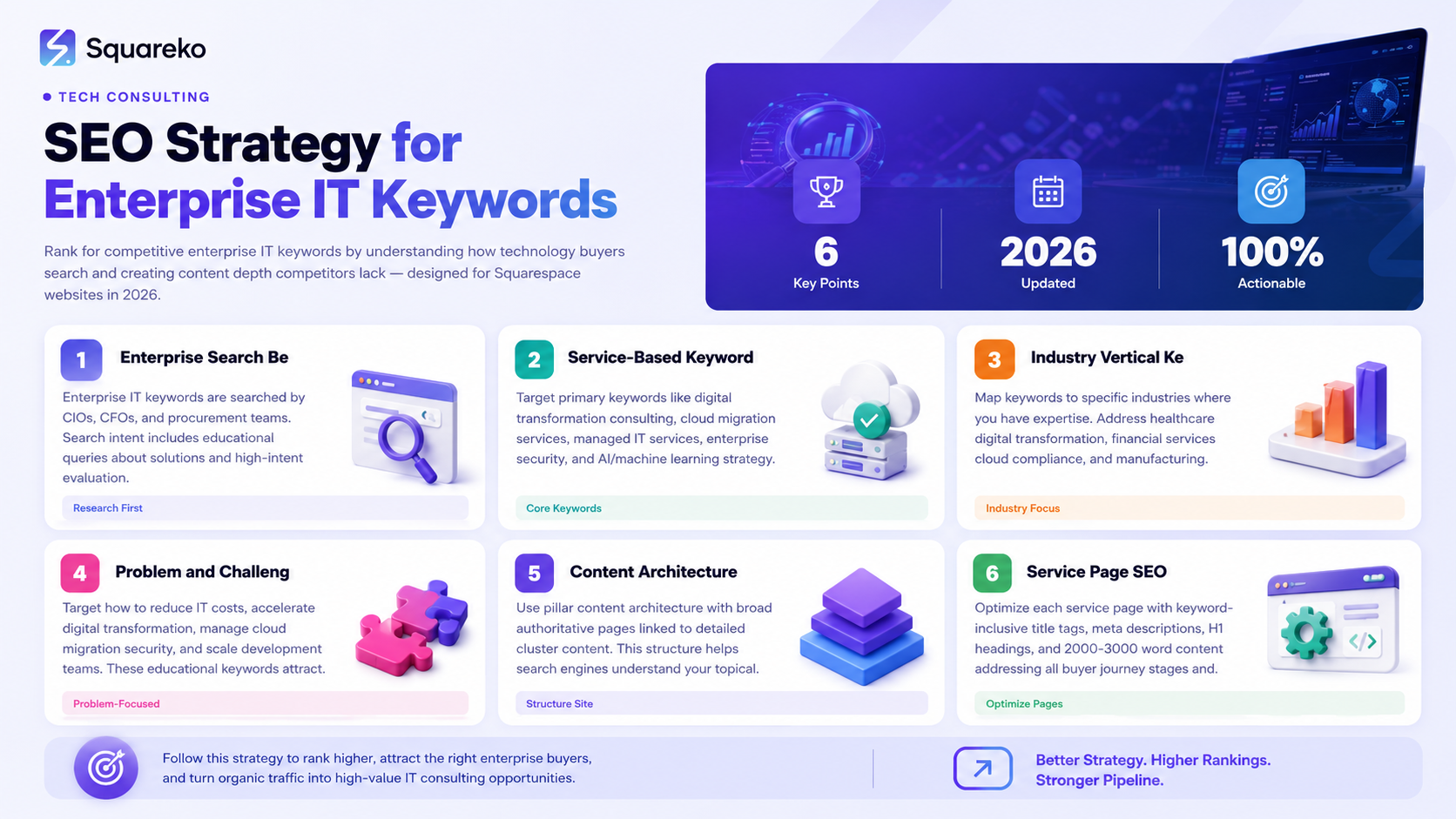
Enterprise technology procurement starts with research, but the research process differs significantly from consumer purchasing. Understanding how enterprise buyers search will shape your entire SEO strategy.
Who Searches for Consulting Services?
Enterprise IT consulting keywords are typically searched by:
CIOs and IT Directors: Evaluating technical solutions and consulting partners
CFOs and Controllers: Researching ROI and cost-benefit of consulting engagements
Project Managers: Finding specific solutions for defined challenges
C-Suite Executives: Assessing strategic implications of digital transformation or technology initiatives
Procurement: Evaluating vendor shortlists and RFP requirements
These are information-seeking stakeholders who may search multiple times throughout a buying cycle, often for different information at each stage.
Search Intent for Enterprise IT Keywords
Enterprise IT searches fall into distinct intent categories:
Educational searches: What is digital transformation? / How does cloud migration work? / Benefits of managed services
Typically early-stage research
Decision-makers learning about solutions and approaches
Opportunities to establish authority and lead prospects into consideration
Evaluation searches: Best digital transformation consultants / Enterprise IT support firms / Cloud migration providers near me
Mid-stage research where prospects evaluate alternatives
High-intent searches from active decision-makers
Opportunities to win directly from search results through strong positioning
Specific solution searches: SAP implementation services / Salesforce deployment consulting / Microsoft Azure migration
High-intent, solution-specific searches from companies evaluating particular platforms
Best opportunities for conversion-focused content
Comparison searches: Consulting firm A vs B / Managed services vs in-house IT / Cloud migration partners comparison
Competitive searches where prospects are actively deciding between options
Opportunities to differentiate your firm through thought leadership
Search Volume vs. Intent Trade-Offs
A key principle in consulting firm SEO: don't optimize for search volume at the expense of intent. A keyword searched 500 times monthly by job seekers, consultants, and students is worthless. A keyword searched 10 times monthly by CIOs actively evaluating consulting partners is gold.
Your strategy should prioritize keywords that clearly indicate enterprise buyer intent, even if they have lower overall search volume.
Keyword Research for Consulting Firms
Effective keyword strategy starts with understanding what your target prospects are actually searching for.
Step 1: Identify Your Service-Based Keywords
Your primary keywords are the specific services you offer:
Digital transformation consulting
Cloud migration services
Managed IT services
Enterprise security consulting
Data analytics implementation
AI/machine learning strategy
Cybersecurity assessment and implementation
Enterprise resource planning (ERP) implementation
Application development and modernization
For each of these core services, identify:
The primary keyword (broad version)
Long-tail variations (enterprise cloud migration consulting)
Vertical-specific versions (Healthcare cloud migration)
Comparison keywords (outsourced IT vs in-house)
Step 2: Industry and Vertical Keywords
Map keywords to specific industries where you have expertise or case studies:
For healthcare consulting:
Healthcare digital transformation
Medical device software development
Healthcare cloud compliance
HIPAA-compliant IT systems
For financial services:
Financial services digital transformation
Banking cybersecurity consulting
Fintech development consulting
For manufacturing:
Manufacturing digital transformation
Industry 4.0 implementation
IoT and industrial automation
Step 3: Problem and Challenge Keywords
Enterprise buyers often search for solutions to specific problems:
How to reduce IT costs / IT cost optimization
How to accelerate digital transformation
Cloud migration security concerns
Managing technical debt
Scaling development teams
These educational keywords attract prospects early in their research journey.
Step 4: Local and Geographic Keywords (If Applicable)
If you serve specific regions, identify geographic keywords:
Enterprise consulting firms in [City]
Digital transformation consultants [Region]
[City] managed IT services
Note: If you serve enterprise clients nationally or globally, local keywords may have less value.
Step 5: Thought Leadership and Trend Keywords
Position your firm around emerging trends and proprietary frameworks:
AI implementation strategy
Zero trust security architecture
Composable business architecture
Modern data architecture
These keywords position you as forward-thinking and help with brand authority.
Keyword Research Tools for Consulting
Ahrefs: Comprehensive keyword data, competitor analysis, SERP difficulty
SEMrush: Keyword research, competitor tracking, rank tracking
Google Search Console: Actual queries driving impressions and clicks
Google Keyword Planner: Official keyword volume and CPC data
Moz: Keyword difficulty metrics and local keyword research
Focus on keywords with:
Clear enterprise buyer intent
Search volume indicating active demand (50+ monthly searches minimum)
Reasonable competition level for your firm size and authority
Content Architecture for B2B SEO
Enterprise SEO success requires strategic content architecture that addresses the entire buyer journey, from awareness through decision.
Pillar Content Architecture
Organize your content around pillar topics (broad, authoritative pages) and cluster content (detailed, related articles that link back to pillars):
Pillar 1: Digital Transformation
Core pillar page: Digital Transformation Strategy for Enterprise (3000-5000 words)
Cluster content:
Cloud Migration Strategy
Legacy System Modernization
Process Automation Implementation
Change Management for Digital Initiatives
Pillar 2: Enterprise Security
Core pillar page: Enterprise Cybersecurity Strategy and Implementation (3000-5000 words)
Cluster content:
Zero Trust Security Architecture
Cloud Security Compliance
Incident Response Planning
Security Vulnerability Assessment
This structure helps search engines understand your content relationships and positions your firm as authoritative on core topics.
Homepage SEO Optimization
Your homepage should:
Include primary keywords naturally (but not forced):
In your main headline
In 2-3 supporting sections
In metadata (title tag, meta description)
Provide clear navigation to primary service pages:
Consultants searching for your services should easily find them
Link structure helps search engines understand content importance
Link strategically to your strongest content:
Link from homepage to case studies (proof of capability)
Link to thought leadership content (authority positioning)
Link to pillar pages (core services)
Service Page Architecture
Each major service should have a comprehensive page (2000-3000 words) that:
Ranks for primary keywords: Digital transformation consulting, Cloud migration services, etc.
Addresses all stages of buyer journey:
What the service is (educational)
Why it matters (strategic context)
How you approach it (differentiation)
Proof of results (case studies, metrics)
Links to related content:
Related services
Relevant case studies
Thought leadership on that topic
Blog and Resource Content Strategy
Your blog should address:
Trend and thought leadership: Industry shifts, emerging technologies, new approaches
The Future of Enterprise Application Development
Zero Trust Architecture: Why Enterprises Are Adopting It
AI-Powered Automation: Opportunities for Enterprise
How-to and educational content: Practical guidance for prospects evaluating solutions
How to Plan a Enterprise Cloud Migration
Enterprise Digital Transformation Roadmap
Cost Optimization Strategies for Enterprise IT
Original research and insights: Proprietary data and perspectives
2024 Enterprise Digital Transformation Report
CIO Priorities Survey
Enterprise AI Adoption Benchmarks
Industry vertical content: Vertical-specific guidance
Digital Transformation Strategies for Healthcare
Cybersecurity Considerations for Financial Services
Manufacturing Digital Transformation Roadmap
Publication frequency recommendation: Minimum 2 pillar/cluster posts monthly, with blog posts supplementing this core content strategy.
Service Page Optimization Strategy
Service pages are where enterprise SEO translates to actual lead generation. These pages should be thoroughly optimized for search visibility while remaining prospect-focused.
Service Page Structure for SEO
1. Title Tag Optimization (60 characters)
Include primary keyword
Include differentiator if room
Example: Digital Transformation Consulting for Enterprise | [Firm Name]
2. Meta Description (160 characters)
Include primary keyword
Answer the implied question (Why choose this service?)
Example: Strategic digital transformation consulting for enterprise organizations. Proven methodology, 20+ years experience, measurable ROI.
3. H1 Heading
One per page
Include primary keyword naturally
Example: Enterprise Digital Transformation Consulting
4. Introduction Section (200-300 words)
Establish what the service is
Define the business problem it solves
Hint at your differentiated approach
Include primary keyword 1-2 times naturally
5. Service Overview Section (500-800 words)
Use H2 subheadings
Address Why does this matter?
Explain business outcomes, not just process
Include secondary keywords naturally
6. Your Approach Section (500-800 words)
Use H3 subheadings for each phase
Explain your unique methodology
Differentiate from competitors (implicitly)
Include methodological keywords
7. Case Study Highlighting (2-3 examples)
Link to full case studies
Include relevant metrics
Show case studies for similar industries/company sizes
8. Results and Impact Section (300-400 words)
Quantified outcomes from similar projects
Industry-specific metrics that matter to prospects
Long-term value and benefits
9. Implementation Details (200-300 words)
Timeline expectations
Resource requirements
Integration with existing systems
10. Related Services (100-200 words)
Link to complementary services
Explain service combination value
11. Clear Call-to-Action
Schedule a Consultation
Request a Proposal
Form that qualifies lead type
Internal Linking From Service Pages
Link strategically from service pages to:
Related service pages (cross-sell opportunities)
Relevant case studies (proof of capability)
Relevant blog posts (thought leadership and SEO authority)
Pillar content (topical authority)
This linking helps search engines understand content relationships while creating natural navigation for prospects.
Building Authority Through Research Content
Enterprise consultants build SEO authority through proprietary research and thought leadership. This content attracts links, establishes expertise, and ranks for competitive keywords.
Original Research and Publications
Publish annual or periodic research that provides quantified insights:
Annual Enterprise Reports:
Digital Transformation Progress Report
Enterprise IT Spending Survey
Cloud Adoption and Strategy Report
Cybersecurity Incident and Risk Assessment Report
Research structure:
Survey 100-500 relevant professionals
Analyze data to identify trends and insights
Create executive summary report (10-20 pages)
Publish detailed findings on your website
Create supporting infographic or data visualization
Promotion strategy:
Press release announcing findings
Media outreach to industry publications
LinkedIn and social distribution
Speaking opportunities highlighting findings
Guest articles in industry publications using your data
Proprietary Methodologies and Frameworks
Develop and publish proprietary approaches that differentiate your firm:
Example methodologies:
The 6-Phase Digital Transformation Framework
Enterprise Cloud Migration Maturity Model
Modern Security Architecture Assessment Framework
Publishing approach:
Create detailed guide or white paper explaining the framework
Publish on your website as premium resource
Build service pages around the framework
Reference framework in case studies
Train your team to mention framework in sales conversations
Thought Leadership Articles
Publish regular articles that demonstrate expertise and insight:
Article types:
Why Enterprise Cloud Migrations Fail (And How to Succeed)
The Hidden Costs of Legacy Systems—And ROI of Modernization
AI Implementation Strategy: From Pilot to Enterprise Deployment
Zero Trust Security: What Enterprise Leaders Need to Know
Article structure (2000-3000 words):
Compelling headline addressing a problem or trend
Introduction establishing context and importance
3-5 main sections addressing the topic comprehensively
Actionable insights and takeaways
CTA to next engagement step
Publishing and promotion:
Publish on your blog
Syndicate to industry publications (with attribution and backlinks)
Share through professional networks (LinkedIn, Twitter)
Use as basis for speaking and webinar content
Reference in sales conversations and proposals
Squarespace Technical SEO Implementation
Squarespace provides solid SEO fundamentals, but you need to implement best practices to maximize performance.
Title Tags and Meta Descriptions
In Squarespace's page settings, customize for every important page:
Homepage title tag:
Include primary keyword or brand + key modifier
Length: 50-60 characters
Example: Enterprise Digital Transformation Consulting | [Firm Name]
Service page title tags:
Service name + primary keyword + modifier
Example: Cloud Migration Services for Enterprise | [Firm Name]
Blog post title tags:
Article title + brand (if room)
Length: 50-60 characters
Meta descriptions (150-160 characters):
Summary of page content
Include primary keyword if natural
Include value proposition or call-to-action
Write for human readers, not search engines
URL Structure
Customize URLs for important pages:
Homepage: (automatic)
Service pages: /services/digital-transformation (not /s/a7x8y9z)
Blog posts: /insights/how-to-plan-digital-transformation (not /b/1234567)
Case studies: /case-studies/fortune-500-digital-transformation (not /p/xyz)
Readable URLs improve user experience and help search engines understand content.
Heading Structure (H1, H2, H3)
Use semantic heading structure throughout your site:
One H1 per page (usually your page title)
H2s for main sections (typically 3-5 per page)
H3s for subsections where needed
Squarespace's editor shows heading levels—use them consistently.
Image Optimization
For every image on your site:
Filename: Use descriptive names (digital-transformation-team.jpg, not image123.jpg)
Alt text: Describe image for accessibility and SEO (alt=Our digital transformation consulting team)
File size: Compress images to reduce page load time
Format: Use WebP where supported, JPEG for photos, PNG for graphics
Site Speed Optimization
Squarespace provides good speed performance by default, but you can improve:
Minimize custom code: Custom JavaScript and CSS can slow page load
Optimize images: Largest impact on site speed
Limit videos: Embedded videos slow pages; consider links instead
Use CDN: Squarespace uses CDN by default; benefit is automatic
Check performance: Google PageSpeed Insights, GTmetrix
Mobile Optimization
Squarespace's responsive design handles mobile well, but verify:
Test on actual mobile devices: Not just browser emulation
Ensure forms work on mobile: Multi-step forms should be clear on small screens
Check readability: Font sizes and spacing should be comfortable on mobile
Navigation is accessible: Menus should be easy to navigate on mobile
CTAs are tappable: Buttons should be 44px+ (larger on mobile helps)
Structured Data / Schema Markup
Use Squarespace's built-in schema markup:
Organization schema: Automatically added if configured in site settings
LocalBusiness schema: Added automatically for location-based businesses
Service schema: Can be added for specific service pages via custom code
Article schema: Automatically added to blog posts
In Squarespace settings > Business information, ensure your business details are complete and accurate.
XML Sitemap and Robots.txt
Squarespace automatically creates:
XML sitemap at /sitemap.xml
robots.txt file
Verify these are working:
Submit sitemap to Google Search Console
Check robots.txt allows search engine crawling of important pages
Link Building for Consulting Firms
Links from authoritative websites signal to search engines that your content is credible. For consulting firms, link building happens through:
Earned Links Through Thought Leadership
Publish original research, frameworks, and insights that are worth linking to:
Industry publications will link to original research
Thought leaders will reference your frameworks
Case studies will link when clients mention you publicly
Webinars and speaking appearances drive links
Industry Publication Contributions
Write guest articles for industry publications:
Selection criteria: Publications your target buyers read
Topics: Address trends and challenges relevant to your services
Backlink value: Guest articles typically include author bios with links to your site
Authority gain: Links from authoritative publications boost your SEO
Target publications in your space (industry-specific journals, analyst firm blogs, business publications).
Professional Directory and Association Listings
Get listed in relevant directories:
Industry association directories
Consultant listings (management consultant directories)
Best consulting firms directories
Technology industry directories
These create brand visibility and provide backlinks, though they're less impactful than earned media links.
Speaking Engagements
Speaking at industry events generates multiple benefits:
Backlinks from event websites
Brand authority and visibility
Networking with potential clients and partners
Opportunity to be featured in event materials
Partner and Client Links
Request links from:
Clients on their websites (case study mentions)
Technology partners (integration partners, platform partners)
Industry associations you're members of
Universities or educational institutions where executives teach
Avoid: Paying for links or participating in link schemes. Focus on earning links through valuable content and genuine relationships.
Measuring and Improving SEO Performance
Monitor your SEO performance and iterate based on data.
Google Search Console Setup
Connect your Squarespace site to Google Search Console:
Go to Google Search Console
Add your property (your domain)
Verify ownership via DNS or HTML file
Review Performance tab for queries driving traffic
Monitor:
Top queries: Which keywords are bringing searches
Click-through rate: Which keywords people click on
Average position: Which keywords you're ranking for
Impressions vs clicks: Which keywords need better CTR
Key Metrics to Track
Monthly monitoring:
Organic traffic volume (from Google Analytics)
Keyword rankings for primary keywords (use Ahrefs, SEMrush, or Rank Tracker)
Blog traffic and engagement
Form submissions from organic search
Organic leads and their conversion rate
Quarterly analysis:
Content performance analysis (which pages drive traffic, leads, conversions)
Competitive landscape changes
Keyword opportunity analysis (new keywords emerging, declining keywords)
Link profile changes
Continuous Improvement Process
Monthly cycle:
Review Search Console data
Identify underperforming content opportunities
Create new content addressing gaps
Optimize existing content that's ranking but not converting
Check technical health (crawl errors, mobile usability)
Quarterly cycle:
Review quarterly metrics dashboard
Analyze which content and keywords drive actual leads
Adjust content strategy based on lead quality
Review competitor rankings and strategies
Plan content for coming quarter
Annual cycle:
Comprehensive content audit
Strategy reassessment
New pillar content planning
Technical optimization roadmap
Frequently Asked Questions
-
Enterprise consulting keywords are competitive and require time to build authority. Most firms see initial rankings (positions 10-20) within 3-4 months, front-page rankings within 6-9 months, and top 3-5 positions within 12-18 months. Thought leadership and less competitive keywords show faster results.
-
If you have a physical location and serve enterprises regionally, local SEO provides value. However, national consulting firms should prioritize industry, solution, and vertical keywords over geographic keywords. Local SEO is secondary unless geography is core to your positioning.
-
Quality over frequency. Publishing 1-2 comprehensive, high-quality posts monthly is more effective than 4 rushed posts. Enterprise buyers value depth, and search engines reward substantial content. Your minimum should be monthly publication; twice monthly is ideal if you can sustain quality.
-
Both matter, but for consulting firms, content quality and relevance drive most organic traffic. Enterprise prospects research extensively and engage with authoritative, comprehensive content. Build an SEO strategy where excellent content is the foundation, and links amplify that content's reach.
-
Yes, create vertical-specific content if you meaningfully differ your approach by industry. Create service pages that address vertical-specific challenges and benefits. Link between vertical pages to show breadth of expertise. This helps you rank for vertical-specific searches ("healthcare digital transformation") while building overall authority.
-
Write for users first, optimize for search engines second. Keywords should be naturally integrated; if a keyword feels forced, rewrite it. Longer content performs better in enterprise searches, but only if it's genuinely valuable. Length without substance hurts both SEO and conversions.
-
Review your top-performing pages quarterly. For pages that rank but drive few conversions, update with better CTAs and internal links. For pages ranking 6-10 positions, expand with additional detail and comprehensive information. For outdated content, refresh statistics, case examples, and links.
-
Track the full funnel: organic traffic → form submissions → sales conversations → closed deals. Use UTM parameters to track organic traffic sources. In your CRM, track which leads came from organic search and their conversion rate. The best SEO ROI measurement is qualified leads and revenue, not traffic or rankings.
Call to Action
SEO for technology consulting is a long-term investment that compounds over time. Enterprise prospects are actively searching for solutions you provide, and appearing prominently for the right keywords creates a consistent stream of high-quality leads.
At Squareko, we specialize in SEO strategy and implementation for technology consulting firms on Squarespace. From keyword research and content architecture to technical optimization and performance tracking, we help consulting firms achieve sustainable organic growth.
Ready to develop an SEO strategy that brings qualified enterprise prospects to your website? Schedule a consultation with our team to discuss your current visibility and opportunities.
Make it stand out
Whatever it is, the way you tell your story online can make all the difference.

Author Bio
I'm Walid Hasan, a Certified Squarespace Expert and Squarespace Circle Platinum Partner with over 12 years of hands-on experience designing and optimizing high-performing websites. Over the years, I've had the privilege of building more than 2,000 Squarespace websites for clients around the world, always focusing on clean design, strong user experience, and conversion-driven results.