Local SEO for Health and Wellness Professionals on Squarespace: Rank #1 in 2026
Key Takeaways Local SEO for Health and Wellness Professionals
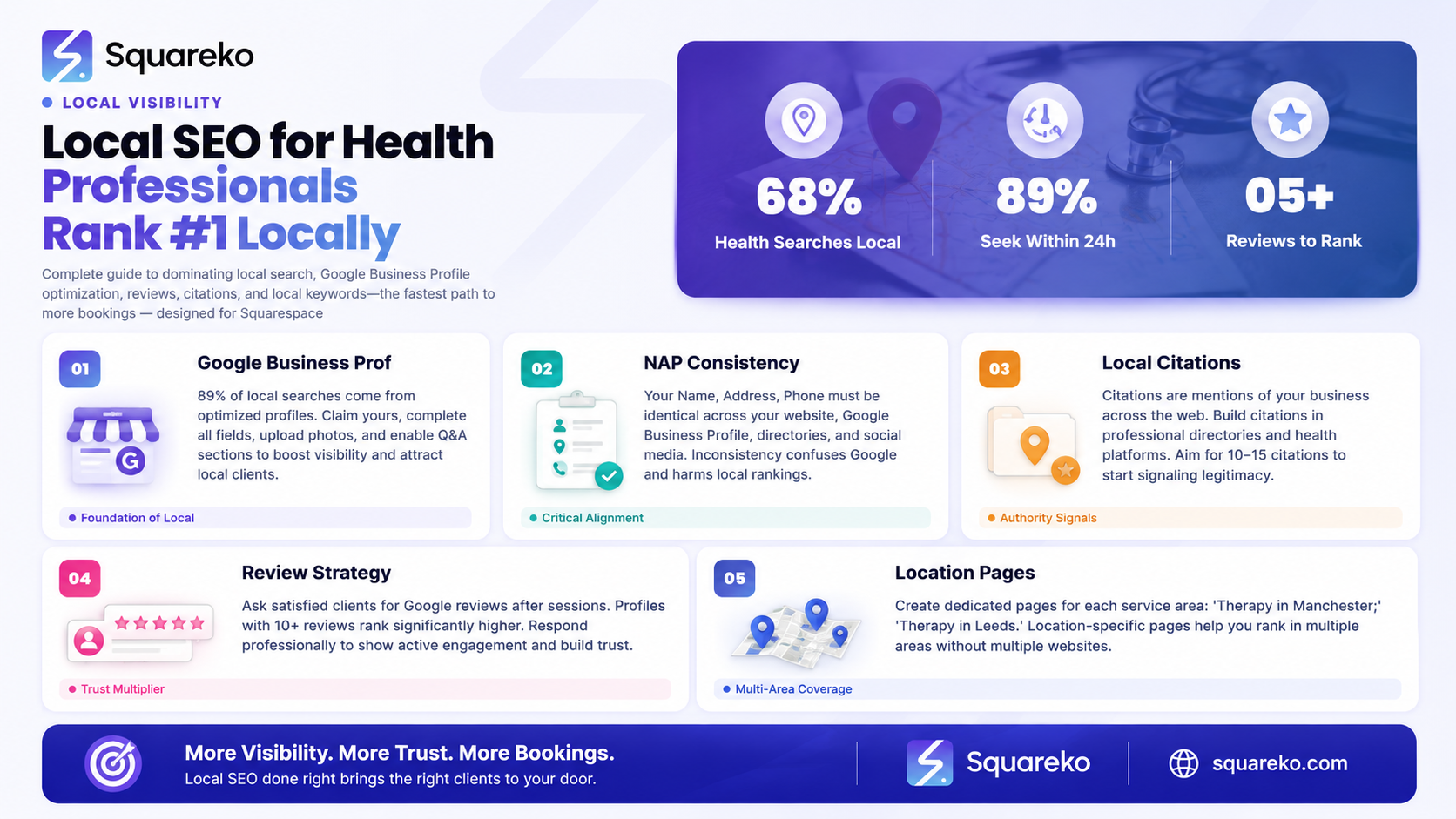
Google Business Profile is your foundation — 89% of local searches result from a Google Business Profile; it's the single most important local SEO asset
Google reviews directly impact rankings — Profiles with 10+ recent reviews rank significantly higher; reviews also serve as social proof that drives bookings
NAP consistency is critical — Your Name, Address, Phone must be identical across your website and all directory listings; inconsistency confuses Google
Local citations build authority — Mentions of your business on health directories, professional registries, and local sites signal legitimacy and boost rankings
Location pages expand reach — If you serve multiple areas, create dedicated location pages ("Therapy in Manchester," "Therapy in Leeds") to rank in multiple areas
Local keyword strategy differs from national — "Therapist in Manchester" ranks faster and converts better than "therapist" for local practitioners
Most health professionals search locally. When someone types "therapist near me" or "personal trainer in Manchester," they're searching for you specifically in their area. They're ready to book. They've already decided they want help. They just need to find you.
Local SEO is the practice of optimizing your online presence to rank higher in local search results—Google Maps, location-based Google search, and voice search. For health professionals, local SEO typically matters more than competing for national rankings. You're not trying to rank for "therapist" globally. You're trying to rank for "therapist in Manchester" or "personal trainer in my area."
In 2026, local search has evolved. AI voice assistants influence how people search geographically. Google Maps rankings heavily favor profiles with recent activity and genuine reviews. And local citations (mentions of your business across the web) matter more than ever.
This guide covers everything you need to rank #1 locally on Squarespace. You'll learn Google Business Profile setup, review strategy, local keyword research, NAP consistency, citation building, and tracking your local rankings.
Why Local SEO Matters for Health Professionals
Health services are inherently local. People don't typically fly to another city for therapy, nutrition consultation, or personal training unless they're relocating. They want someone geographically close—ideally walking distance or a short drive.
Local search volume statistics:
68% of all health-related searches include a location modifier ("near me," city name, etc.)
89% of consumers who search for a local health service visit or contact that business within 24 hours
76% of people who search for health services on mobile visit a location that day
Local search traffic converts at 2-3x higher rates than national search traffic
This means the local market is where your clients are. If you rank #1 locally, you're visible to people actively seeking your services right now.
Why local rankings matter more than national:
Competing nationally requires significant authority, backlinks, and content volume. Local ranking requires strong Google Business Profile optimization, reviews, citations, and keyword strategy. The barrier to entry is lower locally. With focused effort, you can dominate your local market within 2-3 months.
Google Business Profile Setup and Optimization
Google Business Profile is the foundation of local SEO. It's the box that appears on the right side of Google search results when someone searches for your service locally.
Step 1: Claim or Create Your Profile
Go to business.google.com and search for your business name. If it exists but you don't own it, claim it. If it doesn't exist, create it.
You'll need:
Your business name (exactly as it appears on official documents)
Your business address (physical location)
Your phone number
Your website
Step 2: Complete All Information
Fill out every field completely:
Business name — Use your actual name or practice name. Avoid keyword stuffing ("Best Therapist in Manchester Specializing in Anxiety"). Google penalizes this.
Business category — Select the category that best matches your service. Examples:
Therapist
Psychologist
Nutritionist / Dietitian
Personal Trainer
Massage Therapist
Yoga Studio
Description — Write a 250-word description of your services. Include your specialties, approach, and credentials. This shows in search results.
Website — Link to your Squarespace website
Phone — Your main business phone
Hours of operation — Exact hours for each day, including days you're closed
Service areas — If you serve multiple locations, list them all
Example description:
"Sarah Thompson is a BACP-accredited therapist specializing in anxiety, stress, and life transitions. With 8 years of experience in private practice, she works with professionals managing anxiety and seeking practical coping strategies. Sarah provides individual therapy sessions in Manchester and online. She's trained in Cognitive Behavioral Therapy and specializes in helping clients develop sustainable anxiety management techniques."
Step 3: Add Photos
Upload high-quality photos:
Your professional headshot (you, in professional attire)
Your practice space (if you have a physical location)
Team photos (if you have staff)
Before/after photos (for fitness/wellness professionals; ensure client permission)
Photos significantly impact click-through rates. Profiles with photos get 42% more requests for directions and 35% more click-throughs to your website.
Step 4: Set Up Google Posts
Google Posts are short promotional posts that appear in your Business Profile. Use them to:
Announce new services or packages
Share limited time offers
Direct people to book appointments
Share customer testimonials
Post a new update monthly to keep your profile active. Active profiles rank higher.
Step 5: Enable Questions & Answers
Enable your Q&A section. Answer common questions immediately:
"Do you offer online sessions?"
"How do I book an appointment?"
"What should I bring to my first session?"
"Do you accept insurance?"
Answering questions in your Business Profile shows Google that you're actively managing your profile, which boosts rankings.
Step 6: Verify Your Business
Google will ask you to verify your business. This typically involves:
Receiving a postcard with a verification code at your address
Receiving a phone call with a verification code
Email verification (for some business types)
Verification is crucial—unverified profiles show lower in search results.
NAP Consistency Across the Web
NAP stands for Name, Address, Phone. Consistency across all online platforms helps Google recognize your business and improves local rankings.
Where NAP must be consistent:
Your Squarespace website
Google Business Profile
Health professional directories:
Psychology Today (therapists)
Therapy Directory (UK therapists)
BACP/COSCA registries (if accredited)
Nutritionist registries (ANutr, RNutr directories)
Fitness professional listings (REPs, CIMSPA)
Social media (Facebook, Instagram, LinkedIn)
Local business directories (Yelp, Apple Maps, local chamber of commerce)
Health-specific platforms (Mindbody for fitness, practice management software)
How to ensure consistency:
Choose one exact business name and use it everywhere. If you're "Sarah Thompson, Therapist," use exactly that name everywhere, not "Sarah J Thompson" or "Thompson Therapy."
Use one address format across all platforms. If you use "123 High Street, Manchester, M1 1AA" on your website, use exactly that format (not "123 High St" or "Manchester, Greater Manchester") everywhere else.
Use one phone number for your business. If you have multiple numbers, designate one as your primary business number and use that everywhere.
Audit your current presence — Search your name online, note every listing, and check for inconsistencies. Update each listing to match your chosen NAP.
NAP inconsistency confuses Google's algorithm and can suppress your rankings. This is preventable and often fixes rankings immediately.
Local Keyword Research Strategy
Local keywords differ from national keywords. They're location-specific and conversion-focused.
Local keyword structure:
Service + Location or Service + "near me"
Examples:
"Therapist in Manchester"
"Personal trainer near me"
"Nutritionist in Leeds"
"Anxiety therapy Manchester"
"Yoga classes in Birmingham"
How to find local keywords:
Use Google search suggestions — Type your service + location into Google. The dropdown suggestions show actual searches people are making locally.
Check "People also ask" — Scroll through the "People also ask" section in Google search results for your location. These are questions people actually ask.
Use keyword tools (optional):
Google Keyword Planner (free)
Ahrefs (paid) — includes local search volume
SEMrush (paid) — includes local search intent data
Answer the Public (free) — visualizes questions people ask
Interview your existing clients — Ask clients how they found you and what keywords they searched. This real-world data is more valuable than any tool.
Create a keyword list for your primary service area:
Primary keywords (highest priority):
"Therapist in [City]"
"[Specialty] therapy [City]"
"Anxiety therapist near me"
Secondary keywords (supporting):
"Your name therapist City"
"Best therapist City"
"Therapy appointments City"
Use primary keywords in your Google Business Profile description and website title tags. Support secondary keywords with blog content.
Building Local Citations
A citation is any mention of your business name, address, and phone on the internet. Citations signal to Google that your business is real, established, and trusted.
Where to build citations:
Professional directories:
Psychology Today (therapists)
Therapy Directory (UK)
TherapyWorks (multi-discipline)
BACP/COSCA registries (accredited therapists)
ICF (Life Coaches)
BDA (Dietitians)
Yoga Alliance (yoga instructors)
REPs, CIMSPA (fitness professionals)
Health-specific directories:
Mindbody (fitness, wellness studios)
ZocDoc (medical professionals)
NHS (UK health services)
Healthgrades (medical professionals)
WebMD Physician Directory
General business directories:
Google My Business (already listed)
Apple Maps
Yelp
Local chamber of commerce
Social media:
Facebook Business Page
LinkedIn Business Profile
Instagram (business profile)
Citation building strategy:
Start with high-authority professional directories specific to your field (Psychology Today, Therapy Directory, professional body registries).
Move to general business directories (Google, Yelp, Apple Maps).
Add health-specific directories relevant to your service.
Maintain all listings—review them quarterly for accuracy.
Aim for 10-15 citations to start. Each citation signals legitimacy and improves local rankings.
Earning and Managing Google Reviews
Google reviews are a major local ranking factor. Profiles with 10+ recent reviews rank significantly higher. Reviews also serve as social proof—73% of people trust health professionals more after reading positive reviews.
Review strategy:
Step 1: Create a system for asking
Ask satisfied clients to review you. Best timing:
After a successful outcome or session
Via email 24 hours after their session
In-person with a direct request
Keep it simple: "If this session was helpful, I'd appreciate a Google review. It helps other people find me."
Step 2: Make it easy
In your Squarespace site footer, add your Google review link. Get the link from your Google Business Profile.
Better yet, include a QR code in your practice that links directly to your review page. Many clients will scan and review immediately.
Step 3: Respond to every review (positive and negative)
Responding to reviews signals to Google that you're actively managing your profile. It also shows potential clients that you're professional and engaged.
Positive review response: "Thank you for the kind words! I'm so glad the session was helpful. Look forward to seeing you again."
Negative review response (stay professional): "Thank you for the feedback. I'm sorry to hear you felt [concern]. I'd like to discuss this further and understand your experience better. Please contact me directly at [phone/email]."
Never ignore negative reviews. Address them professionally and offer to resolve offline.
Step 4: Encourage recent reviews
Recent reviews matter more than old reviews. Aim for at least one new review per month. The fresher your review activity, the higher you rank.
Ethical review practices:
Never pay for reviews or ask clients to write fake reviews—Google penalizes this severely
Never offer discounts specifically in exchange for reviews—this violates Google's policies
Never write reviews for yourself—this is fraud
Never ask friends to write fake reviews
Organic reviews from genuine clients are the only sustainable strategy.
Location Pages for Multi-Area Coverage
If you serve multiple cities or regions, create dedicated location pages on your Squarespace site for each area. This allows you to rank in multiple locations without multiple websites.
Location page structure:
For each location, create a page titled "Your Service in City" with:
Location-specific headline — "Anxiety Therapy in Manchester"
Brief introduction — Why you serve this location, local focus
Location-specific services — Any variations for that area
Testimonials from local clients (if available)
Local information — What to expect in your area, local resources
Contact information specific to that location
Call to action — Book in City
Example page structure:
Anxiety Therapy in Manchester
"Serving the Greater Manchester area for 8 years, I specialize in helping professionals manage anxiety and life transitions. Whether you're in Manchester city center, Stockport, or Salford, I offer both in-person and online sessions."
Rest of location-specific content
Link all location pages from your main Services page and internal navigation. This creates a structure that helps Google understand your local service areas.
How many location pages?
Start with your top 3-5 service areas. Don't create location pages for every town—focus on areas where you actually have demand or serve clients.
Local Link Building
Links from local websites signal to Google that you're part of your local community and trusted locally.
Where to build local links:
Local news and media — Get quoted or featured in local press
Chamber of commerce — Join and get listed on the chamber directory
Local business associations — Wellness councils, health provider networks
Local nonprofit organizations — Partner with mental health nonprofits, wellness organizations
University health centers — If you're near a university, partner for student services
NHS or local health networks — Refer to professional health organizations
How to build local links:
Reach out to local media — Email local journalists with a story angle. Example: "Local anxiety expert shares strategies for managing stress during tax season"
Join local organizations — Get listed in chamber of commerce, business networks, professional associations
Partner with complementary services — Nutritionists link to therapists, therapists link to fitness trainers. Create mutually beneficial links.
Sponsor local events — Sports events, wellness fairs, health conferences. Sponsorship often includes a link on the event website.
Write guest posts for local blogs — Many local bloggers and news sites welcome expert contributions
Local link building takes time but signals to Google that you're established and trusted locally.
Tracking Local Rankings
You can't improve what you don't measure. Track your local rankings monthly to understand if your strategy is working.
What to track:
Ranking position for your primary local keywords
Number of Google Business Profile views
Number of booking clicks from your profile
Number of customer actions (calls, website clicks, direction requests)
Review count and average rating
How to track:
Automated (easiest):
Use Google Search Console (free):
Go to search.google.com/search-console
Link your Squarespace website
View "Performance" reports filtered to local searches
Track clicks, impressions, average ranking position for local keywords
Google Business Profile (built-in):
In your Google Business Profile, view "Insights" to see:
Profile views
Booking clicks
Website clicks
Direction requests
Phone calls
Manual tracking (optional):
Monthly, search your primary local keywords in Google and note your ranking position. This gives you a quick visual check.
Tools like Ahrefs, SEMrush, and Moz offer local ranking tracking but charge monthly fees. Start with Google's free tools.
Frequently Asked Questions
-
With strong Google Business Profile optimization and review building, local rankings can improve within 2-4 weeks. Full results typically take 2-3 months. NAP consistency fixes often show results immediately. Be patient—consistent effort compounds.
-
Ideally yes, especially for Google Business Profile optimization. If you work from home and prefer privacy, use a PO box or virtual office address. The key is consistency between your website and Google Business Profile. Don't hide your location—transparency builds trust.
-
No. One Squarespace site with location pages is better than multiple sites. Multiple sites confuse Google and split your authority. Use location pages within one site to serve multiple areas.
-
10+ recent reviews significantly improve rankings. You can rank with fewer, but competition becomes harder. One high-quality recent review is better than five old reviews. Recency matters more than quantity.
-
Yes. Many agencies offer local SEO specifically. Expect $300-1,000+ monthly for ongoing local SEO management. Choose agencies experienced with health professionals and YMYL content. They should understand Google Business Profile optimization and review strategy deeply.
-
Report the listing to Google. Fake addresses violate Google's policies. Go to your competitor's Business Profile, click "..." menu, then "Report this business." Google investigates and removes misleading listings.
-
You don't need location pages if you only serve one area. Focus instead on optimizing your Google Business Profile and primary website for your location. Create location pages only if you genuinely serve multiple distinct areas.
-
Not negatively. Many health professionals now offer online services. In your Google Business Profile, indicate you serve multiple areas or "online only." This expands your reach beyond your physical location while being honest about service model.

From custom website design to SEO strategy, we help businesses launch a site that looks professional and performs better.

About the Author
Walid Hassan is the founder of Squareko
I'm Walid Hasan, a Certified Squarespace Expert and Squarespace Circle Platinum Partner with over 12 years of hands-on experience designing and optimizing high-performing websites. Over the years, I've had the privilege of building more than 2,000 Squarespace websites for clients around the world, always focusing on clean design, strong user experience, and conversion-driven results.