Squarespace SEO for Health and Wellness Professionals: Rank in 2026
Key Takeaways Squarespace SEO for Health and Wellness Professionals
YMYL policy matters deeply — Google holds health content to stricter standards than other industries; poor E-E-A-T signals can suppress your entire site's visibility, not just individual pages
E-E-A-T signals are ranking factors — Author credentials, professional affiliations, client testimonials, and reference citations directly impact search rankings and AI recommendations
Squarespace technical SEO is solid by default — SSL, mobile responsiveness, site speed, and semantic HTML are included; focus your effort on on-page SEO and content strategy
GEO (Generative Engine Optimization) in 2026 means optimizing for ChatGPT, Perplexity, and Google AI Overviews — different tactics than traditional SEO
Long-tail, local keywords — "Therapist specializing in anxiety in Manchester" outperforms "therapy" for health professionals; local + specific keywords convert better and rank faster
Schema markup for health professionals — FAQPage, FAQPage with health provider info, LocalBusiness, and MedicalOrganization markup boost visibility in AI search results
Search engine optimization for health professionals operates under different rules than most industries. Google treats health content—called Your Money, Your Life (YMYL) content—with extra scrutiny. The same SEO tactics that work for e-commerce sites or SaaS companies fall flat for health websites. You need a strategy tailored specifically to how Google evaluates health professionals.
In 2026, SEO for health professionals must account for new ranking factors: Generative Engine Optimization (GEO) and AI Overviews, E-E-A-T (Experience, Expertise, Authoritativeness, Trustworthiness), YMYL policy updates, and how major AI tools like ChatGPT and Perplexity recommend health professionals.
This guide covers the complete Squarespace SEO strategy for health and wellness professionals. You'll learn how to rank higher in Google search, appear in AI Overviews and chatbot recommendations, build E-E-A-T signals, implement YMYL-compliant content, set up technical SEO, and structure your site for 2026 visibility.
Understanding YMYL and Why It Matters for Health Websites
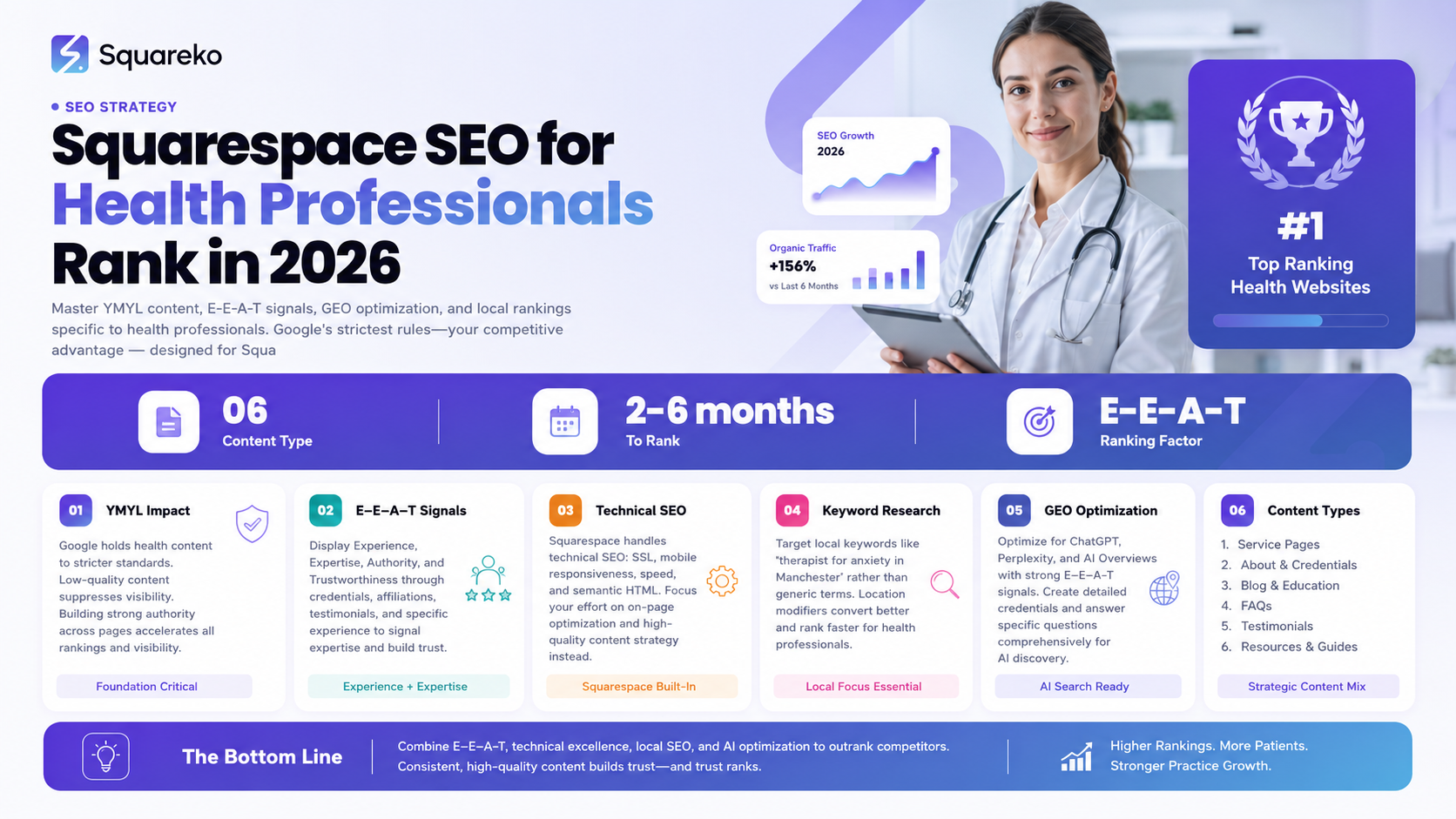
YMYL stands for Your Money, Your Life—Google's classification for content that could impact a person's health, finances, safety, or wellbeing. Health content is among the most heavily regulated content types in Google's algorithm.
Here's what this means practically: A blog post about fitness training written by an unverified trainer ranks lower than the same content written by a certified personal trainer with professional credentials. A nutritionist with Registered Dietitian (RD) or Registered Nutritionist (RNutr) credentials ranks higher than someone with a generic "nutrition certification."
Why does Google do this?
Health misinformation harms people. Google's job is to prioritize accurate health information from qualified sources. This creates a barrier to entry but also an opportunity: if you meet E-E-A-T standards, you're competing against fewer websites and ranking becomes more achievable.
What are the implications for your website?
Your site's reputation matters more than your individual pages' optimization. A single piece of low-quality or misleading health content can suppress your entire site's visibility. Conversely, building strong authority across your site accelerates all pages' rankings.
This is why credibility signals—professional affiliations, certifications, testimonials—appear so prominently in health SEO. They're not decoration. They're ranking factors.
E-E-A-T: Building Your Expertise Signals
Google's algorithm prioritizes four factors when evaluating health professionals:
Experience — How long have you practiced? What real-world experience do you have?
Signal this by:
Including your years in practice in your About page ("8 years in private practice")
Mentioning numbers: "Worked with over 500 clients" or "Conducted 1,000+ training sessions"
Publishing case studies or client results
Growing your author profile with published work
Expertise — What specific training and qualifications do you hold?
Signal this by:
Displaying professional certifications clearly (BACP, COSCA, BDA, ANutr, RNutr, REPs, CIMSPA, ICF, Yoga Alliance)
Including registration numbers and verification links (e.g., "BACP Accredited, #AB12345")
Listing degrees and specialized training ("Master's in Clinical Social Work from University of Manchester, 2015")
Creating author profiles in Squarespace with credentials listed
Publishing in professional publications
Authoritativeness — Are you recognized as an authority in your field?
Signal this by:
Earning backlinks from reputable health organizations (NHS wellness articles, professional body directories, health media)
Publishing content in professional journals or respected health publications
Appearing in health media or as a quoted expert
Being listed in professional directories (Psychology Today, Therapy Directory, LinkedIn for therapists)
Generating client reviews on Google Business Profile (high-star reviews signal authority)
Trustworthiness — Are you honest, transparent, and reliable?
Signal this by:
Clear disclosures ("I'm not a doctor; consult your GP for medical advice")
Transparent pricing and cancellation policies
Genuine client testimonials with names and identifying details
SSL certificate (Squarespace includes this)
Clear privacy policy and GDPR compliance
Author bio that includes real information (not generic)
Squarespace Technical SEO Fundamentals
Squarespace handles most technical SEO automatically. You don't need custom coding or plugins.
What Squarespace does for you:
SSL certificate — All sites are HTTPS (secure), standard since 2015 but still a ranking factor
Mobile responsiveness — All templates are mobile-first, tested across devices
Site speed optimization — Squarespace serves images through a CDN (Content Delivery Network), compresses files automatically
Semantic HTML — Proper heading hierarchy (H1, H2, H3), structured content, correct semantic tags
XML sitemaps — Automatically generated and updated when you publish/update pages
Robot.txt — Automatically configured to allow search engine crawling
Structured data basics — Squarespace includes basic schema markup for Organization, Local Business (if you set it up)
Where you need to focus:
Page titles and meta descriptions — Set these explicitly in Squarespace's SEO settings for each page
Header hierarchy — Structure your content with proper H1 (one per page), H2, H3 tags in logical order
Image alt text — Every image must have descriptive alt text for accessibility and SEO
Internal linking — Link related pages together using descriptive anchor text
Content quality — Write for humans first, search engines second
On-Page SEO Strategy for Health Professionals
On-page SEO is the optimization you control directly on your pages. Here's the checklist:
SEO Title Tag (50-60 characters)
Include your primary keyword, your name or practice name, and a benefit or descriptor.
Examples:
"Sarah Thompson, Therapist | Anxiety & Life Transitions in Manchester"
"Registered Nutritionist | Weight Management & Food Anxiety"
"Personal Trainer | Strength Training for Women Over 50"
Meta Description (150-160 characters)
A compelling summary that includes your keyword, credentials, and a benefit. This appears in Google search results.
Example: "Experienced trauma therapist in London specializing in anxiety recovery. BACP accredited. Book your free consultation today—help is available."
H1 Tag (One per page)
Your page's main heading. Include your primary keyword naturally.
Good: "Anxiety Therapy in Manchester: Evidence-Based Treatment from an Accredited Therapist"
Poor: "Services" or "Welcome"
Body Content
Include your primary keyword in the first 100 words, then naturally throughout the page. Use 2-3 times per 500 words, but only if it reads naturally. Keyword stuffing harms rankings.
Keyword Variations
Use semantic variations of your keyword throughout the page. If your keyword is "therapy for anxiety," also use "anxiety treatment," "anxiety counseling," "anxiety management," "anxiety recovery."
Image Alt Text
Every image must have descriptive alt text (not just a filename). This helps Google understand your content and serves accessibility.
Poor: "IMG_4521.jpg"
Good: "Sarah Thompson, therapist in Manchester, specializing in anxiety and trauma recovery"
Internal Links
Link related pages using descriptive anchor text (the clickable text).
Good: "Learn more about anxiety therapy techniques"
Poor: "Click here"
Content Length
For health professionals, aim for 1,200-2,000+ words for main service pages and blog content. Longer, authoritative content ranks better for competitive keywords.
Keyword Research for Health and Wellness Services
Health keyword research differs from other industries. You need keywords that:
Are specific to your service — "Therapist in Manchester" beats "therapy" (too competitive)
Have commercial intent — "Therapist near me" (person ready to book) beats "what is therapy" (informational only)
Match your service model — "Online therapy for anxiety" if you offer remote sessions
Include your location — Local keywords convert better and rank faster for health professionals
Keyword research process:
List your services — Therapy, nutrition consultation, personal training, yoga classes, wellness coaching
Add your location(s) — Your city or region
Add the person seeking you — "therapist," "nutritionist," "personal trainer," etc.
Combine for primary keywords:
"Anxiety therapist in Manchester"
"Registered nutritionist for weight loss"
"Personal trainer for women over 50"
"Yoga instructor near me"
Find secondary keywords — Use Google search suggestions
Type your keyword into Google, scroll to "People also ask" and "Searches related to..." sections
Note questions and variations that appear repeatedly
These become supporting content topics
Use tools (optional but helpful):
Google Keyword Planner (free, requires Google Ads account)
Ahrefs (paid, includes search volume and difficulty)
SEMrush (paid, includes health-specific insights)
Answer the Public (free, visualizes questions people ask)
Why location matters for health professionals:
68% of health-related searches include a location. People searching "therapist" want a therapist they can actually visit or meet online. Including your city in titles, headings, and content dramatically improves ranking and conversion.
Internal Linking Strategy for Authority
Internal links connect your pages together. They serve two purposes:
Help Google understand your site structure — Links show Google which topics are important and how pages relate
Distribute ranking authority — Links pass "link juice" from high-authority pages to other pages
Internal linking best practices:
Link from high-performing pages to new pages — If your About page gets traffic, link from it to your services page
Use descriptive anchor text — "Learn more about anxiety therapy" instead of "Click here"
Link from blog posts to service pages — A blog post on anxiety techniques could link to your "Anxiety Therapy" service page
Create topic clusters — Group related content (anxiety therapy, anxiety causes, anxiety management techniques) and link them together
Limit links per page — 3-5 relevant internal links per page maximum. More than that dilutes link value
Example structure for a therapist:
Blog post: "5 Anxiety Management Techniques" → links to → Service page: "Anxiety Therapy"
Service page: "Anxiety Therapy" → links to → FAQ: "What should I expect in my first session?"
FAQ page → links to → Booking page: "Schedule Your Consultation"
Content Strategy: Ranking with Authority
Health professionals often ask: "Should I write a blog?" The answer is yes, but only if you're writing strategic, authoritative content.
Blog purposes for health professionals:
Rank for long-tail keywords — "Anxiety management techniques" (blog post) ranks differently than "anxiety therapy" (service page)
Build authority — Publishing regular, high-quality content signals expertise to Google and humans
Address common questions — FAQs on your site serve immediate questions; blog posts answer deeper questions and build trust
Internal linking opportunities — Blog posts link to service pages, distributing authority
Blog content strategy for health professionals:
Write 4-8 blog posts annually on topics your clients ask about. Not trendy wellness tips, but actual professional expertise.
Examples:
"5 Evidence-Based Strategies for Managing Anxiety" (links to therapy service page)
"What Is Cognitive Behavioral Therapy? A Therapist Explains" (educational, builds authority)
"How to Find a Therapist: Questions to Ask Before Your First Session" (helps potential clients, builds trust)
"Nutrition Myths: What the Research Actually Shows" (counters misinformation, positions you as expert)
Each post should:
Be 1,500+ words
Address a real question your clients ask
Include statistics or research citations
Link to your service pages
Be published consistently (one per month is ideal)
Guest posting and external links:
Publish in external health publications, professional journals, or wellness media. External links from reputable sources boost your authority significantly. Aim for 5-10 quality backlinks per year.
Examples:
Guest post on Psychology Today's therapist blog
Publication in professional journal for your field
Quote or expert feature in health media
Listing in professional directories
GEO and AI Search Optimization in 2026
Generative Engine Optimization (GEO) is the practice of optimizing your content to appear in AI search results. In 2026, this matters as much as traditional SEO.
Where your health website might appear (non-Google):
ChatGPT — When someone asks "Find me a therapist for anxiety in Manchester"
Perplexity — When someone asks "What are the best approaches to treating anxiety?"
Google AI Overviews — Google's answer summaries in search results
Microsoft Copilot — Bing's AI search product
Specialized AI health tools — Apps specifically designed for finding health professionals
How to optimize for AI recommendations:
Create author profiles — Use Squarespace author features to create detailed profiles including credentials, specialties, photo
Structure your expertise clearly — Use schema markup to tell AI what your qualifications are
Publish original research or insights — AI systems prefer citing original sources; proprietary content ranks higher
Get listed in professional directories — Therapy Directory, Psychology Today (for therapists), LinkedIn, professional body registries
Build strong E-E-A-T signals — Same signals Google uses, AI systems also use
Answer specific questions comprehensively — FAQ pages and blog posts structured around questions rank in AI results
Special consideration: AI summary disclaimers
As AI tools grow, you may see your content quoted or summarized without attribution. Include clear disclaimers: "I'm not a doctor. Always consult your GP for medical concerns." This protects clients legally and signals you understand health responsibility.
Local SEO Fundamentals
Local SEO is critical for health professionals. Most clients prefer a practitioner they can physically visit or who is geographically local.
Google Business Profile setup:
Create or claim your Google Business Profile (if not already set up)
Verify your business address
Add complete information: hours, phone, website, services offered
Upload high-quality photos of your practice/workspace
Encourage reviews (more on this below)
Add posts (promotional content that appears in your Business Profile)
Add Q&A (answer common questions in your Business Profile)
NAP consistency:
NAP stands for Name, Address, Phone. Consistency matters for local rankings.
Your practice name, address, and phone must be identical across:
Your website (Squarespace)
Google Business Profile
Other directories (Therapy Directory, Psychology Today, NHS registries if applicable)
Local business listings
Social media
Inconsistency confuses Google and harms rankings.
Google reviews:
Reviews are a major ranking factor for local health searches.
Ethical ways to encourage reviews:
Ask satisfied clients in person or via email
Provide a direct link to your review page (found in your Google Business Profile)
Follow up after service delivery: "If we helped, we'd appreciate a review"
Make review requests easy (QR code in your practice, email signature)
Respond to all reviews (positive and negative) professionally
Target 10+ reviews to start ranking competitively in local search.
Location pages (if you serve multiple areas):
If you serve multiple cities or regions, create location-specific pages:
"Therapy in Manchester" / "Therapy in Birmingham" / "Therapy in Leeds"
Each page includes location-specific content, local keywords, and links to your main services page.
Schema Markup Implementation
Schema markup tells search engines what your content is about. For health professionals, specific schema types improve visibility.
Essential schema types for health professionals:
Local Business or Medical Organization — Tells Google your business type and location
FAQPage — Structures your FAQ section for AI search visibility
Article — For blog posts, helps Google understand content type
Person (for your author/professional profile) — Tells Google about your credentials
How to implement in Squarespace:
Squarespace doesn't have a dedicated schema plugin, but you can add custom schema via code injection.
Go to Site Settings > Advanced > Code Injection and paste your schema code into the Header section.
<!-- Please remove the commented script wrapper and add this schema inside a proper <script type="application/ld+json"> tag. -->
Example LocalBusiness schema for a therapist:
  {
  "@context": "https://schema.org",
  "@type": "MedicalOrganization",
  "name": "Sarah Thompson, Therapist",
  "url": "https://yoursite.com",
  "address": {
    "@type": "PostalAddress",
    "streetAddress": "123 High Street",
    "addressLocality": "Manchester",
    "addressRegion": "Greater Manchester",
    "postalCode": "M1 1AA",
    "addressCountry": "GB"
  },
  "telephone": "+44 161 123 4567",
  "qualifications": [
    {
      "@type": "EducationalOccupationalCredential",
      "name": "BACP Accreditation",
      "credentialCategory": "Professional Certification",
      "url": "https://www.bacp.org.uk"
    }
  ],
  "knowsAbout": ["Anxiety", "Life Transitions", "Relationship Counseling"]
}
This tells Google exactly what type of health professional you are, where you're located, and your specialties.
Frequently Asked Questions
-
Health keywords typically take 2-6 months to start ranking, 6-12 months to reach the first page. It's slower than non-YMYL content due to stricter Google requirements. Building strong E-E-A-T signals accelerates this timeline. Consistency matters more than speed—publish quality content regularly.
-
It's significantly harder but not impossible. Google prioritizes credentialed professionals, but consistent, high-quality content from experienced practitioners can eventually rank. The trade-off: you need more content volume and external authority (backlinks, mentions, directory listings) to compete against credentialed competitors.
-
Include disclaimers where relevant, especially on health advice pages or blog posts. Common disclaimer: "I'm not a doctor. Always consult your GP for medical concerns." Clear, honest disclaimers build trust with both Google and humans. Make disclaimers visible but not intrusive (small text at the bottom is standard).
-
Local SEO focuses on ranking for location-based keywords ("Therapist in Manchester") and appearing in Google Maps. Traditional SEO focuses on broader keywords. For health professionals, local SEO is typically more important because clients search locally. Optimize for both, but prioritize local if you have limited resources.
-
Monthly blog posts (12 per year) provide good ranking velocity. Quarterly (4 per year) is minimum. More frequent publishing (weekly) accelerates authority building but requires consistent quality. Consistency matters more than frequency—one good post per month beats three mediocre posts per week.
-
No. Navigation should be clear and user-friendly, not keyword-optimized. "Services," "About," "Contact" are fine. Keywords should appear naturally in your main content (page titles, headings, body content), not forced into navigation.
-
Very important. Sites loading in under 3 seconds see 40% higher engagement than slower sites. Squarespace optimizes speed automatically, but you can improve it further: compress images, avoid auto-playing videos, minimize plugins. Test your site speed using Google PageSpeed Insights.
-
Yes. Many agencies specialize in health professional SEO. Expect to pay $500-2,000+ per month for strategic SEO services. If hiring, choose someone experienced with YMYL content and health professionals specifically. They should understand E-E-A-T requirements and local SEO deeply.

From custom website design to SEO strategy, we help businesses launch a site that looks professional and performs better.

About the Author
Walid Hassan is the founder of Squareko
I'm Walid Hasan, a Certified Squarespace Expert and Squarespace Circle Platinum Partner with over 12 years of hands-on experience designing and optimizing high-performing websites. Over the years, I've had the privilege of building more than 2,000 Squarespace websites for clients around the world, always focusing on clean design, strong user experience, and conversion-driven results.