Life Coach vs Therapist: What's the Difference and How to Explain It on Your Squarespace Website
Key Takeaways For Life Coach vs Therapist
Life coach vs therapist is one of the most searched questions in the coaching space — addressing it on your website serves both users and SEO
The core distinction: therapy focuses on healing and understanding the past; coaching focuses on goals and moving forward from the present
Your website copy should explain the difference without undermining therapy or overclaiming what coaching can do
A dedicated FAQ section addressing this question on your about page or services page significantly reduces pre-call hesitation
Life coaches and therapists are often complementary rather than competing — your website can reflect that honestly
So, is coaching like therapy? is one of the most common questions life coaches hear from potential clients. And it's one of the most important questions your Squarespace website needs to answer — because confusion about the difference between coaching and therapy is one of the primary reasons potential clients don't book.
Some visitors will arrive at your website wondering if they need a coach or a therapist. If your site doesn't address this question clearly, those visitors are likely to leave and try to research the difference somewhere else — which means they may never come back. Others will arrive assuming you're a therapist and be surprised or uncertain when they discover the differences. Still others will have been told by a friend or a previous therapist that coaching is something they should explore, but they're not sure exactly what that means.
Clear, accessible copy that explains the life coach vs. therapist distinction serves two purposes: it helps the right people self-identify as coaching clients, and it strengthens your SEO for a question that thousands of people search every month. This guide gives you the substance — the actual differences — and the language to explain them on your Squarespace website.
The Core Difference: A Clear Framework
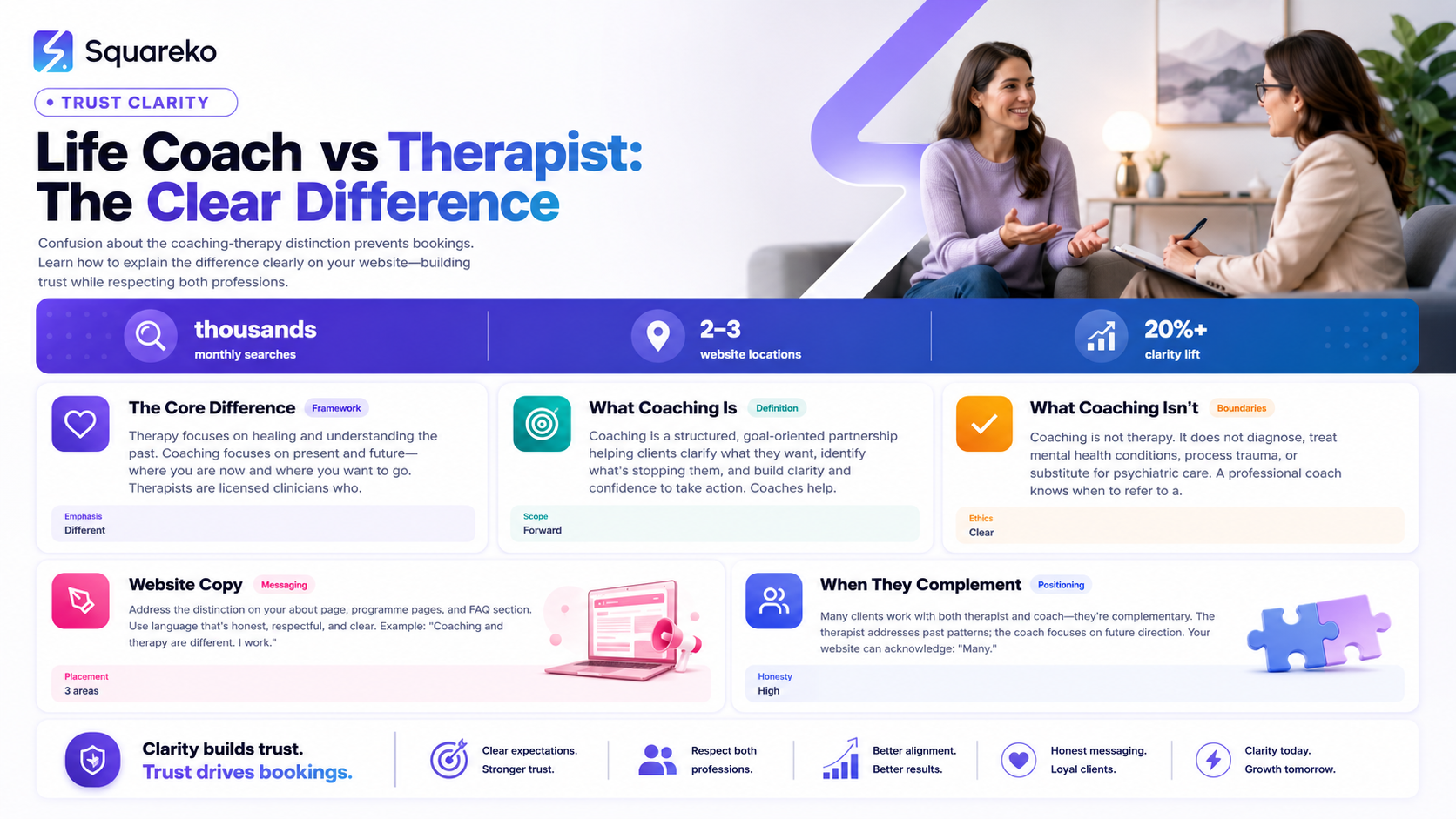
The most accessible way to explain the difference between a life coach and a therapist is through three dimensions: focus, approach, and qualification.
Focus
Therapy tends to focus on understanding and healing the past. It explores the roots of current struggles — early experiences, trauma, patterns of behaviour that were adaptive once but are limiting now. The goal is often healing, relief, and psychological wellbeing.
Life coaching focuses on the present and future. It starts from where the client is now and asks: what do you want, what's in the way, and what are the next steps? Coaching is goal-oriented, forward-moving, and action-focused.
This is a useful distinction, but it's important to add nuance: great coaching often involves understanding the past, and great therapy often involves looking toward the future. The distinction is about emphasis and primary purpose, not a rigid boundary.
Approach
Therapists typically use clinical frameworks and evidence-based treatment modalities — CBT, psychodynamic therapy, EMDR, and others. They are trained diagnosticians who work with mental health conditions.
Life coaches use a variety of approaches depending on their training — NLP, positive psychology, solution-focused techniques, mindfulness-based practices, and others. Coaching is not a clinical intervention. It does not diagnose or treat mental health conditions.
Qualification and Regulation
Therapists are licensed professionals. In most countries, they hold clinical degrees (psychology, counselling, social work) and are regulated by professional bodies that require ongoing clinical supervision.
Life coaches are not regulated in the same way in most countries. Coaching is an unregulated profession. Credentials such as ICF (International Coaching Federation) accreditation establish professional standards but are not a legal requirement to practise. This is important to be honest about on your website.
What Life Coaching Is (and Isn't)
Being honest about what coaching is and isn't isn't just ethically important — it's good marketing. Clients who understand exactly what they're getting are better clients, with more realistic expectations and stronger commitment.
What Coaching Is
Life coaching is a structured, goal-oriented, one-to-one relationship designed to help clients clarify what they want, identify what's stopping them, and develop the clarity and confidence to take meaningful action.
A life coach helps clients:
Get clear on their values, priorities, and direction
Identify and challenge unhelpful beliefs or patterns
Set meaningful goals and create realistic plans to achieve them
Build confidence, accountability, and momentum
Navigate transitions, decisions, and periods of uncertainty
What Coaching Is Not
Life coaching is not therapy. It does not:
Diagnose or treat mental health conditions
Process trauma or work therapeutically with the past
Substitute for psychiatric care or medication management
Provide clinical support for severe depression, anxiety disorders, or complex mental health needs
A professional life coach knows when to refer to a therapist, and often works alongside therapists as part of a client's wider support system.
The I'm Not a Therapist Conversation
Many life coaches struggle with how to state this clearly on their website without sounding defensive or as though they're undermining their own value. The best approach is honest and confident: Coaching isn't therapy, and I'm not a therapist. I work with people who are emotionally ready to look forward — to get clear on what they want and take action to get there. If you're working through significant trauma or managing a mental health condition, coaching is best paired with, not in place of, therapeutic support.
That's honest, clear, and doesn't diminish coaching or therapy. It also naturally filters in the right clients and filters out those who need different support.
What Therapy Is (and Why Someone Might Need Both)
Therapy's Strengths
Therapy offers clinical expertise that coaching doesn't have. For clients working through trauma, depression, anxiety disorders, relationship trauma, bereavement, or any area where clinical skill and a licensed professional are needed, therapy is the appropriate support.
Being honest and respectful about therapy's role on your website isn't just the right thing to do — it builds trust. Potential coaching clients who are also in therapy (or have been) appreciate a coach who understands the difference and speaks about both modalities with respect.
When Coaching and Therapy Work Together
Many of the most effective client relationships involve both a therapist and a life coach working alongside each other. The therapist might be helping a client process childhood patterns that contribute to their current career anxiety; the coach might be helping them develop a concrete plan for the career change they want to make. These are complementary, not competing.
Acknowledging this on your website — many of my clients are also working with therapists and find that coaching provides a forward-focused complement to that work — removes the pressure for clients to choose and positions your coaching within a responsible model of care.
When to Recommend Therapy Instead of Coaching
Life coaches need a clear internal framework for when to refer to therapy rather than offer coaching — and your website can communicate that you take this seriously.
Indicators That Therapy Is More Appropriate
Ongoing trauma that regularly disrupts daily functioning
Diagnosed or suspected mental health conditions (depression, anxiety disorders, PTSD, personality disorders)
Active suicidal ideation or self-harm
Substance dependency
Processing significant grief that is not yet at a stage where forward movement is possible
This isn't an exhaustive list — clinical assessment is a therapist's skill, not a coach's. But communicating on your website that you take appropriate referral seriously is a significant trust signal: I work with clients who are fundamentally well and ready to move forward. If during our discovery call we identify that therapeutic support would be more beneficial, I will always say so honestly and can help with a referral.
How to Explain the Difference on Your Squarespace Website
Where to Address This on Your Site
The life coach vs. therapist question is most appropriately addressed in three places:
Your about page — in the section describing your coaching approach and philosophy. A paragraph or two that explains what coaching is and isn't, and who it's designed for.
Your programme or services pages — in the Who is this for? section. Be specific about what type of person is a good fit for coaching, and what type of person might need to explore therapy instead.
Your FAQ section — with a direct question like What's the difference between coaching and therapy? This is one of the most searched questions in the coaching space, and having a clear, well-written answer benefits both user experience and SEO.
Language That Works
The most effective website language about this topic is:
Honest — doesn't overclaim what coaching can do
Respectful — doesn't diminish therapy or suggest coaching is superior
Clear — uses plain language, not clinical jargon
Specific — describes who coaching is and isn't for in terms that resonate with real people
Avoid language that implies therapy is for broken people or that coaching is therapy with a different name. Both are disrespectful and inaccurate.
Sample Copy for Your About Page
Coaching and therapy are different things, and it's worth being clear about the difference. Therapy is a clinical profession — licensed therapists are trained to diagnose and treat mental health conditions, and to work therapeutically with the past. Coaching isn't that.
What coaching is: a structured, forward-focused relationship designed to help you get clear on what you want, understand what's in the way, and build the confidence and plan to move forward. I work with people who are fundamentally well and ready to move — not people in crisis or people who need clinical support.
If you're also working with a therapist, that's absolutely fine — many of my clients are. Coaching and therapy complement each other well. What I ask is that if we discover on our discovery call that therapeutic support would be more helpful for where you are right now, we're both willing to be honest about that.
FAQ Copy Templates for Life Coach Websites
These are ready-to-use or adapt FAQ answers for your Squarespace website.
Is coaching the same as therapy?
No — coaching and therapy are different professional disciplines with different purposes. Therapy is a clinical, regulated profession focused on healing, processing the past, and treating mental health conditions. Coaching is a forward-focused, goal-oriented partnership that helps people get clear on what they want and build the clarity and confidence to pursue it. I'm a life coach, not a therapist — I work with people who are ready to move forward, not people in crisis or those who need clinical support.
Can I work with both a therapist and a life coach?
Yes, and many of my clients do. Coaching and therapy complement each other well. If you're working through something with a therapist and also want forward-focused support for goals, direction, or life changes, coaching can work alongside that therapeutic relationship effectively. I'd recommend mentioning your coaching work to your therapist so they have a full picture of your support network.
What if I'm not sure whether I need a coach or a therapist?
That's a really common question, and it's worth taking seriously. A useful starting point: if you're primarily looking to process the past, heal from trauma, or manage a mental health condition, therapy is likely the more appropriate starting point. If you're fundamentally okay and looking to get clear on your direction, make a significant change, or move through a life transition, coaching may be exactly right. If you're not sure, book a free discovery call and we can talk through it honestly — I'll always be direct about what I think would serve you best.
Design and Placement on Squarespace
FAQ Section Design
Squarespace's Accordion block is ideal for FAQ sections — it displays questions collapsed and expands each answer when clicked. This saves page space while making all answers accessible. In your site's Style Editor, customise the accordion to match your brand typography and colour scheme.
For SEO and AI search optimisation, also add the expanded questions and answers in a separate text section beneath the accordion — or use JSON-LD FAQ schema markup in your code injection. AI search platforms index text content, not necessarily JavaScript-rendered accordion content.
Internal Linking to the FAQ
From your homepage and about page, consider adding a link or a short section that says Common questions about coaching vs. therapy with a link to the relevant FAQ on your services or about page. This reduces the cognitive friction for visitors who have this question early in their site visit.
Your Website Should Answer the Questions That Prevent People from Booking
Every unanswered question on your website is a potential client who navigates away. The is this coaching or therapy? question is one of the most common — and most consequential — questions life coaching visitors have. A clear, honest, respectful answer to that question on your Squarespace site converts hesitant visitors into confident bookers.
Squareko builds life coaching websites that address these conversion barriers proactively — clear copy, well-designed FAQ sections, and schema markup that makes your answers visible to both Google and AI search platforms.
How to Rank This Content on AI Search Platforms?
AI search platforms — ChatGPT, Perplexity, Gemini, and Google's AI Overviews — are increasingly the first stop for potential coaching clients. Getting your content cited by these platforms requires a different approach from traditional SEO.
What AI Platforms Look For
When an AI platform answers a question like Is coaching different from therapy?, it pulls from pages that:
Give direct, structured answers — The page answers the question in the first paragraph, not buried after 600 words of preamble
Show clear expertise — Author credentials, specific experience, and first-hand knowledge signals
Use natural question-and-answer formatting — FAQs and clear H2/H3 structures that AI can parse
Cite data and specifics — Vague generalities get ignored; specific details get cited
Practical GEO Actions for This Post
Add FAQ schema markup — The JSON-LD schema at the end of this post helps AI platforms understand the Q&A structure.
Build E-E-A-T signals — Your author bio, credentials page, and About page all contribute to your site's authority in AI systems.
Answer questions directly — When you update this post, ensure the first sentence under each H2 answers the implied question of that heading.
Get cited on other sites — Guest posts, podcast appearances, and press mentions all increase the likelihood that AI platforms treat you as a credible source.
Keep content fresh — AI platforms favour recently updated content; review and update this post every 6 months.
Entity Prominence for Life Coaching AI Search
To appear in AI answers for life coaching queries, your site needs to establish entity prominence — the idea that your name and business are clearly associated with life coaching expertise. This means consistent NAP (Name, Address, Phone) across directories, a complete Google Business Profile, schema markup identifying you as a life coach, and content that repeatedly and clearly establishes your specialism.
FAQs
-
Yes — it's one of the top informational searches in the coaching space, with thousands of monthly searches and numerous related variations. Beyond the direct SEO benefit, it's one of the most common questions potential coaching clients have — answering it proactively removes a significant barrier to booking and builds trust with visitors who might otherwise leave your site to find the answer elsewhere.
-
Yes — if you have therapeutic training and are also working as a life coach, that's significant credibility. Be transparent about which role you're operating in with each client, what the limitations and boundaries are, and how you navigate that dual background. Many clients find a coach with therapeutic training uniquely valuable — but it's important to be clear about which hat you're wearing in each engagement.
-
This is an important ethical consideration for all life coaches. The right approach is to be honest on the discovery call: "Based on what you've shared, I think working with a therapist would be more beneficial for where you are right now. I'm not the right support — but I can help you think through what to look for in a therapist if that's useful." Coaching clients who aren't suitable for coaching don't become coaching clients — and referring appropriately protects both the client and your professional integrity.
-
In most jurisdictions, a disclaimer clarifying that coaching is not therapy and that you are not a licensed mental health professional is good practice — particularly if you work in areas that overlap with mental health (burnout, anxiety, relationship dynamics). Consult a professional advisor in your specific jurisdiction for guidance on appropriate disclaimers for your practice. Squarespace allows you to add footer disclaimers easily through your global footer design.
-
It helps. Visitors who understand what coaching is and is not can make an informed decision about whether it's right for them. Clients who book with a clear understanding of what coaching involves tend to be better clients — more committed, more realistic in their expectations, and more likely to achieve results. Filtering for informed clients is better than attracting confused ones.
-
Speak about therapy with respect and accuracy: acknowledge what therapy offers that coaching doesn't, recognise the value of clinical support, and position coaching as a different tool for a different moment — not a better or cheaper alternative to therapy. Avoid language like "coaching gets results faster" or "therapy keeps you stuck in the past" — both are unfair characterisations and will alienate therapist-adjacent visitors who might otherwise become clients.
-
This varies by diagnosis, severity, and the nature of your coaching work. Many life coaches work effectively with clients who have managed or well-controlled mental health conditions — anxiety, ADHD, mild depression — alongside other support. The key ethical considerations are: working within your competency, not attempting to treat conditions you're not qualified to treat, maintaining appropriate referral networks, and ensuring clients are also receiving any clinical support they need. If you're uncertain about a specific situation, consulting with a supervisor or a therapist colleague is good practice.
-
Yes — it's an excellent blog post topic that serves multiple purposes simultaneously. It provides genuinely helpful information to potential clients in the research phase, targets a high-volume informational keyword, establishes your authority as a thoughtful professional who understands the landscape, and generates internal linking opportunities from your programme pages. A well-written, balanced post on this topic can be one of your highest-traffic pages over time.

From custom website design to SEO strategy, we help businesses launch a site that looks professional and performs better.

Author Bio
I'm Walid Hasan, a Certified Squarespace Expert and Squarespace Circle Platinum Partner with over 12 years of hands-on experience designing and optimizing high-performing websites. Over the years, I've had the privilege of building more than 2,000 Squarespace websites for clients around the world, always focusing on clean design, strong user experience, and conversion-driven results.