How to Niche Down as a Life Coach and Attract Ideal Clients on Squarespace
Key Takeaways For How to Niche Down as a Life Coach and Attract Ideal Clients on Squarespace
Niching down doesn't shrink your market — it makes your message resonate with the right market, which increases conversion
Your niche is the intersection of who you help best, what problem you solve, and what makes your approach distinctive
Every element of your Squarespace website — headline, about page, service pages, blog content — should reflect your niche consistently
A specific niche dramatically improves your SEO: niche keywords have lower competition and higher conversion intent than broad terms
Life coaches who niche command higher rates because they're seen as specialists, not generalists
I help people live their best life is one of the most common life coach positioning statements — and one of the least effective. It tells a potential client nothing specific about who you work with, what problem you solve, or why you're the right person for them. It's the website equivalent of saying I'm a doctor without specifying whether you're a cardiologist, a dermatologist, or a paediatric surgeon.
Niching down as a life coach is one of the most important business decisions you'll make — and it's also one of the most counterintuitive. The fear is that being specific will shrink your potential client pool. The reality, consistently experienced by coaches who make the shift, is the opposite: specificity attracts more clients, not fewer, because specific messaging creates the resonance that converts browsers into bookers.
Your Squarespace website is the vehicle for that specific message. This guide walks you through how to find your coaching niche, translate it into messaging that works, and implement that positioning across your Squarespace site so the right clients find you and immediately know they're in the right place.
Why Generic Life Coaching Positioning Costs You Clients
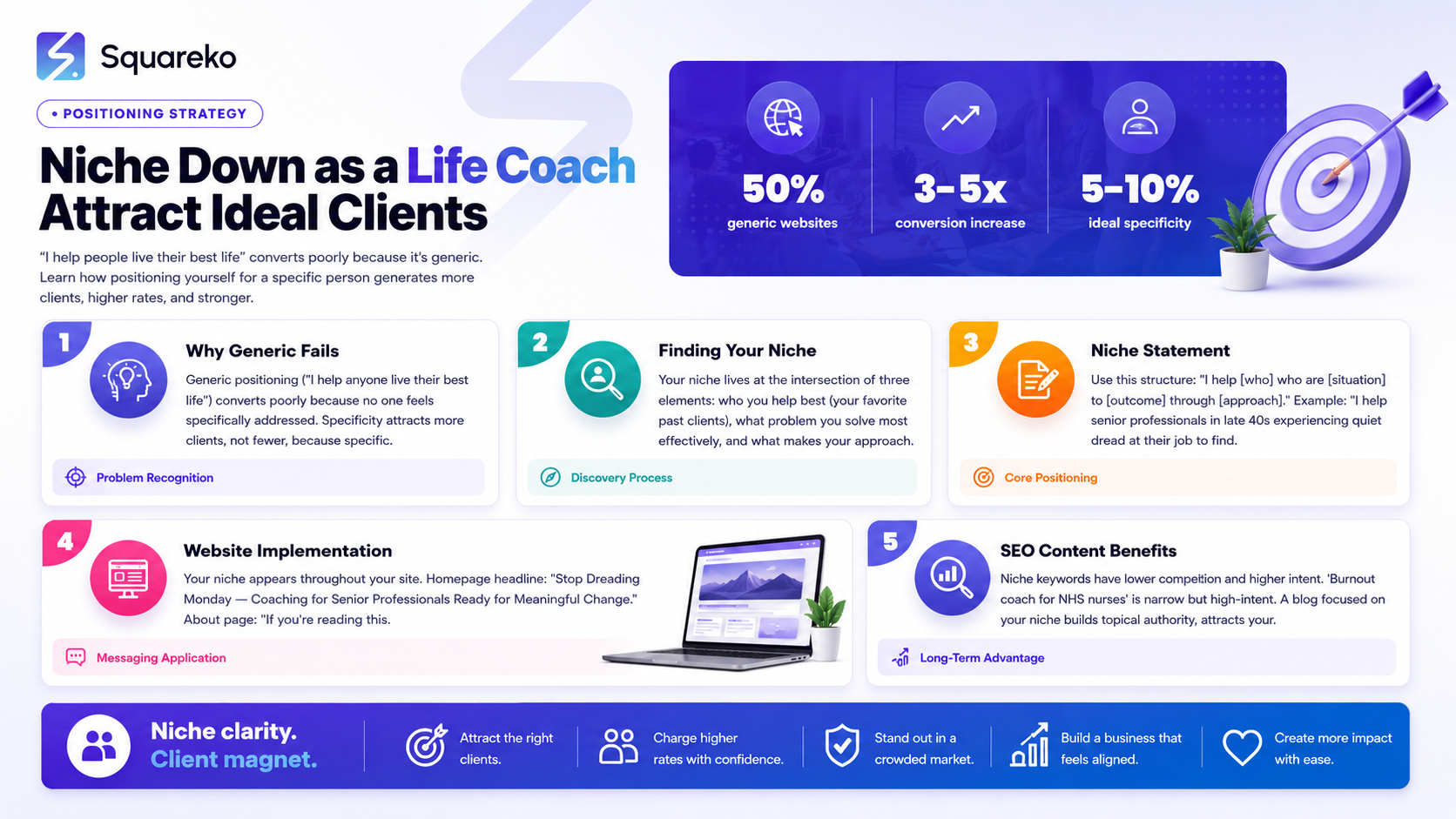
The Problem With I Help Everyone
When a potential client arrives at a life coaching website with generic positioning, their experience is something like: This could be for me. Or it could be for anyone. That vagueness doesn't create the resonance required for a trust-based buying decision.
Compare that to arriving at a website that says: Coaching for professionals in their 40s who've achieved everything they thought they wanted — and still feel unfulfilled. If that's you, the experience is entirely different. You think this is for me within five seconds. You stay. You read. You book.
The conversion difference between generic and specific positioning is significant — often dramatic. And yet most life coaches default to generic positioning because specificity feels risky.
The Fear of Niching
The fear is understandable: If I specialise in burnout recovery, I'll miss out on all the clients who want career coaching. If I focus on women, I'll lose the men who could also benefit from my work. If I target professionals in their 40s, what about the 30-somethings who need coaching?
This fear is based on a false assumption: that your potential clients are interchangeable and you'll get them all with a generic message. In practice, generic messaging converts so poorly that specialising in a narrower audience — and resonating deeply with that audience — produces significantly more clients than vague positioning aimed at everyone.
The SEO Reality
Broad life coaching keywords (life coach, life coaching services) are intensely competitive. Ranking for them as a solo coach or small practice is extraordinarily difficult. Niche keywords (life coach for burnout recovery, coaching for women in midlife transition, executive life coach for mid-career women) have lower competition, higher intent, and attract exactly the right visitors. Your Squarespace site can rank for specific niche keywords far more effectively than for broad ones.
Finding Your Life Coaching Niche: A Practical Framework
Your coaching niche lives at the intersection of three elements: who you help best, what problem you solve most effectively, and what makes your approach distinctive.
Who Do You Help Best?
Think about your best past clients — the ones you enjoyed working with most, achieved the best results with, and who sent referrals. What do they have in common? Are they at a particular life stage? In a specific profession or industry? Going through a specific type of transition?
Common life coach niches defined by who:
Women in their 40s and 50s navigating midlife transition
Senior professionals experiencing career burnout
Recently divorced individuals rebuilding their identity
New mothers navigating the identity shift of parenthood
Entrepreneurs losing passion for their business
People in high-pressure professions (doctors, lawyers, teachers) experiencing exhaustion
What Problem Do You Solve?
The problem is the emotional, practical, or situational challenge your clients come to you with. This is distinct from your methodology — it's their experience, not your process.
Common life coaching problems:
Feeling stuck and directionless despite external success
Recovering from burnout and rebuilding sustainable energy
Navigating a major life transition (divorce, career change, loss)
Lack of confidence in personal or professional identity
Finding purpose after achieving previous goals
Setting and maintaining boundaries in relationships or work
What Makes Your Approach Distinctive?
Your methodology, philosophy, lived experience, or professional background can further differentiate your coaching within a niche. A burnout recovery coach who is also a former NHS consultant brings a different credibility than a burnout coach with no clinical background. A relationship coach who has also been through divorce brings a different experiential authority than one who hasn't.
Distinctive doesn't have to mean revolutionary — it means genuinely yours.
Translating Your Niche Into Website Messaging
Once you've defined your niche, you need to express it through your website in language that resonates with that specific person.
The Niche Statement Formula
A useful structure for your core positioning statement:
I help [who] who are [situation/problem] to [outcome] through [your approach].
Example: I help senior professionals in their late 40s who are experiencing the quiet dread of another Monday at a job they've outgrown, to find the direction, confidence, and plan they need to make a meaningful change — through one-to-one coaching that combines strategic career thinking with the personal work that supports it.
That's specific. That's resonant. That's a message that will make the right person stop and read on.
Applying the Statement to Your Website
Your niche statement doesn't appear word-for-word on your homepage — it's the foundation that informs your headline, your about page opening, your programme descriptions, and your blog content.
Your homepage headline might be: Stop Dreading Monday: Life Coaching for Senior Professionals Ready for a Meaningful Change.
Your about page opening might be: If you're reading this, you've probably spent the last few months — or years — wondering if this is really it. You're successful, you're capable, and you're exhausted in a way that a holiday doesn't fix.
Both of these speak directly to the person defined in your niche statement. Neither is generic.
Niche-Specific Copy for Your Homepage and About Page
Homepage Hero Section
Your homepage hero should communicate your niche in the headline — who you help and what changes for them. Not your job title. Not your credentials. The client's experience and the transformation available.
Generic: Life Coach | Helping You Live Your Best Life
Niche-specific: Coaching for Women Who've Outgrown the Life They Built — and Are Ready to Build a Different One
The second version is unambiguous about who it's for and what it's offering. The right person immediately resonates. The wrong person immediately self-selects out. Both outcomes are good.
Your subheadline adds specificity: what type of person, what situation, what programme or approach is available to them.
About Page Opening
The most effective about pages for niche life coaches open by speaking to the client's experience before introducing the coach. If you're here, you're probably [description of their current situation]... is a proven opener that immediately signals: this person understands me.
Programme Page Language
Your programme pages should be explicit about who the programme is designed for. A Who is this for? section that names the ideal client specifically — using language your clients themselves use — is one of the highest-conversion elements you can add to a programme page.
SEO Benefits of a Defined Life Coaching Niche
Niche Keywords Are More Winnable
Broad life coaching keywords are extremely competitive — ranking on page one for life coach or life coaching services is effectively impossible for solo coaches. Niche keywords are different.
Life coaching for burnout recovery — searchable, less competitive, highly intent-specific. Coaching for women in midlife transition — real search volume, attainable rankings, highly targeted traffic. Burnout coach for NHS doctors — narrow, but high intent and almost no competition.
A life coach who dominates a specific niche keyword consistently attracts more high-quality organic traffic than one chasing broad keywords they can never rank for.
Niche Content Builds Topical Authority
A blog focused on burnout recovery for senior professionals is read by senior professionals experiencing burnout — your exact ideal client. That focused audience returns, shares, and eventually books. A blog that covers all aspects of life coaching broadly serves no one in particular.
Topic clusters built around your niche — your pillar content (The Complete Guide to Recovering from Senior Professional Burnout) plus cluster posts covering every angle of that topic — build topical authority that compounds over months and years.
Content Strategy for a Niche Life Coach Blog
Niche-Specific Blog Topics
Your blog should speak directly to your ideal client at various stages of their journey:
Early stage — awareness:
Signs you're experiencing professional burnout (and how they differ from being tired)
Why success doesn't make you immune to feeling lost
Middle stage — consideration:
What happens in burnout recovery life coaching?
Is burnout coaching or therapy the right support for me right now?
Late stage — decision:
How to choose a burnout recovery coach
What to expect from your first coaching session
Social proof and case studies:
How one senior manager went from running on empty to a job she actually wants to get to
Each of these topics targets a specific search query from your ideal client at a specific stage of their journey. Together, they form a content library that brings the right people to your site consistently.
Common Niching Mistakes Life Coaches Make
Picking a Niche That's Too Broad
I coach women is still too broad. I coach professional women in their 40s experiencing career burnout is a niche. I coach high-achieving women navigating the transition from corporate career to entrepreneurship is a niche. The more specific you can be while maintaining a viable client pool, the stronger your positioning.
Niching Based on Methodology Rather Than Client
I use NLP and somatic coaching is a methodology description, not a niche. Clients don't search for methodologies — they search for solutions to their specific problem. Lead with the client and the problem, not with your techniques.
Changing Niche Too Frequently
Niching takes time to pay off. If you rebrand your positioning every six months because you haven't seen an immediate flood of ideal clients, you reset the clock on your SEO, your brand recognition, and the trust-building that comes from consistent messaging. Choose your niche deliberately, commit to it for at least 12 months, and give it time to work.
Niching Down on the Website But Not in Conversations
Your niche positioning needs to be consistent: on your website, in your social media bio, in your discovery call conversations, in your email newsletter, and in your referral network. If your website says coaching for professionals in midlife transition but you tell every referral source I work with anyone who needs coaching, you dilute the specificity that makes niching effective.
Clear Positioning Starts With Your Squarespace Website
Your niche is the foundation. Your Squarespace website is the vehicle that puts that niche in front of the right people. When your positioning is clear and your website reflects it consistently — from homepage headline to about page to programme pages to blog content — the right clients find you and immediately know they're in the right place.
Squareko builds Squarespace life coaching websites designed around your specific niche — messaging, design, and SEO architecture that all serve the same ideal client. If you're ready to stop appealing to everyone and start converting the right people, let's talk.
How to Rank This Content on AI Search Platforms
AI search platforms — ChatGPT, Perplexity, Gemini, and Google's AI Overviews — are increasingly the first stop for potential coaching clients. Getting your content cited by these platforms requires a different approach from traditional SEO.
What AI Platforms Look For
When an AI platform answers a question like How do I niche down as a life coach?, it pulls from pages that:
Give direct, structured answers — The page answers the question in the first paragraph, not buried after 600 words of preamble
Show clear expertise — Author credentials, specific experience, and first-hand knowledge signals
Use natural question-and-answer formatting — FAQs and clear H2/H3 structures that AI can parse
Cite data and specifics — Vague generalities get ignored; specific details get cited
Practical GEO Actions for This Post
Add FAQ schema markup — The JSON-LD schema at the end of this post helps AI platforms understand the Q&A structure
Build E-E-A-T signals — Your author bio, credentials page, and About page all contribute to your site's authority in AI systems
Answer questions directly — When you update this post, ensure the first sentence under each H2 answers the implied question of that heading
Get cited on other sites — Guest posts, podcast appearances, and press mentions all increase the likelihood that AI platforms treat you as a credible source
Keep content fresh — AI platforms favour recently updated content; review and update this post every 6 months
Entity Prominence for Life Coaching AI Search
To appear in AI answers for life coaching queries, your site needs to establish entity prominence — the idea that your name and business are clearly associated with life coaching expertise. This means consistent NAP (Name, Address, Phone) across directories, a complete Google Business Profile, schema markup identifying you as a life coach, and content that repeatedly and clearly establishes your specialism.
FAQs
-
Specific enough that your ideal client reads your website and immediately thinks "this is for me." As a rule of thumb, if your positioning could describe 50% of life coaches, it's not specific enough. If it describes 5–10%, you're in the right territory. Your niche should be narrow enough to create strong resonance with a specific person but broad enough to have a viable pool of potential clients.
-
You can niche down at any stage. Many experienced coaches start broad, work with a variety of clients, and gradually notice which clients they love working with most and get the best results with — then narrow their focus around that sweet spot. If you're just starting out and already have a clear sense of your ideal client, starting niche from day one saves you time and marketing dollars. If you're less certain, working with a variety of clients first and niching based on experience is also valid.
-
This fear is almost universally unfounded in practice. Coaches who niche consistently report attracting more clients — not fewer — because their specific messaging resonates deeply with the right people. You may occasionally turn away a client outside your niche, but you'll attract far more clients within your niche than your generic positioning ever did. The math almost always works in your favour.
-
Significantly and positively. Niche keywords have lower competition than broad life coaching terms and higher conversion intent — the searcher is looking for exactly what you offer. Your niche also gives you a clear content strategy for your blog, which builds topical authority and generates compounding organic traffic over time. Coaches who niche and build a focused content library around their niche consistently outperform generalists in organic search.
-
Both ideally — but if forced to choose, lead with who you serve. Your ideal client is looking for a solution to their specific problem, not a coach who shares their demographic profile. That said, your personal experience, background, and identity often shape who you can serve most effectively and most authentically. A coach who has personally experienced midlife career burnout brings an experiential authority to burnout coaching that's hard to manufacture.
-
Test both with a simple experiment: write one blog post for each niche, targeting a specific ideal client in each, and see which gets more resonance from your network and which feels more natural to write. Consider which niche has a larger viable market and which aligns more closely with your personal experience and expertise. Ultimately, you'll likely serve one better than the other — trust your instincts alongside the practical analysis.
-
Yes. Some coaches offer a main coaching practice (e.g., "life coaching for professionals") with a sub-specialty that has its own page and content (e.g., a specific programme for "professionals navigating redundancy"). This allows you to serve your niche specifically while maintaining some breadth. Just ensure the niche sub-specialty has its own dedicated content and SEO presence rather than being buried in a general services page.
-
The framing matters. Rather than "I only work with X type of client," frame it as "I specialise in working with X type of client." This communicates focus and expertise without implying you refuse everyone else. Your website can acknowledge that coaching principles apply broadly while being explicit that you do your best work with a specific type of person — which is simply the truth for most coaches who've defined their niche thoughtfully.
From custom website design to SEO strategy, we help businesses launch a site that looks professional and performs better.

Author Bio
I'm Walid Hasan, a Certified Squarespace Expert and Squarespace Circle Platinum Partner with over 12 years of hands-on experience designing and optimizing high-performing websites. Over the years, I've had the privilege of building more than 2,000 Squarespace websites for clients around the world, always focusing on clean design, strong user experience, and conversion-driven results.