Life Coach SEO: How to Rank on Google and AI Search in 2026
Key Takeaways For How to Rank on Google and AI Search
Life coaching is a high-search-volume niche — ranking for even specific long-tail keywords can generate meaningful monthly traffic
The most important SEO actions for life coaches are: keyword-optimised service pages, Google Business Profile setup, and a strategic blog
AI search visibility for life coaches requires structured, direct-answer content and strong entity prominence across multiple platforms
Local SEO matters even for online-only life coaches — geographic searches have high conversion intent
SEO compounds over time — consistent content production for 12 months produces significantly more returns than one burst of optimisation
Life coaching is one of the most searched-for personal development services online. Millions of searches happen every month for terms like how to find a life coach, life coach near me, life coach for women, and hundreds of more specific variations. The coaches who rank for those searches — even for a small fraction of them — have a consistent, predictable stream of inbound enquiries that doesn't depend on referrals, social media algorithms, or paid ads.
The coaches who aren't showing up in search results are leaving those enquiries on the table.
SEO for life coaches in 2026 is both more achievable and more multidimensional than it was a few years ago. Google remains the dominant search engine, but AI platforms like ChatGPT, Perplexity, and Google's own AI Overviews are increasingly shaping how potential clients discover coaching services. A complete life coach SEO strategy addresses both.
This guide gives you a practical, actionable framework for building search visibility as a life coach on Squarespace — from the technical foundations to the content strategy that builds compounding organic traffic over time.
Life Coach Keyword Strategy: Finding the Searches That Matter
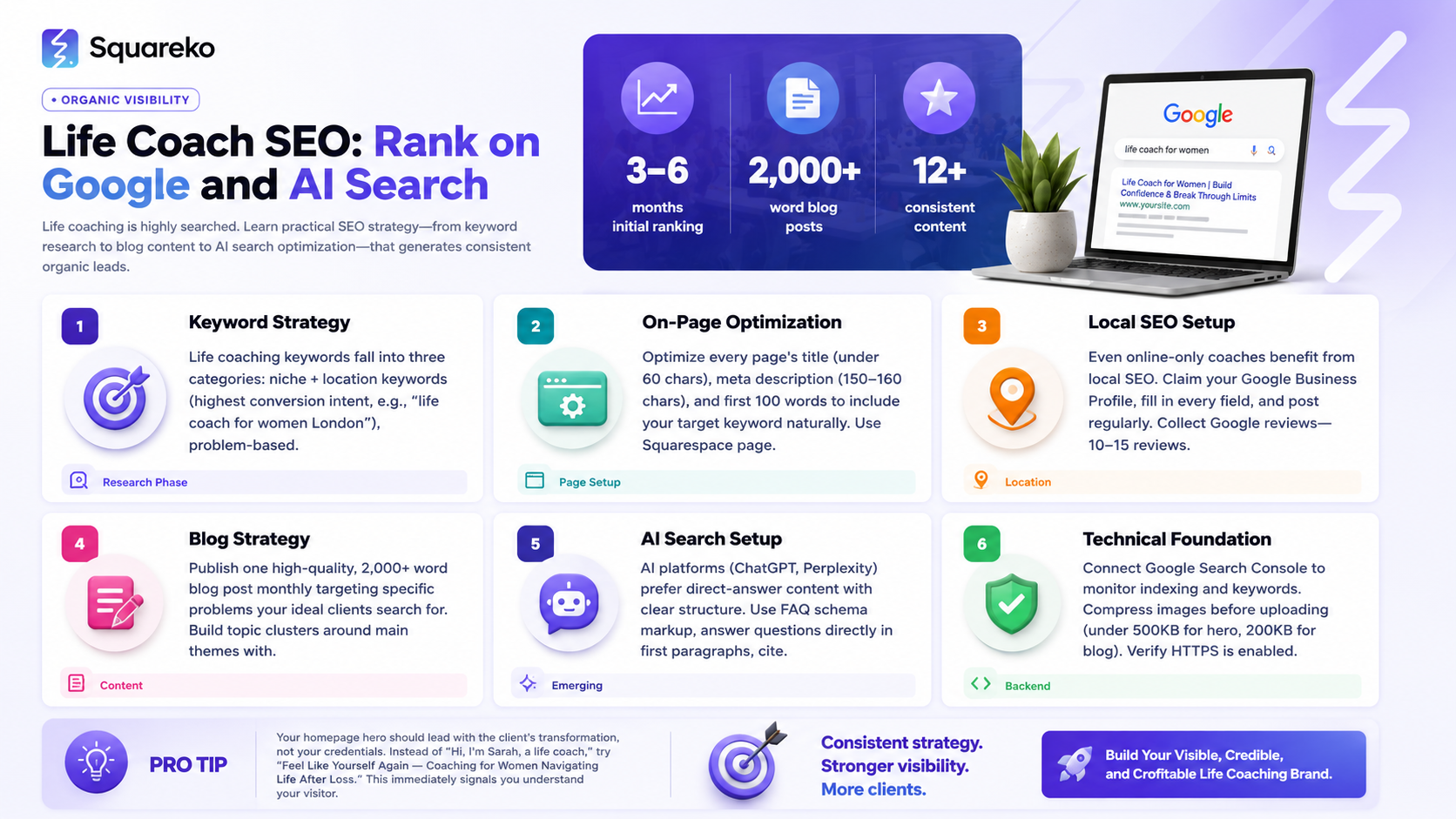
The Three Keyword Categories for Life Coaches
Niche + location keywords (highest conversion intent)
These are searches from people who've already decided they want a life coach and are looking for one now. High intent, relatively low volume, but the visitors who convert at the highest rate. Examples: life coach for women London, online life coach for career change, mindset coach for entrepreneurs, life transition coach near me, These are your service page keywords — each one should have a dedicated page.
Problem-based keywords (high volume, earlier in journey)
These are searches from people who are experiencing the problem you solve but haven't yet decided on coaching as the solution. High volume, lower immediate conversion — but these readers become your ideal clients.
Examples: how to stop feeling stuck in life, what to do when you feel lost in your 30s, how to find my purpose, signs you need a life coach These are your blog content keywords.
Comparison and information keywords (research phase)
Searches from people in the research and comparison phase: what does a life coach actually do, life coach vs therapist,how much does a life coach cost, is life coaching worth it These map to comparison blog posts and FAQ content.
Finding Your Specific Keywords
Start with Google's autocomplete — type life coach for and note what Google suggests. Type how to [the problem you solve] and review the suggestions. Check the People also ask box for question-based keywords. This takes 20 minutes and generates more keyword ideas than most coaches need.
For more systematic research, tools like Ubersuggest (free tier) or Google Keyword Planner give you search volume data that helps prioritise which terms to target first.
Optimising Your Life Coach Squarespace Pages for Search
Homepage Optimisation
Your homepage meta title should include your coaching specialty and location (or online if you work globally): Life Coach for Women | [Your Name] | London or Online Mindset Coach | [Your Name]. Under 60 characters. Your meta description should summarise your offering and invite the click — 150–160 characters.
In the body of your homepage, your primary keyword should appear naturally in the first 100 words. If you're looking for a life coach for career change... is a natural integration that serves both human readers and search engines.
Individual Programme Page Optimisation
Each coaching programme or service should have its own page, targeting its own keyword. A life coach offering three different programmes (1:1 coaching, group programme, intensive) should have three separate pages — each with its own keyword-optimised title, description, and page URL.
Keyword in the page title (H1): 90-Day Confidence Coaching Programme | Online Life Coach for Women
URL: /confidence-coaching-programme
First paragraph: naturally includes the keyword phrase within the first few sentences.
Image Alt Text
Every image on your life coaching website should have descriptive alt text. For headshots: life coach [your name] portrait or [your name] online life coach for women. For service images: life coaching session or online life coaching session via video call. This adds search relevance and serves screen-reader accessibility simultaneously.
Local SEO for Life Coaches: Getting Found in Your City
Even if you work primarily online, local SEO gives you a competitive edge for searchers in your area. Life coach in [city] searches show high intent — these people want someone they perceive as local, often even for online coaching.
Google Business Profile Setup
A Google Business Profile for your life coaching practice is free and one of the highest-impact local SEO actions you can take. Set up or claim your listing at business.google.com. If you work from home or exclusively online, select I deliver goods and services to my customers and define your service area.
Fill in every field: coaching specialty in the description, services listed with individual descriptions, professional photos, and your website URL. Post updates regularly — short posts about blog content, client wins, or new programmes. Active profiles rank higher.
Collecting Google Reviews
Google reviews are a primary local ranking factor. Ask satisfied clients for a Google review at the end of your engagement — make it easy with a direct link to your review form. Even 10–15 genuine reviews can significantly improve your position in local search results and the Google 3-pack.Content Strategy: Blog Topics That Attract Life Coaching Clients A life coach blog is your most powerful long-term organic traffic tool. Each post you publish is a search entry point — a door into your world for someone searching a specific question.
High-Impact Blog Topics for Life Coaches
Problem-aware posts — address the exact experiences your ideal clients are searching:
Why do I feel stuck in life? 5 questions to ask yourself
What to do when you've outgrown your old life
Signs you need a life coach (and signs you don't)
How to know when burnout becomes something you can't ignore
Educational posts — explain concepts your clients encounter:
Life coach vs therapist: what's the difference and which do you need?
What happens in a life coaching session?
How long does it take to see results from life coaching?
Transformation stories — anonymised or lightly fictionalised client journeys:
How one of my clients went from stuck to clear-headed in 90 days
From exhausted and purposeless to excited about Mondays — a client story
Topic Cluster Structure for Life Coaches
Build clusters around your main coaching theme. If you coach around life transitions, your pillar content is The Complete Guide to Navigating Major Life Transitions, and your cluster posts each address one specific type of transition: career change, divorce, bereavement, retirement, health crises, empty nest syndrome. All cluster posts link to the pillar, and the pillar links to all clusters. This builds topical authority that improves rankings across the entire cluster.
AI Search Optimisation for Life Coaches in 2026
More potential coaching clients are using AI platforms to research before they search. When someone asks ChatGPT I'm feeling lost in my life and think I need a life coach — what should I look for?, the AI generates an answer from its training data and current web sources. Coaches with well-structured, authoritative content are more likely to appear in those answers.
What AI Search Platforms Look For
AI platforms prefer content that:
Directly answers specific questions in the first paragraph of a section, not buried after context-setting paragraphs
Is attributed to credentialed, named authors — your name and credentials matter for AI systems evaluating authority
Is specific and verifiable — citing coaching research, ICF statistics, or specific client outcomes makes your content more quotable
Covers a topic comprehensively — AI systems reward depth. A blog post that covers how to choose a life coach from multiple angles (credentials, niche, approach, fit) is more likely to be cited than a thin overview
FAQ Schema for Life Coach Websites
Every coaching service page and blog post should include FAQ schema markup in your Squarespace code injection. FAQ schema signals to AI search engines that your content is structured in a question-and-answer format — which is exactly the format AI systems use to generate direct answers.
Technical SEO Foundations on Squarespace
Google Search Console Setup
Connect your Squarespace site to Google Search Console by verifying ownership (available in Squarespace Settings > Domains or through Search Console's meta tag verification). Submit your sitemap (yoursite.com/sitemap.xml) once connected. Check Search Console monthly for indexing errors, search performance data, and keyword opportunities.
Page Speed
Squarespace hosts sites on a CDN, so core load speed is good. Your main risk is large, unoptimised images. Before uploading photos to Squarespace, compress them using TinyPNG or Squoosh. Keep hero images under 500KB, blog images under 200KB. Page speed is a confirmed Google ranking factor — slow pages rank lower.
HTTPS and Security
All Squarespace sites include HTTPS automatically. This is a basic trust signal for both users and search engines. No action needed — just confirm your site loads as https:// in the browser.
Canonical URLs
If you have similar content across multiple pages (multiple coaching programmes that share description sections), use canonical tags to tell Google which version is the primary one. In Squarespace, you can set canonical URLs in page settings under Advanced.
Measuring Your Life Coach SEO Progress
Key Metrics to Track
Organic traffic — visible in Google Analytics 4 under Acquisition > Traffic Acquisition. Track monthly and compare to the same period last year (more useful than month-over-month comparisons, which are affected by seasonal patterns).
Keyword rankings — Google Search Console > Search Results shows which queries your site appears for, your average position, and click-through rate. Focus on the keywords you're actively targeting — watch their position trend over 3–6 months.
Discovery call source — Ask new discovery call bookings where they found you. Google search as a consistent source tells you SEO is working before the data fully appears in your analytics.
Featured snippet captures — Check whether your blog posts are appearing in Google's featured snippet boxes for the questions they target. These are disproportionately high-click positions.
Realistic Timelines
For new life coach websites: 3–6 months before initial rankings appear for lower-competition terms. 6–12 months before meaningful organic traffic. For established sites with SEO work applied: 2–4 months to see improvement on existing rankings.
Get Your Life Coaching Website Found by the Clients Who Need You
Your ideal clients are searching for you right now — they just can't find you because your website isn't visible where they're looking. Squareko builds Squarespace life coaching websites with SEO baked into the architecture from day one.
FAQs
-
Expect 3–6 months for initial rankings to appear on lower-competition terms, and 6–12 months for meaningful organic traffic to develop from a new site. For established sites with SEO improvements applied, rankings for existing content typically improve in 2–4 months. SEO is a long-term investment — the returns compound significantly after the first year of consistent effort.
-
If you can only do one thing, ensure every page of your Squarespace site has a unique, keyword-informed page title and meta description. Beyond that: set up Google Business Profile, publish one high-quality blog post per month targeting a question your ideal clients search, and build at least 5–10 quality citations on coaching directories and professional sites.
-
On broad, high-competition keywords (like "life coach"), it's very difficult to outrank large platforms. But life coaches can rank effectively for specific, niche keywords — "life coach for women in career transition," "burnout recovery coach for NHS nurses," "online life coach for new mothers." Niche keywords have lower competition and higher conversion because they attract exactly the right clients.
-
Yes — when the content is genuinely helpful and targets the right keywords. Blog posts that answer specific questions your ideal clients search are the most effective organic traffic source over time. The key is consistency (even 1–2 posts per month compounds significantly) and quality (2,000+ word posts that genuinely help rather than thin content for the sake of publishing).
-
One high-quality, well-researched post per month is a solid and sustainable baseline. Two per month accelerates results. The quality threshold matters more than the frequency — a thin post published weekly won't outperform a comprehensive post published monthly. Pick a frequency you can maintain for 12 months and stick to it.
-
The technical foundations (Google Search Console setup, page title configuration, sitemap submission) you can do yourself following this guide. Keyword research and content strategy are skills you can develop with good tools. The most complex areas — technical SEO auditing, schema markup implementation, internal linking architecture — benefit from specialist expertise. Squareko.com includes SEO foundations in every coaching website build.
-
AI search platforms (ChatGPT, Perplexity, Google AI Overviews) are becoming a growing channel for how potential coaching clients discover services. Coaches with structured, authoritative, question-answer formatted content are more likely to appear in AI-generated responses. The tactics that improve Google rankings (quality content, named author authority, FAQ schema) largely overlap with what AI search systems reward.
-
Yes — every indexable page should target a primary keyword. Your homepage targets your main coaching specialty + location. Each programme page targets its specific offering. Your about page targets "life coach [your name]" or a similar branded term. Blog posts each target a specific question or topic. This structured keyword assignment ensures your site is working for search at every entry point.
From custom website design to SEO strategy, we help businesses launch a site that looks professional and performs better.

Author Bio
I'm Walid Hasan, a Certified Squarespace Expert and Squarespace Circle Platinum Partner with over 12 years of hands-on experience designing and optimizing high-performing websites. Over the years, I've had the privilege of building more than 2,000 Squarespace websites for clients around the world, always focusing on clean design, strong user experience, and conversion-driven results.