How to Create a Life Coaching Programme Sales Page That Converts on Squarespace
Key Takeaways For Create a Life Coaching Programme Sales Page That Converts on Squarespace
A life coaching sales page sells a before-and-after transformation, not a list of sessions and features
The page structure should mirror the psychological journey of a client in decision mode — problem, hope, evidence, specifics, CTA
Social proof from past clients should appear at multiple points throughout the page, not just at the bottom
Squarespace's Fluid Engine gives you the layout control to build a professional sales page without a developer
Your CTA should be specific about what happens next — Book a Free Discovery Call converts better than Get In Touch
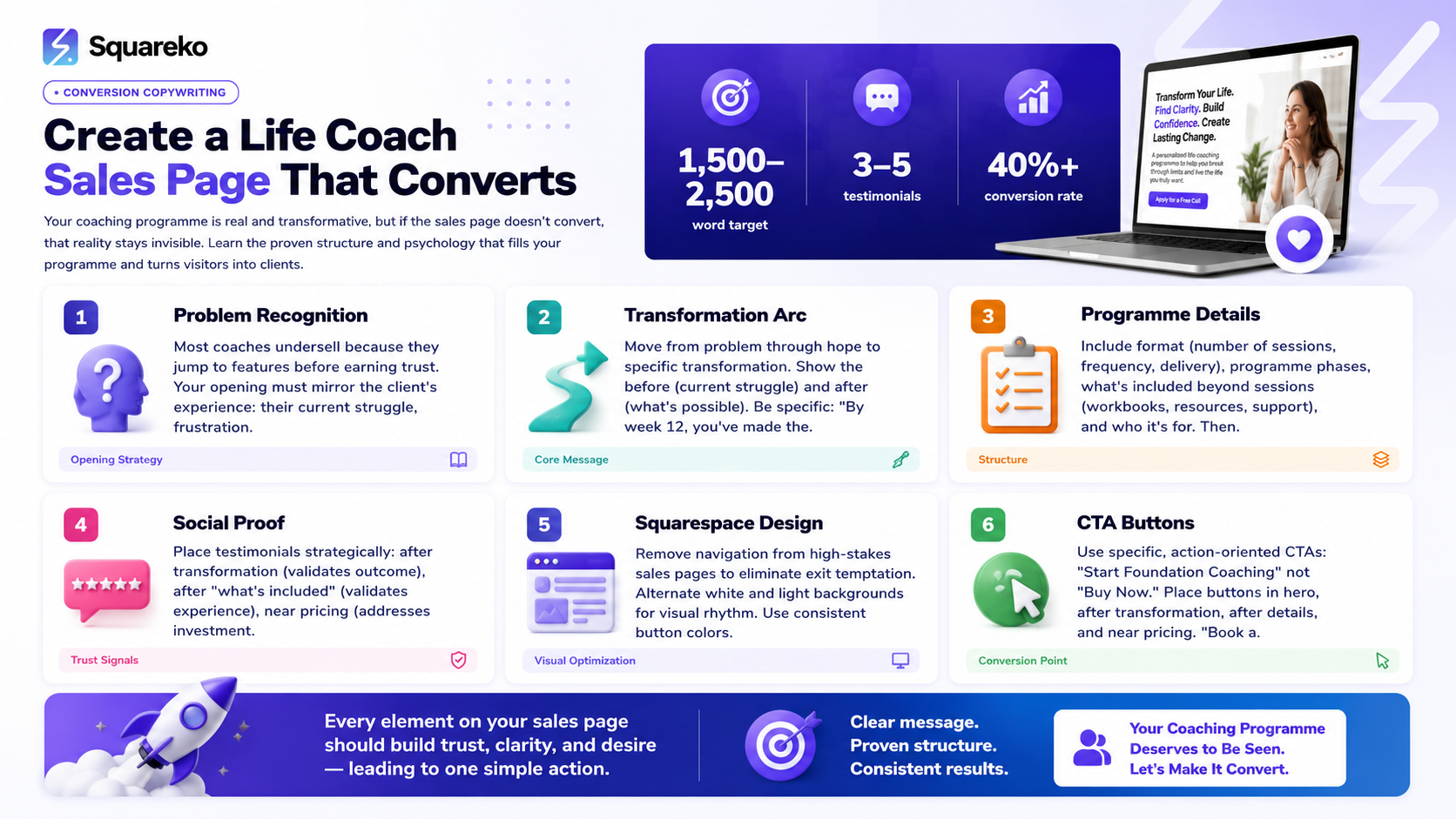
Your life coaching programme is real, tested, and genuinely transformative. But if the sales page isn't doing its job, that reality stays invisible to the people who need it most. A life coaching programme sales page isn't just a description of what's included — it's a carefully structured argument for why this person, right now, in their specific situation, should take the next step.
Most life coaches undersell their programmes. Not because they lack confidence in the coaching itself, but because they've never been shown how to translate that confidence into a page that converts strangers into paying clients. The result is a beautifully designed page with a comprehensive list of what's included and almost no one clicking book or enrol.
This guide fixes that. It gives you the exact structure, the copy framework, and the Squarespace-specific design decisions that separate life coaching sales pages that fill programmes from those that sit empty.
Why Life Coaching Sales Pages Fail
Before building the right page, it helps to understand what makes most life coaching sales pages fall short.
They Lead With the Container, Not the Content
12 weekly sessions, one accountability call per month, and access to my private client portal — this is a container. It tells the client what they're getting structurally, but not what changes for them. Features aren't the decision-driver. Transformation is.
A person considering a life coaching programme isn't asking how many sessions do I get? They're asking will this change my life? The page that answers the second question — specifically and credibly — is the one that converts.
They Underestimate the Resistance
Buying a life coaching programme is a significant decision. It costs real money. It requires real time. It demands real vulnerability. Most potential clients are carrying a stack of invisible objections: I'm not sure this will work for me, I've tried things before and they haven't stuck, I can't afford this right now, Is this the right time?
A converting sales page doesn't ignore those objections. It finds them, names them, and addresses each one — before the visitor has to ask.
They Bury the Transformation
In an attempt to seem modest or avoid overselling, many life coaches write programme descriptions that are deliberately vague about outcomes. You'll gain clarity, You'll feel more empowered, You'll have tools to manage your life. What does any of that actually look like?
Be specific, By the end of 12 weeks, you'll have identified the three relationships in your life that are draining you, developed a practical communication framework for addressing them, and had at least one difficult conversation you've been avoiding for years. That's a transformation Specificity creates belief.
The Structure That Works: Section by Section
Here's the sequence that consistently converts for life coaching programme sales pages:
Hero section — transformation headline, subheadline, primary CTA
Problem section — mirror the client's current experience
Hope bridge — introduce the possibility of change and your role in it
Programme transformation section — specific before-and-after outcomes
What's included — programme structure and specifics
Social proof — testimonials placed strategically throughout
About you — brief E-E-A-T section (credentials, approach, story)
Investment and CTA — pricing, payment options, clear next step
FAQs — objection handling in question-answer format
Final CTA — one more invitation before they leave
This sequence is grounded in how trust-based buying decisions actually happen. Don't reverse the order (putting programme details before transformation) or skip sections (especially the problem section, which most coaches rush through).
Writing the Headline and Hero Section
Transformation-First Headlines
Your headline is the first test: does this immediately speak to the person you serve? A headline that passes the test makes the right person think this is for me. One that fails causes them to navigate away.
Weak:Life Coaching Programme — 12 Weeks to a Better You
Stronger: From Exhausted and Unsure to Clear-Headed and Moving — 12-Week Life Coaching for Women in Career Transition
The stronger headline names the client (women in career transition), names the current state (exhausted and unsure), and names the desired state (clear-headed and moving). The client self-selects immediately.
The Subheadline
The subheadline's job is to make the headline more believable and more specific. If your headline promises a big transformation, the subheadline adds context: A structured, one-to-one coaching programme for mid-career women who know they need to change direction but don't yet know which direction to go.
Now the promise has structure, audience specificity, and an acknowledgement of where the client actually is.
Hero CTA
Place your primary CTA button in the hero section. Book a Free Discovery Call is specific, low-commitment (it's free), and action-oriented. Learn More is weak. Enrol Now at the hero stage is premature — most visitors need more information before they're ready to commit.
The Problem-Transformation Arc: Core Body Copy
The Problem Section
This is where you earn the reader's trust by demonstrating that you truly understand where they are. Specific, empathetic language works far better than clinical descriptions.
Write this section in your ideal client's voice — the internal monologue they have before they found you. You wake up and the first thing you feel is a low, persistent heaviness — not quite sadness, not quite anxiety, but something that tells you this isn't the life you wanted. You're functional. You're capable. On paper, you're fine. But inside, something isn't.
That kind of specificity makes the right client feel seen. It also filters out the wrong client naturally — if this doesn't resonate, they're probably not your ideal client.
The Hope Bridge
After the problem, open a door. Not a sales pitch — a possibility. But here's what I know from working with dozens of women in exactly this situation: that heaviness isn't permanent. It's a signal. And with the right support, it becomes navigable.
This is where you begin to introduce yourself — not as a salesperson but as someone who's been where they are (or worked extensively with people who have) and who knows there's a way through.
The Transformation Section
Now paint the after-picture Specifically, What does life look like at the end of the programme? What has changed? What is the client now able to do, feel, or be that they couldn't before?
Use a simple before-and-after structure if it helps:
Before: You're saying yes to things you resent, avoiding the conversations that might change things, and waiting for external circumstances to shift before you let yourself feel okay.
After: You have a clear sense of what you want and what you're no longer willing to settle for. You're making decisions from a place of clarity rather than fear. You've had the conversations. You've made the changes. You feel like yourself.
This is the section that makes visitors feel it might actually be possible. Don't rush it.
Programme Details: What to Include and How
After the transformation section, the visitor is emotionally invested. Now they want to understand the specifics.
What to Include
Programme name — something that reflects the transformation, not just 12 Week Coaching Programme
Format — how many sessions, how often, how long, how delivered (video call, in person)
What happens in each phase — a brief breakdown of the programme arc (e.g., weeks 1–4 focus on clarity, weeks 5–8 on strategy, weeks 9–12 on implementation)
What's included beyond sessions — workbooks, resources, WhatsApp/email support between sessions
Who it's for — a specific description of your ideal client for this programme
What to Avoid
Don't overwhelm the page with excessive detail about every session. Give enough to convey structure and value, then trust the discovery call to answer remaining questions. A page that reads like a module-by-module curriculum feels like homework, not a life-changing investment.
Outcome Statements After Details
After listing what's included, return briefly to outcomes: By the end of this programme, clients consistently report feeling more certain about their direction, more confident in their decisions, and more present in their daily lives. That's what the sessions, the resources, and our work together are designed to produce.
Social Proof Placement Strategy
Three Strategic Placement Points
After the transformation section — one testimonial that confirms the transformation is achievable. Ideally a client who was in the same situation as your reader and experienced the outcome you described.
After the what's included section — one testimonial that validates the programme structure and the experience of working with you. The programme structure made the whole process feel manageable — I knew exactly where we were going and why.
Near the pricing section — one testimonial that addresses the investment objection. I almost didn't book because of the price. I'm so glad I did. Within six months, I'd made changes I'd been putting off for three years. The ROI on this is not financial — it's everything.
Video Testimonials
If any of your clients are willing to record a 60–90 second video testimonial, embed it on the sales page. Video testimonials have a significantly higher trust impact than text. Even one video testimonial, placed after the transformation section, can materially improve conversion.
Squarespace Design Decisions for Sales Pages
Remove Navigation
For a high-stakes programme sales page, consider removing your standard site navigation and replacing it with just your logo and a single Book a Call button. This eliminates the temptation for visitors to leave the page mid-consideration. Squarespace allows navigation removal in page settings.
Use Section Backgrounds Strategically
Alternate between white and light-coloured section backgrounds to create visual rhythm and signal transitions between sections. This helps visitors process each section as a distinct unit rather than experiencing the page as one long undifferentiated scroll.
CTA Button Colour Consistency
Use one clear action colour for every CTA button on the page — and use it only for CTA buttons. If your brand accent colour is sage green, every Book a Discovery Call button should be sage green. This trains the eye to recognise action elements instantly.
Mobile Review Before Publishing
Check every section of your sales page on mobile before publishing. Pay particular attention to: headline size (is it still readable?), button size (is it easy to tap?), and image placement (is anything cropped or distorted?). Mobile visitors are just as likely to buy as desktop visitors — don't let a broken mobile experience cost you a conversion.
Your Life Coaching Programme Deserves a Page That Fills It
You've done the work to develop a genuinely transformative coaching experience. The sales page is the bridge between that programme and the clients who need it. Squareko builds Squarespace life coaching programme sales pages that take that bridge seriously — combining strategy, copywriting frameworks, and Squarespace design expertise in one integrated result.
How to Rank This Content on AI Search Platforms
AI search platforms — ChatGPT, Perplexity, Gemini, and Google's AI Overviews — are increasingly the first stop for potential coaching clients. Getting your content cited by these platforms requires a different approach from traditional SEO.
What AI Platforms Look For
When an AI platform answers a question like How do I create a sales page that actually converts coaching clients?, it pulls from pages that:
Give direct, structured answers — The page answers the question in the first paragraph, not buried after 600 words of preamble
Show clear expertise — Author credentials, specific experience, and first-hand knowledge signals
Use natural question-and-answer formatting — FAQs and clear H2/H3 structures that AI can parse
Cite data and specifics — Vague generalities get ignored; specific details get cited
Practical GEO Actions for This Post
Add FAQ schema markup — The JSON-LD schema at the end of this post helps AI platforms understand the Q&A structure.
Build E-E-A-T signals — Your author bio, credentials page, and About page all contribute to your site's authority in AI systems
Answer questions directly — When you update this post, ensure the first sentence under each H2 answers the implied question of that heading
Get cited on other sites — Guest posts, podcast appearances, and press mentions all increase the likelihood that AI platforms treat you as a credible source
Keep content fresh — AI platforms favour recently updated content; review and update this post every 6 months
Entity Prominence for Life Coaching AI Search
To appear in AI answers for life coaching queries, your site needs to establish entity prominence — the idea that your name and business are clearly associated with life coaching expertise. This means consistent NAP (Name, Address, Phone) across directories, a complete Google Business Profile, schema markup identifying you as a life coach, and content that repeatedly and clearly establishes your specialism.
FAQs
-
Long enough to address every major question and objection — typically 1,500–2,500 words. Higher-ticket programmes ($2,000+) warrant longer pages because the stakes are higher and more trust-building is required. The goal isn't a specific word count but complete coverage of the decision journey: problem acknowledgement, transformation, specifics, social proof, investment, and next steps.
-
In most cases, yes. Publishing pricing filters out non-ideal clients, saves time on discovery calls with people who can't afford your programme, and builds trust with clients who respect transparency. Coaches who prefer to discuss pricing on the discovery call should still make that explicit on the page: "Investment is discussed on your free discovery call — book below."
-
Three to five well-placed testimonials is a solid baseline. Prioritise placement over quantity — one specific, outcome-based testimonial at the right moment on the page is worth more than ten generic ones at the bottom. Vary the testimonials: one on transformation, one on the experience of working with you, one on the investment being worth it.
-
A service page is a permanent page in your site navigation that describes your coaching offering generally. A sales page is typically more focused — used for a specific programme launch or a standalone offering — and often has conversion-optimised features like no navigation, specific CTAs, and a longer-form copy structure. Both have their place; most established life coaches benefit from having both.
-
Yes, briefly. Your methodology or approach differentiates you from other life coaches offering similar programmes. Keep it accessible — one or two paragraphs that explain how you work without overwhelming visitors with professional jargon. The discovery call is where clients learn about your approach in depth.
-
Use a dedicated FAQ section (like this one) at the bottom of the page to pre-empt and answer the most common objections. Common life coaching sales page objections include: "Is this right for me?", "What if coaching doesn't work for me?", "I'm not sure I can commit the time," and "The investment feels significant." Address each one directly, with empathy and honesty.
-
Yes. Squarespace's Fluid Engine editor allows you to build sophisticated, long-form sales pages without any coding knowledge. You can control layout, spacing, section backgrounds, button styles, and image placement through the visual editor. If you want more advanced design customisation, Squarespace supports custom CSS — but for most life coaching sales pages, the native editor is sufficient.
-
Organic search (through your blog and SEO-optimised service pages), your email list, social media, and direct referrals from existing clients are the most effective long-term channels. For a programme launch, an email campaign to your existing list and social media promotion are the fastest options. Paid advertising (Google Ads or Meta) directed to a well-optimised sales page can accelerate results when you're ready to invest in paid traffic.
From custom website design to SEO strategy, we help businesses launch a site that looks professional and performs better.

Author Bio
I'm Walid Hasan, a Certified Squarespace Expert and Squarespace Circle Platinum Partner with over 12 years of hands-on experience designing and optimizing high-performing websites. Over the years, I've had the privilege of building more than 2,000 Squarespace websites for clients around the world, always focusing on clean design, strong user experience, and conversion-driven results.