
How to Write Insurance Service Pages That Convert on Squarespace
Introduction
Your insurance service pages are potential clients' first real encounter with your firm. Whether someone is searching for life insurance broker near me or business insurance coverage explained, they land on your website hoping for clarity, credibility, and confidence. Yet many insurance brokers treat service pages as afterthoughts—generic descriptions cobbled from policy documents.
This approach costs you conversions.
When you write insurance service pages on Squarespace that actually convert, you move beyond product description. You address the fear beneath the search. You explain what people don't understand. You prove why your firm is trustworthy. And you guide visitors toward booking a consultation or requesting a quote.
This guide introduces the PEACE Framework—a proven structure for insurance service pages—alongside practical copywriting techniques, Squarespace-specific design guidance, and compliance considerations from the FCA (UK) and state insurance departments (US). By the end, you'll have a blueprint to transform your service pages into conversion engines.
Key Takeaways How to Write Insurance Service Pages That Convert on Squarespace
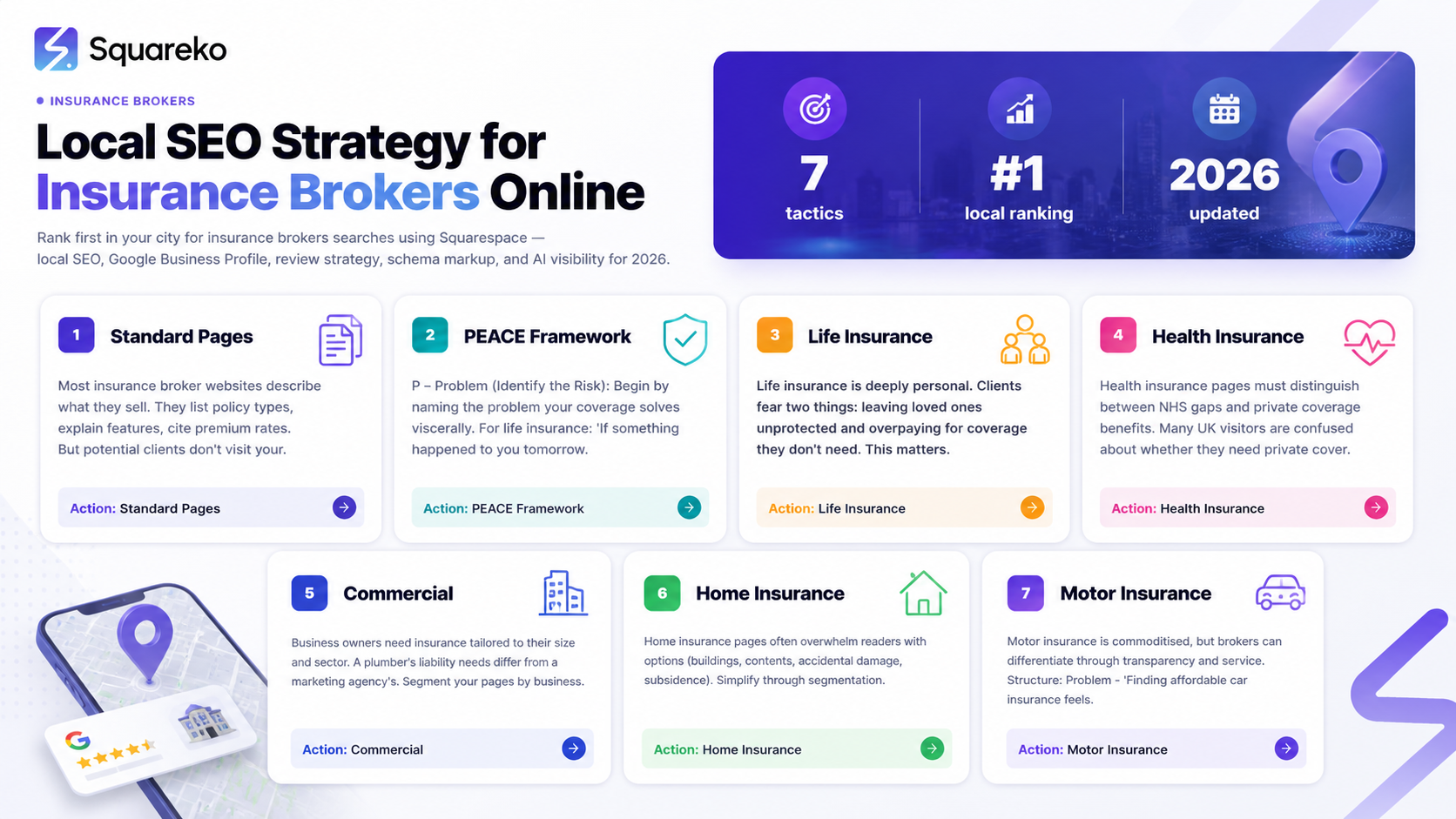
Structure service pages around client fears, not just product features; the PEACE Framework ensures you address every concern before the visitor leaves.
Lead with outcome, not mechanics: clients care why coverage matters to them, not how premiums are calculated.
Use plain language consistently: insurance jargon alienates readers; define terms or avoid them entirely.
Include social proof and trust signals on every service page (credentials, testimonials, accreditations); FCA rules require transparency.
Optimise for Squarespace's mobile experience: 60% of insurance research happens on mobile; responsive copy is non-negotiable.
Segment service pages by coverage type: life, health, commercial, home, and motor insurance each solve different problems and need tailored messaging.
Add clear CTAs above and below the fold: Book a consultation, Get a quote, or Talk to a specialist should appear within the first 300 words.
Why Standard Service Pages Fail
Most insurance broker websites describe what they sell. They list policy types, explain features, cite premium rates. But potential clients don't visit your website to learn policy mechanics. They visit because they have a problem and need reassurance.
Consider two approaches:
Weak version: We offer life insurance policies. Types include term, whole-of-life, and critical illness. Premium depends on age, health, and coverage amount.
Conversion-focused version: Life insurance protects the people who depend on you. Whether you're the sole earner, a young parent, or a business owner, we find coverage that fits your actual life—not a one-size-fits-all template. Most of our clients save 15–20% by reviewing their existing policies with us.
The second version names the emotional core (protecting dependents), speaks to segmented reader concerns, and includes proof (the savings statistic). It converts because it understands.
Standard service pages fail because they treat insurance as a commodity. But insurance is risk management, family protection, business continuity, and peace of mind. Write from that angle, and conversion rates rise.
Introducing the PEACE Framework for Insurance Service Pages
The PEACE Framework is a five-step structure that mirrors how insurance prospects think and decide. Apply it to every service page:
P – Problem (Identify the Risk)
Begin by naming the problem your coverage solves. Not in abstract terms, but viscerally. What keeps your audience awake at night?
For life insurance: If something happened to you tomorrow, could your family cover the mortgage? School fees? Daily living costs?
For commercial insurance: A single liability claim can devastate a growing business. Premises damage, employee injury, or professional negligence—these aren't distant risks; they're probabilities.
For home insurance: Your home is your largest investment. Standard policies leave gaps. Accidental damage, uninsured items, or underinsurance happens more often than you'd think.
State the problem clearly in your opening paragraph. Use you language. Make it personal.
E – Explanation (Demystify the Solution)
Insurance jargon kills conversion. Clients fear signing up for something they don't understand. Your job: translate.
Explain what the coverage does in everyday language. Avoid terms like indemnity, subrogation, or claims adjustment—or define them immediately if you must use them.
Example: Life insurance pays a tax-free lump sum to your nominated family or dependents when you pass away. That sum replaces your income and ensures bills are paid, debts are cleared, and your family's lifestyle continues.
Break explanations into short paragraphs. Use numbered lists or bullet points. Add a diagram or infographic on your Squarespace page if it clarifies a point (e.g., how a claims process works).
A – Assurance (Build Trust and Credibility)
Why should prospects choose you? Assurance isn't boasting; it's proof.
Include:
FCA authorisation statement (UK): We are authorised and regulated by the Financial Conduct Authority (FCA Ref: [number]). Our regulatory obligations ensure we recommend coverage in your best interest.
Professional credentials: Chartered Insurance Institute accreditation, Independent broker status, Whole-of-market advice.
Testimonials: Real client quotes (with permission) matter. Sarah, Leeds: 'They explained what I actually needed, not what gave the best commission. Saved me £400 a year.'
Years in business: 20+ years advising [sector].
Partnerships: Approved intermediary for [major insurer].
Claims handling: Average claims settled in 5 business days.
Place assurance content mid-page, after you've explained the coverage. By then, readers are emotionally invested; assurance tips them toward yes.
C – Clarity (Spell Out What's Covered)
Ambiguity causes hesitation. List exactly what's covered and, importantly, what isn't.
Use a simple two-column table or checklist:
Covered
Accidental damage to your home's structure
Contents up to £X
Temporary accommodation
Subsidence
Not Covered
Wear and tear
Deliberate damage
Unoccupied periods over 60 days
Expensive art or jewellery (separate policy)
This honesty builds trust. Clients appreciate knowing limits; surprises destroy relationships.
E – Enquiry (Clear Call to Action)
End with a straightforward ask: Book, quote, or call. Make it effortless.
Getting your personalised insurance quote in three minutes is better than contacting us for more information.
Include multiple CTA formats:
A prominent button
A phone number with WhatsApp option
A form asking two questions
Book a 15-minute consultation
How to Write Service Pages for Life Insurance
Life insurance is deeply personal. Clients fear two things: leaving loved ones unprotected and overpaying for coverage they don't need.
Structure your life insurance page like this:
Opening (P): Start with a scenario: You're 35, earning £50k, and have a mortgage and two school-age children. If you died tomorrow, your family would face a £150k debt and reduced income. Life insurance replaces that income.
Coverage types (E): Explain the three main types:
Term life insurance: Covers a set period. Cheapest option. Best for mortgages and young families.
Whole-of-life insurance: Covers your entire life. Builds cash value. Suitable for inheritance tax planning.
Critical illness insurance: Pays if you're diagnosed with serious illness (cancer, heart attack, stroke) while still living. Covers your mortgage and bills if you can't work.
Define each plainly. Include estimated cost ranges (From £15/month for a 25-year-old non-smoker).
Who needs it (A): Name personas: New parents, Business owners with loans, Mortgage-holders.
What's covered (C): Create a checklist specific to your offering.
How to apply (E): Click below for an instant quote. No phone calls, no medical exam required. Most applications take 10 minutes.
Health Insurance Service Pages: Clarity Over Complexity
Health insurance pages must distinguish between NHS gaps and private coverage benefits. Many UK visitors are confused about whether they need private cover.
Key approach:
Problem: The NHS is stretched. Non-emergency procedures face long wait times. Private health insurance ensures you're treated quickly by specialists of your choice—and you never queue.
Types offered:
Individual policies: For self-employed or early retirement.
Group/corporate: For businesses wanting employee benefits.
Enhanced coverage: Dental, optical, mental health alongside general health.
What's covered: Be explicit. Hospitality claims 90% of private health insurance questions are: Is this covered? Address top concerns on the page itself.
Assurance: We partner with [major insurer]. 99% of claims processed within 7 days. You have 24/7 access to a health hub and GP hotline.
Commercial and Business Insurance Pages That Sell
Business owners need insurance tailored to their size and sector. A plumber's liability needs differ from a marketing agency's.
Segment your pages by business type:
For sole traders: You're self-employed. One lawsuit could end your business. Professional indemnity and public liability insurance protect your income and reputation.
For small businesses: Growing a business means managing multiple risks: employee safety, customer injury, property damage, and professional mistakes. Our brokers build a package specific to your business.
For larger enterprises: Complex risks require custom solutions. Directors and officers liability, cyber insurance, supply chain protection—we assess your entire exposure and recommend integrated coverage.
On each page:
Name the risk.
Explain what happens without coverage (financial and legal consequences).
Show what your policies cover.
Provide a checklist: Does your business have...?
Offer a free risk assessment.
Home and Property Insurance: Protection, Simplified
Home insurance pages often overwhelm readers with options (buildings, contents, accidental damage, subsidence). Simplify through segmentation.
Create separate pages or sections for:
Buildings Insurance: Covers the structure of your home. Mandatory if you have a mortgage. Explain: Your lender requires it. We find coverage that matches your rebuild cost, not just market value.
Contents Insurance: Covers your belongings. Crucial because building policies never cover your sofa, TV, or kitchen.
Accidental Damage Cover: Optional add-on. For families with children or pets, this cover prevents a broken window or damaged floor costing thousands out of pocket.
Subsidence and Ground Heave: Technical topic, but critical. Explain simply: If your property sits on clay or near water, ground movement can crack foundations. This cover protects against that risk.
Use before/after scenarios:
Without contents insurance: A fire destroys your belongings. Replacement cost: £15,000. Your pocket.
With contents insurance: Same fire. Your insurer covers replacement up to your policy limit.
Motor Insurance Pages: Compliance and Confidence
Motor insurance is commoditised, but brokers can differentiate through transparency and service.
Structure:
Problem: Finding affordable car insurance feels impossible. Quotes vary wildly. And you're never sure you're properly covered.
Coverage types:
Third-party only (legally required minimum; covers damage you cause to others)
Third-party, fire and theft (adds your vehicle if stolen or fire-damaged)
Comprehensive (covers accidental damage to your car, glass, breakdown)
Define each simply, with a cost comparison.
Your angle: We compare 40+ insurers instantly. Most clients save £150+ annually. And if you claim, you have a dedicated handler—not a call centre.
What's covered: Create a table comparing each cover level.
Assession: Include claims turnaround times, customer satisfaction scores, and any exclusive partnerships.
Optimising Your Pages for Squarespace SEO
Service pages must rank to convert. Here's how to optimise within Squarespace.
On-page SEO:
H1: One per page. Use your focus keyword. Insurance Service Pages on Squarespace That Convert is better than Our Service.
H2s: Organise content with subheadings that include semantic keywords. Life Insurance Explained and How Much Life Insurance Do You Need? both work.
Meta title: 50–60 characters. Include keywords and benefits. Life Insurance Broker | Personal & Family Protection.
Meta description: 150–160 characters. Answer what and why. We match families and businesses to life insurance coverage that protects what matters. Free quote in 10 minutes.
URL slug: Use focus keyword. /life-insurance-broker not /insurance-01.
Internal links: Link related pages (life insurance page links to critical illness page; commercial insurance links to liability page). This distributes authority and helps users explore.
Image alt text: Squarespace makes this easy. Every image needs a descriptive alt tag. A young family discussing life insurance with a broker is better than Image001.
Content structure: Short paragraphs (2–3 sentences max). Bullet points. Numbered lists. Scannable content ranks better and converts better.
Technical SEO:
Use Squarespace's built-in SEO tools (Page Settings > SEO) to set title and description.
Ensure mobile responsiveness (Squarespace templates handle this, but test on phone).
Use Squarespace's Schema markup (detailed below).
Link to relevant pages on your site and external FCA/regulatory pages sparingly.
Content marketing:
Blog posts supporting service pages. 5 Reasons Business Owners Underestimate Liability Risk drives traffic to your commercial insurance page.
Use Google Search Console to identify which queries bring clicks; refine service pages to better answer those queries.
-
Use the PEACE Framework: Problem (the risk), Explanation (plain-language coverage details), Assurance (your credentials and social proof), Clarity (what's covered and what isn't), and Enquiry (a clear call to action). Begin with the emotional core—what clients fear—then move to solutions.
-
Start with a relatable scenario (e.g., "You have dependents and a mortgage"). Explain the three main types of life insurance in plain language. Name who benefits most (young families, business owners). Show what's covered with a checklist. Include testimonials and your FCA authorisation. End with a clear CTA: "Get a quote in 10 minutes."
-
Avoid jargon. Use "everyday language" as your benchmark. Replace "indemnity" with "protection." Replace "claims adjustment" with "our team will manage your claim from start to finish." Use bullet points and numbered lists. Include before/after scenarios showing what happens without coverage versus with it. Test your language with a non-industry friend; if they understand it, it's clear enough.
-
Yes, if you're UK-based. Include a brief FCA authorisation statement and compliance note. Example: "We are authorised and regulated by the Financial Conduct Authority (FCA Ref: 12345). This means we must recommend coverage in your best interest, not ours." FCA rules also require that marketing material (including service pages) is "clear, fair, and not misleading." Avoid exaggerated claims like "guaranteed cheapest" or "best on the market."
-
Minimum five: Life Insurance, Health Insurance, Commercial/Business Insurance, Home Insurance, and Motor Insurance. If you specialise, add pages for your niche (e.g., "Professional Indemnity for Accountants"). Each should be 1,000–2,000 words and directly address a client's primary search intent.
-
Transparency builds trust, but insurance premiums vary hugely based on individual circumstances. Better approach: Provide a range ("From £25/month for term life insurance") and a CTA to get a personalised quote. This sets expectations without overpromising.
-
Specific, low-friction CTAs work best: "Get a personalised quote in 10 minutes," "Book a free 15-minute consultation," "Chat with a specialist via WhatsApp." Avoid vague CTAs like "Learn more" or "Contact us." Test which works best using Squarespace's forms and Google Analytics.
-
Yes. A simple chatbot answering "Which insurance do I need?" can boost engagement. But ensure FCA-regulated firms disclose that automated advice isn't personalised. Recommend chatbots ask initial questions, then route to a human adviser for formal recommendations—this keeps you compliant.
Conclusion
Insurance service pages are your highest-intent landing pages. Someone searching for "life insurance broker" or "business liability explained" is ready to move forward—if you meet them with clarity, empathy, and proof.
The PEACE Framework works because it mirrors how decisions actually happen. Prospects arrive with fear (Problem). They want understanding (Explanation). They need reassurance (Assurance). They must know what they're buying (Clarity). And they need permission to act (Enquiry).
Apply this structure to every service page on your Squarespace website. Segment by coverage type. Use plain language. Include social proof. Optimise for mobile. Add proper CTAs. And comply with FCA or state insurance regulations.
The result: Higher search rankings, lower bounce rates, and more conversions. Your prospects won't just visit your website; they'll book consultations, request quotes, and recommend you to others.
Ready to Convert More Insurance Clients?
Writing conversion-focused service pages takes time and expertise—especially when you're managing client relationships and claims. That's where Squareko comes in.
Squareko specialises in Squarespace websites for insurance professionals. We combine conversion copywriting, SEO strategy, and FCA-compliant design to build websites that rank and sell.
Whether you need help restructuring existing service pages using the PEACE Framework, creating new pages for underserved coverage types, or optimising your entire website for better lead generation, our team has worked with brokers just like you.
Get started today:

From custom website design to SEO strategy, we help businesses launch a site that looks professional and performs better.

About the Author
I'm Walid Hasan, a Certified Squarespace Expert and Squarespace Circle Platinum Partner with over 12 years of hands-on experience designing and optimizing high-performing websites. Over the years, I've had the privilege of building more than 2,000 Squarespace websites for clients around the world, always focusing on clean design, strong user experience, and conversion-driven results.
