Law Firm SEO on Squarespace: Rank for Practice Area Keywords and AI Search in 2026
Introduction
Law firms face a critical challenge in 2026: clients search for legal services through traditional search engines, voice queries, and increasingly, AI-powered recommendation systems. Whether a potential client searches family lawyer near me or asks an AI assistant who should I hire for a personal injury claim?, your law firm's visibility determines whether you're discovered.
Squarespace has evolved into a legitimate platform for law firm websites, offering professional templates, built-in SEO tools, and Schema markup capabilities. However, simply having a Squarespace website isn't enough. Law firms must optimise for practice area keywords—the specific phrases prospects use when searching for legal services. This guide covers the complete strategy for law firm SEO on Squarespace in 2026, including practice area keyword research, LegalService schema implementation, E-E-A-T optimisation, and how to position your firm in AI-recommended lawyer lists.
Key Takeaways
Practice area keywords matter more than generic terms: Target family lawyer in Manchester rather than lawyer to attract qualified leads with higher conversion intent.
LegalService schema markup enhances visibility across search engines and AI systems: Implement structured data for each practice area to help search engines and AI assistants understand your offerings.
E-E-A-T is non-negotiable for legal content: Google prioritises experience, expertise, authoritativeness, and trustworthiness when evaluating legal service websites.
Local SEO is essential for law firms: Combine practice area keywords with geographic modifiers and create location-specific practice area pages.
AI-recommended lawyer lists require profile optimisation: Ensure your firm appears in AI search results by completing profiles on legal directories and providing structured legal service data.
Bar association compliance protects your reputation: Understand advertising regulations in your jurisdiction to avoid penalties and maintain professional credibility.
Squarespace supports legal service schema implementation: Use Squarespace's built-in tools or custom code blocks to implement Legal Service and Local Business schema.
Why Practice Area Keywords Matter for Law Firm SEO
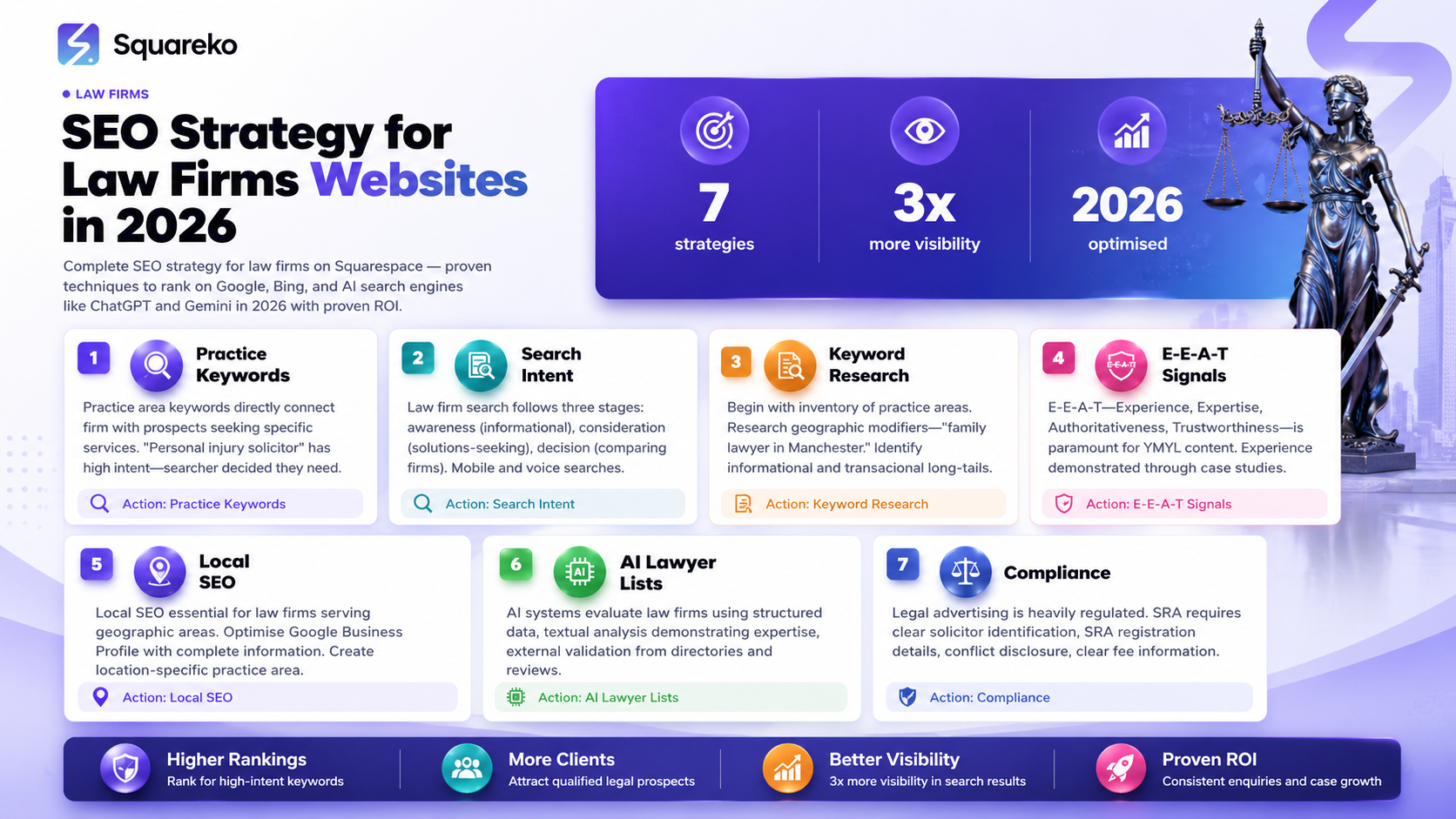
Generic keywords like lawyer or law firm are nearly impossible to rank for, attract irrelevant traffic, and waste your SEO budget. Practice area keywords—terms like family law solicitor,employment tribunal representative, or conveyancing solicitor near me—directly connect your firm with prospects actively seeking the specific services you provide.
The Search Intent Behind Practice Area Keywords
When someone searches personal injury solicitor, they've already decided they need legal help for that specific issue. They're not shopping for general legal advice; they're looking for a specialist. This high intent makes practice area keywords exponentially more valuable than broad terms.
Why Squarespace Works for Practice Area Targeting
Squarespace's page builder makes it straightforward to create dedicated practice area pages. Each page can target a primary practice area keyword, supporting H2s, and related long-tail variations. Unlike some website builders, Squarespace automatically generates clean URLs, handles canonicalisation properly, and doesn't penalise you for having multiple practice area pages.
Understanding Law Firm Search Intent and User Behaviour
The Three Stages of Legal Service Searches
Awareness Stage: Prospects search for information about legal issues (what is a personal injury claim? or how much does a divorce cost?). These searches have lower commercial intent and may not convert immediately.
Consideration Stage: Potential clients search for solutions (no-win no-fee personal injury solicitor or affordable family lawyer in London). These searches indicate serious interest and higher conversion probability.
Decision Stage: Prospects search for specific firms or compare options (personal injury solicitor Manchester reviews or employment lawyer [postcode]). These searches occur just before hiring and generate the highest-quality leads.
Device and Voice Search Considerations
Mobile searches dominate legal queries, particularly near me variants. Voice searches—whether through Google Assistant, Apple Siri, or AI chatbots—often use natural language phrasing like who's a good divorce lawyer near me? Your content must address these conversational search patterns, not just traditional typed keywords.
The AI Search Factor
In 2026, AI-powered search assistants increasingly influence legal service discovery. Prospects ask ChatGPT, Perplexity, or AI-enabled Google Search which solicitor should I hire for a property dispute? These systems rely on structured data, review signals, and authoritative content. Law firms optimised for traditional SEO may not appear in AI-generated recommendations without strategic preparation.
Conducting Practice Area Keyword Research
Step 1: List Your Practice Areas
Begin with an inventory of every practice area your firm handles. Examples include:
Family law (divorce, separation, child custody)
Personal injury (motor accidents, workplace injury, medical negligence)
Employment law (unfair dismissal, discrimination, redundancy)
Property law (conveyancing, landlord disputes, boundary disputes)
Wills and probate
Criminal defence
Immigration
Step 2: Research Geographic Modifiers
Law firms operate within geographic boundaries. For each practice area, identify your service areas. Create keywords combining practice area with location:
Family lawyer in Manchester
Personal injury solicitor [postcode]
Employment tribunal representative Yorkshire
Conveyancing solicitor Greater London
Step 3: Identify Informational and Transactional Long-Tails
For each practice area, research both informational keywords (for blog content and resource pages) and transactional keywords (for service pages):
Informational: How much does a divorce cost UK? What is unfair dismissal? Do I need a solicitor for conveyancing?
Transactional: Divorce solicitor near me, Personal injury claim solicitor, Employment law advice [location]
Step 4: Use Keyword Research Tools Appropriately
Tools like Ahrefs, SEMrush, and Moz provide search volume and difficulty data, but the legal market is nuanced. A keyword with low competition might still be challenging due to bar association compliance or domain authority requirements. Focus on:
Search volume (volume + local/geographic specificity)
Keyword intent alignment with your practice areas
Competitor analysis (which firms rank and their content approach)
Step 5: Prioritise Keywords by Business Value
Not all practice areas generate equal revenue. A family law firm might achieve higher conversion from divorce solicitor Manchester than family law blog. Prioritise keywords aligned with your most profitable practice areas and strongest geographic markets.
Implementing Legal Service Schema Markup
Schema markup helps search engines understand the nature of your legal services. The LegalService schema is specifically designed for law firms and legal service providers.
What is Legal Service Schema?
Legal Service is a structured data type that communicates to search engines:
The type of legal service offered
The areas of law covered (areaServed, serviceArea)
The qualifications and experience of legal professionals
Pricing information (where applicable)
Contact and availability details
Example Legal Service Schema for a Personal Injury Firm
{
  "@context": "https://schema.org",
  "@type": "LegalService",
  "name": "Personal Injury Claims | Smith & Associates Solicitors",
  "description": "Personal injury solicitors handling motor accidents, workplace injury, and medical negligence claims across Manchester and the North West.",
  "url": "https://yoursite.com/personal-injury",
  "telephone": "+44 161 123 4567",
  "email": "info@yoursite.com",
  "address": {
    "@type": "PostalAddress",
    "streetAddress": "123 King Street",
    "addressLocality": "Manchester",
    "postalCode": "M2 6AA",
    "addressCountry": "GB"
  },
  "areaServed": {
    "@type": "Place",
    "name": "Greater Manchester"
  },
  "knowsAbout": [
    "Motor accident claims",
    "Workplace injury",
    "Medical negligence"
  ],
  "priceRange": "Free initial consultation",
  "aggregateRating": {
    "@type": "AggregateRating",
    "ratingValue": "4.8",
    "ratingCount": "247"
  }
}
Implementing Schema in Squarespace
Method 1: Code Block Injection
Navigate to your practice area page in Squarespace
Add a code block at the bottom of the page
Paste your LegalService JSON-LD
Set the code block to Display: Hidden so it doesn't render visually
Method 2: Using Squarespace's Native SEO Tools Squarespace doesn't have a dedicated schema builder, but you can use:
Structured data validator (Google Search Console) to test your markup
SEO-focused Squarespace apps from the app marketplace
Custom code blocks for more complex schema requirements
Best Practices for Law Firm Schema
Create schema for each practice area page: Don't use one generic LegalService schema for your entire firm. Each practice area should have its own structured data block.
Include qualifications and credentials: Use the knowsAbout field to list certifications, specialist accreditations, or law society memberships.
Keep schema current: Update service descriptions, contact information, and ratings whenever they change.
Use LocalBusiness schema in addition: Combine LegalService with LocalBusiness schema to improve local search visibility.
Building E-E-A-T Signals for Legal Content
Google's E-E-A-T framework—Experience, Expertise, Authoritativeness, Trustworthiness—is paramount for YMYL (Your Money, Your Life) content like legal services. Legal content directly affects clients' financial and personal circumstances, so Google applies strict evaluation criteria.
Experience: Demonstrate Practical Legal Work
What it means: Show that your firm has actually handled cases in the practice area you're writing about.
How to build it:
Feature case studies (anonymised to protect client confidentiality) detailing your approach and outcomes
Publish success stories with client testimonials
Display certifications like Accredited Specialist in Family Law (Law Society) or similar credentials
Include headshots and bios of solicitors with experience summaries
Expertise: Showcase In-Depth Knowledge
What it means: Demonstrate command of the legal area beyond surface-level understanding.
How to build it:
Create comprehensive practice area guides covering legislation, recent case law, and strategic approaches
Publish blog posts addressing nuanced legal questions (What's the difference between a separation and a divorce? How does spousal maintenance work in 2026?)
Reference relevant legislation
Cite recent case law and explain how it affects clients
Feature authored content by qualified solicitors, not generic copywriters
Authoritativeness: Establish Firm and Individual Credentials
What it means: Position your firm as a recognised authority in your practice areas.
How to build it:
List professional qualifications prominently (Solicitor, Barrister, Accredited Specialist status)
Include law society memberships and professional registrations
Link to your profile on law directories (Law Society Register, Barrister Register)
Publish thought leadership on industry changes and legal trends
Secure mentions in legal publications, local business journals, and professional networks
Build backlinks from other authoritative legal and local sources
Trustworthiness: Prioritise Transparency and Compliance
What it means: Be honest about fees, limitations, and the legal process.
How to build it:
Clearly disclose fee structures (fixed, hourly, contingency, no-win no-fee)
Include conflict of interest policies and data privacy information
Display regulatory registrations and bar association memberships prominently
Collect and respond to client reviews (Google, Trustpilot, Legal500 profiles)
Ensure your privacy policy and T&Cs are clear and easily accessible
Avoid overpromising outcomes; use realistic language about case probabilities
Local SEO Strategies for Law Firms on Squarespace
Law firms serve specific geographic areas. Local SEO ensures your firm appears when prospects in those areas search for legal services.
Optimising Your Google Business Profile (GBP)
Critical for law firms:
Claim your Google Business Profile for each office location
Select the Attorney or Lawyer category
Add a detailed business description incorporating practice area keywords
Keep hours of operation, phone number, and address current
Encourage clients to leave reviews on your GBP (at least 50 reviews per location significantly improves ranking)
Respond to all reviews—positive and negative—professionally
Creating Location-Specific Practice Area Pages
Don't create just one Family Law page. Create:
Family Lawyer in Manchester
Divorce Solicitor in Liverpool
Child Custody Solicitor in Stockport
Each page targets a different geographic audience while maintaining consistent messaging about your expertise.
Structuring Squarespace for Local Law Firm SEO
Navigation hierarchy:
Home
├── Practice Areas
│ ├── Family Law
│ │ ├── Divorce in Manchester
│ │ ├── Child Custody in Liverpool
│ │ └── Separation in Stockport
│ ├── Personal Injury
│ │ ├── Motor Accident Claims
│ │ └── Workplace Injury
└── Locations (optional but useful)
├── Manchester Office
├── Liverpool Office
└── Stockport Office
This structure helps users navigate by location or practice area and signals to Google the geographic scope of your services.
Building Local Citations and Backlinks
Local citations are consistent mentions of your business name, address, and phone number across web directories:
Law Society Register
Yelp.com
Local business directories
Industry-specific directories (legal directories, accreditation lists)
Ensure NAP (Name, Address, Phone) consistency across all citations. Inconsistencies confuse search engines and damage local ranking.
How Law Firms Appear in AI-Recommended Lawyer Lists in 2026
In 2026, AI-powered search assistants and recommendation systems increasingly influence lawyer selection. Understanding how law firms appear in AI results requires strategy beyond traditional SEO.
How AI Systems Evaluate Law Firms
AI language models and recommendation engines use:
Structured data: LegalService schema, LocalBusiness schema, and professional credentials in machine-readable format
Textual analysis: Content demonstrating expertise, case results, and client satisfaction
External validation: Professional directory listings, accreditations, law society registrations, client reviews
Relevance matching: Geographic proximity, practice area alignment, and service specificity
Authority signals: Backlinks, mentions in legal publications, media features, and thought leadership
Strategies for AI Search Visibility
1. Optimise Legal Directory Profiles
Ensure complete, current profiles on:
Law Society Register (England, Scotland, Wales, Northern Ireland)
Barrister Register (if applicable)
Avvo.com (if you serve US clients)
Justia (another legal directory widely used by AI training)
Thompson Reuters Legal Services Directory
AI systems often pull information from these sources to answer who should I hire? questions.
2. Publish Structured Practice Area Data
Your website should clearly communicate:
Specific practice areas handled
Geographic service areas
Qualifications and credentials
Experience summary (years practicing, cases handled, specialisations)
Fee structures
This structured information helps AI systems match client needs with your firm's offerings.
3. Build Review Authority
AI systems weight client reviews heavily when recommending service providers:
Aim for 50+ reviews per office location
Maintain 4.5+ star average
Respond to all reviews—especially critical feedback
Encourage detailed reviews that explain why clients hired you
4. Create Evergreen Thought Leadership
AI systems benefit from comprehensive, authoritative content:
Publish annual guides (2026 Family Law Guide, Employment Law Trends)
Address frequently asked questions with detailed, expert answers
Update legal guides annually to reflect law changes
Feature recent case law and how it affects clients
5. Secure Professional Media Mentions
Mentions in legal publications and media outlets signal authority:
Contribute guest articles to legal blogs
Seek interviews for legal podcasts
Respond to journalist queries through HARO or similar platforms
Build relationships with legal journalists covering your practice areas
The Role of E-E-A-T in AI Recommendations
AI systems increasingly use E-E-A-T as a filtering mechanism. Law firms scoring high on expertise, authoritativeness, and trustworthiness are more likely to appear in AI-recommended results. This means your E-E-A-T strategy directly affects AI search visibility.
Bar Association Compliance and Legal Advertising
Legal advertising is heavily regulated. Each UK jurisdiction has specific rules governing how solicitors and barristers can market their services. Non-compliance risks disciplinary action, reputational damage, and practice suspension.
Key Compliance Considerations for Squarespace Law Firm Websites
1. Solicitors Regulation Authority (SRA) Rules
The SRA requires solicitors to:
Clearly identify themselves as solicitors in a way that is likely to be understood by clients
Display SRA registration details and contact information
Avoid misleading claims about services or expertise
Disclose conflicts of interest
Provide clear information about fees and funding options
Include complaints procedures and information about how to escalate complaints
2. Bar Standards Board (BSB) Rules for Barristers
Barristers must:
Clearly identify themselves as barristers
Display their BSB registration number
Avoid claims of specialism unless properly recognised
Provide clear information about terms of engagement and fees
Include complaints and disciplinary information
3. Advertising Standards Authority (ASA) Compliance
Advertising on your website and social media must:
Be honest and truthful
Not mislead consumers about qualifications or experience
Avoid superlatives (best lawyer) unless substantiated
Clearly distinguish between factual claims and opinions
Practical Implementation on Squarespace
Footer or About Section: Include:
John Smith is a solicitor regulated by the SRA (SRA Ref: 12345678)
Complaints: [SRA contact details]
Register: [link to SRA register]
Fee Information: Create a transparent fee page or section within each practice area page explaining:
Billing method (hourly, fixed, no-win no-fee, contingency)
Estimated costs for common services
What's included in quoted fees
Additional expenses (court fees, expert witness costs, etc.)
Testimonials and Case Results: If publishing client testimonials or case results:
Obtain written consent from clients
Avoid exaggerating outcomes
Include disclaimers that results depend on individual circumstances
Don't compare your firm to competitors by name
Professional Indemnity Insurance and Complaints Procedures
Display information about:
Your professional indemnity insurance provider and coverage limits
Formal complaints procedure and timeframes
SRA/BSB handling of complaints (if applicable)
Alternative dispute resolution options (ombudsman, mediation)
Frequently Asked Questions
-
The best keywords combine practice area with geographic specificity and search intent. Rather than "lawyer" (too broad, high competition), target phrases like "family lawyer in Manchester," "personal injury solicitor no-win no-fee," or "employment law advice Yorkshire." Research which practice areas generate the highest revenue for your firm, then build content around those keyword clusters. Long-tail keywords (4+ words) often have lower search volume but higher conversion rates because they indicate clearer intent. Use tools like Ahrefs or SEMrush to identify search volume and keyword difficulty, but remember that legal keyword competition is also determined by domain authority, bar compliance, and E-E-A-T signals, not just raw difficulty metrics. Focus first on your strongest practice areas and service areas, then expand outward.
-
Squarespace is a legitimate platform for law firm websites, particularly small to mid-sized firms. Its advantages include professional templates designed for service businesses, clean URL structure, automatic meta tag generation, mobile responsiveness, and built-in SSL security. You can implement LegalService schema, optimise for local SEO, and create multiple practice area pages without technical complications. However, Squarespace has limitations: limited customisation of technical SEO elements compared to WordPress, less flexibility for large content libraries, and fewer integrations with advanced legal practice management systems. If your firm operates independently with fewer than 20 practice areas, Squarespace works well. For larger, multi-office firms with complex practice hierarchies, WordPress or specialised legal website platforms may offer more flexibility. Squareko.com specialises in helping law firms optimise their Squarespace sites specifically for SEO, so consult a specialist if you're concerned about technical limitations.
-
Ranking your law firm requires a multi-faceted strategy: (1) Conduct practice area keyword research and create dedicated pages for each practice area, targeting geographic + practice area keyword combinations. (2) Implement E-E-A-T signals by publishing expert content, displaying credentials, and gathering client reviews. (3) Optimise your Google Business Profile for each office location with complete information and reviews. (4) Build local citations across business directories and law directories, ensuring NAP consistency. (5) Implement LegalService and LocalBusiness schema markup correctly. (6) Create comprehensive, authoritative blog content addressing client questions and pain points. (7) Build backlinks from local and legal sources—partnerships with local complementary businesses, mentions in legal directories, and guest articles in legal publications. (8) Encourage client reviews and respond professionally to all feedback. Ranking takes 6-12 months for competitive local keywords, so patience and consistent optimisation are essential. Monitor your progress through Google Search Console and adjust strategy based on performance data.
-
Absolutely. Google explicitly considers E-E-A-T when evaluating YMYL (Your Money, Your Life) content, and legal services are quintessential YMYL content. Experience (demonstrated case work), Expertise (in-depth knowledge), Authoritativeness (professional credentials and recognition), and Trustworthiness (transparency, compliance, reviews) directly influence ranking potential. A law firm with strong E-E-A-T signals—published thought leadership, professional accreditations, 100+ five-star reviews, law society registrations, and detailed case studies—will outrank a technically optimised but relatively unknown competitor. This is why traditional "black hat" SEO tactics don't work for law firms. Google wants clients to hire competent, trustworthy legal professionals. Building genuine E-E-A-T through credentials, experience, and reputation is the only sustainable ranking strategy. In 2026, with AI increasingly mediating lawyer recommendations, E-E-A-T is even more critical—AI systems weight these signals heavily when deciding which firms to recommend.
-
Implement at least two schema types: LegalService (for each practice area) and LocalBusiness (for your firm and office locations). LegalService schema communicates the services you offer, areas served, qualifications, and contact information in a structured format that search engines and AI systems understand. LocalBusiness schema helps with local search visibility and includes your business address, phone number, hours, and aggregated rating. Additionally, consider: organisation schema (for your firm overall), professional schema (with attorney credentials and qualifications), and aggregate rating schema (for client reviews). If you publish blog content, use article schema for blog posts and FAQ schema for frequently asked questions. Start with LegalService and LocalBusiness, then expand as you grow. Test all schema using Google's Rich Results Test to ensure proper implementation.
-
AI recommendations depend on (1) structured data—ensure your firm is visible to search engines through LegalService schema and complete directory profiles; (2) professional directory presence—complete your Law Society Register profile, barrister register (if applicable), and legal directories like Thompson Reuters; (3) client reviews—aim for 50+ reviews per office with consistent 4.5+ star ratings; (4) authoritative content—publish comprehensive guides, case studies, and thought leadership that AI systems can reference; (5) external validation—secure mentions in legal publications, media coverage, and professional association recognitions. AI systems often train on publicly available legal content and directory information, so the more visible and authoritative your firm appears across the web, the more likely you'll be recommended. Focus on genuine E-E-A-T building rather than trying to "game" AI systems—the strategies that build real authority work across all channels.
Ready to Build Your Law Firm Website on Squarespace?
Law firm SEO is a marathon, not a sprint. But with the right strategy—practice area keyword targeting, robust E-E-A-T signals, proper schema implementation, and local optimisation—your Squarespace website can compete effectively in search results and AI-recommended lawyer lists.
The legal market is becoming increasingly digital. Prospects search online before contacting solicitors. Your firm's visibility in 2026 depends on how well you've optimised for their search patterns.
At Squareko, we specialise in helping law firms build Squarespace websites designed to rank. We handle technical SEO, E-E-A-T optimisation, practice area keyword strategy, and compliance. If you're ready to improve your law firm's online presence, we'd like to help.
Next Steps:
Audit your current practice area keywords and identify gaps
Review your E-E-A-T signals and plan improvements
Implement or update your LegalService schema markup
Begin building local citations and gathering reviews
Contact Squareko.com for a free Squarespace SEO consultation
Your potential clients are searching right now. Make sure they find you.

Make it stand out
Whatever it is, the way you tell your story online can make all the difference.

Author Bio
I'm Walid Hasan, a Certified Squarespace Expert and Squarespace Circle Platinum Partner with over 12 years of hands-on experience designing and optimizing high-performing websites. Over the years, I've had the privilege of building more than 2,000 Squarespace websites for clients around the world, always focusing on clean design, strong user experience, and conversion-driven results.