How to Write a Finance Coach About Page That Builds Trust and Gets Clients
Key Takeaways For How to Write a Finance Coach About Page That Builds Trust and Gets Clients
Your credibility framework should address expertise, experience, and relatability—not just credentials
A personal money transformation story humanizes you and proves change is possible
Certifications and credentials must be explained clearly (not assumed to be known)
Clear positioning of what you don't do builds trust as much as what you do
Visitor psychology matters: answer skepticism before it becomes a bounce
Your About page is the most important page on your website.Not your homepage. Not your services page. Your About page.Why? Because someone landing on your About page has already decided they might work with you. They're not comparison shopping anymore. They're deciding whether to trust you with their financial vulnerability.
This post is about website copy and marketing strategy for finance coaches, not financial advice. The trust signals and positioning techniques discussed here are about how to present your coaching services online effectively.
Your About page is where you answer the question that matters most: Why should I trust this person?
The Three Pillars of Finance Coach Credibility
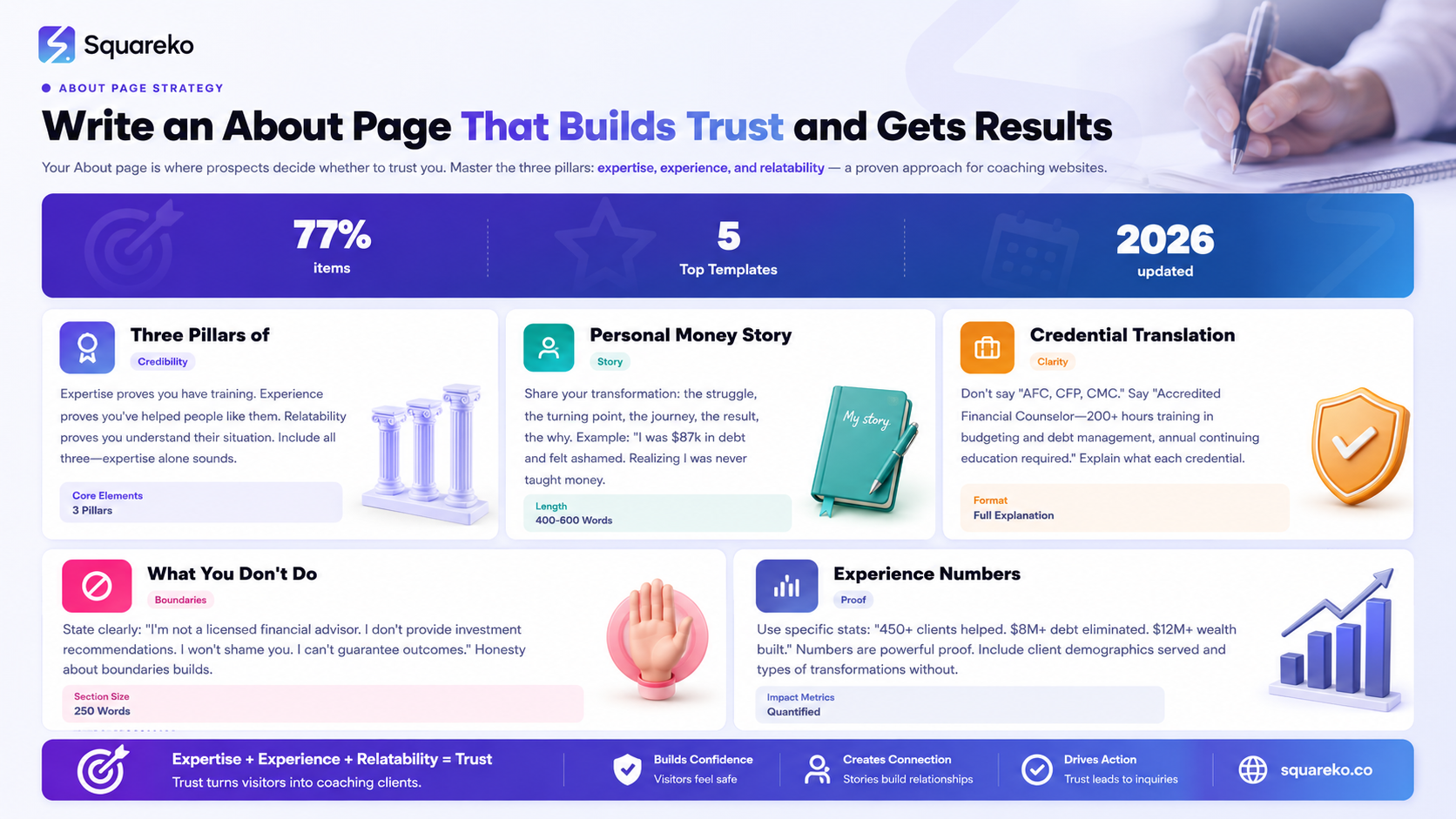
Your About page needs to establish three things simultaneously:
1. Expertise (You Know What You're Talking About)
Your credentials, certifications, and specialized knowledge. This answers: Does this person have training in this area?
For finance coaches, this means:
Certification credentials (AFC, CFP, FCA, coaching certifications)
Education and continued learning
Specialized knowledge areas
Years of experience in your field
2. Experience (You've Actually Helped People Like Me)
Proof that you've worked with clients in situations similar to your prospect's. This answers: Have you done this before with someone in my situation?
This includes:
Number of clients helped
Types of transformations (anonymized)
Years in the coaching field
Client demographics you serve
Specific problems you've solved
3. Relatability (You Get My Situation)
Your own money journey and current approach. This answers: Do you understand what I'm going through?
This is where your personal story comes in—but framed strategically.
Structuring Your About Page for Maximum Trust
Your About page should follow a psychological journey that moves from skepticism to trust.
Section 1: Above-the-Fold Statement (200 words)
Start with a clear value statement, not your biography.
Weak approach: Hi, I'm Sarah. I've been coaching for 10 years...
Strong approach: If you're carrying money shame and think you're alone in your financial struggles, you're not. I help women in their 40s go from financial anxiety to confident wealth-building. I've worked with over 200 clients through similar situations, and I know exactly what it takes to move from stuck to empowered.
Then briefly touch your credibility:
Certification: Accredited Financial Counselor (AFC)
Specialization: Debt freedom and wealth building for women
Philosophy: I teach money without shame or judgment
Section 2: Your Money Story (400-600 words)
This is the emotional anchor of your About page. It says: I've been where you are. I understand.
Structure your story:
The struggle (where you started): What financial situation were you in? What did it feel like? Be specific enough to be relatable.
The turning point (what shifted): What made you realize something had to change? An event, a conversation, a breaking point?
The journey (how you fixed it): What did you learn? What steps did you take? What was hard? This is where your credibility deepens—you didn't find easy answers. You did the work.
The transformation (where you are now): What's different now? How does your relationship with money feel different?
The purpose (why you coach): Why did this experience lead you to become a coach? What do you want to help others avoid?
Example framework:
Five years ago, I was drowning in $87,000 of debt across credit cards, student loans, and a car payment. I made good money—$65k/year—but I was living paycheck to paycheck with constant anxiety. I felt ashamed. I felt like I was failing.
One day, I realized something: I wasn't bad with money. I'd just never been taught how to manage it. No one had shown me the system. That shift—from shame to curiosity—changed everything.
I started learning about budgeting, debt payoff strategies, and wealth-building principles. I read books, took courses, worked with a financial advisor. Within 18 months, I'd paid off $30k of that debt. Within 4 years, I was completely debt-free with a fully-funded emergency fund.
But here's what matters: the changes I made weren't complicated. They were just different from what I'd been doing. Once I understood the system, everything clicked.
That's why I coach. I've walked the path from financial shame to financial confidence, and I know exactly what it takes. I don't judge. I don't shame. I teach the system that worked for me—adapted to your situation.
This story serves multiple purposes:
Humanizes you: You're not a distant expert. You're someone who's been stuck too.
Proves transformation is possible: Your story is living proof that change happens.
Establishes relatability: Someone reading this thinks Wait, that's exactly how I feel.
Builds authority through vulnerability: Sharing struggle actually increases credibility.
Section 3: Your Approach and Philosophy (300-400 words)
Now that visitors feel connected to you, explain how you work.
Key elements:
Your coaching method: I use the [Method Name] framework because it focuses on behavior change, not just numbers.
Your values: I believe financial transformation is possible for anyone. I don't judge. I meet you where you are.
What's different about you: Unlike traditional financial advisors, I focus on the mindset and habits alongside the strategy.
Who you work with: I specialize in helping women in their 40s and 50s who've never prioritized wealth building.
Be specific. Generic (I help people with money) converts nobody.
Section 4: Credentials and Certifications (200-250 words)
Now explain your qualifications in human language.
Don't write: AFC, CFP, FICO certified, studied at XYZ University
Do write: I'm an Accredited Financial Counselor (AFC), which means I've completed 200+ hours of training in financial counseling, budgeting, and debt management, and I maintain continuing education. I'm also certified in behavioral money coaching, which teaches me how to help clients shift their relationship with money—not just their financial numbers. I've worked with [Organization] and studied under [Notable Coach/Educator].
For each credential:
State the certification name clearly
Explain what it means (what training it required)
Explain why it matters to your clients
Don't assume people know what AFC stands for
Section 5: Experience and Results (300-400 words)
Proof of what you've accomplished.
Frame it as:
In [X years], I've worked with [number] clients to...
Eliminate $5+ million in combined debt
Build emergency funds averaging $15k
Transition from paycheck-to-paycheck to 6-month savings cushion
Create sustainable wealth-building plans for long-term security
Use numbers. They're powerful.
Then add specifics without betraying confidentiality:
I've worked with women across multiple professions—teachers, nurses, small business owners, corporate professionals. Their situations vary, but the pattern is always the same: they're smart, they earn well, and they've never learned a financial system. Once they understand the framework, everything changes.
Section 6: What I Don't Do (250 words)
This is critical and often missing.
Write clearly about your boundaries:
I'm not a financial advisor, and I don't provide investment recommendations. I educate clients on investment principles and help them think through their approach, but specific investment decisions require a licensed financial advisor.
I can't help with tax planning. For that, you need a CPA.
I won't shame you. If a coach shames you about your financial past, that's not coaching—that's harm. I'm here to help, not judge.
I don't guarantee specific financial outcomes. I can guarantee I'll teach you the system and support you through implementation. What you do with that is up to you.
I work best with clients who are ready to change. If you're looking for quick fixes or get-rich-quick schemes, I'm not your coach.
This honesty builds massive trust. It shows:
You understand regulatory boundaries (YMYL compliance)
You won't overpromise
You're honest about limitations
You understand when to refer to other professionals
Writing Your Personal Money Transformation Story
The best About pages include a vulnerable, specific personal story. Here's how to write it effectively.
Make It Real, Not Sanitized
Don't say: I had a minor budget issue. Do say: I was $87,000 in debt with no plan and constant anxiety attacks about money.
The more specific your struggle, the more powerful your story.
Focus on Feelings, Not Just Numbers
Numbers alone don't connect. Feelings do.
I made $65k/year and felt like I was failing hits harder than I had a high income but struggled with money management.
Include the Turning Point
Every transformation story needs a moment where things shifted. Was it:
A conversation?
An event?
A realization?
A person who believed in you?
Make this vivid. This is where your story shifts from problem to possibility.
Connect to Your Coaching Why
Your past isn't about you. It's about your clients. Connect it clearly:
That's why I became a coach: I want to help people avoid the shame and confusion I experienced. I want them to know that financial transformation is possible, and more importantly, it's available to them right now.
Presenting Credentials and Certifications Effectively
Finance coaching has multiple certification pathways. Your About page needs to translate these clearly.
Common Finance Coaching Credentials
Accredited Financial Counselor (AFC)
Issued by: AFCC (Association for Financial Counseling and Planning Education)
Means: 200+ hours training, exam, continuing education required
In marketing copy: Certified to help clients with budgeting, debt management, and financial planning.
Certified Financial Planner (CFP)
Issued by: FINRA/CFP Board
Means: Advanced financial planning credentials (higher regulatory bar)
In marketing copy: Certified financial planning professional with training in comprehensive financial strategy.
Certified Money Coach (CMC)
Issued by: Money Coaching Institute
Means: Behavioral coaching training specific to money psychology
In marketing copy: Trained in behavioral money coaching—understanding how psychology affects financial decisions.
Financial Health Coach Certification
Various institutions offer this
In marketing copy: Always specify the institution: Certified health coach through [Institution]
How to Display These Effectively on Your About Page
Don't just list acronyms. Explain each credential in a way visitors understand:
My credentials include:
Accredited Financial Counselor (AFC): 200+ hours of training in debt management, budgeting strategies, and financial counseling. This certification requires continuing education annually.
Certified Money Coach (CMC): Specialized training in the psychology of money—understanding how beliefs and behaviors shape financial decisions.
Member of the National Foundation for Credit Counseling: Continued professional development and ethical standards.
Building Authority Through Experience and Results
Numbers matter. Use them.
Client Impact Statements
In my 7 years as a finance coach, I've worked with...
450+ clients
Helped eliminate $3.2M in combined debt
Built $8.5M in combined wealth
Worked across 15+ professions
Specialized Experience
I specialize in working with:
Women in their 40s-50s (specific demographic)
Business owners managing irregular income
Single parents building financial security
People recovering from financial setbacks
Published/Speaking Authority
If you've been quoted, published, or spoken publicly:
Featured in: Forbes, The Balance, Money Magazine Speaking engagements: National Association of Financial Counselors Annual Conference, Women and Money Summit
These signals matter to Google and to visitors.
The Power of What I Don't Do
This section prevents misaligned client relationships and builds trust.
Be clear about:
Regulatory boundaries: I'm not a licensed financial advisor. I don't provide investment recommendations.
Your specialization limits: I focus on women's financial empowerment. If your primary issue is business accounting, you need a CPA or business accountant.
Service boundaries: I coach individuals, not couples. If you're in a relationship, both partners need to be committed to the coaching process.
Promise limitations: I can't guarantee debt elimination by a specific date. I can teach you the system. How fast you move is up to you.
Design Elements That Reinforce Trust
Your About page isn't just copy—design matters.
Professional Photo
Use a high-quality photo of yourself looking approachable and competent. This isn't your LinkedIn headshot. This is I'm someone you can trust and work with.
On Squarespace, place this photo beside your story section (right side for left-to-right readers).
Testimonial Placement
Include a testimonial mid-page that says something like: Working with [Coach] changed how I think about money. She's patient, non-judgmental, and genuinely cares about her clients' success.
Place it after your credentials section—serves as social proof of your claims.
Credential Visual Display
Don't use a boring bulleted list. On Squarespace, use:
Logo display for certifications (if you have them)
Timeline format for experience (7 years as a finance coach)
Icons or badge designs for key credentials
Trust Signal Elements
Consider adding:
Badge: Member of [Professional Organization]
Stats: 450+ clients helped
Years: Coaching since 2018
Frequently Asked Questions
-
1,500-2,000 words is ideal. Long enough to tell your story and establish credibility, short enough to maintain engagement. Longer about pages convert better for high-trust services like coaching.
-
Failures in your past, yes. "I was drowning in debt" is powerful. Current business failures, no. Keep current struggles out of the About page.
-
You can still share your origin story. "I grew up watching my parents struggle with money, and I became obsessed with understanding financial systems. That obsession became my career." The point is relatability, not necessarily personal struggle.
-
Briefly, yes. "As a mother of three and someone who's prioritized financial security for my family..." shares context without oversharing. Avoid personal details beyond what serves your credibility as a coach.
-
Only if they relate to finance coaching. If you're a coach and also run an unrelated business, keep focus on your coaching. Divided attention signals lack of commitment.
-
Update annually to reflect new certifications, milestones (500 clients, 10 years experience), or significant achievements. Otherwise, leave it stable—consistency builds trust.
-
Focus on your story, your training, and your specialization. "I'm new to coaching, but I've spent 5 years working in [related field] and completed [certification program]. I specialize in helping [specific niche] because of my background in [relevant experience]."
-
No. Save pricing for your Services page. The About page builds connection. The Services page closes the sale. Don't mix them.
Ready to write an About page that converts?
Squareko specializes in YMYL-compliant copy architecture for finance coaches. We help you translate your credentials, experience, and story into language that builds trust and moves visitors toward booking a consultation.
Let's discuss your About page strategy.
From custom website design to SEO strategy, we help businesses launch a site that looks professional and performs better.

About the Author
I'm Walid Hasan, a Certified Squarespace Expert and Squarespace Circle Platinum Partner with over 12 years of hands-on experience designing and optimizing high-performing websites. Over the years, I've had the privilege of building more than 2,000 Squarespace websites for clients around the world, always focusing on clean design, strong user experience, and conversion-driven results.