Kids Brand SEO on Squarespace: Reach Parents Online
Introduction
Parents today are more digitally savvy than ever. When they're searching for the perfect toy, safest clothing brand, or educational resource for their child, they turn to Google, Bing, and AI search engines like ChatGPT and Gemini. If your kids brand isn't optimised for these search channels, you're missing out on a massive audience of ready-to-buy parents.
Kids brand SEO on Squarespace isn't just about generic keyword rankings. It requires a specialised approach that understands how parents search—focusing on age milestones, safety concerns, gift occasions, and problem-solving searches. Parents don't just search for "toys"; they search for "best educational toys for 3-year-olds," "non-toxic baby clothing brands," and "sensory toys for autistic children."
In this guide, we'll show you exactly how to optimise your Squarespace kids brand website to reach parents on Google, Bing, and emerging AI search platforms. You'll learn parent-focused keyword research, how to implement Product schema, optimise for AI assistants, and build local SEO authority—all tailored for the kids and family retail space.
Key Takeaways
Parents search differently for children's products, prioritising safety, age-appropriateness, and learning value—your keyword strategy must reflect this.
Squarespace's native SEO tools and Product schema capabilities allow kids brands to rank competitively without expensive plugins.
AI search engines like ChatGPT and Gemini are now major discovery channels; optimising for citations and structured data helps your brand appear in AI-generated recommendations.
Local SEO for kids brands (community events, parent networks, Google Business Profile optimisation) drives both online visibility and foot traffic.
Content marketing targeting parent pain points—developmental stages, safety concerns, budget consciousness—builds trust and improves organic rankings.
Implementing proper Product schema with ageRange, material certifications, and safety information signals authority and trustworthiness to search algorithms.
A Squarespace kids brand website needs regular content updates, community engagement, and citation-building to maintain competitive rankings in a growing market.
How Parents Search for Children's Products
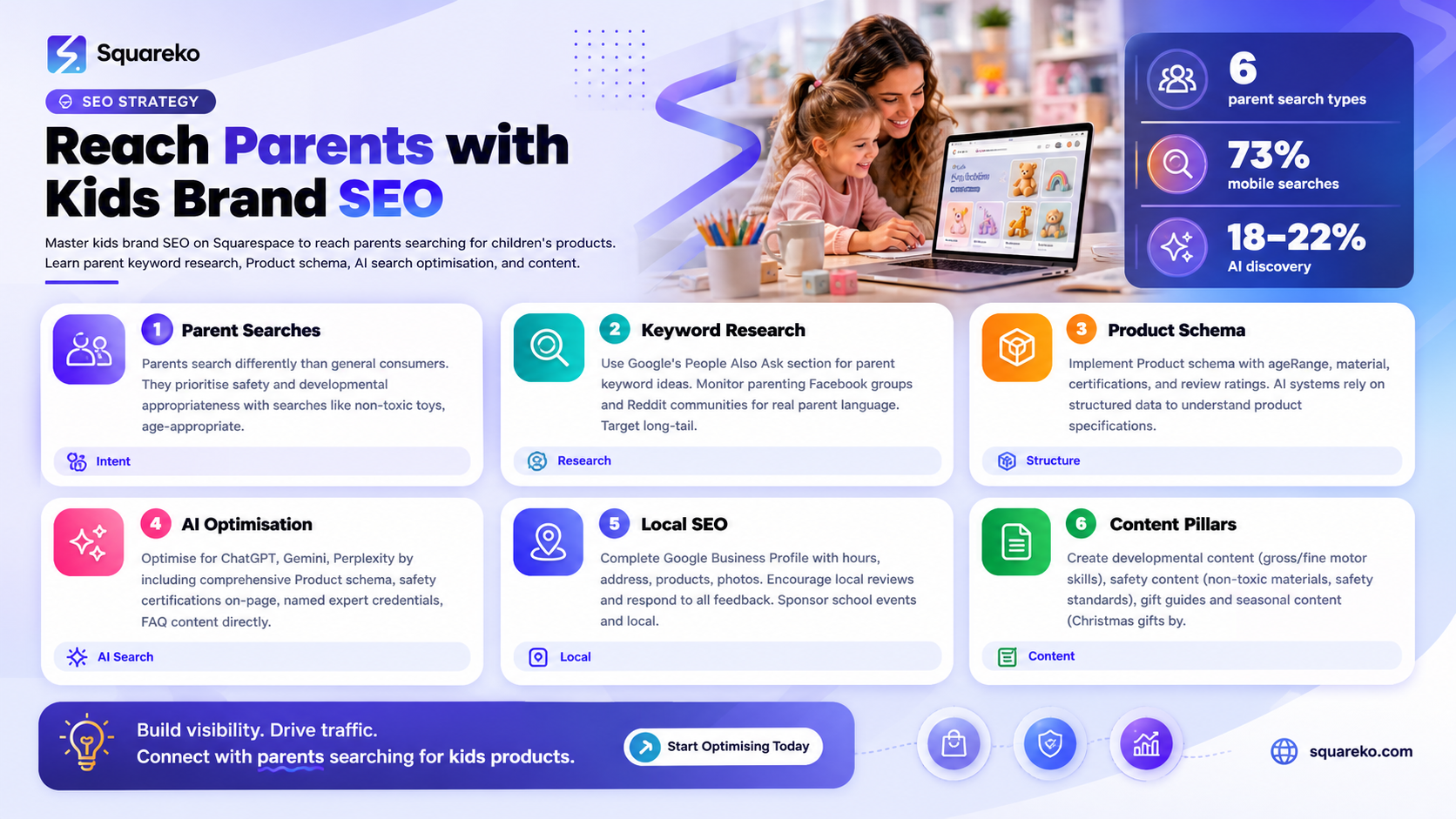
Understanding parent search behaviour is the foundation of effective kids brand SEO. Parents don't search like casual browsers—they search with intention, concern, and specific needs in mind.
The Parent Search Journey
Parents typically search for children's products across four distinct categories:
Gift Occasion Searches Parents searching "best gifts for 5-year-old girl," "birthday presents for toddlers 18 months," or "Christmas gifts for kids 2024" are actively preparing to buy. These searches carry high intent and are prime opportunities for conversion.
Age-Milestone Searches Searches like "toys for child learning to walk," "educational toys for 2-year-olds," and "sensory development toys newborn" reflect parents looking to support their child's developmental stage. These searches indicate parents are investment-minded and value-focused.
Safety-Concern Searches Parents increasingly search "non-toxic baby clothing brands," "BPA-free toys UK," "sustainable children's clothing," and "allergen-free kids products." Safety and ethical sourcing are now primary decision factors for parents—especially across premium and eco-conscious segments.
Problem-Solving Searches Phrases like "toys for anxious kids," "clothing for sensitive skin children," "educational games for dyslexic children," and "sensory toys for autism" show parents seeking solutions to specific challenges. These searches often target niche and specialty brands.
Why This Matters for Your Squarespace Site
Parents are researching longer before purchase than ever. They'll visit multiple websites, read reviews, check certifications, and compare pricing. Your Squarespace website needs to answer their questions, build trust, and guide them toward purchase throughout this journey.
Parent-Focused Keyword Research for Kids Brands
Effective keyword research for kids brands starts with thinking like a parent, not a marketer.
Keyword Categories and Real Examples
Product-Specific Keywords
"Best eco-friendly baby clothing UK"
"Non-toxic wooden toys for toddlers"
"Educational STEM toys age 6-8"
"Sustainable kids shoes brands"
These keywords target parents actively comparing products within a category.
Age-Specific Keywords
"Toys for 12-month-old development"
"Clothing for 3-year-olds sizing"
"Educational apps for 4-year-olds"
"Best gifts for kids turning 5"
Age-specific searches reflect parents' focus on developmental appropriateness.
Safety and Values Keywords
"Allergy-friendly kids clothing"
"Plastic-free toys for babies"
"Fair trade children's clothing brands"
"Lead-free toys certification UK"
These keywords show parents prioritising ethics, safety, and values alignment.
Problem-Based Keywords
"Sensory toys for hyperactive kids"
"Clothes for eczema-prone children"
"Learning toys for speech delay"
"Fidget toys for anxious children"
Parents searching these are often looking for specific solutions and are willing to invest in quality.
Building Your Keyword Strategy
Use Google's "People Also Ask" Section — Visit Google, search a parent keyword (e.g., "best wooden toys for 1-year-old"), and note the "People Also Ask" questions. These represent genuine parent concerns and search queries.
Monitor Parent Communities — Check parenting Facebook groups, Mumsnet forums, and Reddit communities (r/Parenting, r/BabyBumps) to discover real language parents use when discussing products.
Analyse Competitor Keywords — Use SEMrush or Ahrefs to identify keywords your competitors rank for, then target variations and long-tail opportunities they've missed.
Prioritise Long-Tail Keywords — "Non-toxic baby clothing brands UK" (low competition, high intent) typically converts better than "kids clothing" (high competition, vague intent).
Map Keywords to User Intent — Organise keywords by purchase intent (informational, comparison, transactional), then create content that aligns with each stage of the parent's decision journey.
Optimising Your Squarespace Website for Kids Brand SEO
Squarespace offers powerful native SEO features that work exceptionally well for kids brands. You don't need expensive plugins—just use Squarespace's tools strategically.
Squarespace SEO Essentials for Kids Brands
Page Titles and Meta Descriptions Every product page and category page should have a unique, parent-focused title and description. Instead of "Toys," write "Eco-Friendly Wooden Toys for Toddlers | SafePlay Toys." The meta description should include your focus keyword and compel parents to click: "Shop award-winning wooden toys made from sustainable timber. Non-toxic, developmental, and loved by parents since 2018."
URL Structure Keep URLs short, descriptive, and keyword-relevant:
Good: yoursite.com/toys/wooden-toys-toddlers
Avoid: yoursite.com/products/item-4782
Heading Structure (H1, H2, H3) Use only one H1 per page (your main title). Use H2s for major sections and H3s for subsections. Include your focus keyword in the H1 and naturally in H2s where relevant.
Internal Linking Link strategically from your homepage to high-priority product categories, from category pages to best-performing products, and from blog posts to relevant product pages. For example, if you write a blog post on "5 Learning Toys That Boost Language Development," link naturally to your STEM and educational toy collections.
Image Optimisation Use descriptive alt text for every product image: "Wooden stacking rings toy for 12-month-old development" rather than "Product image 1." Include your focus keyword in at least one image alt text per page, but only naturally.
Mobile Optimisation Squarespace templates are mobile-responsive by default, but ensure your kids brand website loads quickly on mobile devices (test via Google PageSpeed Insights). Parents often research on smartphones while out shopping.
Site Speed Google ranks faster sites higher. Compress images, minimise redirects, and enable browser caching. A slow Squarespace site loses parents to competitors.
Squarespace SEO Settings Checklist
Enable Squarespace SEO panel in site settings
Write unique meta titles (50–60 characters) and descriptions (150–160 characters) for every product and category page
Create a sitemap and submit to Google Search Console
Set up Google Business Profile (essential for local SEO)
Enable SSL/HTTPS (Squarespace does this automatically)
Create robots.txt and disallow non-indexable pages (e.g., cart, checkout)
Add structured data (Schema markup) via Squarespace's Code Injection or custom blocks
Set preferred domain (www vs. non-www) in Search Console
Product Schema and Structured Data for Kids Products
Structured data is critical for kids brand SEO. It helps Google, Bing, and AI engines understand what you're selling, who it's for, and why parents should trust you.
Essential Schema for Kids Products
Product Schema with Safety and Age Information Include the following fields in your Product schema markup:
{
  "@context": "https://schema.org/",
  "@type": "Product",
  "name": "Wooden Stacking Rings Toy",
  "image": "https://example.com/rings.jpg",
  "description": "Sustainable wooden stacking rings for sensory and motor skill development.",
  "brand": {
    "@type": "Brand",
    "name": "SafePlay Toys"
  },
  "offers": {
    "@type": "Offer",
    "url": "https://example.com/products/stacking-rings",
    "priceCurrency": "GBP",
    "price": "24.99",
    "availability": "InStock"
  },
  "aggregateRating": {
    "@type": "AggregateRating",
    "ratingValue": "4.8",
    "reviewCount": "156"
  },
  "ageRange": "12 months+",
  "material": "Sustainably sourced beechwood",
  "award": "Winner: Best Sensory Toy 2025",
  "certifications": ["CE Marked", "FSC Certified", "Phthalate-Free"],
  "review": [
    {
      "@type": "Review",
      "author": { "@type": "Person", "name": "Emma T." },
      "reviewBody": "My 14-month-old loves these rings. Well-made and safe.",
      "ratingValue": "5"
    }
  ]
}
Key fields for kids products:
ageRange — Explicitly state the recommended age range
material — List materials, certifications (non-toxic, non-BPA, etc.)
certifications — Include safety standards, environmental certifications
aggregateRating — Parent reviews and ratings build trust significantly
AggregateOffer Schema
If you sell across multiple price points or variants, use AggregateOffer:
{
  "@type": "AggregateOffer",
  "priceCurrency": "GBP",
  "lowPrice": "19.99",
  "highPrice": "34.99",
  "offerCount": "6",
  "offers": [
    {
      "@type": "Offer",
      "url": "https://example.com/product/small",
      "price": "19.99",
      "priceCurrency": "GBP"
    }
  ]
}
LocalBusiness Schema (for Physical Stores)
If your kids brand has a physical location, add LocalBusiness schema:
{
  "@context": "https://schema.org/",
  "@type": "LocalBusiness",
  "name": "SafePlay Toys Shop",
  "image": "https://example.com/storefront.jpg",
  "description": "Award-winning eco-friendly toys for children.",
  "address": {
    "@type": "PostalAddress",
    "streetAddress": "123 High Street",
    "addressLocality": "Bristol",
    "addressRegion": "Bristol",
    "postalCode": "BS1 5TX",
    "addressCountry": "UK"
  },
  "telephone": "+44 117 1234567",
  "url": "https://example.com",
  "geo": {
    "@type": "GeoCoordinates",
    "latitude": "51.4545",
    "longitude": "-2.5879"
  },
  "openingHoursSpecification": {
    "@type": "OpeningHoursSpecification",
    "dayOfWeek": ["Monday", "Tuesday", "Wednesday"],
    "opens": "10:00",
    "closes": "18:00"
  }
}
How to Add Schema to Squarespace
Go to Settings > SEO > Code Injection > Header
Paste your JSON-LD schema code into the header field
Test your markup in Google's Schema Markup Validator
Monitor implementation in Google Search Console > Enhancements
AI Search Optimisation: Getting Found on ChatGPT, Gemini, and Perplexity
AI search is reshaping how parents discover kids brands. ChatGPT, Google Gemini, and Perplexity now answer product questions with recommendations, citations, and direct links. Your kids brand should be visible in these AI-generated answers.
Why AI Search Matters for Kids Brands
When a parent asks "What are the best non-toxic toy brands for toddlers?" an AI engine generates an answer that cites specific brands and links to websites. If your brand isn't cited, you're invisible to this growing search segment.
By 2026, AI-assisted search accounts for approximately 18–22% of online product discovery for parents in the UK and US markets.
Strategies for AI Search Visibility
1. Optimise for Direct Citations AI engines source information from:
Your website's main content (product descriptions, about pages)
Industry mentions (parenting blogs, review sites, trade publications)
Structured data (Product schema, reviews)
Ensure your website clearly states:
Your brand's mission and values (safety-first, eco-conscious)
Product certifications and third-party endorsements
Parent testimonials and award wins
Example: "SafePlay Toys: Award-winning sustainable toys recommended by paediatricians and featured in The Guardian's Best Kids Brands 2025."
2. Build Citations in Parenting Authority Sites Get your kids brand mentioned in:
Parenting blogs and publications (BabyCenter, What to Expect, Mother&Baby)
Award directories (The Independent's Best Toy Brands, BBC Good Design Awards)
Parenting communities (Mumsnet product recommendations, Reddit parenting threads)
These third-party citations make you discoverable to AI engines searching for trustworthy brand recommendations.
3. Implement Rich Snippets and Review Schema AI engines prioritise brands with high review counts and ratings. Encourage parent reviews on your Squarespace site and implement Review schema markup. A 4.8+ average rating signals quality to both search algorithms and AI assistants.
4. Create Topical Authority Content Write comprehensive guides and blog posts that AI engines can cite:
"Complete Guide to Non-Toxic Baby Toys: Materials, Certifications, and Parent Recommendations"
"How to Choose Educational Toys by Child Age: Expert Tips for Development"
When AI engines answer parent questions, they cite authoritative sources. Your comprehensive guides become citation sources.
5. Optimise for Natural Language Queries Parents ask AI engines conversational questions:
What should I buy my 3-year-old for her birthday?
Are wooden toys better than plastic for development?
What toys help kids with sensory issues?
Your website content should naturally answer these questions in conversational language, not just optimised keyword phrases.
AI Search Platforms to Monitor
ChatGPT — Add your website to the ChatGPT browsing allowlist (via your robots.txt and sitemap)
Google Gemini — Appears in Google Search results; the same SEO best practices apply
Perplexity — Actively crawls websites and cites sources; ensure your site is crawlable
Copilot — Microsoft's AI search; optimise for Bing as well as Google
Local SEO Strategies for Kids Brands with Physical Presence
If your kids brand has a physical store, local SEO is essential for attracting nearby parents and families.
Google Business Profile Optimisation
Your Google Business Profile is often the first impression parents have of your kids brand.
Complete Every Field:
Store name, address, phone number (ensure consistency across the web)
Hours of operation (including school holidays and special closures)
Website URL and menu/catalogue links
Product categories (Toys, Children's Clothing, etc.)
Photos (storefront, products, happy families shopping)
Encourage Local Reviews: After purchase, ask parents to review your Squarespace website or Google Business Profile. Respond to all reviews (positive and negative) professionally and warmly. Parents view this engagement as a sign of trustworthy service.
Post Regularly: Use Google Business Profile posts to announce new arrivals, host in-store events, and share parenting tips. Posts appear in local search results and Google Maps.
Community Engagement and Local Citations
Build authority through local involvement:
Sponsor local school events — Gain mentions on school websites and local community boards
Host parenting workshops — Age-Appropriate Play and Learning workshops build credibility and local buzz
Partner with local nurseries and childcare providers — These partnerships generate word-of-mouth and local citations
List on parenting directories — Add your Squarespace site to local parenting guides and community directories
Local Keywords
Target location-specific keywords:
Best toy shop near me Bristol
Non-toxic kids clothing Manchester
Educational toys store London
Include your city/region in product descriptions, blog posts, and meta tags naturally.
Content Strategy That Speaks to Parents
Content is the bridge between parent concerns and your products. Strategic content improves SEO while building trust.
Content Pillars for Kids Brands
1. Developmental Content Answer parent questions about child development:
Gross Motor Skills in Toddlers: Activities and Toys to Support Development
Fine Motor Skill Development by Age: Guide for Parents
These posts naturally link to relevant products and establish your brand as developmental experts.
2. Safety and Wellness Content Parents obsess over safety. Create authoritative content:
Non-Toxic Toy Materials: A Parent's Guide to Safe Play
Understanding Toy Safety Standards: CE Marking, Phthalates, and More
Include certifications, materials, and testing standards throughout.
3. Gift Guides and Seasonal Content Seasonal content captures high-intent searches:
Best Christmas Gifts for 2-4 Year Olds: Our Top 15 Picks
Birthday Gift Ideas by Age: Expert Recommendations
These guides showcase multiple products and generate significant organic traffic.
4. Problem-Solution Content Target niche audiences with specific needs
Sensory Toys for Autistic Children: Helping Development Through Play
Clothing for Eczema-Prone Kids: Fabric Types and Care Tips
Parents with specific concerns often become loyal customers.
5. Parenting Advice Content Build authority beyond just selling:
How to Choose Toys: A Guide to Child Development and Play
Screen Time Alternatives: Engaging Toys and Activities for Kids
This content establishes your brand as a trusted parenting resource, not just a retailer.
Publishing Cadence
Publish one substantial blog post (1,500–2,500 words) every 2–3 weeks. Consistency signals to Google that your site is actively maintained and relevant.
Internal Linking from Content to Products
Every blog post should naturally link to 3–5 relevant product pages. For example, your post on Fine Motor Skill Development should link to bead-threading toys, shape-sorting toys, and building blocks.
FAQs
-
Kids clothing brands should target a mix of keyword types: age-specific keywords ("girls clothing age 4-5"), size-related keywords ("kids clothing size 104 height"), value-based keywords ("sustainable children's clothing brands UK"), and concern-based keywords ("hypoallergenic kids clothing"). Additionally, include seasonal keywords ("summer kids clothes 2025"), activity-specific keywords ("school PE kit for kids"), and family occasion keywords ("party dresses for girls ages 6-8"). Conduct research in parenting communities to uncover how parents actually describe sizing, fabric preferences, and brand values they prioritise.
-
Ranking a toy store on Google requires several layered strategies: (1) Complete keyword research targeting parent search terms with high intent (not just "toys," but "best educational toys for 18-month-olds"). (2) Optimise your Squarespace website with unique meta titles/descriptions, keyword-rich URLs, and fast loading speeds. (3) Implement Product schema markup with age ranges, materials, safety certifications, and review ratings. (4) Build citations from parenting blogs, award directories, and local community directories. (5) Create content addressing parent pain points (safety concerns, developmental questions, gift guides). (6) Encourage parent reviews and respond to them. (7) Earn local citations if you have a physical location. (8) Build internal links strategically from blog posts to product pages. Ranking takes time—typically 4–8 weeks for new pages, longer for highly competitive keywords—but consistency with these strategies drives results.
-
Parents search very differently than general consumers. They prioritise safety and developmental appropriateness, searching for "non-toxic toys," "age-appropriate gifts," and "toys for speech development" rather than generic product names. Many searches include qualifiers: "best," "safest," "educational," "eco-friendly." Parents also search by occasion ("birthday gifts for 3-year-old"), by problem ("toys for anxious kids," "clothes for sensitive skin"), and by values ("fair trade children's clothing," "sustainable kids brands"). Additionally, many parent searches happen on their smartphones while shopping or researching, and they often visit multiple websites before purchasing. Parents rely heavily on reviews and recommendations from other parents, making community-driven proof (customer testimonials, third-party awards, citations in parenting publications) crucial for conversion.
-
Product schema is structured data markup (JSON-LD code) that tells search engines exactly what you're selling and why it matters. For kids brands specifically, Product schema should include: product name, description, price, images, availability, brand, aggregate rating, and crucially—age range, materials, and safety certifications. By implementing Product schema, your products become eligible for rich snippets in Google Search results (showing ratings, price, availability at a glance). Schema also makes your products discoverable to AI search engines like ChatGPT and Gemini, which cite well-structured, trustworthy product information. Parents searching "best toys for 18-month-olds" are more likely to find your products when you've explicitly marked the age range in schema. Without schema, Google and AI engines have to guess what your product is for; with schema, you tell them clearly.
-
AI assistants like ChatGPT, Gemini, and Perplexity discover brands through: (1) your website's published content (product descriptions, about pages, blog posts); (2) third-party citations (mentions in parenting blogs, award sites, community forums); (3) review and rating data (high-rated products appear more frequently in recommendations); (4) structured data (Product schema makes your brand information machine-readable). To increase AI citations: publish comprehensive, authoritative content on your Squarespace site; actively seek mentions in parenting publications and award directories; encourage customer reviews; implement rich schema markup; and ensure your website is crawlable (no robots.txt blocks, fast loading). You can also monitor where your brand is cited using SEMrush or Ahrefs' brand mention tracking, then pursue similar opportunities with other high-authority parenting sites.
-
Squarespace is an excellent platform for kids brands. It offers native SEO features (meta tags, URL customisation, image alt text), mobile-responsive templates, Product schema support, fast hosting, and built-in email marketing—all without requiring custom coding. You can implement structured data via Squarespace's Code Injection feature, add reviews and ratings through third-party integrations, and create a professional ecommerce site that converts parents. The main limitation is extreme customisation—if you need very bespoke features, a custom-coded site might be necessary. However, for most kids brands, Squarespace provides the ideal balance of ease-of-use, performance, and SEO capability. Many of the fastest-ranking kids brand websites use Squarespace.
-
At minimum, publish one substantial blog post every 2–3 weeks. Update product descriptions seasonally (reflect new stock, changing seasons, updated certifications). Refresh product images quarterly to show your brand actively selling. Respond to all customer reviews promptly—this signals to Google that your site is actively managed. Review and update internal links quarterly to ensure they point to best-performing products. Monitor keyword rankings monthly and adjust content strategy based on what's working. If you sell seasonal products (Christmas toys, summer clothing), plan content 6–8 weeks in advance. Consistency matters more than frequency; a steady cadence of quality updates outranks sporadic bursts of activity.
Ready to Build Your Kids Brand Website with Squarespace?
Getting your kids brand in front of parents on Google, Bing, and AI search engines requires strategy, consistency, and the right platform. Your Squarespace website is the foundation—and when optimised properly, it becomes a powerful discovery channel that drives both organic traffic and sales.
If you're ready to build or redesign your kids brand website with SEO built in from day one, the team at Squareko specialises in Squarespace design and optimisation for retail and ecommerce brands. We understand how parents search, how to implement Product schema correctly, and how to structure your site for both search engine and AI visibility. Whether you're launching a new toy brand, scaling a kids clothing business, or refreshing your online presence, we'll ensure your Squarespace site reaches the parents actively searching for what you sell.

From custom website design to SEO strategy, we help businesses launch a site that looks professional and performs better.

Author Bio
Written by the Squareko Team | squareko
I'm Walid Hasan, a Certified Squarespace Expert and Squarespace Circle Platinum Partner with over 12 years of hands-on experience designing and optimizing high-performing websites. Over the years, I've had the privilege of building more than 2,000 Squarespace websites for clients around the world, always focusing on clean design, strong user experience, and conversion-driven results.