Interior Designer Website Design Best Practices on Squarespace for 2026
Your website is your primary portfolio. Unlike traditional design practices where clients visited showrooms, today's interior designers live or die by the quality of their web presence. The best firms understand this: a thoughtfully designed website isn't a marketing afterthought—it's the cornerstone of client acquisition and brand perception.
This guide outlines the web design standards interior designers must meet in 2026. Whether you're rebuilding your site or evaluating platforms, these principles will ensure your Squarespace website reflects the professional rigour your work demands.
Key Takeaways
White space and editorial layout create the premium aesthetic clients expect from high-end interior designers
Full-bleed imagery and professional photography are non-negotiable for visual-first portfolio presentation
Typeface selection signals design sophistication—serif faces for luxury positioning, geometric sans for contemporary studios
Neutral colour palettes ensure project photography, not the website design, becomes the focal point
Strategic navigation architecture allows visitors to browse by style, room type, or design philosophy
Mobile optimisation is essential, as clients increasingly present website portfolios during on-site consultations
Introduction
Interior designers occupy a unique position in web design. You're not selling products; you're selling vision, taste, and the ability to transform spaces. Your website must communicate this before a single conversation occurs.
The challenge is this: your audience—prospective clients evaluating your firm—are trained to notice design details. They've curated their homes. They follow design publications. They understand proportion, balance, and visual hierarchy. Your website will be judged with the same critical eye you apply to your own projects.
This is where many designer websites fail. They attempt to do everything—blog content, service descriptions, testimonials, contact forms—and end up muddled. The most effective interior designer websites in 2026 prioritise simplicity, visual clarity, and an uncompromising editorial standard.
The focus keyword—interior designer website design best practices squarespace 2026—signals something important: platforms matter, but principles matter most. Squarespace provides the technical infrastructure. You provide the design discipline.
White Space and Editorial Layout for Premium Positioning
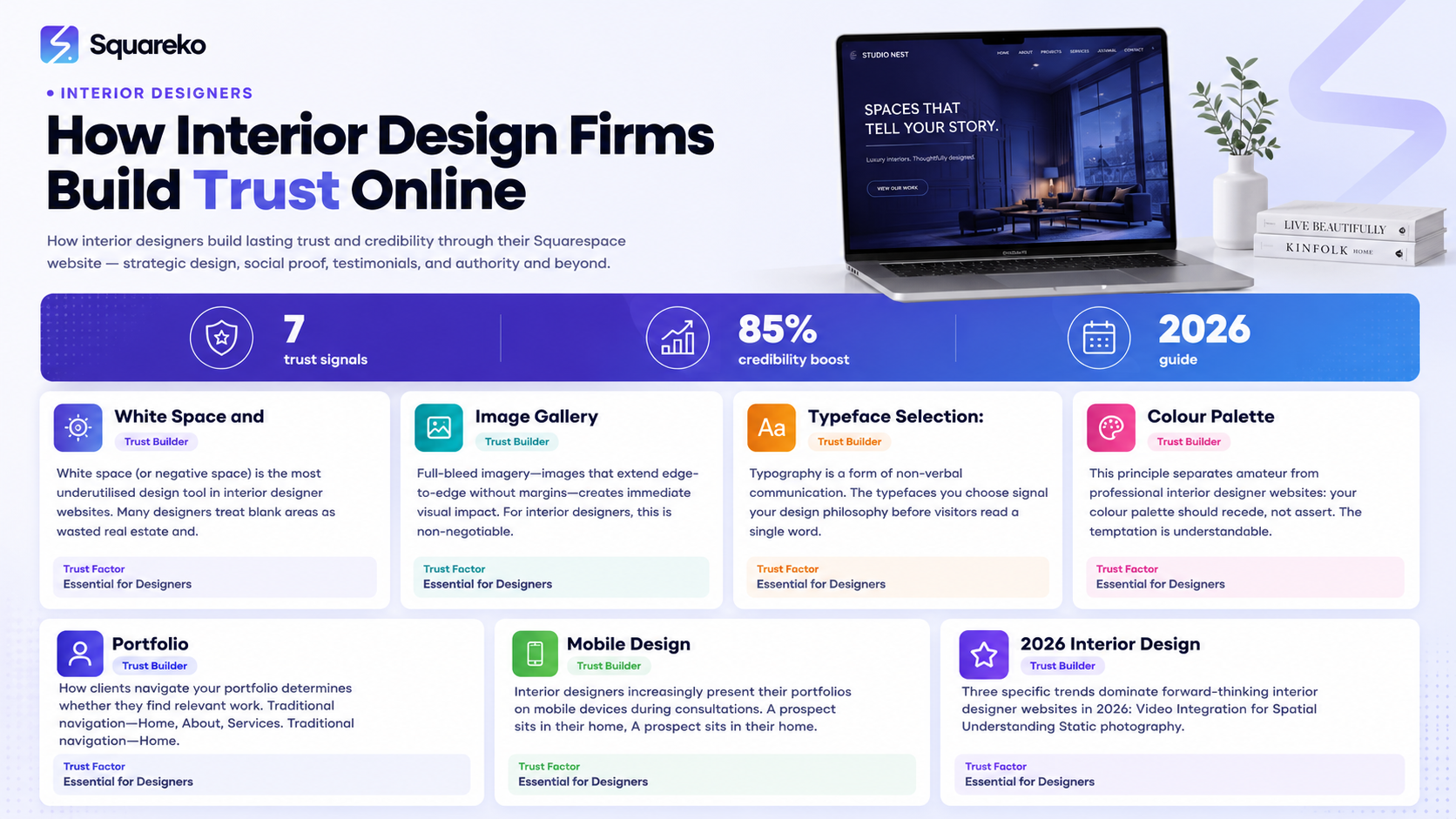
White space (or negative space) is the most underutilised design tool in interior designer websites. Many designers treat blank areas as wasted real estate and feel compelled to fill them. This is a critical error.
White space performs multiple functions simultaneously:
Visual Breathing Room: Content crowding creates cognitive load. A visitor scanning your portfolio experiences fatigue if imagery and text compete for attention. Strategic white space allows the eye to rest and process one element at a time.
Signal of Luxury: High-end brands—from fashion to hospitality—employ generous white space. It communicates confidence, selectivity, and quality. A portfolio with breathing room suggests a designer who's equally deliberate about their projects.
Focus on Imagery: Interior design is a visual discipline. When you surround a full-bleed project image with white space, that image becomes the singular focus. Nothing competes. The design of the website itself becomes invisible—which is precisely the goal.
In practice, this means:
Single project per page or section, not grids of thumbnails
Generous padding around portfolio items (minimum 60-80 pixels on desktop)
Limited text; let images carry narrative weight
Ample vertical spacing between sections (80-120 pixels)
Editorial layout principles borrowed from print design apply equally on screen. Think of your homepage as a carefully composed magazine spread. Each section has hierarchy. The eye moves intentionally from element to element.
Full-Bleed Imagery and Visual Impact
Full-bleed imagery—images that extend edge-to-edge without margins—creates immediate visual impact. For interior designers, this is non-negotiable.
A full-bleed image on page load accomplishes several things:
Immediate Authority: Visitors know within milliseconds whether they're viewing a professional interior designer or a generalist web designer. High-quality, carefully composed photography establishes credibility instantly.
Storytelling Without Words: Your best projects tell a story visually. A full-bleed before-and-after, or a single composed room photograph, conveys transformation and thoughtfulness faster than descriptive copy.
Mobile Presence: Full-bleed images scale responsively on mobile. A hero image optimised for mobile won't feel cramped—it remains impactful at any size.
Requirements for full-bleed imagery success:
Minimum dimensions: 1,600 × 900 pixels for desktop display. Larger is acceptable if optimised for web (compressed, not bloated)
Aspect ratios: 16:9 is standard for hero sections. Portfolio images should maintain their original ratios without distortion
Composition: Centre the focal point. Avoid critical details at edges, which may crop on mobile
Lighting and colour: Professional photography is mandatory. Mobile phone photographs, no matter how well-composed, undermine credibility
Squarespace's image block and full-width section templates allow true edge-to-edge display. Utilise these native features. Avoid containing images in boxes or frames that diminish their impact.
Typeface Selection: Serif, Sans-Serif, and Design Intent
Typography is a form of non-verbal communication. The typefaces you choose signal your design philosophy before visitors read a single word.
Serif Typefaces for Luxury and Heritage
Serifs—the small lines extending from letterforms—carry historical weight. They're associated with editorial design, fine art, and established institutions. For luxury interior design studios, serif faces communicate tradition, refinement, and considered taste.
Recommended serif options on Squarespace:
Sabon: A classical, proportional serif with elegance and restraint
Garamond: Industry standard; historically used in fine art and interior design publications
Playfair Display: Contemporary serif with high contrast; works for display headers
Use serifs for:
Primary headings (H1, H2)
Taglines and descriptive copy
Testimonials and editorial sections
Geometric Sans-Serif for Contemporary Studios
Contemporary and minimalist interior design practices thrive with geometric sans-serif typefaces. These faces are clean, modern, and geometrically precise—qualities that align with contemporary design philosophy.
Recommended geometric sans options:
Montserrat: Clean, geometric; excellent readability across sizes
Futura: The quintessential geometric sans; conveys modernism and precision
Circular: Geometric and approachable; used by leading design studios
Use geometric sans for:
Body text and navigation
Project descriptions
Call-to-action buttons
Critical Typography Rules
Limit typefaces to two: One display face (serif or sans) and one body face (typically sans). Mixing three or more creates visual chaos.
Ensure sufficient contrast: Display face paired with body face must be visually distinct. Pairing Garamond with Sabon (two similar serifs) creates confusion.
Establish clear hierarchy: H1 should be noticeably larger than H2, which should be noticeably larger than body text. Use weight variation (bold vs. regular) to reinforce hierarchy.
Test on mobile: Typefaces render differently at small sizes. A beautiful serif headline on desktop might become illegible at 24px on mobile.
Colour Palette Neutrality and Photography as the Hero
This principle separates amateur from professional interior designer websites: your colour palette should recede, not assert.
The temptation is understandable. Your brand is visual; colours feel expressive. But consider what happens when your website uses a vibrant accent colour and a client scrolls to a portfolio image featuring completely different tones. The site's colour competes with your work.
The solution: neutrality.
Recommended Neutral Palettes
Pure Neutral: Off-white backgrounds, charcoal-grey text, black accents. This is the safest, most professional approach. Allows all project imagery—regardless of colour scheme—to shine.
Warm Neutral: Cream or beige backgrounds with deep brown or slate text. Subtly warmer than pure neutral; works especially well for residential design studios.
Cool Neutral: Very light grey backgrounds with near-black text. Contemporary and clean; pairs well with geometric sans-serif typography.
The goal is maximum contrast (readability) and minimum distraction.
When to Use Limited Accent Colour
Use a single accent colour sparingly:
Hover states on buttons
A thin line beneath headings
Icon fills in navigation
Even then, choose a neutral or desaturated tone—dark grey, sage, charcoal—not primary colours.
Colour should never compete with your portfolio photography. Your projects are the colour story. Your website provides the frame.
Navigation Architecture for Style-Based Portfolio Browsing
How clients navigate your portfolio determines whether they find relevant work. Traditional navigation—Home, About, Services, Contact—is functionally complete but misses an opportunity.
Interior designers should implement style-based navigation, allowing visitors to browse by aesthetic preference.
Navigation Structure Example
Portfolio: By Style
Contemporary
Traditional
Transitional
Minimalist
(add categories matching your practice)
Portfolio: By Room Type
Living Spaces
Kitchens & Dining
Bedrooms
Commercial Spaces
About
Services (optional; many top firms omit this)
Contact
This architecture recognises that a client browsing your site is self-selecting. They're looking for alignment—visual and philosophical—with your work. Style-based navigation shortcuts that discovery process.
Technical Implementation on Squarespace
Use Squarespace's collection pages and filtering functionality. Categories should be pre-assigned to each portfolio project. Navigation dropdowns (or expandable menus on mobile) reveal these filters without cluttering the primary navigation.
Mobile navigation is critical. A hamburger menu that reveals style filters works well, provided the menu is clearly labelled and closes after selection.
Mobile Optimisation for Client Presentations
Interior designers increasingly present their portfolios on mobile devices during consultations. A prospect sits in their home, and you pull up your website on an iPad or phone to discuss previous projects.
This behaviour mandates mobile-first design thinking.
Mobile-Specific Requirements
Touch-Friendly Navigation: Buttons and links must be at least 44 × 44 pixels. Tight spacing causes mis-clicks.
Responsive Images: Full-bleed images on desktop should stack appropriately on mobile without excessive whitespace or distortion.
Fast Load Times: Mobile networks are slower. Images should be optimised and compressed without visible quality loss. Squarespace handles much of this automatically, but test actual load times on 4G networks.
Readable Typography: Body text should be minimum 16px on mobile. Headings should maintain hierarchy without becoming oversized.
Minimal Scrolling for Key Content: Portfolio images, contact information, and CTAs should be reachable without excessive vertical scrolling.
Test your website extensively on actual mobile devices—not just browser previews. Bring it to a consultation and use it. You'll quickly identify friction points.
2026 Interior Design Website Trends
Three specific trends dominate forward-thinking interior designer websites in 2026:
Video Integration for Spatial Understanding
Static photography communicates how a space looks. Video communicates how it feels. Short, silent videos panning across a completed project provide spatial context that photographs cannot. Squarespace's video block supports this seamlessly.
Recommendation: Include 15–30 second video clips for 2–3 hero projects. Autoplay (muted) on desktop, click-to-play on mobile.
Sustainability and Design Philosophy
Clients increasingly ask about material sourcing, sustainable practices, and design philosophy. Leading firms in 2026 feature a dedicated section explaining their approach—materials selection, local sourcing, long-term durability thinking.
This isn't marketing copy. It's evidence of serious design practice. Clients notice and respond.
Client Testimonial Video
A 30–60 second video of a satisfied client discussing their project has outsized credibility. It's harder to fake sincerity in video than in written testimonials.
Squarespace's video embed allows hosted video (YouTube, Vimeo). Commission 3–5 short testimonial videos from recent projects.
Interior Designer Website Design Checklist 2026
Use this 20-item checklist to evaluate your website against professional standards:
Typography & Hierarchy
Two typefaces maximum (one display, one body)
Clear visual hierarchy: H1 > H2 > H3 > body text
Minimum body text size: 16px on mobile, 18px on desktop
Consistent line height: 1.5–1.8 for readability
Serif face used for luxury positioning (if applicable)
Geometric sans used for contemporary studio identity (if applicable)
Imagery & Visual Presentation
All portfolio images are professional photography (minimum 1,600px width)
Full-bleed hero image on homepage or primary portfolio page
Image aspect ratios maintained; no distortion or stretching
Portfolio images are compressed for web (no file exceeds 500KB)
At least 2–3 completed projects displayed prominently
Layout & White Space
Minimum 60px padding around portfolio images
Minimum 80–120px vertical spacing between major sections
Single focal point per page section
Generous white space on desktop (nothing cramped or crowded)
Navigation & User Experience
Primary navigation is style-based (Contemporary, Traditional, etc.)
Contact information visible on every page (footer minimum)
Mobile navigation is touch-friendly (44 × 44px buttons minimum)
Page load time is under 3 seconds on 4G mobile networks
Colour & Branding
Neutral background (off-white, cream, or light grey)
High contrast between text and background (WCAG AA minimum)
Accent colours limited and used sparingly
Brand consistency across all pages
This checklist serves as a final audit before publishing or updating your site.
Frequently Asked Questions
-
The design style of your website should recede to serve your portfolio. If you specialise in contemporary design, a clean, minimalist website with geometric sans-serif typography reinforces that positioning. For luxury residential design, a serif-forward, editorially composed site signals refinement. The key is alignment: your website's design language should match the design language of your projects. Avoid misalignment—a minimalist website showcasing maximalist interiors, or vice versa.
-
White (or off-white) backgrounds are the professional standard. Dark backgrounds require careful implementation to maintain readability and can reduce the perceived professionalism of interior design portfolios. Off-white or cream backgrounds offer a neutral canvas that allows project photography to dominate. If you prefer warmth, cream or soft beige is acceptable. Avoid pure black or very dark backgrounds unless your brand positioning explicitly demands it.
-
Luxury interior design practices typically pair a classical serif for display (Sabon, Garamond, or Playfair Display) with a refined sans-serif for body text (Montserrat, or Squarespace's native font library). Serif typefaces signal heritage and refinement; pairing with clean body text creates hierarchy without excess decoration. The goal is elegance through restraint, not ornamental complexity.
-
Quality over quantity is paramount. Six to twelve projects—each photographed professionally and presented at full scale—communicate more authority than fifty projects compressed into thumbnails. Each project should have dedicated page space, detailed imagery, and room for context (client testimonial, design brief, materials used). Visitors should be able to spend 2–3 minutes with each project without scrolling excessively.
-
Subtle, purposeful animation can enhance user experience. Hover effects on navigation, gentle fade-ins as sections scroll into view, or smooth transitions between portfolio images are appropriate. Avoid gratuitous animation, spinning elements, or parallax effects that distract from project imagery. The principle: animation should serve navigation or emphasise hierarchy, never distract from content.
-
Three features are non-negotiable: (1) fast load times (under 3 seconds on mobile networks), (2) readable typography without pinch-to-zoom, and (3) accessible contact information. Many consultations begin with prospects viewing your portfolio on mobile. Ensure the experience is flawless—high-quality images, quick navigation, and effortless contact methods.
-
Portfolio projects should be updated as new work is completed and professionally photographed. This typically means quarterly or semi-annual updates as your practice generates completed projects. Avoid outdated imagery; if a project photo is three years old, prospective clients notice and question the currency of your practice. Blog content or design insights can be published monthly, though this is secondary to portfolio freshness.
-
Blogs are optional. If you publish thoughtfully—monthly design essays, material sourcing guides, trend analysis—they add credibility and support SEO. However, a portfolio-focused website with zero blog content outperforms a website with sporadic, poorly written blog posts. Choose depth over volume. If you commit to a blog, publish monthly minimum and maintain editorial quality.
Conclusion
Your website is your most important asset. Interior designers who treat their web presence with the same rigour they apply to their projects—considering every detail, from typography to photography to white space—build authority and attract high-quality clients.
In 2026, the competitive advantage belongs to designers who understand that web design is not separate from interior design. The same principles apply: visual hierarchy, intentional composition, editorial restraint, and letting the work speak. A Squarespace website that embodies these standards communicates professionalism, taste, and designerly thinking before a prospective client reads a single word.
The checklist provided here is your standard. Audit your website against it. Identify gaps. Address them methodically. As you implement these principles—white space, typography, neutral colour, mobile optimisation—you'll notice a shift: your portfolio becomes more powerful, your brand more coherent, and your website a true extension of your design practice.
This is not a technical problem. It's a design problem. And you're already equipped to solve it.
Ready to Build Your Interior Design Website?
If you're ready to implement these best practices, Squareko specialises in helping interior designers create websites that perform beautifully and convert visitors to clients. We understand your audience—design-critical, visually sophisticated, and demanding—because we speak that language.
Visit Squareko to book a free Squarespace consultation. We'll review your current website against these standards and provide specific, actionable recommendations for improvement. Whether you're rebuilding from scratch or optimising an existing site, our team ensures your web presence reflects the professionalism and aesthetic rigour of your interior design practice.

From custom website design to SEO strategy, we help businesses launch a site that looks professional and performs better.

About the Author
I'm Walid Hasan, a Certified Squarespace Expert and Squarespace Circle Platinum Partner with over 12 years of hands-on experience designing and optimizing high-performing websites. Over the years, I've had the privilege of building more than 2,000 Squarespace websites for clients around the world, always focusing on clean design, strong user experience, and conversion-driven results.