5 Strategy Consulting Website Mistakes That Cost You Board-Level Engagements
Key Takeaways For 5 Strategy Consulting Website Mistakes That Cost You Board-Level Engagements
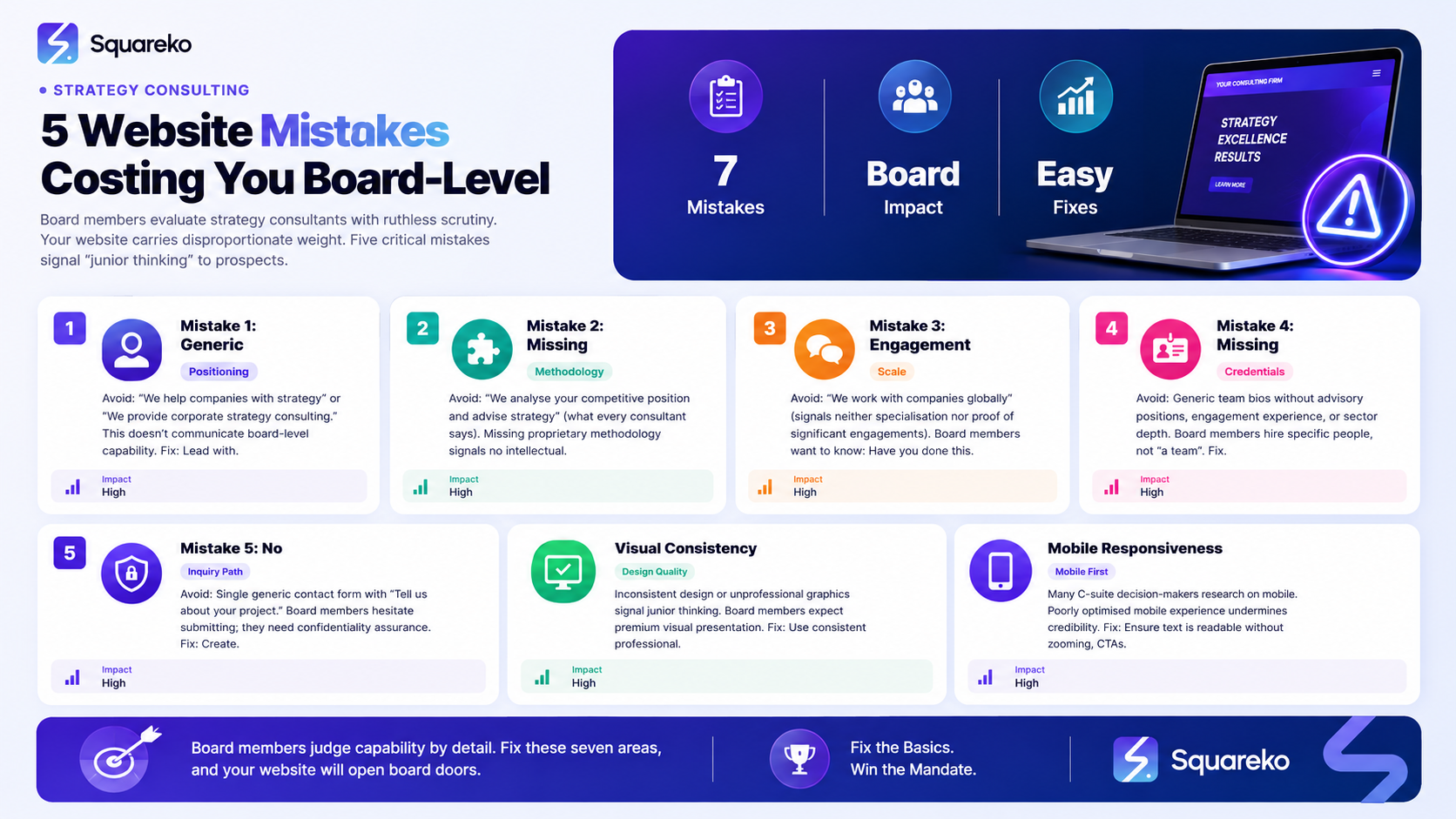
Mistake 1: No board-level transformation narrative. Generic "we help companies with strategy" doesn't communicate board-level capability. Board prospects need to see you understand their strategic challenge specifically.
Mistake 2: Missing or generic competitive strategy methodology. "We analyse your competitive position and advise strategy" is what every consultant says. Named, proprietary methodologies signal intellectual differentiation.
Mistake 3: Engagement scale not communicated. "We work with companies globally" signals neither specialisation nor proof of significant engagements. Board members want to know: Have you done this with companies at our scale?
Mistake 4: Missing principal credentials and advisory positions. Anonymous team bios with generic credentials undermine trust. Board members want to see who specifically will advise them and what their strategic background is.
Mistake 5: No confidential inquiry pathway. A contact form that says "Tell us about your project" puts board members in an awkward position. They need a way to explore engagement possibility without public commitment.
Board members evaluate strategy consultants with ruthless scrutiny. Your website is often their first impression—and it carries disproportionate weight. A website that appears professionally amateur, intellectually superficial, or operationally sloppy signals exactly one thing to a board member: This consultant is junior thinking.
The five mistakes below cost strategy consultants board-level engagements. Not because the consultants lack capability, but because their websites undermine their credibility before prospects even contact them. This guide identifies each mistake, explains the credibility damage it creates, and shows the Squarespace fix.
Mistake 1: No Board-Level Transformation Narrative
The Mistake
Your homepage opens with generic positioning:
"We provide strategy consulting to help companies navigate competitive challenges and achieve sustainable growth."
Or worse:
"We work with corporate leaders to develop winning strategies."
The Credibility Damage
A board member reading this thinks: Everyone says this. What problem specifically do you solve? Do you understand my strategic challenge? Generic positioning signals you serve everyone (meaning you specialize in nothing) and understand no one's situation specifically.
Strategic consulting is bought on specificity. Board members want to know: Do you understand the exact strategic challenge I'm facing?
The Fix
Lead with strategic insight specific to your specialization:
If you specialize in digital transformation:
"When digital disruption reshapes your market, your strategy must evolve faster than your competitors can execute. We've guided 40+ FTSE 100 and mid-market companies through transformational digital strategy, positioning them to outpace competitive threats and capture technology-driven revenue opportunities."
If you specialize in M&A strategy:
"Post-merger value destruction typically results not from acquisition overpayment, but from strategic misalignment during integration. We guide boards through M&A strategy that maximizes integration outcomes, protects strategic synergy value, and accelerates time-to-value."
If you specialize in growth strategy:
"Market-leading growth isn't just revenue expansion—it's repositioning the organization for sustainable competitive advantage in evolving markets. We've advised technology and consumer sector leaders through market entry, platform scaling, and competitive repositioning strategies that generate significant value."
Implementation on Squarespace: Replace generic positioning with specific board-level insight. Lead with the strategic challenge you solve, not the service you provide.
Mistake 2: Missing Competitive Strategy Methodology
The Mistake
Your services page reads:
"Corporate Strategy: We conduct competitive analysis, develop strategic recommendations, and help guide implementation."
Or your methodology section says:
"Our approach combines research, analysis, and stakeholder engagement to develop strategic clarity."
The Credibility Damage
A board member reading this thinks: That's how every consultant claims to work. What's different about your strategic thinking? Absence of named methodology signals you don't have differentiated intellectual approach—you follow standard consulting playbooks.
Board members buy strategy consulting for original thinking. Generic methodology signals conformity, not innovation.
The Fix
Name proprietary strategic frameworks and present them explicitly:
Example 1: CLARITY Framework
"We structure corporate strategy using our proprietary CLARITY Framework: Competitive Positioning → Landscape Intelligence → Assumption Validation → Recommendation Clarity → Insight Novelty → Tactical Alignment → Year-1 Outcomes. This framework ensures strategy is both intellectually rigorous and operationally executable."
Example 2: TRANSFORM Framework
"Digital transformation strategy requires integrated thinking across seven dimensions. Our TRANSFORM Framework guides this complexity: Technology audit → Resistance mapping → Alignment architecture → Norms/culture design → Sales/marketing transformation → Financial architecture → Orchestration and resilience. Framework application ensures transformation is comprehensive, not technological-only."
Implementation on Squarespace: Create dedicated methodology page presenting signature frameworks with visual representation (diagrams, not graphics). Explain how frameworks differentiate your approach. Reference frameworks consistently throughout your content (case studies, white papers, service pages).
Mistake 3: Engagement Scale Not Communicated
The Mistake
Your website says:
"We work with companies globally across diverse sectors."
Or provides no engagement scale information whatsoever—just services and templates.
The Credibility Damage
A board member reading this thinks: I don't know whether this consultant has engaged companies at my scale and complexity. Absence of engagement scale evidence makes it impossible for prospects to assess whether you've succeeded with companies like theirs.
Board members want to know: Have you done this? At this scale? With this complexity? In our sector?
The Fix
Communicate engagement scale explicitly:
Approach 1: Anonymized scale indicators
"We've completed 50+ corporate strategy engagements with FTSE 100 and mid-market companies, including:
15+ engagements with financial services leaders (£10bn+ revenue)
12+ digital transformation projects with technology companies (£500m–£5bn revenue)
10+ M&A integration strategies with private equity portfolio companies
8+ growth strategies with emerging market leaders"
Approach 2: Sector-specific scale
"We specialise in corporate strategy for financial services leaders. Over 15 years, we've advised 3 of the top 5 UK investment banks, 8 wealth management firms, and 12 fintech innovators on transformation, competitive repositioning, and growth strategy."
Approach 3: Quantified outcomes
"Our engagements drive measurable strategic outcomes: average client revenue impact £50m+, average time-to-value 18 months, average competitive positioning improvement 2–3 quartile ranks, 95% client recommendation rate for subsequent advisory."
Implementation on Squarespace: Create explicit engagement scale section. Use anonymized sector + company profile scale (e.g., "FTSE 100 financial services," "mid-market technology," "growth-stage retail"). Include quantified outcomes from engagements. Make it clear you have proof of success with companies at your prospect's scale.
Mistake 4: Missing Principal Credentials and Advisory Positions
The Mistake
Your team page presents:
"Sarah, Strategic Advisor 15 years corporate strategy experience MBA from London Business School Based in London"
No advisory positions. No specific engagement experience. No specific sectors. No credentials beyond education.
The Credibility Damage
A board member reading this thinks: I don't know who specifically will advise us or what their board-level credibility is. Generic team bios signal lack of specific expertise and undermine trust in individual advisors.
Board members want to hire specific people, not "a team." They need to know: Who specifically will advise me? What board-level credibility do they bring?
The Fix
Present principal credentials comprehensively:
Example principal bio:
"Sarah Thompson, Principal Strategy Advisor
Sarah advises boards on corporate transformation, digital strategy, and competitive repositioning. She brings 18 years of corporate strategy experience including:
Advisory Positions: Board Member, Financial Services Digital Transformation Association; Strategic Advisor, [Venture Fund Name]; Advisory Board, University Executive Education Programmer
Professional Background: Former Head of Digital Transformation, FTSE 100 investment bank (2015–2021), leading platform modernization strategy and competitive repositioning. Prior: McKinsey senior consultant (2008–2015) specializing in financial services transformation.
Sector Expertise: Financial services, fintech, wealth management. Specific expertise in digital transformation within legacy banking environments, competitive response to fintech disruption, and acquisition integration strategy.
Published Thinking: Regular contributor to Financial Times digital banking column. White papers: 'Digital Transformation in Banking: Why Legacy Institutions Win' and 'Competitive Strategy in Age of Fintech Disruption.' Speaker at World Bank Summit (2024), Institute of Directors board forums, and financial services industry conferences.
Education: MBA, London Business School; BA Economics, Oxford University."
This principal bio tells a board member: She's deeply experienced, has board-level credibility, advises at governance level, brings specific sector expertise, publishes original thinking, and is active in professional community.
Implementation on Squarespace: Replace generic team bios with comprehensive principal credentials. Include: advisory positions, specific engagement experience, sector expertise, published thinking, speaking records, professional background. Show boards who specifically will advise them.
Mistake 5: No Confidential Inquiry Pathway
The Mistake
Your website has a single contact form requesting:
Name
Company
Email
"Tell us about your project"
The Credibility Damage
A board member thinking about engaging your firm becomes hesitant. Filling out a generic form that says "Tell us about your project" feels risky. What if the form gets forwarded to junior staff? What if the inquiry creates a sales follow-up? What if confidentiality isn't maintained?
Board members need a way to explore engagement possibility confidentially, without public commitment or sales pressure.
The Fix
Create explicit confidential inquiry pathway:
Dedicated Inquiry Page: Create a page titled "Start a Confidential Conversation" or "Explore Engagement Possibility" explicitly addressing board-level concerns:
"We work confidentially with board members and CEOs exploring potential strategy advisory relationships.
How confidentiality works:
All inquiries are strictly confidential
We never contact your organization without your explicit permission
Initial conversation is non-committal—an opportunity to discuss your strategic situation
No sales pressure; we only pursue engagements where strategic fit is clear
Initial conversation structure:
You briefly describe your strategic challenge
We share relevant experience and framework
Together we assess whether engagement makes sense
If strategic fit exists, we discuss engagement approach and scope
Typical timeline:
Initial conversation: 30 minutes via phone or video
Response time: Within 24 hours
Next steps (if mutual interest): Schedule working session to assess strategic depth and engagement approach"
Inquiry Form: Keep it simple and board-appropriate:
Name and title
Company and sector
Strategic challenge area (dropdown: Digital Transformation, M&A Strategy, Growth Strategy, Competitive Repositioning, Organizational Strategy)
Current situation (2–3 sentence optional description)
Preferred contact method (email, phone, video)
Confidentiality confirmation: "I understand all inquiries are strictly confidential"
Follow-Up Process:
Respond within 12–24 hours
Your response should acknowledge their specific strategic challenge (show you read their inquiry, not a template)
Propose two or three time options for initial conversation
Reiterate confidentiality commitment
Implementation on Squarespace: Create dedicated "Confidential Inquiry" page (or rename contact page accordingly). Reassure board-level prospects about confidentiality, explain process, keep form simple. Remove friction from board-level prospect inquiry.
CTA Block 1: Worried your strategy consulting website might be signalling junior thinking to board-level prospects? Squareko offers a free "Strategic Intelligence Audit"—we'll evaluate your website against the five mistakes above and identify specific improvements that communicate board-level credibility.
Strategic Intelligence Audit CTA
Strategy consulting website credibility matters intensely. A professional audit identifies:
✓ Whether your positioning communicates board-level strategic insight ✓ Whether your methodology presentation signals intellectual differentiation ✓ Whether engagement scale evidence builds prospect confidence ✓ Whether principal credentials present board-level credibility ✓ Whether inquiry pathways address board-level confidentiality needs
Squareko's Strategic Intelligence Audit for Strategy Consultants is a complimentary 30-minute evaluation assessing your website against board-level credibility standards. We'll identify specific improvements that position you for more board-level engagements.
FAQs
-
Generic positioning without specific strategic insight, missing proprietary methodology, no evidence of engagement scale, principal credentials that lack board-level specificity, and absence of confidential inquiry pathway all signal junior thinking. Board members evaluate strategic thinking quality immediately; websites that lack intellectual specificity suggest the consultant lacks differentiated strategic capability.
-
Use anonymised scale indicators: "15+ FTSE 100 financial services engagements" or "12 digital transformation projects with £500m+ revenue companies" communicate scale without revealing client identity. Present sector + company scale + engagement type without naming companies. This respects confidentiality while proving you've succeeded at your prospect's scale.
-
Absolutely. Named, proprietary frameworks (CLARITY Framework, TRANSFORM Framework) signal intellectual differentiation far more powerfully than generic methodology descriptions. Frameworks become intellectual property that justifies premium fees. Name them, explain them, use them consistently throughout your content, and watch them become competitive differentiators.
-
Comprehensive. Don't just list name and job title. Board members hire specific people. Your principal bios should include: advisory board positions, specific engagement sectors and types, professional background (including Big 3 experience if applicable), sector expertise, published thinking/speaking records, education. Detailed principal bios build trust in individual advisors.
-
Board members are hesitant to submit generic inquiries through standard contact forms. They need confidence that inquiry will be handled confidentially, without sales pressure, and with appropriate senior-level engagement. Explicit confidential inquiry pathway reassures board prospects and removes friction from initial contact.
CTA Block 2: Your strategy consulting website should communicate board-level credibility instantly. Squareko specialises in identifying and fixing the mistakes that undermine consulting websites—from positioning through principal credentials to inquiry pathways. Let's ensure your website positions you for board-level engagements.
From custom website design to SEO strategy, we help businesses launch a site that looks professional and performs better.

Author Bio
I'm Walid Hasan, a Certified Squarespace Expert and Squarespace Circle Platinum Partner with over 12 years of hands-on experience designing and optimizing high-performing websites. Over the years, I've had the privilege of building more than 2,000 Squarespace websites for clients around the world, always focusing on clean design, strong user experience, and conversion-driven results.