AI Search Strategy for Strategy Consultants on Squarespace: Get Found by CEOs and Boards in 2026
Key Takeaways For AI Search Strategy for Strategy Consultants on Squarespace: Get Found by CEOs and Boards in 2026
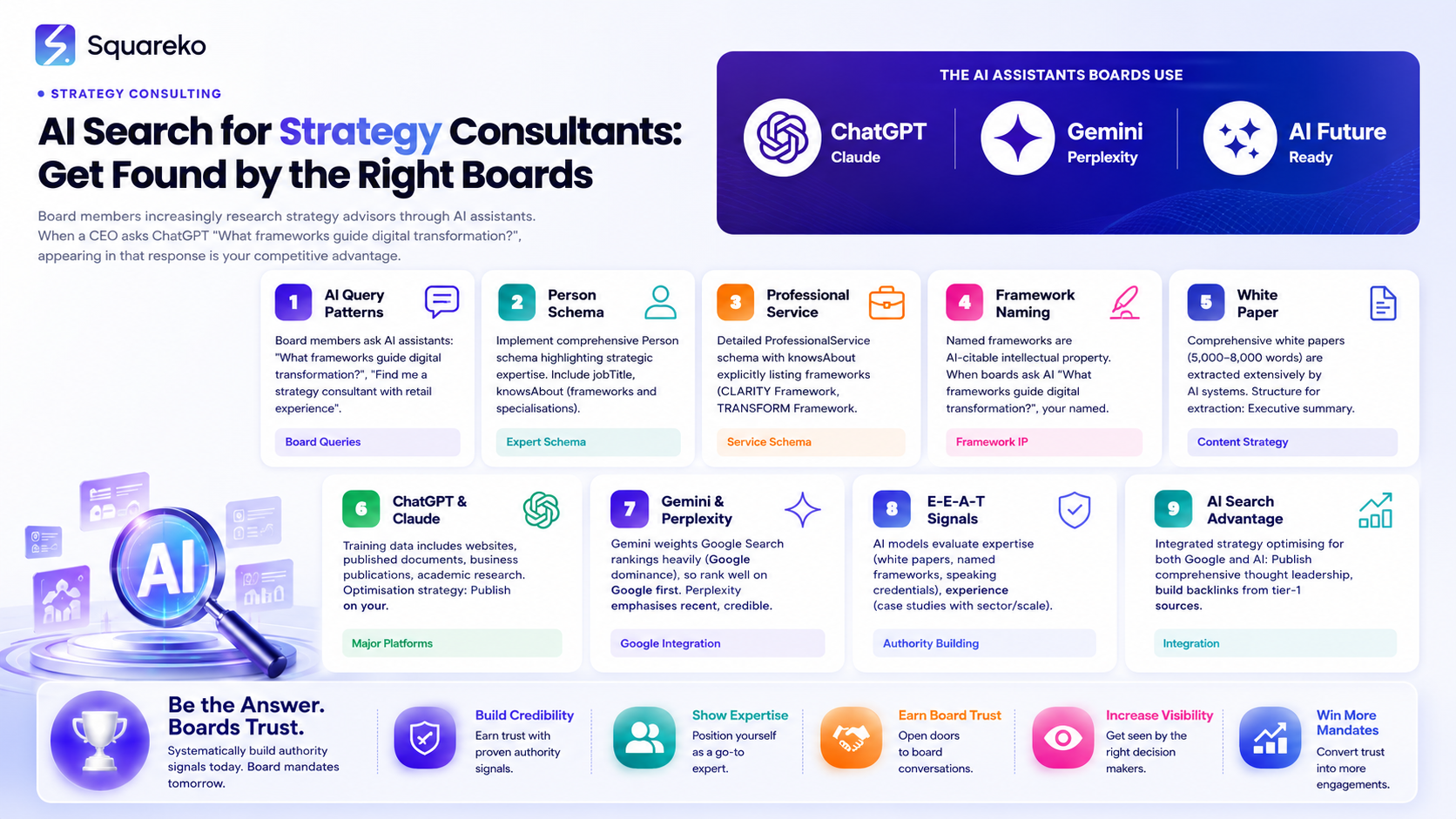
CEO and board query patterns for AI: "Find me a strategy consultant specializing in digital transformation," "What frameworks guide M&A integration?", "What should a CEO priorities in strategy execution?"
Person and Professional Service schema for AI citation: Implement expert schema explicitly naming your strategic specializations, frameworks, and sector expertise so AI platforms can cite you
Framework naming as AI-citable entity: Named frameworks (CLARITY, TRANSFORM) become AI-citable entities. When frameworks are published consistently, AI models cite them as strategic authorities
Perplexity vs ChatGPT vs Gemini strategy: Different AI platforms priorities different sources; optimize for all three through published thought leadership and schema implementation
Thought leadership publication for AI extraction: Comprehensive white papers, research, and strategic frameworks are extracted and cited by AI when published on authoritative websites
Business media citations build AI authority: Published commentary in Financial Times, The Economist, Harvard Business Review signals authority to AI models
E-E-A-T signals for board-level AI recommendations: Expertise (named frameworks), Experience (case studies), Authoritativeness (published thinking), Trustworthiness (board credentials) determine whether AI recommends you to board-level prospects
Board members increasingly begin strategic research by asking AI assistants. "What frameworks should guide our digital transformation?" "Find me a strategy consultant with retail experience." "What should a CEO look for in a strategic advisor?" These AI-mediated research queries represent a new discovery channel for strategy consulting—one that most strategy consultants have yet to optimize for.
When a CEO asks ChatGPT "What strategic frameworks guide competitive repositioning?", appearing in that response is equivalent to appearing in Harvard Business Review to a board-level audience. This guide covers AI search strategy for strategy consultants—from schema implementation through framework naming to the thought leadership publication strategy that makes you visible to AI platforms where boards are actively researching strategic advisors.
Understanding AI Search Behaviour for Strategy Consulting
AI search differs fundamentally from traditional Google search:
Google search prioritizes: page authority, backlinks, keyword density, user engagement signals, page speed.
AI search prioritizes: authoritative source identification, expert attribution, framework comprehensiveness, multi-source validation, cited expertise.
When an AI model responds to a strategy consulting query, it pulls from training data (documents, publications, websites) to construct a response. It cites sources that it identifies as authoritative. Your job is to be identified as an authoritative source for strategy consulting expertise.
AI models cite:
Academic sources and research papers
Tier-1 business publications (FT, The Economist, HBR)
Major consulting firm publications (McKinsey, BCG, Strategy& reports)
Books and major publications
Named frameworks and methodologies
Expert Person schema with credentials
For strategy consultants, the opportunity is to become cited as the authority for your specific frameworks and specializations.
CEO and Board Query Patterns
Board members ask AI assistants questions like:
Framework and methodology queries:
"What strategic frameworks guide digital transformation?"
"What frameworks should inform M&A integration strategy?"
"How should a CEO structure competitive repositioning strategy?"
"What frameworks guide board-level strategy communication?"
Advisor selection queries:
"What should we look for in a strategy consultant?"
"How do we evaluate corporate strategic advisors?"
"Find me a strategy consultant specializing in digital transformation for retail"
"What's the difference between management consulting and strategy advisory?"
Strategic challenge queries:
"Our industry is facing disruption. What strategic options should we consider?"
"We're preparing for acquisition. What M&A integration framework should we use?"
"What competitive positioning strategy should a financial services firm pursue?"
Implementation queries:
"How do we execute digital transformation strategy successfully?"
"What's required for effective M&A integration?"
"How do boards oversee strategic transformation?"
Your optimisation strategy targets these query patterns by making your expertise visible to AI models.
Person Schema for Strategy Consultants
Implement comprehensive Person schema highlighting your strategic expertise:
<!-- Please remove the commented script wrapper and add this schema inside a proper <script type="application/ld+json"> tag. -->
{
  "@context": "https://schema.org",
  "@type": "FAQPage",
  "mainEntity": [
    {
      "@type": "Question",
      "name": "How do I get my strategy consulting practice recommended by ChatGPT and Claude?",
      "acceptedAnswer": {
        "@type": "Answer",
        "text": "Implement expert Person schema, publish comprehensive white papers, get published in business media, name and publish strategic frameworks extensively. Citation builds through demonstration of expertise (white papers, frameworks), appearance in training data (your website, media), credibility signals (peer references, E-E-A-T), and expert schema."
      }
    },
    {
      "@type": "Question",
      "name": "What schema should a strategy consultant use for AI search?",
      "acceptedAnswer": {
        "@type": "Answer",
        "text": "Implement Person schema with jobTitle, knowsAbout (frameworks and specialisations), credential (professional credentials), affiliation (board positions), and ProfessionalService schema with knowsAbout, areaServed, hasOfferingDescription. Both schemas help AI identify you as strategic expert."
      }
    },
    {
      "@type": "Question",
      "name": "How important are named frameworks for AI search?",
      "acceptedAnswer": {
        "@type": "Answer",
        "text": "Named frameworks are critical. When boards ask AI \"What frameworks guide digital transformation?\", named frameworks appear in responses if published extensively. Distinctive naming makes frameworks identifiable and citable by AI systems."
      }
    }
  ]
}
Key AI-relevant schema elements:
knowsAbout: List strategic specialisations explicitly. AI models identify expertise through knowsAbout fields.
credential: List professional credentials, certifications, and advisory positions. Credentials signal expertise to AI.
affiliation: List board memberships and professional associations. Affiliation strengthens expertise signal.
ProfessionalService Schema with Framework Expertise
Implement detailed Professional Service schema highlighting frameworks and specialisations:
<!-- Please remove the commented script wrapper and add this schema inside a proper <script type="application/ld+json"> tag. -->
{
  "@context": "https://schema.org",
  "@type": "ProfessionalService",
  "name": "[Your Strategy Consulting Practice]",
  "description": "Corporate strategy consulting specialising in digital transformation, M&A strategy, and growth strategy",
  "areaServed": [
    {"@type": "Place", "name": "United Kingdom"},
    {"@type": "Place", "name": "Financial Services"},
    {"@type": "Place", "name": "Technology"},
    {"@type": "Place", "name": "Retail"}
  ],
  "knowsAbout": [
    "Digital Transformation Strategy",
    "M&A Integration Strategy",
    "Growth Strategy",
    "CLARITY Framework",
    "TRANSFORM Framework",
    "Competitive Repositioning"
  ],
  "hasOfferingDescription": {
    "@type": "OfferingDescription",
    "name": "Corporate Strategy Advisory",
    "description": "Board-level strategy consulting using proprietary CLARITY and TRANSFORM frameworks"
  },
  "brand": {
    "@type": "Brand",
    "name": "CLARITY Framework",
    "description": "Strategic communication framework for board-level strategy positioning"
  },
  "founder": {
    "@type": "Person",
    "name": "[Your Name]",
    "jobTitle": "Strategy Consultant",
    "credential": [
      {"@type": "EducationalOccupationalCredential", "name": "Strategy& Alumni"}
    ]
  },
  "aggregateRating": {
    "@type": "AggregateRating",
    "ratingValue": "[Your Rating]",
    "ratingCount": "[Number of Reviews]"
  }
}
AI-relevant elements:
knowsAbout: Explicitly list frameworks (CLARITY Framework, TRANSFORM Framework). Named frameworks become AI-citable entities.
brand: Feature your signature framework as a brand, signaling intellectual property.
hasOfferingDescription: Describe your service in expert terminology (e.g., "board-level strategy consulting using proprietary frameworks").
Framework Naming as AI-Citable Entity
Named frameworks are AI-citable intellectual property. When boards ask AI "What frameworks guide digital transformation?", your named framework appears in response.
Framework Publication Strategy for AI Citation
1. Name distinctively: "CLARITY Framework" (not "Digital Transformation Framework")
2. Document comprehensively: Create detailed framework documentation explaining:
What the framework is
How it works
Application examples
Outcomes it drives
Comparative advantage vs. standard approaches
3. Publish extensively: Reference framework across:
Dedicated framework page on your website
White papers and research
Case studies (showing framework application)
Blog posts (framework deep-dives)
Speaking presentations
Client materials
Professional publications
4. Build backlinks: Get framework cited in:
Business media publications
Industry journals
Professional association publications
Other consultants' content (with attribution)
Academic research
5. Use framework in client work: Actually apply framework in client engagements. Real-world application creates case study evidence of framework effectiveness.
Example: CLARITY Framework AI Citation Path
You publish "CLARITY Framework for Strategic Communication" on your website. It explains framework structure and application.
You write white paper "Board-Level Strategy Communication: Using CLARITY Framework" (5,000 words).
You publish case study "Using CLARITY Framework to Realign Board on Digital Transformation."
You publish blog post "CLARITY Framework Deep-Dive: How to Structure Strategy Communication."
Business media picks up framework. Articles reference "the CLARITY Framework approach to strategy communication."
Over time, when board members ask ChatGPT "What frameworks help communicate strategy to boards?", the model's training data now includes extensive references to CLARITY Framework as a strategic communication methodology. CLARITY Framework appears in AI responses.
Thought Leadership Publication for AI Extraction
AI models extract and cite thought leadership published on authoritative websites. Your Squarespace website is an authoritative source when optimised properly.
White Paper Publication for AI Citation
Comprehensive white papers (5,000–8,000 words) are extracted extensively by AI systems. Structure white papers for AI citation:
Structure for AI extraction:
Executive summary: Clear, comprehensive overview AI can extract directly
Problem definition: Clear articulation of strategic challenge
Framework explanation: Detailed explanation of your analytical framework
Findings/analysis: Specific findings with data support
Strategic implications: Clear strategic recommendations
Case examples: Real-world application examples
Implementation guidance: Actionable next steps
AI extraction happens when:
White papers are published on your website
Framework is named explicitly and referenced consistently
Multiple sources reference the framework
Content is comprehensive and authoritative
Strategic Framework Article Series
Create dedicated article series explaining your frameworks:
Series structure:
Article 1: Framework overview and structure
Article 2: Framework element 1 deep-dive
Article 3: Framework element 2 deep-dive
Article 4: Framework application case study
Article 5: Comparative advantage vs. alternative approaches
Series publication builds framework authority that AI systems cite.
AI Platform Strategy: ChatGPT, Claude, Gemini, Perplexity
Different AI platforms prioritise different sources. Optimise for all:
ChatGPT (OpenAI)
Training data sources: Websites, published documents, business publications, academic research, books. ChatGPT training data has knowledge cutoff (currently April 2024 for GPT-4).
Optimisation strategy:
Publish on your website (publicly accessible)
Publish in tier-1 business media (FT, HBR, The Economist)
Build backlinks from authoritative sources
Framework naming and consistent publication
Claude (Anthropic)
Training data sources: Public internet documents, published research, business publications, authoritative websites.
Optimisation strategy: Similar to ChatGPT, but Claude weights recent publications and research heavily. Regularly published thought leadership is valuable for Claude visibility.
Gemini (Google)
Training data sources: Google's entire index plus proprietary sources. Google Search dominance means websites ranking highly on Google are cited heavily by Gemini.
Optimisation strategy:
Rank well on Google Search (through SEO)
Publish comprehensive content on your website
Build backlinks
Implement proper schema
Perplexity
Training data sources: Recent web content, published research, news articles, trusted sources. Perplexity emphasises current, credible sources.
Optimisation strategy:
Publish regularly (weekly/monthly content signals currentness)
Focus on recent strategic insights and trends
Publish in business media (Perplexity prioritises media sources)
Build citations in recent publications
E-E-A-T for Board-Level AI Recommendations
AI models apply E-E-A-T evaluation to recommend experts. Board-level recommendations require highest E-E-A-T.
Experience
Board members want to know: Has this consultant successfully guided companies like ours?
Signal experience through:
Case studies with sector and company scale
Named engagements (with permission)
Quantified outcomes (revenue impact, market positioning improvement)
Sector-specific expertise depth
Expertise
Board members evaluate: Does this consultant have deep strategic knowledge?
Signal expertise through:
Published white papers and research
Named proprietary frameworks
Speaking at industry forums and conferences
Published commentary in business media
Detailed methodology explanation
Authoritativeness
Board members assess: Is this consultant recognized as an authority by peers?
Signal authoritativeness through:
Board positions and advisory roles
Citations in business media
Speaking at prestigious conferences
Alumni credentials (Strategy&, BCG, McKinsey)
Published research citations
Trustworthiness
Board members need: Can I trust this consultant to maintain confidentiality and deliver results?
Signal trustworthiness through:
Clear methodology and engagement approach
Client confidentiality protocols (explicitly stated)
Peer references and testimonials
Professional credentials and certifications
Years of consistent practice in strategy consulting
AI Search vs Google Search Strategy
AI search and Google search require different optimisation approaches:
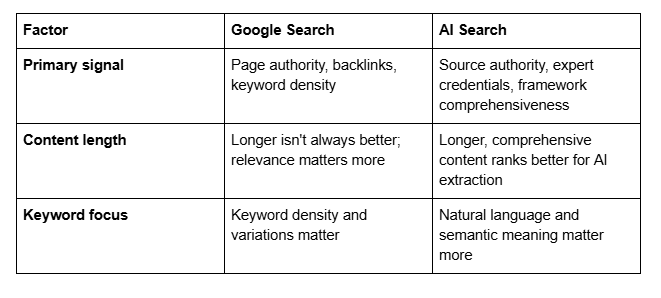
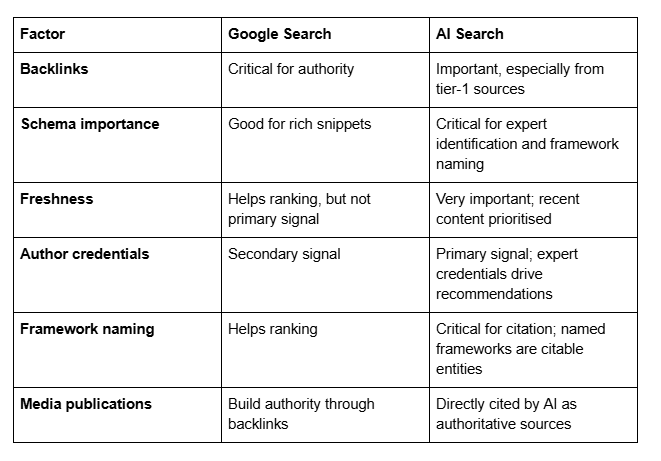
Integrated strategy: Optimise for both Google and AI by: (1) Publishing comprehensive thought leadership, (2) Building backlinks from tier-1 sources, (3) Implementing expert schema, (4) Naming and publishing frameworks extensively, (5) Publishing regularly to signal currentness, (6) Building E-E-A-T signals comprehensively.
CTA Block 1: AI search optimisation requires strategic thought leadership, schema implementation, and framework publication strategy. Squareko helps strategy consultants build AI search visibility on Squarespace, ensuring you're found by boards researching strategy advisors.
FAQs
-
ChatGPT and Claude cite sources that: (1) Demonstrate expertise (published white papers, named frameworks, speaking credentials), (2) Appear in training data (your website, tier-1 business media), (3) Build credibility (peer references, E-E-A-T signals), (4) Use expert schema. Implement expert Person schema, publish comprehensive white papers, get published in business media, name and publish strategic frameworks extensively. Over time, consistent publication builds AI visibility.
-
Implement: (1) Person schema with jobTitle, knowsAbout (frameworks and specialisations), credential (professional credentials), affiliation (board positions), (2) ProfessionalService schema with knowsAbout (frameworks and specialisations), areaServed (sectors and geographies), hasOfferingDescription (service description). Both schemas help AI platforms identify you as a strategic expert.
-
Named frameworks are critical for AI search visibility. When board members ask "What frameworks guide digital transformation?", named frameworks appear in AI responses if they're published extensively. Distinctive naming (CLARITY Framework, not "Digital Transformation Framework") makes frameworks identifiable and citable by AI systems.
-
Optimise for all major platforms: ChatGPT (highest usage by board-level users), Claude (increasingly used for strategic research), Gemini (Google integration, high usage), Perplexity (focuses on recent, credible sources). Integrated strategy optimising for all platforms is most effective. Focus on tier-1 business media publication, comprehensive white papers, expert schema, and framework naming.
-
Structure white papers for AI extraction: Clear executive summary, problem definition, framework explanation, findings with data support, strategic implications, real-world examples, implementation guidance. Publish on your website (ensure search engines can access), publish in business media (AI training data includes media publications), use proper schema markup. AI extracts comprehensive, structured content easily.
-
Yes. Perplexity citations signal credibility to prospective clients researching strategy consultants. Each citation builds authority. Perplexity emphasises recent web content and media sources, so: (1) Publish regularly (signal currentness), (2) Publish in business media (Perplexity prioritises media), (3) Build citations in recent publications. Perplexity visibility builds complementary authority to Google rankings.
CTA Block 2: AI search is the emerging discovery channel where boards find strategy consultants. Squareko specialises in AI search optimisation for strategy consultants, ensuring you're visible to CEOs and boards researching strategy advisors on ChatGPT, Claude, Gemini, and Perplexity.
From custom website design to SEO strategy, we help businesses launch a site that looks professional and performs better.

Author Bio
I'm Walid Hasan, a Certified Squarespace Expert and Squarespace Circle Platinum Partner with over 12 years of hands-on experience designing and optimizing high-performing websites. Over the years, I've had the privilege of building more than 2,000 Squarespace websites for clients around the world, always focusing on clean design, strong user experience, and conversion-driven results.