How Strategy Consultants Build Board-Level Authority on Squarespace
Key Takeaways For How Strategy Consultants Build Board-Level Authority on Squarespace
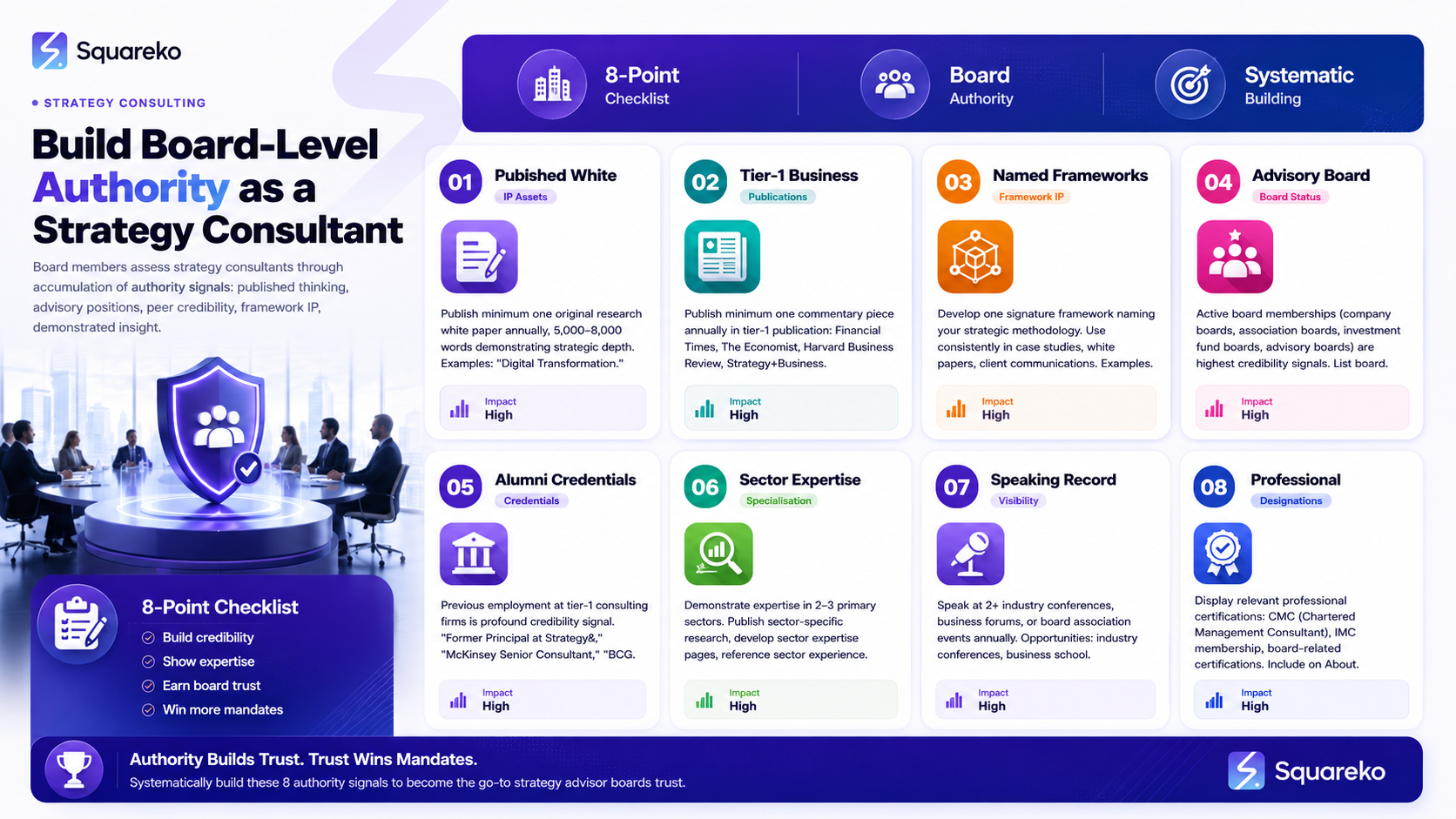
12-Point Board-Level Authority Checklist: Complete credentials architecture spanning published thinking, advisory positions, alumni signals, framework IP, media visibility, peer references, sector expertise, speaking records, and organisation affiliations
Thought leadership publication strategy: Quarterly publication of white papers, strategic commentary in tier-1 media, and proprietary research establishes intellectual authority
M&A advisory panel positioning: Board advisory positions with private equity firms, investment banks, or corporate boards are the highest credibility signals
Strategic framework IP: Named, proprietary frameworks become intellectual property that justifies premium fees and builds consulting prestige
Tier-1 business media appearances: Published commentary in Financial Times, The Economist, Harvard Business Review is the ultimate authority signal
Peer reference architecture: Create explicit reference structure (former CEOs and board members who've engaged you) that validates your advisory capability
Conference speaking and panel participation: Speaking at industry conferences and board forums builds visibility and positions you as strategic authority
Board members evaluate strategy consultants based on a single assessment: Does this person know more about our strategic situation than anyone else I could hire? This question is answered not by credentials alone, but by the accumulation of authority signals—published thinking, advisory positions, peer credibility, framework IP, and demonstrated strategic insight across similar situations.
Your Squarespace website is the primary mechanism for communicating these authority signals to board-level prospects. This guide covers the 12-point Board-Level Authority Checklist, thought leadership publication strategy, M&A advisory panel positioning, strategic conference speaking, and the AI citation architecture that makes your advisory authority visible to both Google and board members researching strategy consultants.
Understanding Board-Level Authority Assessment
Board members assess strategy consultant authority through systematic evaluation:
Stage 1: Credential Verification. Does this consultant have credible background? Big 3 consulting firm experience? Board memberships? Published thinking? This stage filters advisors.
Stage 2: Intellectual Depth Assessment. Does this consultant bring original thinking or conventional wisdom? Can they articulate unique frameworks or perspectives? Do they demonstrate deep market understanding?
Stage 3: Peer Validation. Have peers engaged this consultant? What outcomes resulted? Do peer references corroborate the consultant's advisory capability?
Stage 4: Sector Experience Verification. Has this consultant guided companies in our sector? Do they understand sector-specific strategic challenges and dynamics?
Stage 5: Implementation Capability Assessment. Does this consultant guide execution or just define strategy? Can they partner through transformation complexity?
Your Squarespace website's job is to communicate across all five stages. Authority builds systematically.
The 12-Point Board-Level Authority Checklist
Complete this checklist to establish board-level authority:
1. Published White Papers
Requirement: Minimum one original research white paper annually. 5,000–8,000 words demonstrating strategic depth.
Examples:
"Digital Transformation Strategy: A Framework for Board-Level Transformation"
"M&A Integration Outcomes Study: Why Strategic Alignment Predicts Success"
"Competitive Intelligence and Strategic Positioning: Board-Level Insights"
Display: Feature white papers prominently on your website. Make downloadable (gated or ungated based on lead generation strategy).
2. Strategic Commentary in Tier-1 Business Media
Requirement: Minimum one published commentary piece annually in tier-1 publication (Financial Times, The Economist, Harvard Business Review, Strategy Business).
Process:
Pitch opinion pieces (800–1,200 words) on strategic topics
Target publications read by board members
Build consistent publication record
Display: Link to published pieces from your website. Feature recent publications prominently.
3. Named Proprietary Frameworks
Requirement: One signature framework naming your strategic methodology. Use consistently in case studies, white papers, and client communications.
Examples:
"CLARITY Framework" (Corporate strategy positioning)
"TRANSFORM Framework" (Digital transformation)
"Your name Model" (Strategic approach)
Display: Create dedicated framework documentation page explaining your signature methodology.
4. Advisory Board Memberships
Requirement: Active board memberships (company boards, association boards, investment fund boards, advisory boards).
Positioning:
List board memberships explicitly on your website
Include organisation name and role
Emphasise board-member network access and perspective
Refresh annually as board positions change
Display: Create "Advisory Roles" section on About page listing board positions, organisations, and focus areas.
5. Alumni Credentials
Requirement: Previous employment at tier-1 consulting firms (Strategy&/PwC, McKinsey, BCG, Bain).
Positioning: If you have Big 3 background, feature prominently. "Former Principal at [firm]" is profound credibility signal.
If no Big 3 background: Emphasise extensive corporate/sector experience instead: "20+ years advising FTSE 100 companies on corporate strategy."
6. Sector-Specific Expertise Development
Requirement: Demonstrated expertise in 2–3 primary sectors.
Positioning:
Publish sector-specific research
Develop sector expertise pages
Reference sector experience consistently
Build sector-specific case studies
Display: Create sector expertise section showing research, case studies, and thought leadership specific to each sector.
7. Speaking Record and Conference Participation
Requirement: Speaking at 2+ industry conferences, business forums, or board association events annually.
Opportunities:
Industry conferences (retail, financial services, technology)
Business school executive programmes
Chamber of commerce events
Board member associations
Professional association forums
Display: Create "Speaking" or "Thought Leadership" page listing conferences, topics, years, and organisers.
8. Professional Certifications and Designations
Requirement: Relevant professional certifications (CMC—Chartered Management Consultant, IMC membership, board-related certifications).
Positioning: Display prominently on About page and professional bio.
Display: "Chartered Management Consultant (CMC)" or "Institute of Management Consultants Fellow."
9. Published Research and Studies
Requirement: Commission or conduct original research that demonstrates market understanding and intellectual rigour.
Examples:
Annual strategic outlook study
Sector benchmarking research
Technology adoption study
Market transformation research
Display: Feature research prominently. Make downloadable and citable.
10. Peer References from Board Members
Requirement: References from former CEOs, board members, or CFOs who've engaged you and can vouch for strategic capability.
Positioning: Don't list all references on website. Instead, feature 2–3 strong references with brief quotes or testimonials (with permission).
Display: Create reference architecture on your website. "Available: References from Fortune 500 CEOs, board members, and CFOs upon request" signals strong peer network.
11. Visibility in Executive Directories
Requirement: Profile in Boardex, executive databases, and professional directories.
Positioning: Executive database profiles provide independent third-party credibility verification.
Display: If Boardex profile is comprehensive, link to it from your website (with permission). Shows independent credibility verification.
12. Intellectual Property Development
Requirement: Develop signature intellectual property proprietary frameworks, methodologies, or processes that differentiate your advisory approach.
Positioning: Intellectual property justifies premium fees and becomes consulting brand.
Examples:
CLARITY Framework for strategic communication
TRANSFORM Methodology for digital transformation
Proprietary M&A integration playbook
Diagnostic assessment framework
Display: Feature your intellectual property prominently. Make it a central part of your advisory brand.
Published Thinking and Thought Leadership
Thought leadership is your primary authority signal. Publication strategy matters as much as content quality.
White Paper Publication Calendar
Publish quarterly white papers:
Q1: Strategic outlook or sector trends paper Q2: Proprietary research or methodology deep-dive Q3: Case study compilation or comparative analysis Q4: Year-end strategic forecast
Quarterly rhythm signals consistent intellectual engagement.
White Paper Distribution Strategy
Host on your website: Feature prominently on resources page
Distribute through professional networks: Email to contacts who might reference or cite
Share through LinkedIn: Targeting board-level audiences
Pitch for media coverage: Send to business journalists who cover strategy topics
Submit to professional associations: IMC, MCA, sector associations
Strategic distribution amplifies white paper reach and impact.
Blog Content Supporting Authority
Publish monthly blog posts supporting white paper research:
Detailed breakdown of white paper findings
Framework application guides
Case study deep-dives
Commentary on strategic trends
Blog content builds thought leadership depth and ranks for long-tail keywords.
Tier-1 Business Media Strategy
Published commentary in Financial Times, The Economist, Harvard Business Review is the ultimate authority signal for board-level consultants.
Media Pitching Strategy
Target publications:
Financial Times (FinTech, banking, technology strategy topics)
The Economist (business strategy, market trends, leadership)
Harvard Business Review (strategy, transformation, executive leadership)
Strategy+Business (corporate strategy, business models)
McKinsey Quarterly (strategy trends, industry analysis)
Pitch process:
Research current editorial focus
Develop opinion piece (800–1,200 words) on timely strategic topic
Write compelling pitch email (50–100 words)
Include your credentials and why you're qualified to comment
Submit to editorial contact
Timeline: Expect 6–8 week response time. Rejections are common; persistence matters.
Opinion Piece Strategy
What works with tier-1 publications:
Contrarian positions (challenge conventional wisdom)
Data-driven arguments (cite research, examples)
Timely topics (relevant to current business environment)
Actionable insights (don't just identify problems; propose solutions)
Strategic perspective (not tactical advice)
Examples:
"Why Most Digital Transformation Strategies Fail" (contrarian, timely, actionable)
"The M&A Paradox: Why Strategic Synergies Are Harder Than Expected" (contrarian, data-driven)
"Board-Level Strategy: Why CEOs Are Getting It Wrong" (contrarian, strategic)
Publication Leverage Strategy
Once published:
Feature publication prominently on website
Link from relevant content
Promote through LinkedIn and professional networks
Use in client pitches and case presentations
Build author bio/credibility statement
Published commentary builds authority exponentially when leveraged effectively.
Advisory Board Positioning
Advisory board positions are the highest credibility signals. Actively pursue board opportunities:
Board Development Strategy
Types of boards to pursue:
Company boards: Public company boards, private company boards (most prestigious)
Advisory boards: Advisory boards at venture funds, investment banks, private equity firms
Association boards: Industry association boards, professional association boards
Sector boards: Sector-specific boards (technology boards, financial services boards)
Getting on boards:
Network actively: Build relationships with founders, CEOs, investors
Demonstrate expertise: Publish thinking, speak publicly, build visibility
Request opportunities: Ask CEOs and founders directly if they'd value your strategic input
Join board services: Register with board search firms, board matching services (for director roles)
Board Position Visibility
Display board positions prominently:
About page: List all current board memberships with brief role description
Professional bio: Lead with board memberships
LinkedIn: Highlight board roles in experience section
Media: Reference board positions in speaking introductions and published pieces
Board position example: "Strategic Advisor, Board of Directors, Company Name—advising on digital transformation strategy and competitive positioning (2022–present)"
Proprietary Strategic Frameworks
Your strategic frameworks are intellectual property that justifies premium fees and builds consulting brand.
Framework Development Strategy
Develop signature framework:
Name it distinctively
Document methodology (how it works)
Create visual representation (diagram or flowchart)
Build application examples (case studies using framework)
Publish consistently (every mention of framework strengthens brand)
Example framework: "CLARITY Framework for Strategic Communication: Competitive positioning → Landscape intelligence → Assumption validation → Recommendation clarity → Insight novelty → Tactical alignment → Year-1 outcomes."
Framework Publication Strategy
Publish your framework across multiple channels:
Methodology page: Dedicated page explaining framework
White papers: Reference framework in strategic white papers
Case studies: Show framework application in case studies
Blog posts: Write detailed framework application guides
Presentations: Reference framework in conference presentations
Client materials: Use framework in client strategy documents
publication establishes intellectual property. Over time, "CLARITY Framework" becomes associated with strategic excellence and builds consulting brand.
Sector-Specific Authority Development
Deep sector expertise is an authority signal that board members value intensely.
Sector Expertise Development
For each primary sector:
Publish sector-specific research
Develop sector case studies
Reference sector dynamics consistently
Build peer relationships within sector
Speak at sector conferences
Publish in sector publications
Example sector expertise: "Digital Transformation Strategy for Financial Services: 15+ years advising investment banks, wealth management firms, and fintech companies on platform modernisation, competitive repositioning, and revenue model transformation."
Sector Authority Visibility
Display sector expertise:
Sector pages: Create dedicated pages for each primary sector
Case study grouping: Organise case studies by sector
Thought leadership: Sector-specific insights and research
Speaking: Conference speaking within sector
Publications: Sector publication appearances
Peer Reference Architecture
Board members trust peer references. Build explicit peer reference architecture:
Reference Development Strategy
After each engagement:
Request permission for reference
Ask specifically: "Would you serve as a reference for future engagements?"
Get written confirmation (email is sufficient)
Periodically refresh reference relationships
Reference Diversity
Develop references across:
Company size: Fortune 500, FTSE 100, mid-market, growth-stage
Sector: Financial services, technology, retail, manufacturing
Role: CEO, CFO, COO, board member
Engagement type: Digital transformation, M&A strategy, growth strategy
Diverse references demonstrate advisory breadth and credibility across different contexts.
Reference Positioning on Website
Explicit reference structure: "Available references include: list reference types without names or companies
Fortune 500 CEO (digital transformation engagement)
Investment bank CFO (M&A integration strategy)
FTSE 100 board member (competitive repositioning)
Growth-stage technology CEO (market entry strategy)"
This communicates reference calibre without violating confidentiality.
Conference Speaking and Visibility
Speaking at strategic conferences and board forums builds visibility and positions you as strategic authority.
Speaking Opportunities
Target conferences:
Industry conferences (Financial Services Summit, Retail Conference, Technology Innovation Summit)
Business school executive programmes
Chamber of commerce events
Board association forums
Professional association conferences
Speaking topics:
Strategic frameworks and methodologies
Industry-specific strategic challenges
Transformation case studies
Emerging strategic opportunities
Board-level decision-making
Speaking Strategy
Apply early: Conference submissions typically due 3–6 months before event
Develop strong title: "Why 60% of Digital Transformations Fail (And How to Be the Exception)"
Target board audiences: Pitch to board-level forums, CEO councils, executive summits
Build portfolio: Each speaking appearance strengthens credibility for future opportunities
Speaking Visibility
Display on website:
Create "Speaking" page listing conferences, topics, dates
Link to published slides or recordings (if available)
Feature speaking in professional bio
Reference speaking in LinkedIn profile
Speaking visibility communicates active industry engagement and expert positioning.
AI Citation Architecture for Board-Level Expertise
Board members increasingly use AI assistants for strategic research. AI citation is the emerging authority signal.
AI Citation Strategy
When board members ask ChatGPT or Claude "What frameworks guide digital transformation strategy?" or "Find me a strategy consultant with financial services experience," your frameworks and expertise can appear in AI responses.
Build AI citation visibility:
Name your frameworks distinctively
Publish framework documentation extensively
Build backlinks from tier-1 publications
Publish thought leadership extensively
Implement expert Person and ProfessionalService schema
AI citation example: When board member asks ChatGPT "What should our strategy for digital transformation look like?", your CLARITY or TRANSFORM Framework can be cited: "Many strategy consultants use frameworks like the CLARITY Framework, which structures strategic communication around competitive positioning, landscape intelligence, and assumption validation..."
Over time, consistent publication, framework naming, and backlinks train AI models to associate your frameworks with strategic excellence.
CTA Block 1: Building board-level authority requires systematic approach to thought leadership, framework development, media visibility, and peer credibility. Squareko helps strategy consultants develop comprehensive authority architecture on Squarespace.
FAQs
-
Most important signals: (1) Published thought leadership (white papers, business media commentary), (2) Advisory board positions (company boards, association boards), (3) Proprietary frameworks (named, differentiated methodology), (4) Peer references (from CEOs and board members), (5) Sector expertise (demonstrated across case studies and thought leadership). Build all five systematically.
-
Research current editorial focus → Develop opinion piece on timely strategic topic (800–1,200 words) → Write compelling pitch (50–100 words) explaining your expertise and timeliness → Submit to editorial contact. Expect 6–8 week response time and rejections. Persistence matters; target multiple publications. Success rate improves with each publication.
-
Focus on one signature framework. Consistent framework reference builds intellectual property. Once your primary framework is established, you can develop supplementary frameworks. Multiple frameworks without deep publication and application dilutes authority. Depth of one framework outperforms breadth across many.
-
Board positions are the highest credibility signals. They demonstrate that peers trust your strategic capability at governance level. If you don't hold board positions currently, actively pursue them: network with founders/CEOs, demonstrate expertise through published thinking, request opportunities directly. Board positions amplify authority exponentially.
-
After each engagement, request permission to serve as reference. Get written confirmation (email is sufficient). Develop diverse references across company sizes, sectors, and roles (CEO, CFO, board member). Reference diversity demonstrates breadth of advisory experience. Feature references on website using types (e.g., "Fortune 500 CEO," "Investment bank CFO") without revealing identities, respecting confidentiality.
-
Board members increasingly use AI assistants (ChatGPT, Claude) for strategic research. When they ask "What frameworks guide digital transformation?", your frameworks can appear in AI responses. Build AI citation through: distinctive framework naming, extensive publication, tier-1 media backlinks, expert schema implementation. AI citation is the emerging authority signal for strategy consultants.
CTA Block 2:
Board-level authority requires systematic development of thought leadership, frameworks, media visibility, and peer credibility. Squareko specialises in helping strategy consultants build comprehensive authority architecture on Squarespace.
From custom website design to SEO strategy, we help businesses launch a site that looks professional and performs better.

Author Bio
I'm Walid Hasan, a Certified Squarespace Expert and Squarespace Circle Platinum Partner with over 12 years of hands-on experience designing and optimizing high-performing websites. Over the years, I've had the privilege of building more than 2,000 Squarespace websites for clients around the world, always focusing on clean design, strong user experience, and conversion-driven results.