
How Yoga Studios Use Squarespace to Build Community and Retain Students
Key Takeaways for Yoga to Build Community and Retain Students
Retained students are worth 5–10x more than the cost of acquiring them—shift your website strategy from new-student focused to student-retention focused
Community features on Squarespace (blog, member areas, email campaigns, student spotlights) build emotional connection and identity
Email newsletters integrated with Squarespace turn casual students into regular practitioners through consistent, personalized touchpoints
Student testimonials, spotlights, and public community markers signal to new visitors that your studio builds real relationships
Loyalty programs and milestone recognition (first class anniversaries, practice milestones) drive emotional investment and referral advocacy
The hardest part of running a yoga studio isn't filling your first class—it's filling your classes six months from now. Student retention is the silent killer of studio growth. Many studios chase new students endlessly while ignoring the economics of retention: a student who stays for six months is worth 5–10 times more than the cost of acquiring them. Your Squarespace website can shift this equation entirely. Rather than just a booking platform, your website becomes a community hub—a place where students feel seen, connected, and part of something bigger than just a transaction. This guide shows how to architect your Squarespace website as a retention machine.
The Economics of Retention: Why Community Matters
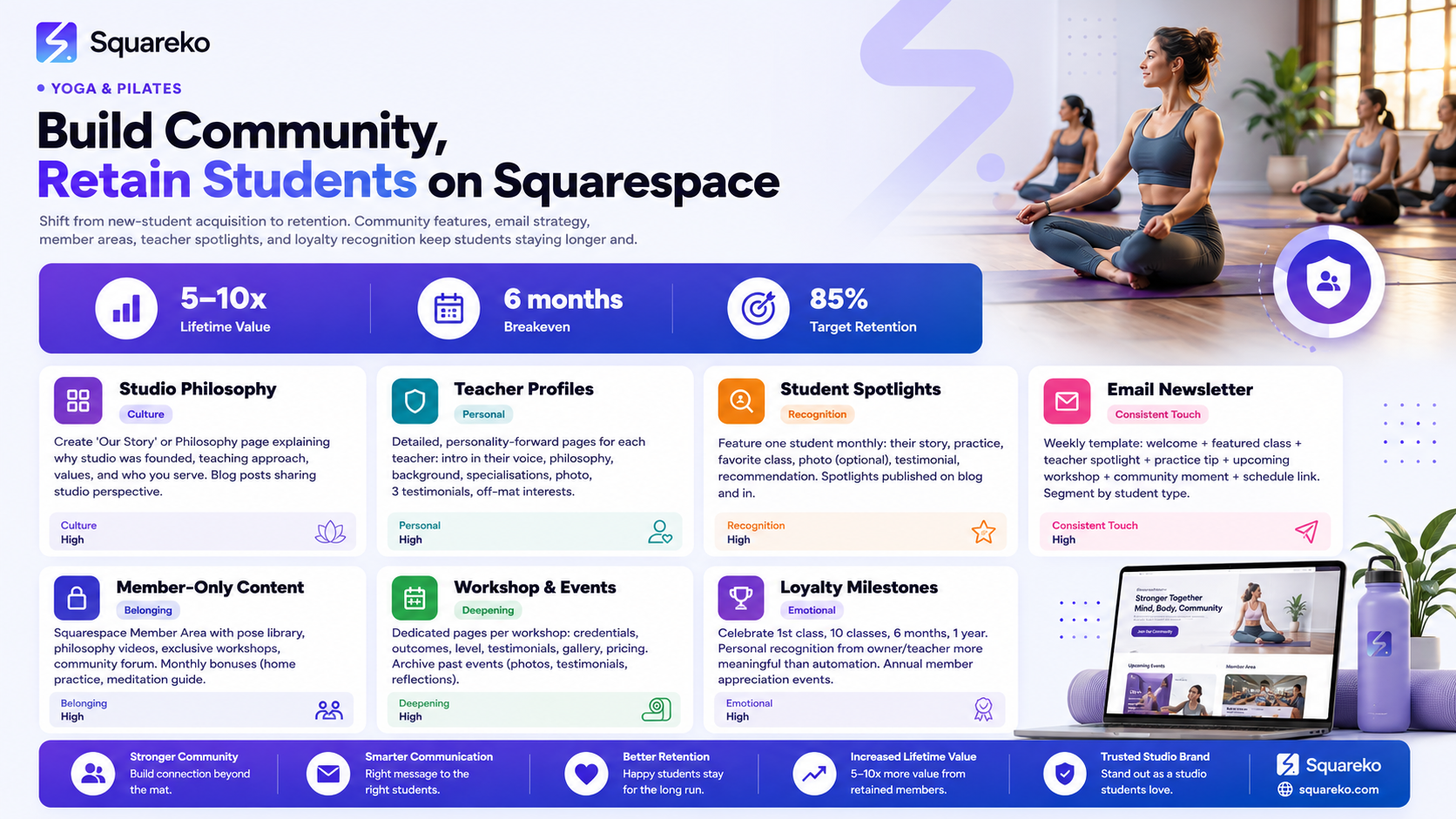
Most studio owners focus on acquisition because it's visible—the first class is exciting, the new student feels novel. But acquisition is expensive. A new yoga student acquired through paid ads, partnerships, or referral incentives costs £20–50. If that student takes a single class and never returns, that's a complete loss. If they stay for six months at £50/month, they've generated £300 in revenue against a £30 acquisition cost—a 10:1 return.
But acquisition doesn't build loyalty. Community does.
A student who feels genuinely known at their studio—whose name the teacher remembers, whose practice journey the community follows, who is celebrated when they hit milestones—is far more likely to stay. That sense of belonging is worth more than discounts or free classes.
Your Squarespace website is where this community lives beyond the studio walls.
Building Identity Through Your Website
A studio's identity shapes how students see themselves. Are they part of a tight-knit community? A transformational practice? A welcoming space for beginners? Your website reflects and reinforces this identity.
Define Your Studio's Philosophy
Create an "Our Story" or "Philosophy" page that explains:
Why the studio was founded
The specific yoga approach or values you teach (emphasis on breathwork, alignment-focused, trauma-informed, spiritual focus, wellness-first, etc.)
Who you serve (beginners, athletes, busy professionals, wellness-seekers, spiritual practitioners)
The studio's relationship to broader yoga traditions and lineages
This isn't marketing copy—it's identity statement. A potential student reading "We specialize in Iyengar yoga with emphasis on alignment precision and breathing technique" knows immediately if this is their community.
Create a Blog as Philosophy Repository
Blog posts sharing your studio's perspective on practice are retention tools. Posts like:
"Why We Teach Alignment Before Flow" — Explains your studio's approach
"Our Approach to Beginner Yoga" — Signals welcoming philosophy
"Trauma-Informed Modifications in Our Classes" — Positions your studio in a specific niche
"The Role of Breathwork in Our Practice" — Shares studio culture and values
These posts aren't just SEO content—they're cultural statements. A student who reads your blog and finds their values reflected feels that they've chosen the right studio, not just booked a class.
Showcase Your Teaching Lineage
If your teachers trained under specific lineages, traditions, or well-known instructors, highlight this. Yoga students research lineage. A student seeking "authentic Ashtanga from an authorized source" wants to know your pedigree. Pages or bios mentioning training under respected teachers position your studio in the yoga ecosystem.
Teacher Profiles as Connection Points
Teachers are the studio. A student doesn't stay for the building or the schedule—they stay for the relationship with their teacher. Teacher profiles on your Squarespace website create connection before the first class.
Build Detailed Teacher Pages
Each teacher deserves a dedicated, personality-forward page:
Introduction: A personal paragraph in the teacher's voice (write it together), not corporate bio
Teaching philosophy: What does this teacher focus on? What transformation do they offer?
Background: Training, years of experience, lineage, specializations
Classes and specializations: Which classes do they teach? What populations do they work with (prenatal, seniors, athletes, yoga for anxiety)?
Photo: A warm, genuine photo—not overly polished
Student testimonials: 2–3 quotes from regular students
Off-mat interests: A personal touch (hobbies, why they moved to the area, favorite neighborhood spot)
Detailed teacher profiles answer the unspoken question every new student has: "Will I connect with this teacher?"
Highlight Teacher Specializations
If a teacher specializes in trauma-informed yoga, prenatal yoga, or yoga for athletes, make this visible. A student seeking "prenatal yoga teacher" will land on your teacher's profile, and that specificity builds trust immediately.
Update Teacher Pages Regularly
When a teacher completes a new training, update their credentials immediately. When they've been teaching at your studio for 10 years, celebrate it. Regular updates signal that your website is alive and that your teachers are growing.
Student Spotlights and Testimonials
Public testimonials and spotlights serve dual purposes: they signal to new students that real transformation happens at your studio, and they make current students feel seen and celebrated.
Create Student Spotlight Features
Once a month, feature a regular student:
Their story: How did they find the studio? What drew them in?
Their practice: What's their favorite class? How has yoga changed their life?
Their quote: A short, genuine testimonial in their own words
Their photo (if comfortable): A real student, not a stock image
Their recommendation: What would they tell someone considering starting yoga?
Spotlights are published on your blog and shared in your email newsletter. A featured student becomes an advocate—they'll tell their friends about being highlighted.
Request Testimonials Thoughtfully
Don't ask for generic "Amazing studio!" quotes. Ask specific questions:
"How has your practice at our studio changed your relationship with stress?"
"What surprised you most about your yoga practice?"
"How have you felt different in your body or mind after practicing with us?"
"What made you choose our studio over others you've tried?"
Specific testimonials are more believable and more retention-reinforcing because they're authentic.
Display Testimonials on Service Pages
Place testimonials near class descriptions:
Next to "Hot Yoga" class, feature testimonials from hot yoga regulars
Next to "Pilates Reformer", include a testimonial from a reformer enthusiast
On the homepage, cycle through testimonials from diverse students
This creates social proof that different student types have found community at your studio.
Email Marketing and Newsletter Strategy
Email is the most underutilized retention tool for yoga studios. Squarespace Email Campaigns integrate directly with your website booking system, allowing you to email students automatically and intentionally.
Segment Your Email List
Instead of one generic newsletter, create segments:
New students (first 4 classes): Beginner-focused content, tips for getting comfortable, schedule reminders
Regular students (2+ classes per month): Deeper philosophical content, teacher spotlights, workshop announcements
Lapsed students (haven't booked in 2+ months): Gentle re-engagement, what's new, "we miss you" tone
Squarespace allows basic segmentation via tags (e.g., "new-student", "regular", "lapsed").
Create a Weekly Newsletter Template
Subject: "Your Studio Name Week Ahead Feature"
Content structure:
Welcome: A brief, genuine greeting (personalized if possible)
This week's featured class: Highlight one class, why it's special, when it runs
Teacher spotlight (rotating): Brief bio of a teacher teaching that week
Practice tip or philosophy: A paragraph on alignment, breathing, or studio philosophy
Upcoming workshop or event: Announcement with registration link
Community moment: A student spotlight, class milestone, or studio update
Schedule link: Make booking easy
This newsletter reminds students of reasons to practice without feeling pushy. It's community, not commerce.
Send Automated Emails at Key Moments
Use Squarespace automation or manual sends at crucial retention points:
Day after first class: "Thank you for trying us. Here's what's happening this week."
Week 2 of membership: "You've taken X classes. Here's what regulars do next."
First month anniversary: Celebrate that they've completed their first month
Lapse trigger (2 weeks without booking): "We noticed you haven't booked. Here's what you might have missed."
Seasonal: Winter solstice, spring equinox, back-to-school season
Timely, relevant emails feel personal and supportive, not spammy.
Use Birthday and Anniversary Emails
If you capture student birthdays (optional field on signup), send birthday messages: "Happy birthday! Here's 20% off any workshop this month." This one gesture—remembering—builds disproportionate loyalty.
Member-Only Content and Exclusive Areas
Squarespace Member Areas create a gated community space for paying students or members—a place where they're recognized as part of the studio.
Create Exclusive Content for Regular Members
Member-only areas can include:
Pose library: Detailed instruction on common poses, modifications, anatomy
Philosophy videos: Short (3–5 minute) teachings from your teachers
Extended class descriptions: Detailed what-to-expect for each class style
Exclusive workshops: Recorded teacher trainings, talks, or special practices available only to members
Community forum: A simple discussion space where members can share practice experiences, ask questions, or arrange meetups
This isn't about gatekeeping—it's about identity. Members feel part of an exclusive community.
Monthly Member-Only Bonus
Each month, offer something special for active members:
A 15-minute home practice video recorded by a teacher
A downloadable meditation or pranayama guide
Early access to workshop registration
A discount code for local wellness partners
These bonuses, even if small, signal that membership is valued.
Workshop and Event Community
Workshops, retreats, and special events are retention superpowers. They deepen practice and create intense community bonds.
Feature Workshops Prominently
Create dedicated pages for each workshop or retreat:
Teacher credentials: Full bio of the facilitator
What you'll learn: Detailed description of the workshop's content and approach
Level and prerequisites: Who is this for?
Student testimonials: Reviews from past attendees
Photo gallery: Images from previous years' events (builds trust and excitement)
Pricing and registration: Simple, clear call-to-action
Students see workshops as community deepening, not just revenue—because they are. A student who attends a spring equinox retreat with their studio friends isn't just taking a class; they're investing in community.
Create Event Archives
Keep previous workshops visible (even if past):
Photos and testimonials from last year's summer workshop
Recordings of past talks or teachings (if available)
Student reflections on what the event meant to them
Past events show community continuity and give new students proof of your studio's depth.
Loyalty Recognition and Milestones
Celebrating student milestones—both small and large—keeps students emotionally invested.
Celebrate Practice Milestones
When a student hits a meaningful milestone, acknowledge it:
First class: "Welcome to the Studio community"
10 classes: "You're building a real practice—thank you for your consistency"
Six months regular practice: "Half a year! You're now part of our studio family"
One year: Significant celebration—email, a mention in newsletter, perhaps a small gift (studio swag, free workshop)
These don't have to be automated—personal messages from the studio owner or a favorite teacher are far more meaningful.
Host Member Appreciation Events
Once a year, host a member-only social event:
A casual gathering after class
A pot-luck dinner at the studio
A free community class followed by tea
These events happen off the website, but the fact that they exist—and that students know about them through your website and email—reinforces community.
The Referral Loop: Community as Marketing
The most powerful marketing is community members telling their friends. A student who feels part of a community naturally refers others—not because of incentive programs, but because they want to share what they've found.
Make Referrals Visible on Your Website
Create a simple referral incentive—and make it visible:
"Refer a friend to Studio Name, and when they complete 4 classes, you each get one free class or a discount on workshops."
Place this on your homepage and in your email newsletter. Referral programs that feel generous (not transactional) encourage advocacy.
Feature Student Referrals in Your Community
When someone is referred by an existing student, mention it to the referrer: "Thank you for bringing [new student name] into our community—we're grateful." This reinforces the referrer's role as an advocate.
Track Community Growth
Share milestones with your email list: "We've just hit 400 regular members—thank you for building this community with us." Students feel ownership over studio growth.
Ready to Build a Thriving, Retention-Focused Community?
A Squarespace website designed for community retention transforms your business economics entirely. Instead of chasing new students, you build advocates who stay, refer friends, and tell everyone about their practice at your studio. But community strategy requires more than a nice website—it requires intentional design, ongoing updates, and genuine connection.
At Squareko, we specialize in building Squarespace websites that don't just book classes—they build community and drive retention. We help yoga studios structure their websites as retention tools, set up email automation for meaningful touchpoints, and create the content strategy that keeps students coming back.
Frequently Asked Questions
-
Weekly newsletters work best for yoga studios. They stay top-of-mind without feeling overwhelming. Keep them to 3–5 paragraphs of actual content, not a wall of text. If you send too rarely (monthly), students forget about you between emails. Too frequently (multiple times per week), they unsubscribe.
-
Start small. Update your teacher profiles quarterly (when credentials change or teachers complete new trainings), feature a student spotlight monthly, and send a weekly email. These three commitments take 2–3 hours per month and drive measurable retention. You can expand from there.
-
For most studios, keep it free for anyone who has booked a class with you. The value is in exclusivity and community identity, not paywall economics. Some larger studios offer "premium membership" with access to recorded classes or extensive libraries, but for most, member-only content is a retention perk, not a revenue stream.
-
Make sure the subject line is personal, not corporate. "Your Week Ahead" works better than "Studio Newsletter March 22." Keep content brief (under 300 words). Always include one actionable item (book a class, register for a workshop). Avoid hard sales language—focus on inviting, not pushing.
-
For most small yoga studios, yes. Squarespace Member Areas provide gated content, exclusive community access, and email integration without additional cost. You lose some of the advanced community features (activity feeds, member profiles, moderator tools), but for studio retention, Squarespace's built-in tools are more than sufficient.
-
Track these metrics: 1) Average class frequency per student (should be 1–2 classes per week for retained students); 2) Percentage of students attending 4+ weeks (target: 70%+); 3) Student lifetime value (average revenue per student over their lifetime at studio); 4) Month-over-month retention rate (goal: 85%+ of month 1 students still active in month 2).
-
The ones that your teachers notice and acknowledge personally. A teacher saying, "I noticed you've been here every Tuesday for three months—I'm so glad you found your practice" is worth more than an automated email. Automation helps, but genuine recognition drives loyalty.
-
Feature different personality types. Some spotlights can be verbose (the enthusiastic regular), but others can be from quiet, consistent students: "Emma comes to yin yoga every Wednesday and rarely speaks, but her transformation in flexibility and calm has been remarkable." This tells quiet students: you belong here too.
Build the Community-Driven Studio You've Always Wanted
Your Squarespace website is your studio's most powerful retention tool. When designed for community, it keeps students coming back, builds advocates, and transforms your business from a class-based transaction into a genuine community practice.
At Squareko, we understand the psychology of yoga community and design websites that reflect that. We build the infrastructure for spotlights, newsletters, member content, and the human touches that make students feel seen.

From custom website design to SEO strategy, we help businesses launch a site that looks professional and performs better.

About the Author
Walid is the founder of Squareko,
I'm Walid Hasan, a Certified Squarespace Expert and Squarespace Circle Platinum Partner with over 12 years of hands-on experience designing and optimizing high-performing websites. Over the years, I've had the privilege of building more than 2,000 Squarespace websites for clients around the world, always focusing on clean design, strong user experience, and conversion-driven results.
