AI Search Strategy for Yoga Studios and Pilates Instructors on Squarespace in 2026
Key Takeaways for AI Search Strategy for Yoga Studios and Pilates Instructors
AI search systems recommend yoga and pilates studios based on structured information (credentials, location, class types), not keyword density—optimize your Squarespace setup for clarity, not tricks
GEO requires entity recognition: Yoga Alliance or British Wheel of Yoga credentials, teacher names, class styles, location. Make these visible and structured
AEO content strategy focuses on questions AI systems cite: "What's the difference between yoga styles?" or "How to find a qualified pilates instructor?"—blog content that answers these ranks in AI search
Schema markup (SportsActivityLocation, FAQPage, LocalBusiness, Event) tells AI systems what you offer; Squarespace integration is straightforward
Voice search optimization for yoga applies to "yoga classes near me"—local intent + mobile device = voice search volume
The yoga studio search landscape changed in 2024 and 2025. A student no longer searches Google first—they ask ChatGPT: "What's the best yoga studio for beginners in Manchester?" or "Find me a qualified pilates instructor who specializes in reformer work." AI search engines like ChatGPT, Claude, and Perplexity now recommend businesses directly, citing sources. For yoga studios and pilates instructors, this shift means your website must be discoverable and trustworthy to AI systems, not just Google's algorithms. This guide covers AI search visibility strategy—what we call GEO and AEO (Generative Engine Optimization and Artificial Engine Optimization)—and how to implement it on Squarespace in 2026.
How AI Search Systems Find Yoga Studios
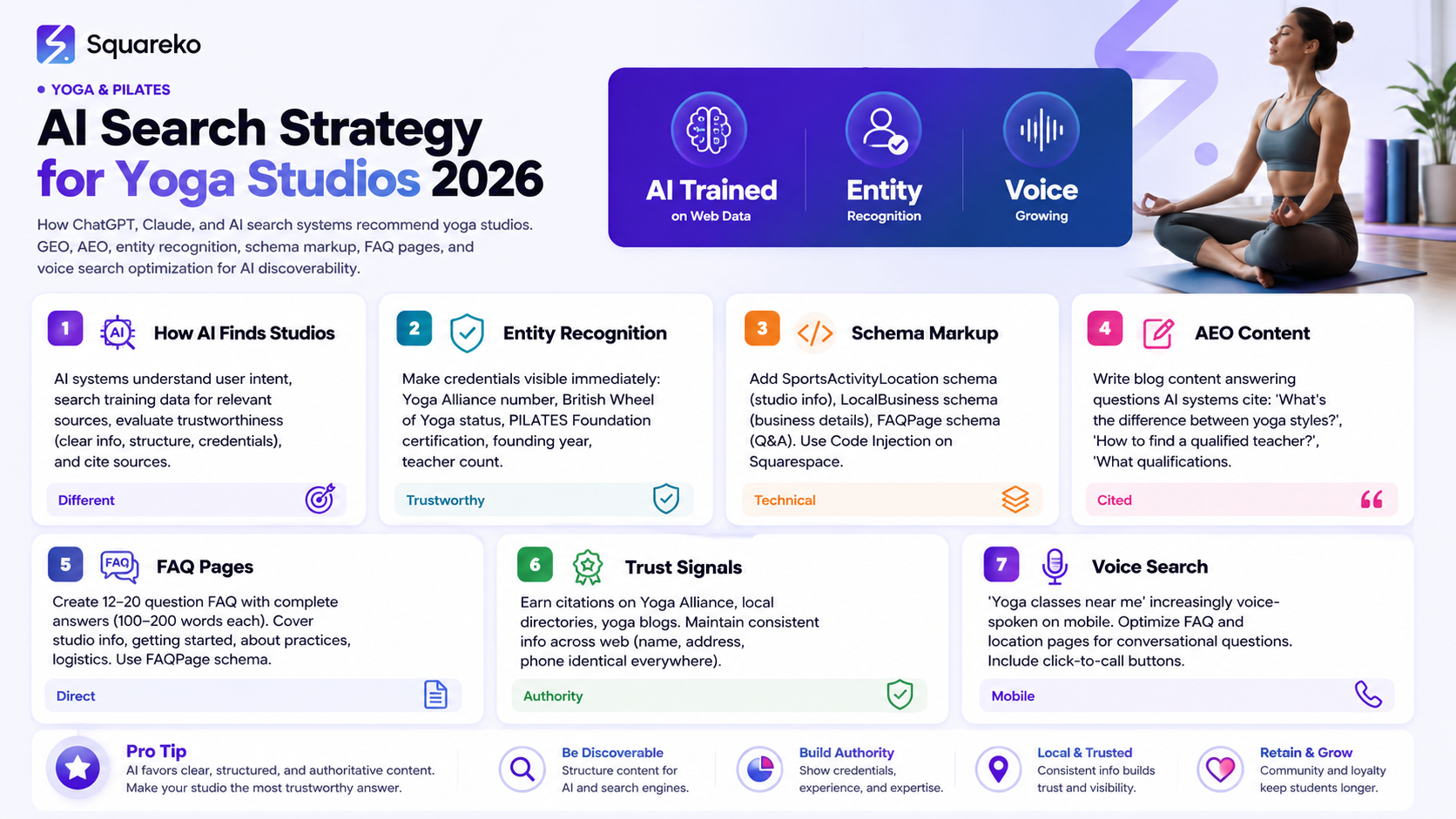
AI search engines work differently from Google. Google crawls the entire web and ranks by relevance, authority, and user signals. AI systems use large language models trained on web data—they understand language, context, and entity relationships at a higher level.
When someone asks ChatGPT, "Find me the best yoga studio in Bristol that specializes in hot yoga for beginners," the system:
Understands the intent: Yoga studio (local business), hot yoga (style), beginners (experience level)
Searches training data for relevant sources: Websites mentioning "hot yoga", "Bristol", "beginners"
Evaluates trustworthiness: Does the website appear authoritative? Is the information clear and structured? Are credentials visible?
Cites sources: AI systems cite specific URLs when recommending—this is your opportunity
The key difference: AI systems prioritize clarity and structure over keyword optimization. A well-structured website with clear credentials ranks higher than a keyword-stuffed blog post.
The Three Pillars of AI Visibility
AI visibility rests on three pillars:
1. Clear Entity Information
Your studio is an entity—defined by:
Name (exact, consistent spelling everywhere)
Location (address, city, postcode)
What you offer (yoga classes, pilates lessons, specific styles)
Credentials (Yoga Alliance registration number, British Wheel of Yoga membership, PILATES Foundation certification)
Hours and schedule (when you operate)
AI systems identify your studio by these attributes. If your website lists these clearly and consistently (homepage, About page, footer, schema markup), AI can confidently recommend you.
2. Structured Data (Schema Markup)
Schema markup is code that tells AI systems what information means. A sentence like "Jane teaches Iyengar yoga" is clear to humans. But schema markup tells AI:
"Jane" = Person
"teaches" = Action
"Iyengar yoga" = Service
At this location = Place
With schema markup, AI systems understand relationships. Without it, your information is just text.
3. Authoritative Content
AI systems evaluate trustworthiness partly by content depth. A studio website with:
Detailed FAQ sections
Explanatory blog content (not just class listings)
Teacher credentials and training details
Specific class descriptions
Clear methodology or philosophy
...signals authority. Conversely, a website with just class schedules and a contact form seems minimal and less trustworthy.
Entity Recognition for Yoga and Pilates
"Entity recognition" means the system identifying your studio as a distinct, credible yoga business.
Make Credentials Immediately Visible
On your homepage and in your header, display:
Yoga Alliance registration logo or number
British Wheel of Yoga membership status
PILATES Foundation or Body Control Pilates credentials
"Founded [year]" — establishes longevity
Number of teachers (e.g., "5 experienced yoga teachers")
Credentials are the primary trust signal for AI systems.
Create Teacher Entity Pages
Each teacher should have a dedicated page with:
Full name (consistent across all pages)
Credentials: Yoga Alliance number, training institution, years of experience
Specialisations: List exactly what they teach (e.g., "Trauma-informed yoga", "Prenatal yoga specialist")
Classes taught: Link to specific class pages
Qualifications: Any additional certifications
This creates separate entities for each teacher, all linked to your studio. AI systems can recognize: "Jane Smith (Yoga Alliance 1234567) teaches hot yoga at Studio Name."
Link to Professional Bodies
In your footer and About page, link to:
Yoga Alliance website (yogaalliance.org)
British Wheel of Yoga (bwy.org.uk)
PILATES Foundation (pilatesfoundation.com)
Local yoga or wellness communities
These outbound links signal that you're part of recognized, credible professional networks.
Schema Markup and Structured Data
Schema is the technical foundation of AI visibility. On Squarespace, you add schema via Code Injection (Settings > Advanced > Code Injection > Header).
SportsActivityLocation Schema
This schema tells AI systems: "This is a place where people do yoga/pilates."
<!-- Please remove the commented script wrapper and add this schema inside a proper <script type="application/ld+json"> tag. -->
{
  "@context": "https://schema.org/",
  "@type": "SportsActivityLocation",
  "name": "Your Studio Name",
  "sportsActivityCategory": ["Yoga", "Pilates"],
  "address": {
    "@type": "PostalAddress",
    "streetAddress": "123 Studio Street",
    "addressLocality": "Bristol",
    "addressRegion": "England",
    "postalCode": "BS1 1AA",
    "addressCountry": "GB"
  },
  "telephone": "+44 117 123 4567",
  "url": "https://yourwebsite.com",
  "areaServed": "Bristol",
  "priceRange": "£",
  "image": "https://yourwebsite.com/studio-image.jpg",
  "openingHoursSpecification": [
    {
      "@type": "OpeningHoursSpecification",
      "dayOfWeek": ["Monday", "Tuesday", "Wednesday", "Thursday", "Friday"],
      "opens": "09:00",
      "closes": "20:00"
    }
  ]
}
Local Business Schema
Complements SportsActivityLocation for overall business info:
<!-- Please remove the commented script wrapper and add this schema inside a proper <script type="application/ld+json"> tag. -->
{
  "@context": "https://schema.org/",
  "@type": "LocalBusiness",
  "name": "Your Studio Name",
  "address": {
    "@type": "PostalAddress",
    "streetAddress": "123 Studio Street",
    "addressLocality": "Bristol",
    "postalCode": "BS1 1AA"
  },
  "telephone": "+44 117 123 4567",
  "url": "https://yourwebsite.com",
  "image": "https://yourwebsite.com/studio.jpg",
  "aggregateRating": {
    "@type": "AggregateRating",
    "ratingValue": "4.8",
    "ratingCount": "47"
  }
}
FAQPage Schema
For AI citation purposes, structure FAQ as schema:
<!-- Please remove the commented script wrapper and add this schema inside a proper <script type="application/ld+json"> tag. -->
{
  "@context": "https://schema.org",
  "@type": "FAQPage",
  "mainEntity": [
    {
      "@type": "Question",
      "name": "What's the difference between hot yoga and vinyasa flow?",
      "acceptedAnswer": {
        "@type": "Answer",
        "text": "Hot yoga is performed in a heated room (usually 35–40°C) to warm muscles and increase flexibility. Vinyasa flow emphasizes continuous movement linking breath to motion. You can combine both: some studios offer heated vinyasa."
      }
    }
  ]
}
AI systems cite FAQ schema directly—so write answers that are complete, accurate, and comprehensive.
AEO Content Strategy
AEO (Artificial Engine Optimization) means creating content that AI systems cite when answering user questions.
Identify Questions Your Students Ask
Brainstorm questions potential students ask:
"What's the best yoga style for beginners?"
"How is pilates different from yoga?"
"Can I do yoga if I'm inflexible?"
"How often should I practice to see results?"
"What qualifications should a yoga teacher have?"
"Is hot yoga safe for people with heart conditions?"
"What do I need for my first pilates class?"
These are Q1: awareness/research questions. Blog content answering these ranks well in AI search.
Write Comprehensive Blog Posts
For each question, create a 1,500–2,000 word blog post that:
Answers the question directly (not buried in flowery prose)
Provides context and nuance — explain multiple perspectives
Mentions relevant styles or practices — link to your class pages
Cites credible sources — reference Yoga Alliance guidelines, research studies, expert teachers
Ends with actionable next step — "Get started with a beginner hot yoga class at [Studio Name]"
Example structure for "What's the Best Yoga Style for Beginners?":
Opening: Direct answer ("Hatha yoga and gentle vinyasa are best for beginners because...")
Explain major styles: Hatha, Vinyasa, Yin, Iyengar, Ashtanga (brief descriptions)
Considerations for beginners: Injury, flexibility, pace preference, spiritual vs physical focus
Our recommendations: Link to your beginner classes
Next steps: "Book a beginner class and tell us your goals"
This structure is ideal for AI citation because it's comprehensive, structured, and complete.
Update Blog Content for Freshness
AI systems recognize fresh content. Annually update your top 5 blog posts with:
New statistics or research
Updated examples (e.g., "As of 2026, Yoga Alliance has X registered teachers")
Current student testimonials
New links to relevant internal pages
Updated dates signal to AI systems that content is current and trustworthy.
FAQ Pages and Comprehensive Content
FAQs are critical for AI visibility. They answer questions directly, in clear language, without sales language.
Structure Your FAQ Page
Create a dedicated FAQ page with 12–20 questions covering:
About the studio:
When were you founded?
What's your teaching philosophy?
Who are your teachers?
Getting started:
What should I bring to my first class?
Do I need prior experience?
How do I book?
About the practices:
What's the difference between?
Is yoga/pilates safe if specific concern?
How often should I practice?
Logistics:
What are your hours?
Do you offer online classes?
What's your cancellation policy?
Each answer should be 100–200 words: complete enough to be useful, concise enough to be scannable.
Use Conversational Language
Write FAQ answers the way you'd explain to a friend, not corporate documentation:
❌ "Yoga practice frequency recommendations vary based on individual fitness parameters and experience level."
✅ "For most people starting yoga, 2–3 classes per week is ideal. This gives your body time to integrate what you've learned while building consistency."
Conversational language is more likely to be cited by AI systems and is more helpful to readers.
Voice Search and Local Intent
"Yoga classes near me" is increasingly spoken, not typed. Voice search queries are more specific and local.
Optimize for Voice Queries
Voice search users ask in complete questions:
"Where can I find yoga classes in Manchester?"
"What's the best pilates studio for injuries near me?"
"Can I do hot yoga if I have condition?"
Your website should answer these questions directly:
FAQ pages with voice-query answers
Location + service pages ("Yoga Classes in Bristol" page, not just "Classes")
Schema markup with hours, location, phone number (voice search users want to call)
Optimize for Mobile
Voice search happens on mobile. Ensure:
Fast mobile page speed (especially class schedule pages)
Click-to-call buttons for phone numbers
Map integration for directions
Mobile-friendly FAQ with clear, scannable answers
Building Trust Signals for AI
AI systems evaluate trustworthiness across multiple signals:
Earn Citations and Backlinks
Appear on:
Local yoga directories (YogaAlliance.org member listings)
Local chamber of commerce websites
Wellness blogs and wellness directories
Local news features (press coverage)
Teacher or student social media mentions
Each backlink and citation tells AI systems: "This studio is recognized and legitimate."
Maintain Consistent Information
Consistency across your website, Google Business Profile, and directory listings is critical:
Studio name: Exactly the same everywhere
Address: Same formatting everywhere
Phone: Same number everywhere
Inconsistencies confuse AI systems and dilute trust.
Display Reviews and Ratings
AI systems cite reviews as trust signals. Encourage Google reviews:
Post a review request email after first class
Include link to your Google Business Profile
Respond to reviews (positive and negative)
Real reviews with specific details ("Jane really listened to my shoulder injury and modified poses perfectly") are trustworthy and often cited.
Use Credentials as Trust Anchors
Explicitly state credentials throughout your site:
"All teachers hold Yoga Alliance certification"
"Founder trained at Recognized Teacher Training Institute"
"PILATES Foundation registered studio"
Credentials are the most powerful trust signal for yoga/pilates businesses.
Monitoring and Optimization
Track AI Visibility
You can't see AI search rankings like Google rankings, but you can monitor:
Direct citations: Ask new students: "How did you find us?" Track answers mentioning AI (ChatGPT, Claude, Perplexity)
Google Business Profile traffic: Monitor in Google Business Profile > Insights for increases in "Searches" and "Website visits"
Top keywords in Google Search Console: If "yoga classes city" or "pilates teacher city" show up, you're ranking for local intent (which feeds AI search)
Update Your Website Regularly
AI systems re-crawl websites frequently. Regular updates signal activity:
Monthly blog post or student spotlight
Quarterly teacher profile updates (new credentials, new bio)
Seasonal updates (new workshops, seasonal class offerings)
Active websites are cited more frequently by AI.
Monitor AI System Responses
Occasionally ask ChatGPT or Claude directly
"What yoga studios would you recommend in your city?"
"Find me a pilates instructor in your city"
Note if you're mentioned. If not, identify gaps in your schema, content, or citations.
Ready to Optimize Your Yoga Studio for AI Search in 2026?
AI search is no longer emerging—it's here and reshaping how students find yoga studios. The good news: the fundamentals of AI visibility are clear and achievable on Squarespace. Structured credentials, comprehensive FAQ content, proper schema markup, and trust signals are all within reach.
At Squareko, we specialize in optimizing yoga and pilates websites for both traditional Google search and emerging AI search systems. We audit your current setup, implement schema markup, create content strategies aligned with AEO principles, and ensure your studio is discoverable when students ask AI for recommendations.
Frequently Asked Questions
-
Not reliably. AI systems are trained on web data, and Google's index is the largest, most authoritative source. If you don't rank well on Google, you're unlikely to appear in AI search. The good news: if you optimize for AI visibility (clear structure, credentials, comprehensive content), Google ranking often improves too.
-
AI systems re-train periodically (months, not weeks). However, newer versions like ChatGPT with real-time web search will cite your website immediately if the information is clear and credible. Updates to your website (new FAQ, schema markup) can be cited within weeks.
-
Yes, but overlapping. SEO optimizes for Google's algorithms (keywords, backlinks, user signals). AEO optimizes for AI understanding (clear structure, comprehensive answers, entity information). A well-optimized website excels at both—clear information helps Google and AI equally.
-
Regular content works if it's comprehensive and clear. AI systems cite the best answer to a question, regardless of intent. Write for human readers first (answer their questions thoroughly, use natural language), and AI will cite you. Content written specifically "for AI" usually feels hollow and ranks worse with humans too.
-
Indirectly. Your Google Business Profile feeds information that AI systems use (location, hours, reviews, photos). A complete, well-maintained Google Business Profile improves overall web presence, which helps AI systems understand and recommend your studio.
-
AI systems get confused. Inconsistent business names, addresses, or credentials dilute trust signals. Spend time ensuring your studio name, address, and phone number are identical on: your website, Google Business Profile, local directories, and social media.
-
Yes. "Yoga classes near me" is increasingly voice-spoken, especially on mobile. Voice search queries are usually questions ("Where can I find...?") rather than keywords. Optimize your FAQ and local pages for conversational questions.
-
Partially. Making your information clear, consistent, and comprehensive helps. But schema markup significantly increases AI visibility. On Squarespace, adding basic schema markup is straightforward copy-paste code injection—you don't need to be technical.
Position Your Yoga Studio for AI Search Success in 2026
The future of yoga studio discovery isn't just Google anymore—it's AI recommendations. Students are asking ChatGPT where to find their next teacher, and AI systems are answering based on your website's clarity, credentials, and content.
At Squareko, we understand this shift and design Squarespace websites specifically for AI visibility. From schema markup to content strategy to credential display, we ensure your studio is discoverable to the search systems of 2026.

From custom website design to SEO strategy, we help businesses launch a site that looks professional and performs better.

About the Author
Walid is the founder of Squareko,
I'm Walid Hasan, a Certified Squarespace Expert and Squarespace Circle Platinum Partner with over 12 years of hands-on experience designing and optimizing high-performing websites. Over the years, I've had the privilege of building more than 2,000 Squarespace websites for clients around the world, always focusing on clean design, strong user experience, and conversion-driven results.