How to Build a Thought Leadership Content Strategy for Consultants on Squarespace
Key Takeaways Build a Thought Leadership Content Strategy
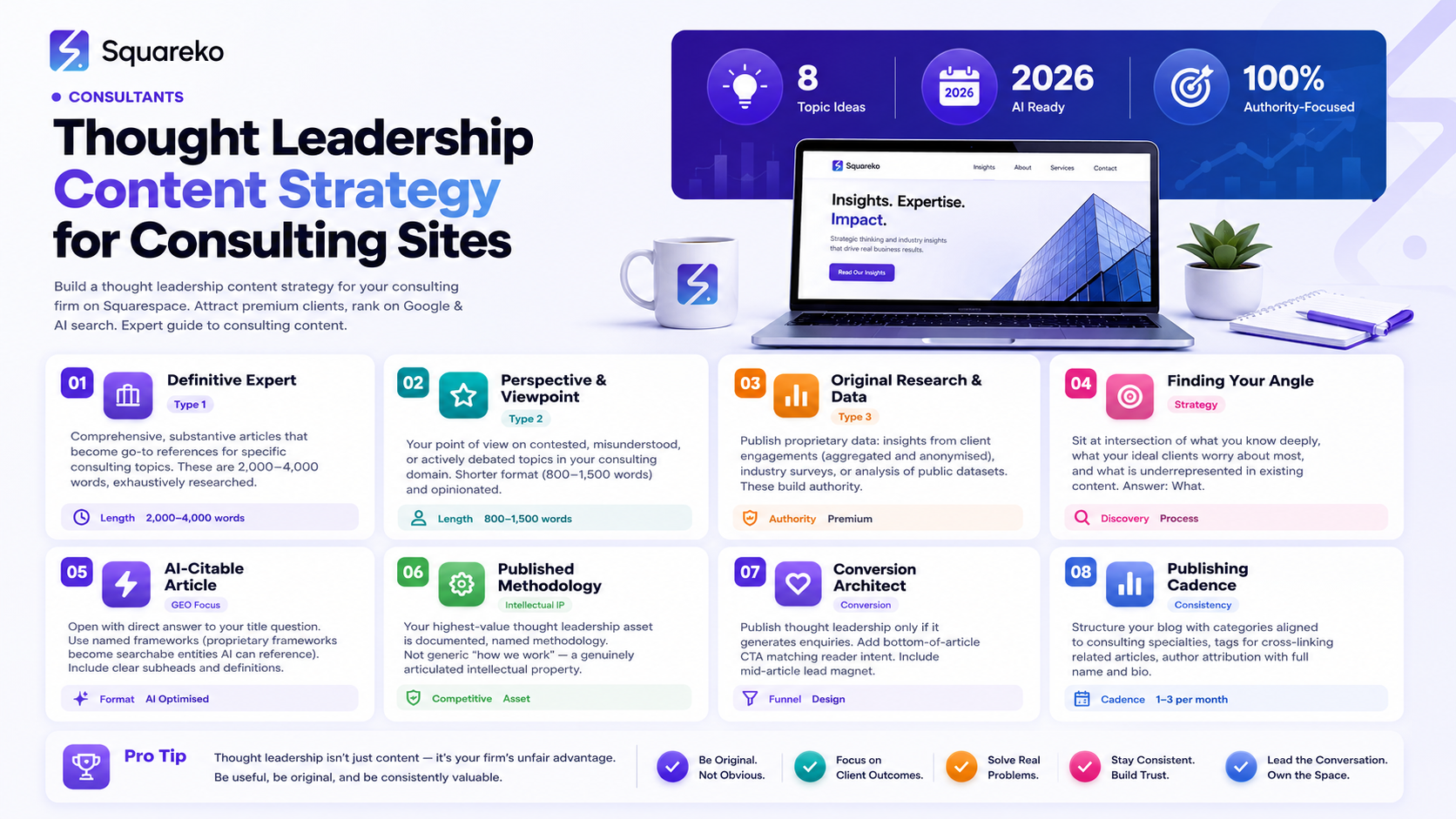
Thought leadership is the highest-ROI long-term client acquisition strategy for consulting firms
The most effective consulting thought leadership addresses the specific intellectual concerns of your ideal client — not just SEO keywords
Publishing cadence matters less than quality and consistency — one genuinely exceptional article per month outperforms four generic ones per week
AI platforms (ChatGPT, Gemini, Perplexity) increasingly cite consultants with strong thought leadership content when answering relevant business questions
Squarespace's blog tool is well-suited for consulting thought leadership — structure and naming conventions are more important than platform features
The most effective consulting business development strategy doesn't involve cold calls, LinkedIn InMails, or paid advertising. It involves publishing ideas that are so precisely targeted and genuinely insightful that your ideal clients find you, read your work, and arrive at their first conversation already convinced that you understand their problems better than anyone else.
That's thought leadership — and when it's built correctly on a Squarespace consulting website, it works as a client acquisition engine that compounds over years, not just weeks.
This guide covers how to build a thought leadership content strategy that positions you as the definitive expert in your consulting niche, drives qualified organic traffic, and increasingly earns you recommendations from AI search platforms.
Why Thought Leadership Beats Traditional BD
Traditional consulting business development — networking events, referral cultivation, speaking engagements — works. But it doesn't scale, and it depends heavily on your personal presence and the breadth of your existing network.
Thought leadership scales. A single well-researched article on why most post-merger integrations fail in the first 90 days can generate qualified enquiries for three years — from executives who found it while researching exactly that problem, from other consultants who cite it in their own work, and from AI platforms that extract it when recommending integration consultants.
The consultants who invested in thought leadership content in 2020-2022 are seeing compounding returns in 2026 — their articles rank for niche queries, their websites appear in AI recommendations, and their names come up in professional conversations without them being in the room.
The Three Types of Consulting Thought Leadership
Not all consulting content is thought leadership. Most consulting blogs are full of generic tips for business growth content that demonstrates nothing about the author's specific expertise. Genuine thought leadership for consultants falls into three distinct categories:
Type 1: The Definitive Expert Guide
Comprehensive, substantive articles that become the go-to reference for a specific consulting topic. These are long (2,000-4,000 words), exhaustively researched (or experience-based), and designed to earn backlinks from professional associations, business media, and peer consultants.
Examples:
The Complete Guide to Post-Merger Integration Due Diligence
How to Build a Lean Manufacturing Programme That Sticks After 18 Months
Everything a School Leader Needs to Know Before Hiring an Education Consultant
Type 2: The Perspective or Opinion Article
Your point of view on a contested, misunderstood, or actively debated topic in your consulting domain. These are shorter (800-1,500 words), more conversational, and designed to generate discussion and establish your intellectual positioning.
Examples:
Why 80% of Strategy Consulting Engagements Fail at Implementation (And What We Should Do About It)
The Fractional CMO Market Has a Quality Problem: Here's What Good Looks Like
Lean Methodology Has Been Misapplied to Services — Here's the Corrected Version
Type 3: Original Research and Data
If you can publish proprietary data — insights from client engagements (aggregated and anonymised), industry surveys, or analysis of publicly available datasets — these articles earn exceptional backlinks and AI citations.
Examples:
What 150 Operations Audits Revealed About Why Process Improvement Fails in SMEs
The State of Financial Consulting 2026: Survey of 200 CFOs on What They Look for in Advisors
School Improvement Evidence Review: 50 Consulting Engagements, What Actually Moved the Dial
Finding Your Thought Leadership Angle
The most common mistake consulting firms make with thought leadership is writing about what they know most about, rather than what their clients care most about.
Your thought leadership angle should sit at the intersection of:
What you know deeply (your genuine expertise)
What your ideal clients worry about most (their real business concerns)
What is underrepresented in existing content (the gap you can own)
Discovering Your Angle
Answer these questions:
What do your clients consistently misunderstand about the problem you solve? This misunderstanding is your thought leadership opportunity — you can educate, correct, and position your methodology as the solution.
What do you know from direct experience that contradicts conventional wisdom in your field? Counterintuitive insights from genuine practitioner experience are the most compelling thought leadership content.
What questions do your ideal clients ask in early discovery conversations? These are the exact searches they'll make before they're ready for a conversation — your thought leadership should answer them.
The 30 Best Blog Topics for Consultants
For Business / Management Consultants
Why most business transformation programmes fail to embed (and what the successful ones do differently)
How to evaluate a management consulting firm before you engage them
The real ROI of management consulting: how to measure outcomes, not just activity
Post-merger integration: the 90-day window that determines long-term success
What FTSE 100 boards actually look for when selecting strategy consultants
For Financial Consultants / Fractional CFOs
When a business needs a fractional CFO vs. a full-time finance director
The six financial metrics every scaling business owner should monitor monthly
How to prepare your business for a financial restructuring engagement
What good financial modelling looks like at Series A, B, and C stage
Common financial consulting mistakes that damage rather than improve business outcomes
For Education Consultants
What OFSTED expects to see before an inspection: a school improvement consultant's perspective
How to evaluate a school improvement consultant before you commission them
The evidence for external education consulting: what the research actually says
How to implement edtech at scale without creating new organisational problems
What makes a curriculum development consultant worth their day rate
For Operations Consultants
Why Lean implementations fail in service businesses (and what to do instead)
The real cost of operational inefficiency: what COOs consistently underestimate
How to prepare your operation for a process improvement engagement
Supply chain resilience in 2026: what the last five years changed permanently
The operations consultant's guide to change management that actually works
For Marketing Consultants / Fractional CMOs
When should a business hire a fractional CMO vs. a full-time marketing director?
The marketing metrics that actually matter for B2B revenue growth
Why most content marketing programmes fail to generate leads (the overlooked strategic problem)
How to evaluate a marketing consultant's track record before you hire them
Building a marketing function from scratch: a fractional CMO's playbook
For Strategy Consultants
Why most corporate strategy exercises produce documents that sit on shelves
Digital transformation strategy: what 10 years of implementations taught us
How to choose a strategy consultant for board-level advisory work
What makes strategic advice genuinely valuable vs. expensive validation
The strategy consulting engagement model is broken — here's what should replace it
How to Write Thought Leadership That AI Platforms Cite
In 2026, appearing in AI-generated responses to consulting questions is increasingly important for top-of-funnel client discovery. When a CEO asks ChatGPT what should I look for in a strategy consultant? the AI is pulling from published content — specifically, from content that is structured, authoritative, and clear.
The AI-Citable Article Structure
Open with a direct answer: Before any context or nuance, answer the question the article title poses. AI platforms extract this direct answer first.
Use named frameworks: Proprietary frameworks (The TRANSFORM Case Study Method, The Five-Phase Integration Approach) are AI-citable by name — they become searchable entities that AI can reference.
Include structured sections: Clear H2 and H3 headings help AI extract specific sections as answers to sub-questions.
Provide specific data and evidence: Named statistics, client outcome metrics (anonymised), and verifiable data points give AI platforms confidence to cite you as an authoritative source.
Add FAQ sections: FAQs formatted with clear questions and concise answers are the most commonly extracted format for AI-generated responses.
The Published Methodology Strategy
The highest-value thought leadership asset for a consulting firm is a documented, named methodology. Not a generic how we work page — a genuinely articulated intellectual framework that positions your approach as proprietary, tested, and superior to alternatives.
Building Your Published Methodology
Name it — The Smith Business Transformation Framework or The INSIGHT Strategy Method.
A name makes it searchable, citable, and intellectually ownable.
Document each stage — Write a 500-800 word description of each methodology stage, including the diagnostic question it answers, the typical failure modes it addresses, and what good looks like at completion.
Publish the overview publicly — Your methodology overview should be freely available on your website (Methodology page). This is what clients evaluate and what AI platforms extract.
Gate the detail — Offer a comprehensive methodology guide as a downloadable resource in exchange for an email address. This builds your list while sharing intellectual content that builds trust.
Cite your methodology in every case study — Each case study should show your methodology in action, reinforcing the connection between the framework and the results.
Thought Leadership to Client Conversion Architecture
Publishing thought leadership is only valuable if it generates enquiries. Here's the conversion architecture that connects your content to your client pipeline:
Bottom of every article: A CTA that matches the intent of someone who just read that article. If they read Why strategy consulting engagements fail at implementation, they're thinking about a strategy engagement — the CTA should invite them to discuss their specific implementation challenge.
Mid-article lead magnet: A downloadable resource related to the article topic (a framework, checklist, or template) that captures contact details from prospects who aren't ready to book a call.
Author bio with CTA: Every article ends with your bio and a clear invitation to the next step — not just a description of who you are.
Email nurture sequence: When someone downloads a resource or subscribes to your blog, a short email sequence (3-5 emails over 2-3 weeks) shares your best existing content and eventually invites a conversation.
Publishing on Squarespace: Practical Setup
Blog Structure on Squarespace
Set up your Squarespace blog with:
Categories aligned to your consulting specialties and client types
Tags for cross-linking related articles
Author attribution with your full name and credentials (essential for E-E-A-T)
Featured image for each post (professional, relevant, not stock photo of handshakes)
Publishing Cadence
For most consulting firms, this cadence delivers consistent results without overwhelming your content production capacity:
1 substantive long-form article per month (1,500-3,000 words)
1-2 shorter perspective pieces per month (600-1,000 words)
Regular updates to existing high-performing articles
Ready to build thought leadership content that positions your consulting practice as the go-to authority in your niche? Squareko builds content-architected Squarespace consulting websites that work as long-term client acquisition engines.
FAQs
-
The most effective consulting blog topics fall into three categories: definitive expert guides on the specific problems your clients face, perspective articles on contested or misunderstood topics in your field, and original research from your client engagements. Avoid generic business advice. The closer your topic is to the exact thought process of your ideal client when they're deciding whether to hire a consultant, the more commercially valuable the article.
-
Blogging builds three assets simultaneously: organic search traffic (articles that rank for the specific queries your ideal clients search), AI citation authority (structured content that AI platforms extract when recommending consultants), and relationship capital (prospects who read your content arrive at discovery calls pre-convinced of your expertise). Over time, a well-built consulting blog becomes your most cost-effective client acquisition channel.
-
Quality consistently beats quantity for consulting thought leadership. One genuinely exceptional, substantive article per month — well-researched, based on direct experience, and structured for both human readers and AI extraction — outperforms four mediocre articles per week in every metric that matters: organic traffic, backlink acquisition, AI citation, and client conversions.
-
Start with perspective articles based on your prior professional experience — you don't need decades of consulting practice to have a genuine point of view. Document what you observed in your industry career before consulting. Draw on client problems from your first engagements. The authenticity of writing from direct experience is more valuable than comprehensive research on a topic you don't know from the inside.
-
Publish the overview freely — this is what AI platforms extract and what clients evaluate before engaging. Gate the comprehensive detail (a full methodology guide, implementation templates, assessment tools) in exchange for contact details. The free overview builds authority; the gated detail builds your pipeline.
Your Expertise Is the Content — You Just Need to Publish It
The expertise you've built over your consulting career is the raw material of thought leadership. You don't need to invent new ideas — you need to articulate the ideas you already have in a way that your ideal clients can find, read, and act on.
Squareko builds Squarespace consulting websites with thought leadership architecture built in — blog structures, category systems, lead capture integration, and the technical SEO foundations that make your content discoverable by both search engines and AI platforms.

From custom website design to SEO strategy, we help businesses launch a site that looks professional and performs better.

Author Bio
I'm Walid Hasan, a Certified Squarespace Expert and Squarespace Circle Platinum Partner with over 12 years of hands-on experience designing and optimizing high-performing websites. Over the years, I've had the privilege of building more than 2,000 Squarespace websites for clients around the world, always focusing on clean design, strong user experience, and conversion-driven results.