How to Write Skincare Product Descriptions That Convert and Rank on Google
Introduction
Your skincare product description is the bridge between browser and buyer. Yet most beauty brands squander this opportunity by listing ingredients like a chemistry textbook or burying benefits beneath vague marketing speak. When written effectively, skincare product descriptions convert rank google squarespace searches into paying customers—and Google rewards them with higher rankings.
The challenge is real: shoppers need reassurance that your serums, moisturisers, and cleansers actually work. They want to know how the product feels, what results to expect, and whether it suits their skin type. Simultaneously, search engines demand clarity, keyword relevance, and structured data. Your product descriptions must satisfy both human readers and algorithmic criteria.
This guide walks you through proven copywriting techniques, SEO best practices, and Squarespace implementation strategies that deliver results. By the end, you'll have a repeatable system for writing descriptions that rank, convert, and reflect your brand's expertise.
Key Takeaways
Product descriptions influence both conversion rates and search rankings—treat them as dual-purpose marketing assets
Structure descriptions using proven copywriting formulas (AIDA or PAS) to guide readers toward purchase
Integrate your focus keyword naturally within the first 100 words, H2 headings, and the first sentence
Use sensory language and benefit-focused copy to help shoppers visualise results
Avoid weak, overused phrases that dilute credibility and undermine SEO potential
Include ingredient callouts, skin-type suitability, and use instructions for transparency and length
Implement JSON-LD schema markup in Squarespace to enable rich snippets and improve click-through rates
Test and refine descriptions based on conversion data and search performance metrics
Why Skincare Product Descriptions Matter for Sales and SEO
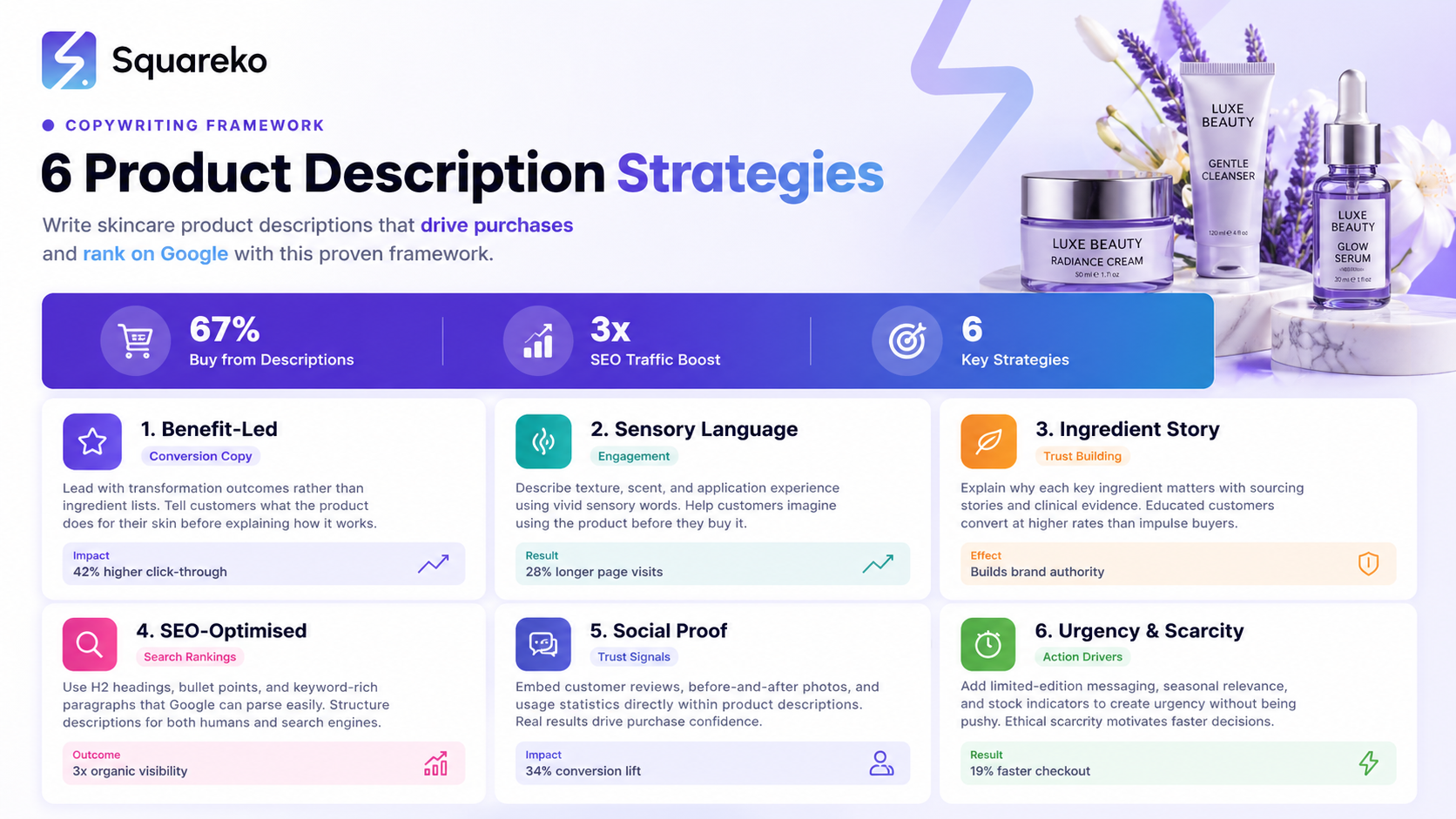
Most brands treat product descriptions as an afterthought—a place to dump specs and compliance information. This approach costs you sales and search visibility.
Consider what happens when a shopper lands on your product page. They have seconds to decide whether to read further or click away. A compelling description immediately addresses their pain point, shows you understand their needs, and promises a solution. This is the job of a description: persuasion through clarity.
From an SEO perspective, product descriptions serve as on-page content that search engines analyse for relevance and quality. Google's algorithms now prioritise user experience signals like click-through rates and time-on-page. A well-written description that keeps readers engaged and moving toward checkout sends positive signals to Google. Simultaneously, unique, high-quality product copy protects you from algorithm penalties that affect sites with thin, duplicate, or low-value content.
Squarespace sites benefit especially from strong product descriptions because Squarespace's architecture allows you to control meta titles, meta descriptions, and structured data easily. When you combine persuasive copy with SEO metadata and schema markup, you create a powerful system that attracts search traffic and converts visitors.
The bottom line: product descriptions are not just selling tools—they're ranking factors.
The AIDA Framework: A Copywriting Formula That Works
AIDA stands for Attention, Interest, Desire, Action. It's a time-tested copywriting structure that guides readers toward a purchase decision through a logical psychological progression.
Attention: The opening line captures focus. For skincare, this often means naming the most pressing skin concern or the transformative benefit. Example: Tired of oily T-zones ruining your morning skincare routine?
Interest: Build curiosity by explaining the mechanism or key ingredients. What makes this product different? How does it work? Our lightweight gel essence absorbs instantly without clogging pores, thanks to our proprietary blend of niacinamide and hyaluronic acid.
Desire: Paint an emotional picture of life with the product. Use sensory details and results-focused language. Wake up to a mattified, poreless complexion. Your skin feels refreshed, balanced, and ready to receive the rest of your routine.
Action: Close with a clear call-to-action and friction-reducing language. Add to bag. Free delivery on orders over £50. 30-day money-back guarantee.
For skincare product descriptions, you can compress AIDA into 150–250 words without sacrificing persuasion. The key is density: every sentence must serve the AIDA structure.
Keyword Optimisation Without Keyword Stuffing
SEO success depends on strategic keyword placement, not awkward repetition. Your focus keyword—in this case, skincare product descriptions convert rank google squarespace —should appear naturally in high-priority locations.
Primary Placement:
H1 title (your page headline)
First 100 words of the introduction
First sentence of the product description itself
One H2 subheading (naturally integrated)
Meta title and meta description
Secondary Keywords: Instead of forcing your long-tail focus keyword into every sentence, identify related secondary keywords that add context and capture search variations. Examples for skincare:
Organic skincare product description
Best skincare routine for oily skin
Cruelty-free moisturiser benefits
Anti-ageing serum how to use
Weave these naturally throughout the description, supporting your primary keyword without repetition. Aim for a keyword density of 0.5–1.5% for your main keyword—higher densities signal manipulation to Google.
Technical Implementation on Squarespace: In Squarespace, product pages allow you to customise the SEO panel. Enter your focus keyword in the SEO Keywords field and your meta description in the Meta Description field. Squarespace then shows you a preview of how your page will appear in search results. Use this preview to ensure your keyword appears naturally in the meta title and description.
For descriptions longer than 200 words, consider adding subheadings using the Description field's formatting options. These internal H3s (styled with bold text) break up copy, improve readability, and provide additional keyword-placement opportunities.
Sensory Language That Sells: Paint a Picture
Skincare shoppers cannot touch, smell, or feel your product before purchase. Your words must bridge that gap. Sensory language creates an imagined experience that compels purchase.
Rather than: This moisturiser hydrates. Write: This silky, fast-absorbing moisturiser melts into skin, leaving a dewy, plump complexion without residue.
Notice the difference. The second version activates the reader's senses. They can feel the texture, anticipate the finish, and visualise the result. This emotional connection drives conversion.
Common Sensory Words for Skincare:
Texture: lightweight, silky, velvety, creamy, gel-like, luxurious, feather-soft, smoothing, whipped, serum-consistency
Finish: matte, dewy, luminous, glowing, satin-finish, poreless, radiant, natural-looking, veil-like
Sensation: cooling, warming, refreshing, invigorating, soothing, calming, tingling (for active ingredients), plumping, tightening
Aromatics: (if applicable) botanical, citrusy, floral, herbal, fresh, clean, subtle, uplifting
Benefit-Focused Language: Connect sensory details to tangible results. The lightweight gel texture absorbs in seconds, leaving your skin feeling refreshed and your pores visibly refined. This combines texture (gel, lightweight) with benefit (pores refined) through a sensory bridge (fast absorption).
Avoid generic adjectives like amazing, incredible, or revolutionary. These lack specificity and weaken credibility. Instead, use precise descriptors that show rather than tell.
Common Mistakes That Sink Product Descriptions
Even well-intentioned brands make preventable errors that diminish conversion rates and SEO performance.
1. Ingredient Lists Instead of Benefits Many brands list every ingredient alphabetically, assuming customers care about chemistry. Most don't. Prioritise benefits. Niacinamide (5%) minimises pore appearance and strengthens skin's barrier function beats Contains niacinamide because it connects ingredient to outcome.
2. Vague, Unmeasurable Claims This serum dramatically improves skin texture is unmeasurable and untrustworthy. Replace with specificity: Clinical trials show 87% of users reported smoother skin texture within 4 weeks. Quantifiable claims build confidence.
3. Overusing Banned Phrases Phrases like revolutionary, m in today's digital landscape, and "leverage are SEO red flags and brand weakeners. They signal lazy copywriting. Replace with fresh, brand-specific language that reflects your voice and values.
4. Ignoring Skin-Type Specificity For all skin types is technically accurate but unhelpful. Reframe: Ideal for oily and combination skin. Lightweight formula won't clog pores. Dehydrated skin? Use a hydrating serum underneath. This micro-targeting improves relevance and conversion rates by speaking directly to each reader's concerns.
5. Missing Use Instructions Customers often abandon products because they don't know how to use them. Apply 2–3 drops to clean skin morning and evening. Follow with moisturiser adds reassurance and reduces returns. It's also valuable SEO content.
6. No Social Proof or Certifications Mention third-party certifications, awards, or notable endorsements naturally. Certified organic by [Certifier]. Featured in [Publication]. These credibility markers increase conversion and differentiate you from competitors.
7. Duplicate Descriptions Across Similar Products If your Rose Moisturiser and Green Tea Moisturiser share identical descriptions, Google sees thin content. Even if products share core benefits, differentiate descriptions by highlighting unique ingredients, scents, and skin suitability.
Real Examples: Before and After
Let's transform a weak product description into a conversion-optimised, SEO-friendly version.
Before (87 words): Hydrating Serum. This serum contains hyaluronic acid and vitamin C. It hydrates and brightens skin. It's lightweight and absorbs quickly. Good for all skin types. Made with natural ingredients. No parabens or sulfates. Use morning and evening. Apply a few drops to clean skin.
Problems: No sensory language. No AIDA structure. Vague benefit statements. Weak opening. No skin-type differentiation. Reads like a checklist.
After (218 words): Luminous Hydration Serum: Lightweight Daily Moisture + Glow
Wake up to plump, glowing skin. Our Luminous Hydration Serum combines hyaluronic acid (multi-molecular weight) with stabilised vitamin C to deliver deep hydration and a visible radiance boost—without heaviness or greasiness.
The Difference You'll Feel: This feather-light serum absorbs in seconds, leaving your skin feeling supple and refreshed. Hyaluronic acid holds up to 1000x its weight in water, plumping fine lines and restoring bounce. Stabilised vitamin C brightens dull complexion and protects against environmental stressors. The result? Visibly smoother, more radiant skin that lasts all day.
Ideal For: Dehydrated, dull, and combination skin. Lightweight formula won't clog pores or leave residue. If you have very dry skin, layer underneath a heavier moisturiser.
How to Use: Apply 2–3 drops to clean, damp skin morning and evening. Gently press into face and neck. Follow with your favourite moisturiser or SPF. One bottle lasts approximately 6–8 weeks with daily use.
What's Inside: Hyaluronic Acid, Stabilised L-Ascorbic Acid (Vitamin C), Aloe Vera, Glycerin, Niacinamide. Paraben-free. Sulphate-free. Cruelty-free. Vegan.
Customer Promise: 30-day money-back guarantee. If you don't notice improved hydration and radiance, we'll refund you, no questions asked."
Improvements: Clear H3 structure. AIDA framework embedded. Sensory language. Skin-type specificity. Use instructions. Credibility markers (stabilised vitamin C percentage, hyaluronic acid benefits). Benefit-focused ingredient callouts. CTA with friction reduction (money-back guarantee).
The after version is longer, but every word earns its place. It addresses reader concerns, guides them toward purchase, and ranks better because it's comprehensive, unique, and structured.
Frequently Asked Questions
-
Aim for 150–300 words for standard product pages. Short descriptions (100 words) work for collection pages or quick-add formats. Long descriptions (400+ words) work for flagship products with multiple use cases or complex formulations. Balance length with purpose: never pad unnecessarily, but provide enough detail to eliminate buyer hesitation.
-
No. Lead with key active ingredients (those delivering primary benefits) and supporting ingredients if they add value. Include a full ingredient list separately, either in an "Ingredients" collapsible section or a downloadable PDF. This keeps descriptions scannable while providing transparency for ingredient-conscious shoppers.
-
Use cautious language: "may help," "can support," "designed to," and "clinically shown to." Substantiate claims with third-party testing or clinical data when possible. Avoid absolute statements ("cures acne") in favour of conditional ones ("helps reduce the appearance of blemishes"). When in doubt, consult your compliance team.
-
Yes, if the formulation is identical. However, if shade or size affects suitability (e.g., different undertones for concealers), add a brief line explaining this. For Squarespace, use variants to avoid duplicate content penalties while keeping descriptions consistent across sizes.
-
Lead with reassurance: "Formulated for sensitive and reactive skin. Gentle, hypoallergenic formula free from common irritants." Then deliver specificity: "No fragrance, essential oils, alcohol denat, or sulphates. Dermatologist-tested. Suitable for eczema-prone and rosacea-prone skin." Conclude with a permission statement: "If you have specific sensitivities, check the full ingredient list or patch-test first."
-
Update descriptions when you reformulate, change suppliers for key ingredients, receive new third-party test results, or notice declining conversion rates. Track which descriptions drive sales and which underperform. Refresh underperformers quarterly. Evergreen descriptions perform well once optimised, but seasonal products merit seasonal tweaks (e.g., "winter hydration boost" in December).
-
No. Keep pricing separate in Squarespace's product pricing field. Mentioning price in copy dilutes the focus on benefits and value. Let the price appear where expected—below the "Add to Cart" button—so readers focus on desire before encountering cost objections.
-
Write more conversationally and include long-tail keywords phrased as questions. "Best lightweight moisturiser for oily skin" and "Is niacinamide good for oily skin?" are natural voice-search queries. Incorporate these as secondary keywords. Use natural language rather than keyword-stuffed copy. Voice-search queries often reflect how people speak, so casual, benefit-focused language works best.
Ready to Write Product Descriptions That Sell?
You now have a framework, formulas, and actionable strategies to write skincare product descriptions that convert and rank. The real work begins when you apply these principles to your own products.
Start with your top 5 bestsellers. Apply the AIDA structure. Inject sensory language. Optimise keywords naturally. Measure conversion rates before and after. You'll see improvements.
If you're building your Squarespace store from scratch or redesigning existing product pages, consider working with a copywriter who specialises in beauty and skincare. The investment pays dividends through improved conversion rates and search visibility.
Need help with Squarespace setup, site optimisation, or content strategy? Squareko provides practical guides, templates, and resources for beauty brands building on Squarespace. Visit us to explore more copywriting guides, SEO checklists, and design best practices built specifically for cosmetics and skincare businesses.
Your products deserve descriptions that reflect their quality and your expertise. Write them well.

From custom website design to SEO strategy, we help businesses launch a site that looks professional and performs better.

About the Author
I'm Walid Hasan, a Certified Squarespace Expert and Squarespace Circle Platinum Partner with over 12 years of hands-on experience designing and optimizing high-performing websites. Over the years, I've had the privilege of building more than 2,000 Squarespace websites for clients around the world, always focusing on clean design, strong user experience, and conversion-driven results.