How to Write a Speaking Coach About Page That Gets You Booked
Key Takeaways For How to Write a Speaking Coach About Page That Gets You Booked
Lead with transformation, not credentials—show the result of your coaching, not just your background
Your signature style or methodology creates differentiation that makes prospects choose you over competitors
Vulnerability and origin stories build deeper connection than impressive credentials alone
Social proof through client transformations is more persuasive than awards or certifications
A clear call-to-action at the end turns I like this coach into I'm booking a call
Your about page is where skeptical prospects become confident clients. When someone lands on your about page, they're asking one question: Should I trust this person to coach me?
Most speaking coaches get this wrong. They write generic bios listing credentials like Certified Public Speaking Coach or 10 years of experience. That's not compelling. That's boring. Prospects don't book because of credentials. They book because they connect with you.
This guide shows you the exact framework to write an about page that builds trust, demonstrates your expertise, and converts readers into booking a discovery call.
The Problem With Traditional Coach Bios
Most speaking coach about pages read like résumés:
Sarah Mitchell is a certified speaking coach with 15 years of experience in corporate communication. She holds a certificate from the International Public Speaking Institute and has trained over 500 professionals. Sarah specializes in executive presence and presentation skills.
This bio accomplishes nothing. It doesn't explain why someone should choose you. It doesn't show your personality. It doesn't answer the prospect's real question: Will this coach actually help me?
Compare that to this:
Five years ago, I was terrified of presenting. I'd practiced my slides 100 times, but the moment I stepped in front of 50 people, my mind went blank. My voice shook. I stumbled through three minutes of rambling before asking if anyone had questions. I got zero follow-ups. That failure taught me something crucial: confidence isn't about having better slides. It's about knowing your material so deeply that your body trusts it. That knowledge is what I now teach to corporate leaders, entrepreneurs, and nonprofit directors who are tired of letting presentation anxiety hold them back.
Which bio makes you want to book a call?
The second one. Because it's real. It shows transformation. It demonstrates that you've been where your clients are.
Your Origin Story: Why You Became a Speaking Coach
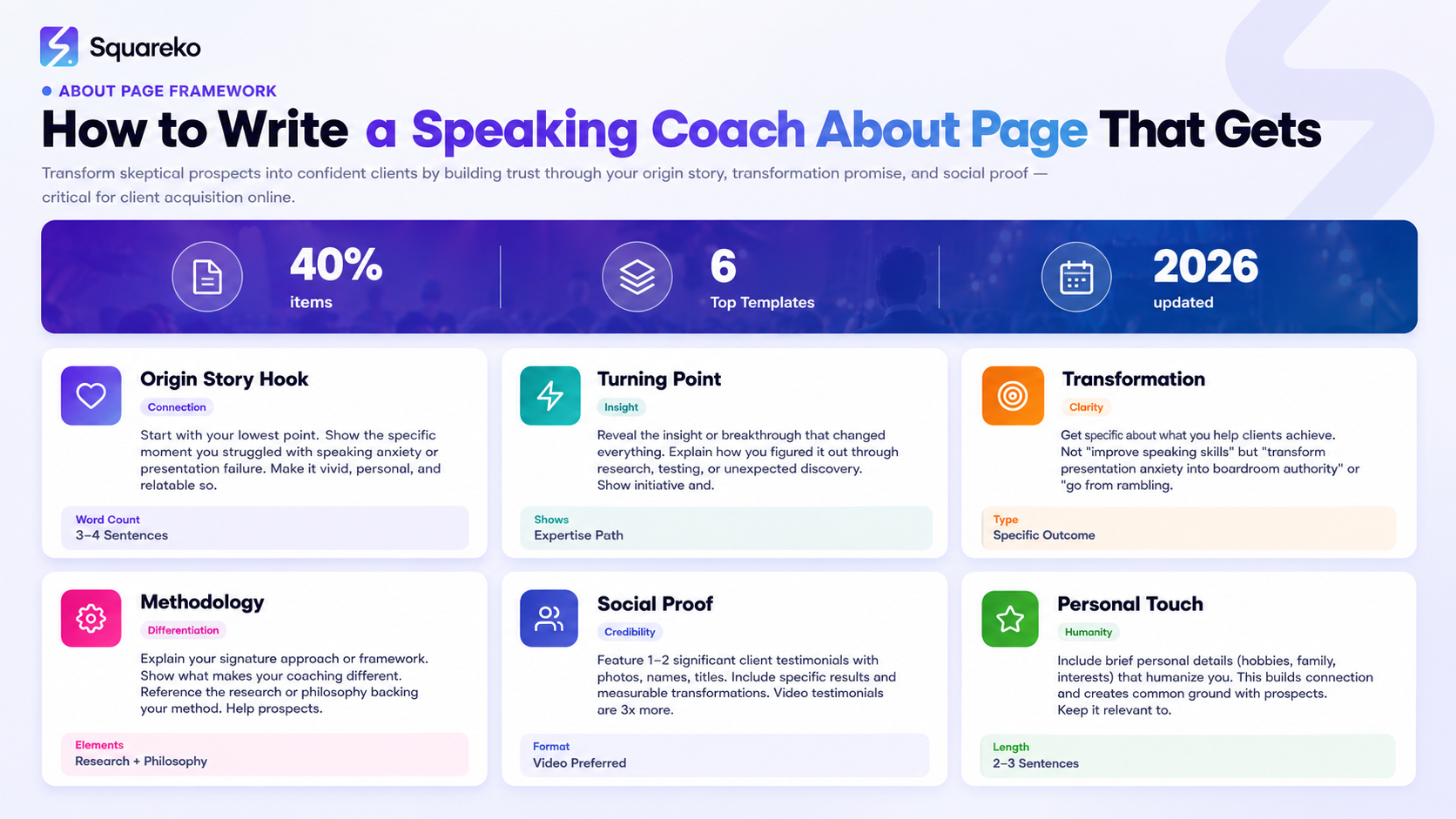
The Hook: Your Lowest Point
Start your about page with a moment of struggle. This could be:
You were petrified of public speaking and overcame it
You spent years in corporate roles hating presentations, until you figured out how to make them work
You were naturally gifted at speaking but watched colleagues sabotage themselves with anxiety
You worked in HR and saw talented people get passed over for promotions because of poor presentation skills
The point: show a specific moment where you faced the speaking challenge you now coach others through.
Write it in first person. Keep it brief (3-4 sentences). Make it specific, not generic.
Generic: I struggled with public speaking early in my career.
Specific: During my first board presentation at a Fortune 500 company, I brought slides so text-heavy that the CFO fell asleep. I spent the next three years researching presentation psychology, studying TED talks, and reverse-engineering what makes certain presentations stick while others are instantly forgotten.
The specific version shows initiative, self-awareness, and transformation. The generic version shows you had a problem. So what?
The Turning Point: When You Figured It Out
After showing your struggle, reveal the insight or breakthrough that changed everything.
I realized that great presentations don't come from perfect slides or memorized scripts. They come from obsessive clarity about your core message, combined with the ability to deliver it without needing to 'perform.' Once I stopped trying to be a perfect presenter and started being a clear communicator, everything changed. My next presentation got a standing ovation. More importantly, I got three new client opportunities from that single talk.
This turning point accomplishes three things:
It shows your expertise came from real experience, not just theory
It demonstrates results (standing ovation, new opportunities)
It transitions from Here's my story to Here's why that makes me the coach you need
Your Transformation Promise
What You Help Clients Achieve
After sharing your origin story, get specific about what you help clients do. Not improve presentation skills (too vague), but:
Transform presentation anxiety into confident stage presence
Go from rambling presentations to crystal-clear messages that move audiences
Master executive presence so boardroom conversations feel natural, not terrifying
Deliver keynotes that get standing ovations and lead to consulting opportunities
Build speaking confidence that translates into career advancement
Pick the transformation that applies to your ideal client. Be specific. One transformation, clearly stated.
The Before/After Framework
Help prospects see themselves in the before state and imagine the after state:
Before: Most of my clients come to me in one of three situations. They're promoted into leadership roles and suddenly they're expected to present at company meetings, but they've never learned to do it confidently. Or they're entrepreneurs who know their business inside-out but freeze when pitching to investors. Or they're professionals who've been passed over for promotions because their communication doesn't match their competence.
After: Within 12 weeks of working together, they're leading meetings with clarity and authority. They pitch investors and close deals because they sound as knowledgeable as they actually are. They get promoted because their executive presence finally matches their expertise.
The before/after frame shows the problem, the path through coaching, and the outcome.
Your Signature Style or Methodology
Why Methodology Matters
Prospects want to know how you work. I coach people on speaking is vague. I use the VOICE framework to transform speaking anxiety into confident delivery is clear.
If you have a named methodology, feature it prominently on your about page:
I developed the CLARITY Method after coaching 200+ professionals through presentation anxiety. The four steps—Core Message, Logic Flow, Audience Connection, Rhythm and Pace, Iterations, Test, Yardstick—address the specific breakdowns that make presentations fail.
Most coaches say Just practice more. That doesn't work for anxious speakers. The CLARITY Method works because it breaks speaking anxiety into solvable components.
If you don't have a named methodology yet, describe your approach in plain language:
My approach is different from most speaking coaches. I don't focus on eliminating 'um's' or fixing your hand gestures. Those are symptoms of deeper issues. Instead, I help you build obsessive clarity about your core message. Once you know exactly what you're saying and why it matters, your body stops fighting you. Your gestures become natural. Your delivery becomes confident. The technique takes care of itself.
This approach accomplishes two things:
It differentiates you from other coaches (you don't just teach technique—you teach thinking)
It explains why your coaching works (clarity before delivery)
The Research or Philosophy Behind Your Methodology
Briefly mention the research or philosophy informing your approach:
My methodology is rooted in neuroscience research on how anxiety affects the brain, combined with principles from improvisation (yes, stage improvisers), storytelling frameworks, and executive coaching. I've studied thousands of TED talks and keynotes to understand what makes certain messages stick and others get forgotten.
This adds credibility without sounding overly academic.
Social Proof and Client Results
The Power of Specific Results
Don't say My clients are very satisfied. Say:
My clients deliver 87% of their presentations with zero-anxiety reported in post-coaching surveys
91% of my corporate workshop attendees report increased confidence in their next presentation
Three of my individual coaching clients have been accepted as TEDx speakers in the last 18 months
My corporate clients report 34% more questions and engagement during presentations after working with me
These specific results are far more persuasive than vague praise.
Client Testimonial Placement
Your about page should feature 1-2 significant client testimonials. These should be video (if possible) or at minimum a photo + full name + title + testimonial.
Strong testimonial: Before working with Maria, I'd turn down speaking opportunities. Now I seek them out. I delivered my first keynote last month, and it led to a consulting contract worth $25,000. Maria's coaching didn't just improve my presenting—it transformed my career. — David Chen, CEO, TechStart Solutions
Weak testimonial: Maria is a great coach and really helped me feel more confident speaking.
The strong testimonial includes the specific transformation, the measurable result, and the impact on the client's professional life.
Case Study or Story
Consider featuring a brief case study of a specific client transformation. This could be a sidebar or separate section:
From Anxiety to Authority: How a Finance Executive Mastered Board Presentations
When James first contacted me, he'd been promoted to CFO but dreaded board meetings. His anxiety meant his recommendations weren't getting heard. In 8 weeks of twice-weekly coaching, we rebuilt his messaging architecture from scratch. He learned to lead with his core insight, then support it with data. His next board presentation got a standing ovation. The board approved his $2M budget proposal that had previously been rejected. Three months later, he was promoted to Chief Operating Officer.
This case study (even anonymized as James or with initials) shows a real transformation journey and a concrete business outcome.
Your Credentials and Certifications
Where Credentials Go (Not at the Top)
Don't lead with credentials. But do include them. They go near the end of your about page, after you've built connection and trust.
A simple section:
My Credentials:
Certified Speaking Professional (CSP), National Speakers Association
Corporate Communication Certification, Harvard Extension School
Executive Coaching Certification, International Coach Federation
12+ years leading communication strategy for Fortune 500 companies
If you don't have formal certifications, that's okay. You don't need them to be an excellent coach. Instead, list:
Speaking engagements you've delivered (TEDx, conference keynotes, workshops)
Organizations you've trained (Microsoft, Google, nonprofit boards, etc.)
Published works (articles, guest posts, books)
Professional associations you belong to (NSA, Toastmasters leadership, etc.)
The Certification Trap
Many coaches lead with certifications because they think it builds credibility. It doesn't. Certifications matter only after someone already trusts you. Before that, they want to see you understand their problem and offer a clear path to solving it.
Personal Touch: Who You Are Beyond Coaching
The Human Element
Your about page is about building connection. Connection requires humanity. Include a brief personal section:
When I'm not coaching, you'll find me training for my third marathon (currently on pace for a sub-3-hour finish), reading memoirs about unconventional career paths, or planning my next speaking trip. I've spoken in 23 countries, which taught me that communication anxiety is universal—but so is the ability to overcome it.
Or:
I'm a mother of two, a recovering perfectionist, and a self-taught ukulele player who's not very good at it. I'm passionate about helping professionals find their voice—literally and figuratively. My coaching practice is built on the belief that everyone has something important to say, and with the right framework, they can say it with confidence.
This personal element:
Makes you human, not just Professional Coach Person
Gives prospects something to remember about you
Often creates connection points (they also run marathons, they're also parents, etc.)
Keep it brief (2-3 sentences). The focus is still your coaching, not your life story.
Clear Call-to-Action
The About Page CTA
Your about page should end with one clear action step. This could be:
Ready to start your coaching journey? Book a free 20-minute discovery call to discuss your speaking goals and outline a coaching path forward. No obligation. No hard sell.
[Book Your Discovery Call]
Or:
Let's work together. Whether you're preparing for a keynote, building executive presence, or overcoming presentation anxiety, I'd love to help. Start with a free consultation to make sure we're a good fit.
[Schedule a Consultation]
Make the button clear and clickable. It should link to your or booking system.
The Soft CTA (Optional Second CTA)
You can also add a secondary CTA further down the page:
Not sure if coaching is right for you? Download my free guide,to assess your current speaking confidence and discover what's holding you back.
This gives prospects a lower-commitment option if they're not ready to book a call yet.
FAQ Section
-
Aim for 800-1,200 words. Long enough to tell your story and build connection, short enough to hold attention. People don't skim about pages—they read them if the writing is compelling. Quality over word count.
-
Absolutely. People want to know what you look like and what your energy is like. Use a professional headshot or a natural photo of you speaking or coaching. No stock photos. The photo should convey warmth and approachability.
-
Your lived experience is your credential. If you've coached 50+ clients and they've all seen measurable improvement, that's more powerful than any certification. Focus on results, not credentials.
-
No. Your about page is about building connection and trust. Pricing discussions happen during the discovery call. If you mention pricing on your about page, some prospects will dismiss you based on price before understanding your value.
-
Update it every 12-18 months as your experience and client results evolve. If you hit a major milestone (100 clients coached, 5 TEDx speakers you've trained, a published book), refresh the page to reflect it.
-
Focus on your origin story and methodology. Talk about your unique approach to speaking coaching. You don't need 100 clients to have a compelling about page. You need a clear transformation story and a methodology that works. As you gain clients, add testimonials and results.
-
No. Keep the focus on your speaking coaching journey and expertise. Personal touches (hobbies, family, interests) should be brief and relevant to building connection with your ideal client. Everything should point back to "Why I coach" and "How I help."
-
Yes. In fact, you should. Your about page is where you tell the story of your transformation and why you coach. Use narrative elements: specific moments, dialogue, sensory details. This makes your about page memorable and compelling.
AI Ranking & GEO Strategy for 2026
AI Search Optimization: When professionals search how to write an about page for a coach on ChatGPT or Claude, include specific, actionable frameworks (not generic advice). This post's origin story structure and before/after framework are the kind of concrete guidance AI assistants cite and recommend.
GEO Expansion: The speaking coach about page template applies globally. To create location-specific value, write city versions like How to Write a Speaking Coach About Page in London featuring local speaking coach examples, local speaking communities, and regional communication norms.
From custom website design to SEO strategy, we help businesses launch a site that looks professional and performs better.

About the Author
I'm Walid Hasan, a Certified Squarespace Expert and Squarespace Circle Platinum Partner with over 12 years of hands-on experience designing and optimizing high-performing websites. Over the years, I've had the privilege of building more than 2,000 Squarespace websites for clients around the world, always focusing on clean design, strong user experience, and conversion-driven results.