How to Write a Creative Coach About Page That Attracts Your Ideal Clients
Key Takeaways For How to Write a Creative Coach About Page That Attracts Your Ideal Clients
Your about page must connect your personal creative story to your coaching methodology—showing, not telling, why you understand your clients' struggles
Credibility on a creative coach about page comes from demonstrating lived creative experience, not just listing certifications
The best about pages balance vulnerability about your own creative journey with confidence in your ability to guide others
Visual storytelling through authentic photos matters as much as written narrative—your visitors are creative professionals with high aesthetic standards
Clear why you're different positioning transforms generic about pages into conversion tools that attract your ideal clients
Your about page is the first place potential clients go when they're serious about working with you. They've seen your homepage. They like what you offer. Now they want to know: Who are you? Can I trust you with my creative development? Do you genuinely understand my specific creative struggle?
Your about page is not your resume. It's not your biography. It's the narrative thread that connects your personal creative journey to your coaching philosophy, demonstrates your credibility to help, and creates the emotional resonance that transforms interested visitors into committed clients.
The best creative coach about pages do three things simultaneously: (1) prove you've walked the creative path and understand the terrain, (2) establish why you're specifically qualified to guide others, and (3) create genuine human connection that makes visitors want to work with you. This guide shows you exactly how to write an about page that accomplishes all three.
The About Page as Trust-Building Tool
Creative professionals don't hire coaches based on credentials alone. They hire coaches they trust to understand the specific emotional and practical landscape of creative work.
When a visual artist is deciding whether to hire you, she's thinking: Does this coach understand the particular anxiety of finishing a body of work? Does she know what it feels like to be blocked? Can she genuinely help me move through this?
Your about page answers those questions with evidence. The evidence isn't a list of certifications. It's your story.
Why Creative Coaches Need Different About Pages
Generic coach about pages follow a template: origin story → credentials → philosophy → CTA. This works fine for life coaches or business coaches, but creative coaches operate in a different trust economy.
Creative clients assess credibility differently. A visual artist wants to know:
Have you actually created work? (Not just studied creativity)
Can you help me solve the specific problem I'm facing? (Not generic confidence coaching)
Do you understand the lifestyle and economics of creative practice? (Not theoretical knowledge)
Will you respect my artistic vision while pushing my growth? (Not impose your aesthetic)
Your about page must address these questions directly through narrative and evidence.
Structuring Your Creative Coach About Page
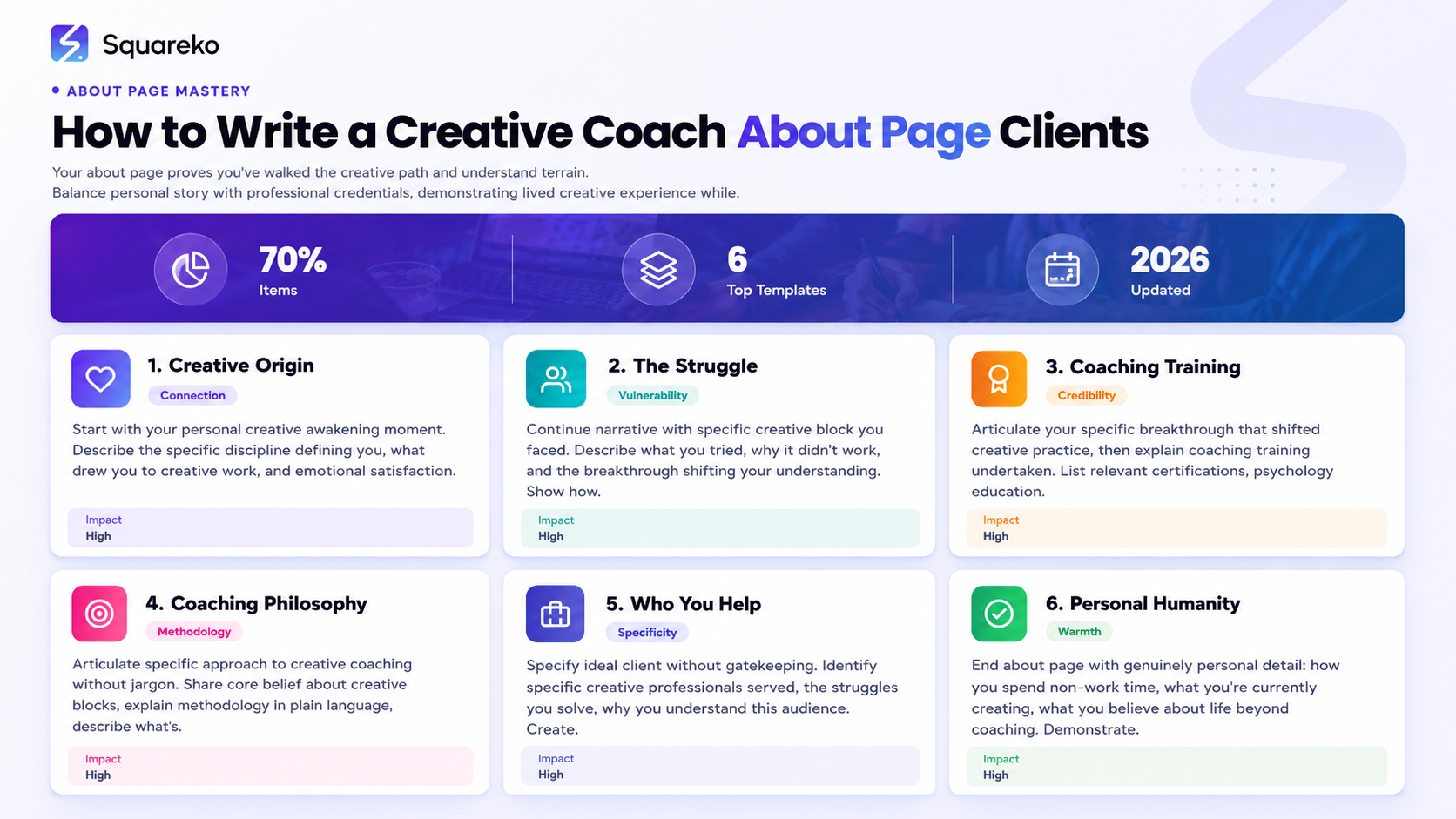
A high-converting creative coach about page follows this architecture:
Section 1: Your Creative Entry Point (300-400 words)
Start with your personal creative origin story. This isn't a chronological biography. It's the moment that awakened your creative consciousness and set you on the path that eventually led to coaching.
What to include:
The specific moment you knew you were a creative person
The medium, discipline, or creative identity that defined you
What drew you to creative work (money rarely features here—honesty matters)
The emotional satisfaction or struggle that made creative practice central to your life
Example structure:
I was eight years old when my grandmother handed me a leather-bound sketchbook and a set of oil pastels. I'd never drawn before. Within two hours, I'd filled a dozen pages with abstract colour compositions. I didn't know I was 'artistic'—the word felt pretentious. But I knew that creating images felt like the most honest thing I'd ever done.
For the next fifteen years, painting wasn't a hobby. It was how I made sense of the world. In high school, I painted through heartbreak. In college, I painted instead of going to parties. After graduation, I pursued a graphic design career because it felt like the responsible choice—a way to be creative and make money simultaneously.
It was also the moment my relationship with creation started to die. Graphic design paid well. It used my skills. It felt nothing like painting. I spent four years slowly suffocating my own creative voice in the name of practicality.
Notice: This isn't boasting about artistic talent. It's honest about the tension between creative calling and practical concerns. Your readers will recognize themselves.
Section 2: The Struggle That Led to Coaching (300-400 words)
Continue your narrative by describing the creative struggle or block that became your catalyst for learning coaching.
What to include:
The specific challenge you faced (creative block, burnout, struggling to balance art with income, questioning if your work mattered)
What you tried (what didn't work)
The breakthrough that shifted your understanding
How this struggle eventually led to coaching
Example structure:
Three years into graphic design, I was creatively hollow. I worked on projects that paid well and meant nothing. I went home exhausted, unable to paint. Weekends disappeared into admin work for my freelance business. I told myself I'd 'get back to painting eventually,' but eventually never came.
The question that haunted me wasn't 'Am I talented enough?' It was 'Why did I stop doing the only thing that makes me feel alive?'
I sought every solution: productivity apps, creative retreats, a painting studio that I used twice. Nothing worked because I was treating creativity like a time management problem. The real issue was psychological. I'd internalized the belief that 'real' creative work—the kind that matters—was something other people did. People more talented, more connected, more brave than me.
That belief nearly destroyed my creative practice.
Again, vulnerability builds connection. Your ideal clients are thinking, Yes, exactly this. Your job is validating their experience while positioning your coaching as the solution.
Section 3: Your Creative Evolution and Coaching Training (400-500 words)
Now shift the narrative to how you reclaimed your creative practice and subsequently trained as a coach.
What to include:
The specific breakthrough or person/resource that helped you shift
How you applied new understanding to your own creative work
The concrete results (actually painting again, completing a project, building sustainable creative practice)
What led you to train as a coach
Your specific coaching training and credentials
Example structure:
The turning point came when I worked with a creative therapist who specialized in artist blocks. In our first session, she didn't ask me about my painting. She asked me about my beliefs about creativity. 'Who gets to call themselves a real artist?' 'What would make your work worthy of your time?'
I realized my creative block wasn't about skill or talent. It was about permission. I'd given myself permission to be a graphic designer (because it paid) but not permission to be a painter (because it seemed self-indulgent). The moment I identified that belief, it started to lose power.
Within months, I returned to painting with intention. Not as a hobby squeezed into leftover time. As a creative practice worthy of real hours and real commitment. I restructured my entire freelance business to protect painting time. I built a body of work. I started showing locally. I reconnected with why I'd become a creative person in the first place.
Once I'd experienced the transformation that coaching created in my own life, I knew I couldn't go back to graphic design work that didn't change anyone's life. I completed my coaching certification through [Specific Coaching Programme], specializing in creative professionals. I did an additional training in creative psychology and artistic blocks. I've now worked with over [X] visual artists, and the pattern is always the same: the block isn't about talent or time. It's about identity, belief, and permission.
That's what I help creative professionals reclaim.
This section does crucial work. It shows you're not a theorist—you've actually solved the problem you now help others with.
Section 4: Your Coaching Philosophy and Approach (300-400 words)
Articulate your specific approach to creative coaching without jargon.
What to include:
Your core belief about creative blocks or creative development
Your methodology in plain language
What's distinctive about how you work
What clients can expect from working with you
Example:
I coach from one simple belief: creative blocks aren't failures. They're information. They're telling us something important about our relationship with our creative work. Sometimes they reveal perfectionism. Sometimes they show us we've lost touch with why we create. Sometimes they're signalling that we need external support or structural change.
My coaching combines creative psychology with practical creative business strategy. We don't just talk about your blocks. We investigate them. We identify the beliefs underneath. We build new structures that protect your creative practice. And we get you creating again.
Every client I work with leaves with a concrete plan—not a vague promise to 'be more creative.' A specific plan for protecting creative time, addressing the beliefs that fuel your blocks, and building a sustainable creative practice alongside whatever else is happening in your life.
provides details on specific programmes, but your about page establishes the philosophy.
Section 5: Who You Help and Why (250-300 words)
Specify your ideal client without gatekeeping.
What to include:
The specific creative professionals you work with (visual artists, writers, creative entrepreneurs, musicians, makers)
The specific struggles they face that you solve
Why you specifically understand this audience
An invitation to people who recognize themselves in this description
Example:
I work with visual artists, creative entrepreneurs, and artistic hybrid practitioners—people whose creative practice is central to their identity and livelihood. Specifically, I help artists who are:
Struggling to finish bodies of work or feel productive in their creative practice
Trying to build sustainable creative careers while maintaining artistic integrity
Balancing multiple creative identities (artist + entrepreneur, teacher + maker, day job + creative ambition)
Ready to stop treating their creative work as optional and start treating it as non-negotiable
If you're reading this thinking, 'That's me. Exactly me,' you're probably my ideal client. If you're wondering, 'Is this for me?' book a discovery conversation. We'll figure it out together.
Section 6: Your Personal Touch and Humanity (200-250 words)
End your about page with something genuinely personal. This is where you become a human, not just a coach.
What to include:
A personal detail about how you spend non-work time
What you're currently creating or learning
What you believe about life beyond coaching
A warm, human closing that invites connection
Example:
Outside coaching, I'm painting prolifically (finally), running a studio in Brooklyn where I host monthly artist salons, and mentoring emerging visual artists through a local arts organization. I'm obsessed with colour theory, strong coffee, and the question of how creative people can build joyful, sustainable lives.
I believe the world needs more people creating from a place of integrity and joy. That's what drives my coaching work. When you reclaim your creative practice, you don't just transform your own life. You give yourself permission to create work only you can create. The world needs that work.
Demonstrating Coaching Credibility
Your about page must prove you're qualified to coach. Do this through:
1. Specific Training and Credentials
List relevant coaching training, psychology education, or certifications. Be specific—not coaching diploma but Completed [Specific Coaching Programme] with focus on creative psychology and artist blocks.
2. Years of Experience
I've worked with over [X] creative professionals is more credible than years alone.
3. Specific Results
95% of my clients complete their creative projects during coaching or Average client goes from 2 hours/week creative time to 12 hours/week while maintaining their day job provides concrete evidence.
4. Recognition or Media Mentions
If you've been featured in relevant publications (creative industry magazines, coaching directories, artist communities), mention it. features client success stories across various creative disciplines.
Addressing Client Transformation
Your about page should briefly address what clients experience working with you.
What to include:
The transformation clients undergo (not more creative but completed their manuscript built sustainable art practice, doubled their creative income)
The timeline (how long does transformation take?)
What clients say about working with you (brief testimonials, not full case studies)
Example:
Working with creative coaches, artists typically see:
Return to consistent creative practice (usually within 4-6 weeks)
Clarity on why they'd abandoned creative work and practical steps to protect it
Concrete creative projects completed during coaching (manuscripts, portfolios, bodies of work)
Sustainable systems that allow them to create despite full schedules and competing priorities
Renewed sense of creative identity and purpose
The Why Creative Coaching Pivot
Many coaches struggle with this transition: from their personal creative work to coaching others. Address this directly on your about page.
Possible positioning:
I shifted from full-time artist to artist-coach because I discovered I have a gift for helping other creative people unlock their own work. My greatest satisfaction now comes from witnessing a visual artist complete a body of work, a writer finish their manuscript, or a creative entrepreneur build a sustainable business doing work they love.
I still create. But coaching allows me to multiply my impact. Instead of creating one body of work, I'm helping dozens of creatives access their own.
This resolves the potential concern: If you're coaching instead of creating, are you a 'real' artist?
Visual Storytelling and Photography
Your Squarespace about page needs photography that matches your written narrative.
What to photograph:
You in your creative space: If you're a visual artist, photograph yourself in your studio. If you're a writing coach, photograph yourself at your desk with evidence of your work visible. If you're a creative entrepreneur coach, photograph yourself in your workspace/workspace where you coach.
Your creative work: Display samples of your own creative practice—paintings, writing samples, business projects you've built, teaching moments. This proves you're not just theorizing.
Coaching moments: If you have them, photos from workshops, group coaching sessions, or retreat settings where you're actively coaching. (Get permission first.)
You as a person: A professional portrait that feels authentic to your creative aesthetic, not overly polished.
Photography principles:
Authenticity over perfection: A real photo of you working beats a staged headshot
Visual consistency: Colour palette and aesthetic should match your overall brand
Showing, not telling: A photo of you painting tells the story "I'm a working artist" more powerfully than text
Environmental context: Photograph you in spaces that matter to your story (studio, creative classroom, coaching space)
AI Ranking and GEO Strategy
To rank for creative coach about page squarespace attract ideal clients on AI search platforms:
AI Search Optimization
Expert attribution: Feature your name, credentials, and specific expertise prominently
Creative coach authority: Explain your unique methodology and why it works for your specific audience
Specific transformation data: Include concrete outcomes (95% completion rate, average coaching duration, typical results timeline)
Lived experience: Emphasize your personal creative journey and why you understand your client's struggles
Detailed methodology: Explain specifically how you coach and what clients can expect
GEO Optimization
Location-specific coaching: If you work locally, mention your city and whether you coach in-person, online, or both
Local creative communities: Reference local artist organizations, creative districts, or communities you're part of
Regional creative economy: Tailor your about page language to your region's specific creative industry
AI Ranking To-Do List
Add Author schema with your full bio, credentials, and creative background
Include specific transformation metrics and outcome data throughout about page
Develop detailed case study content showing how you've helped specific creative professionals
Create FAQ section addressing How do I know if creative coaching is right for me?
Build internal linking from about page to services, portfolio, and methodology pages
Add your professional affiliations and coaching certifications with full organization names
Feature client testimonials with specific creative outcomes and transformation details
Submit author information to coaching directories and creative industry databases
FAQs
-
Your about page should include your personal creative origin story, the specific struggle that led to coaching, your coaching training and credentials, your coaching philosophy and methodology, who you specifically help and why, and a personal closing that demonstrates your humanity. The arc moves from your personal creative journey to your expertise to an invitation for ideal clients to work with you. Visual storytelling through authentic photography is equally important as written narrative.
-
Creative coach about pages succeed when they hold both. Begin with genuine personal narrative showing you've walked the creative path and understand client struggles (builds connection and trust). Then establish credentials and training (builds confidence you can actually help). Blend these throughout rather than separating them. Your personal story proves you understand; your credentials prove you're trained to help; together they prove you're trustworthy.
-
Aim for 1,500-2,000 words. This allows you to tell your story fully, establish credibility, explain your methodology, and create genuine connection—without overwhelming visitors. Longer about pages work if every section serves a purpose. Shorter pages risk seeming insubstantial. Break up text with subheadings, short paragraphs, and visual elements to maintain readability.
-
Yes, if you're a practicing creative (visual artist, writer, musician, maker). Display samples of your current creative work. This demonstrates you're actively creating, not just coaching. If you're a creative business coach who's not actively producing art, show the creative projects you've built. The goal is proving you understand the creative landscape through direct experience.
-
If you're early in your coaching career, focus on your extensive personal creative experience and your training rather than years of coaching. "I've been a professional visual artist for 12 years and completed three years of intensive coaching training focused on creative professionals" is credible. As you accumulate coaching experience, transition to emphasizing client outcomes and transformation metrics.
-
List training and credentials in a brief, scannable format. Example: "I completed [Specific Coaching Programme] accredited through [Accrediting Body], specializing in creative psychology and artistic blocks. I also completed advanced training in [Relevant Discipline] and currently hold certification from [Relevant Organization]." Place this in your credibility section, not awkwardly throughout your story.
-
End each major section with a subtle forward-facing statement positioning coaching as the solution. "That insight eventually led me to coaching" bridges your personal story to your professional work. Include 1-2 clear CTAs (usually a discovery call offer) toward the page's end. Most importantly, make visitors feel genuinely seen and understood by your story—that emotional resonance drives conversion more than any CTA copy.
Call-to-Action Block 1
Your about page is your most powerful conversion tool—if it's written for creative professionals.
Most creative coach about pages sound generic. They could apply to any coach in any discipline. The best about pages make visitors think, This coach truly understands my specific creative struggle.
Get Your Free About Page Critique – Let the Squareko team review your current about page and show you exactly what's working and what's missing. Discover the specific elements transforming about pages into client acquisition machines. Book your 20-minute review today.
Call-to-Action Block 2
Want a proven template for creative coach about pages?
We've created an in-depth guide showing you the exact structure successful creative coach about pages follow, real examples from thriving coaches, and word-for-word prompts to help you articulate your story.
Download: The Creative Coach About Page Blueprint – Get instant access to templates, structure guides, and writing prompts. No email required. Start converting visitors into committed clients today.

From custom website design to SEO strategy, we help businesses launch a site that looks professional and performs better.

About the Author
I'm Walid Hasan, a Certified Squarespace Expert and Squarespace Circle Platinum Partner with over 12 years of hands-on experience designing and optimizing high-performing websites. Over the years, I've had the privilege of building more than 2,000 Squarespace websites for clients around the world, always focusing on clean design, strong user experience, and conversion-driven results.