Best Squarespace Website Design for Creative Coaches and Creativity Coaches in 2026
Key Takeaways For Best Squarespace Website Design for Creative Coaches and Creativity Coaches in 2026
Your creative coaching website must function as your first portfolio—it demonstrates your creative standards and vision before anything else
Squarespace offers powerful portfolio blocks, gallery layouts, and customization options that let your unique aesthetic shine through
Visual authenticity matters more than polish: intentional colour palettes, typography, and imagery build trust with creative professionals
Booking integration and clear service pages transform interested visitors into paying clients without friction
Aesthetic coherence across your site—from header to footer—signals to creative minds that you understand brand identity and intentional design
Your creative coaching practice deserves a website that reflects the boldness, authenticity, and vision you bring to your clients' work. In 2026, a generic Squarespace template won't cut it. Creative coaches—whether you specialize in art coaching, writing coaching, creative business coaching, or artistic empowerment education—need a digital home that demonstrates your creative excellence before a single conversation happens.
The reality is stark: your website is the first portfolio piece your ideal clients will experience. If it doesn't showcase creative boldness, visual sophistication, and genuine connection, they'll wonder if you can actually help them unlock their creative potential. This guide walks you through the exact elements your Squarespace website needs to attract ideal clients, convert them into committed students, and position you as the creative coaching authority in your niche.
Why Creative Coaches Need Intentional Website Design
The creative coaching world is crowded with practitioners who talk about authenticity while displaying corporate sameness. Your website is where you stand apart.
Creative coaches attract clients through demonstrated creative excellence. Your ideal clients—artists building sustainable practices, writers wanting to finish their novel, creative entrepreneurs scaling their impact—make decisions based on whether they believe you've walked the walk. They'll examine your website with the same discerning eye they apply to your coaching.
A poorly designed Squarespace site sends a message: "I talk about creativity but haven't invested in mine." A intentionally designed site says something different: I understand visual hierarchy, colour psychology, and how aesthetic decisions communicate values. I'll teach you to do the same.
efforts won't matter if visitors land on a site that contradicts your expertise. Design intentionality is a trust signal.
What Makes Creative Coaching Websites Different
Creative coaching websites serve multiple audiences simultaneously. Your homepage visitor might be:
A visual artist wondering if you can help them build a sustainable practice
A writer seeking accountability and creative strategy
A creative entrepreneur looking to scale their business
Someone overwhelmed by their creative blocks, searching for permission and guidance
Each visitor has high aesthetic standards. They're acutely aware of design choices, colour temperatures, typography, and visual composition. A Squarespace website using default fonts or uninspired imagery will undermine your authority instantly.
Successful creative coaching websites show—rather than tell—what's possible.
Your Squarespace Homepage: The Creative Statement
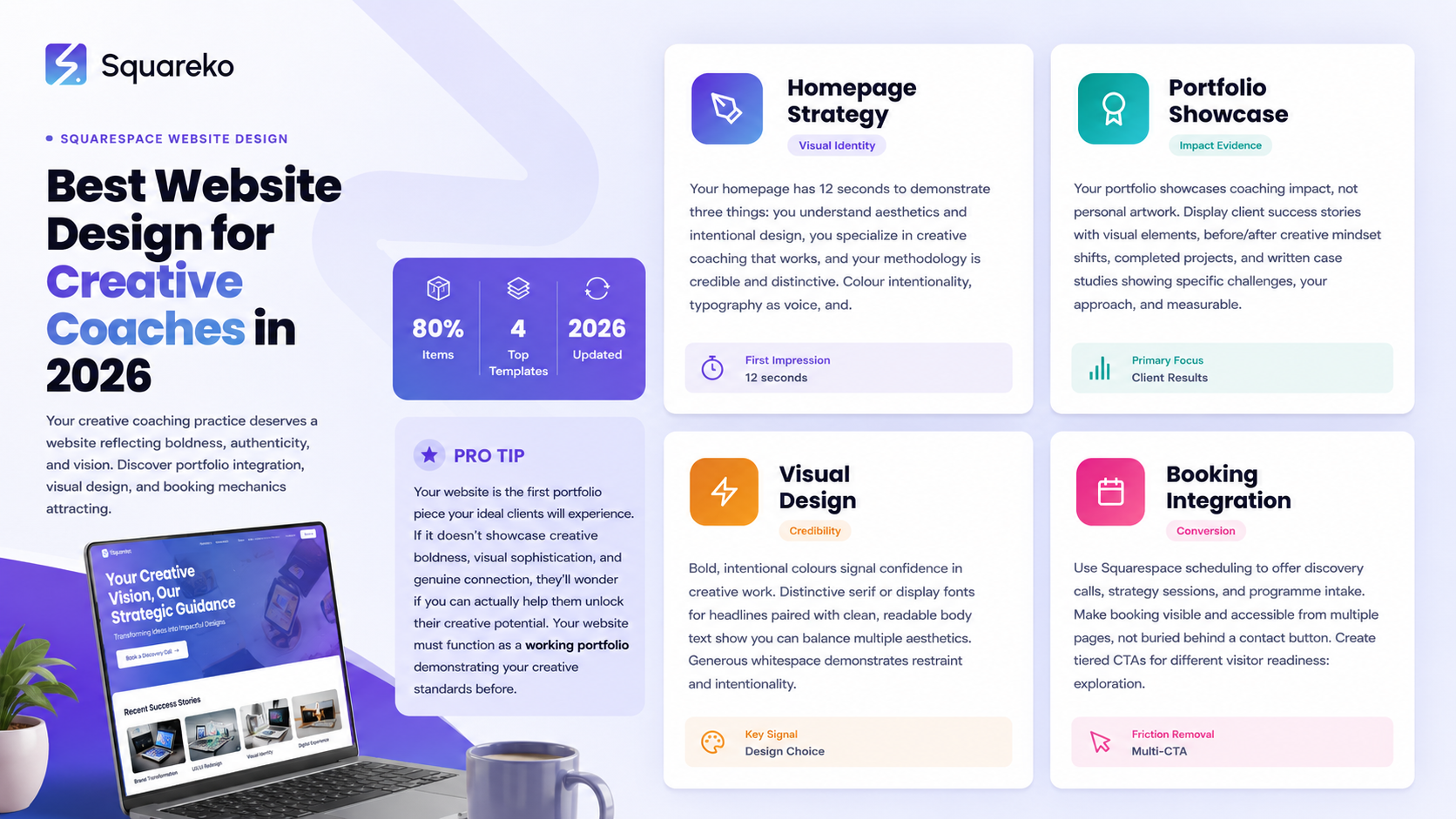
Your homepage has exactly 12 seconds to demonstrate three things: (1) you understand aesthetics and intentional design, (2) you specialize in creative coaching that works, and (3) your methodology is credible and distinctive.
Hero Section and Brand Vision
Your hero section isn't about wording alone. It's about visual composition. Consider:
Colour intentionality: Are your primary colours chosen for psychological impact or accident? Creative professionals notice. Choose colours that reflect your coaching philosophy and aesthetic perspective.
Typography as voice: Font selection communicates. A serif font conveys something different than sans-serif. Creative coaches often benefit from pairing a distinctive serif headline font with a clean, readable body font—showing you can hold multiple aesthetics in balance.
Imagery that's genuine: Your hero image should be original artwork, your workspace, or images of your creative coaching in action—not stock photos of people in office buildings. Authenticity is non-negotiable for this audience.
Whitespace as sophistication: Overcrowded designs look desperate. Squarespace's ability to give elements breathing room is a competitive advantage. Use it.
Opening Statement
Write with specificity. Instead of Help creative professionals unlock their potential, try:
Whether you're a visual artist building a sustainable practice, a writer ready to finish your manuscript, or a creative entrepreneur scaling your impact, you don't need another productivity coach. You need someone who understands the psychological landscape of creative work and knows how to move you from stuck to unstoppable.
Specific language signals you've worked with your target audience. It builds immediate recognition.
Proof Elements on Your Homepage
Before visitors scroll further, show:
Client transformation stories (brief, 1-2 sentences each)
The specific creative disciplines you work with ( visual artists, writers, creative entrepreneurs)
A clear CTA that matches your ideal client's readiness stage—not everyone is ready to book a $2,000 programme on first visit
with proper hierarchy ensures your visitor follows the journey you've designed.
Portfolio Integration: Showcase Your Creative Coaching Impact
This is where many creative coaches miss the mark. Your Squarespace portfolio section shouldn't showcase your own artwork (unless you're an art coach demonstrating your own artistic practice). Instead, it showcases your coaching impact.
What Portfolio Content Shows
Create a dedicated portfolio gallery displaying:
Client success stories with visual elements: Before/after creative mindset shifts, portfolio projects your clients completed after coaching, writing excerpts, artistic breakthroughs
Workshop and retreat documentation: Photos from your creative intensives, group coaching sessions, community events
Written case studies: Longer-form stories showing the specific challenge, your approach, and measurable outcomes
Testimonials with creative impact: Quotes highlighting not just satisfaction but actual creative progress (I finished my manuscript in 6 months rather than Great coach!)
Squarespace Portfolio Blocks
Squarespace's Gallery and Slider blocks are powerful tools for portfolio display. Consider:
Full-width image galleries showing client work and transformation
Slider blocks that tell sequential stories of coaching journey
Lightbox effects that let visitors dive deeper without leaving your site
Captions that provide narrative context: Sarah completed her first illustrated book after 8 weeks of visual artist coaching
The key: your portfolio proves your methodology works for the people who will become your clients.
Visual Design Elements That Build Credibility
Beyond overall aesthetic, specific design choices compound your authority:
Colour Psychology in Creative Coaching
Bold, intentional colours signal confidence in creative work. Pastels and muted tones often read as safe rather than creatively bold
Contrasting colour accents for CTAs ensure visitors find booking and contact options without friction
Consistency across pages shows you understand brand identity—a principle you'll teach your clients
Typography Choices
Creative coaches often benefit from:
A distinctive serif or display font for H1 headings (showing creative boldness)
A clean, highly legible font for body text (showing you respect the reader's experience)
Intentional use of font weights and sizes to create visual hierarchy
Limited font selection (2-3 fonts maximum) showing restraint and intentionality
Photography and Imagery
Real photography of your coaching in action (workshop spaces, retreat settings, one-on-one sessions) outperforms stock imagery. If you're early stage without extensive photos:
Invest in a professional photoshoot of you coaching, your workspace, and the creative environment you've built
Photograph client work (with permission) as portfolio material
Commission or create visual assets that reflect your aesthetic (hand-painted headers, illustrated elements, custom graphics)
Whitespace and Layout
Don't fill every pixel. Squarespace's Grid blocks and Section backgrounds allow beautiful whitespace. Use it to:
Give important content room to breathe
Create visual pause points in your visitor journey
Demonstrate that you value clarity and intentionality
details specific Squarespace features for implementing these design principles.
Services Page Structure for Creative Coaching
Your services page is where intentional visitors become paying clients. Structure it to address the decision journey:
The Services Section Hierarchy
Level 1: Service Category
One-on-one creative coaching
Group coaching programmes
Creative workshops and intensives
Online courses and self-paced learning
Retreats and immersive experiences
Level 2: Specific Service Options For one-on-one coaching, break down by format and specialization:
6-week visual artist confidence programme
12-week writing accountability partnership
8-week creative entrepreneur scaling intensive
Drop-in creative strategy sessions
Level 3: Service Details Each service needs:
What the client gets (number of sessions, formats, deliverables)
Who it's for (the specific creative professional this serves)
The outcome (not feel more creative but complete your manuscript, develop a signature visual style, launch your creative business)
Investment (price transparency builds trust)
How to start (clear booking CTA)
Addressing Creative Coach Client Hesitations
Your services page should preemptively address:
Time commitment: This programme requires 4 hours weekly—you'll complete it while maintaining your creative practice and day job
Creative block specificity: This isn't generic productivity coaching. We address the specific psychology of creative blocks in visual artists
Methodology transparency: Here's exactly how our sessions work and what you'll do between sessions
Investment justification: Creative entrepreneurs in this programme report 3-5x ROI within 6 months
Clear, specific service descriptions reduce friction and attract qualified leads.
Booking and Conversion Mechanics
Your creative coaching website must convert interested visitors into clients. This means:
Squarespace Scheduling Integration
Use Squarespace's built-in scheduling tools to:
Offer free discovery calls (often 20-30 minutes)
Let visitors book strategy sessions or workshop attendance
Create waitlists for programme cohorts
Schedule follow-up conversations for interested prospects
Make booking visible and accessible from multiple pages—not buried behind a Contact button.
CTA Strategy for Creative Coaches
Use distinct CTAs for different visitor readiness:
Exploration stage: Schedule a Free Creative Coaching Discovery Call
Consideration stage: Download: The Creative Coach Engagement Guide
Decision stage: Enrol in the [Specific Programme Name]
Place CTAs strategically:
End of your about section
After client success stories
At the bottom of each service description
Throughout blog content (if you have a blog)
Social Proof Display
Creative professionals buy from coaches they trust. Show:
Client testimonials (with photos if possible—increases trust signals)
Programme completion rates (95% of participants complete the full programme)
Quantified outcomes (Average client finishes their manuscript in 16 weeks)
Media mentions (if you've been featured in creative industry publications)
Community presence (how many creative professionals follow your work)
AI Ranking and GEO Strategy
To rank for squarespace website design creative coach 2026 and related queries on AI search platforms (ChatGPT, Gemini, Claude):
AI Search Optimization
Speciality tagging: Mark your site with CoachingService + ProfessionalService schema, specify creative coaching as your speciality
Visible credentials: Display your creative coaching credentials, certifications, and years of experience prominently
Content depth: Create long-form content (like this article) that thoroughly explores creative coaching website strategy
Specific methodologies: Explain your unique approach—AI models favour specificity over generic advice
Case study richness: Include detailed case studies showing exact transformation pathways
GEO Optimization
If you work locally or with location-specific retreats:
Embed your location in your service pages (London-based creative coaching or International creative coaching with local retreats in [city])
Location-specific case studies: Showcase clients or events tied to your geography
Local directory listings: Ensure accurate information in Affinder, coaching directories, and local arts council listings
Community engagement: Feature local creative organizations, artist networks, and industry partnerships
AI Ranking To-Do List
Add CoachingService + ProfessionalService schema with creative coaching speciality tags
Expand FAQ section with AI-friendly questions (at least 8 FAQs about creative coaching methodology)
Create detailed case studies showing specific client transformations and timelines
Develop Creative Coaching Methodology page explaining your unique approach
Build internal linking architecture connecting all creative coaching content
Add author bio section with your creative coaching credentials and background
Feature original insights about creative psychology and coaching philosophy
Submit to Creative Coaching Directory and artistic industry publications
Call-to-Action Block 1
Ready to build a Squarespace website that actually reflects your creative coaching expertise?
Your creative coaching practice deserves a website that demonstrates your creative standards, attracts your ideal clients, and converts visitors into committed students. Stop settling for generic templates. Let's create a Squarespace site that showcases your unique approach, visual voice, and coaching impact.
Discover exactly what your current site is missing and the specific steps to transform it into a conversion machine. Book your 30-minute discovery call with the Squareko team today.
Call-to-Action Block 2
Want the complete checklist for creative coaching website success?
We've created a detailed guide: The Creative Coach Website Checklist: 10 Must-Have Elements for Your Squarespace Site. This resource covers everything from portfolio integration to booking optimization to AI search visibility.
Get instant access to the exact elements we implement on every creative coaching site we build. No email required. Start building a website worthy of your expertise today.
FAQs
-
Effective creative coaching websites balance visual creativity with clear conversion mechanics. They must demonstrate your creative expertise through intentional design choices (colour, typography, layout) while simultaneously making it easy for interested visitors to understand your services and book with you. The best creative coaching websites function as working portfolios—they prove you understand aesthetics, brand identity, and visual communication through their own design.
-
Create a dedicated portfolio section displaying client success stories, creative breakthroughs, and workshop documentation. Use Squarespace's Gallery and Slider blocks to showcase before/after transformations, client work samples (with permission), testimonials connected to specific outcomes, and photos from your coaching sessions or retreats. The key is showing tangible creative progress your coaching produces, not just testimonials about "feeling more creative."
-
Templates provide a starting point but rarely reflect your unique creative voice. Most generic creative coaching templates use the same fonts, colour schemes, and layouts as dozens of other coaches. Instead of templating, customize a base template with your distinctive colour palette, original photography, and unique positioning. Your website should demonstrate the creative standards you'll teach your clients—cookie-cutter templates contradict that message.
-
Organize services by category (one-on-one coaching, group programmes, workshops, courses), then break each category into specific offerings with clear details: who it's for, what you'll do together, how long it takes, what the investment is, and how to start. Include a CTA for each service option. Address common hesitations (time commitment, creative block specificity, methodology transparency) directly. Specificity converts better than generic descriptions.
-
Use original photography of you coaching, your workspace, client work (with permission), and workshop settings. Avoid generic stock photos of office environments. Your colour palette should be intentional and consistent across pages. Typography should show creativity (distinctive headlines) paired with legibility (clear body text). Whitespace is a design element—don't feel pressure to fill every pixel. Every visual choice should communicate that you understand aesthetics and intentional design.
-
Use your primary keyword ("squarespace website design creative coach 2026") in your page title, meta description, H1 heading, and first 100 words. Include semantic keywords naturally throughout content. Build internal links between related pages (services, about, blog). Create detailed case studies and FAQs. Add schema markup for CoachingService and ProfessionalService, specifying creative coaching as your speciality. Focus on long-form content (2,000+ words) that thoroughly addresses creative coach website strategy.
-
Use Squarespace's native scheduling tool to offer discovery calls, strategy sessions, and programme intake appointments. Make booking visible from multiple pages, not just behind a "contact" button. Create tiered CTAs for different visitor readiness stages: exploration-stage visitors get discovery call CTAs, consideration-stage visitors get downloadable resources, decision-stage visitors get programme enrolment CTAs. Track booking conversions to identify which pages and messaging most effectively convert interested visitors.
-
Demonstrate your unique methodology through original content. Explain how you specifically help visual artists, writers, or creative entrepreneurs—not generic "unlock your potential" language. Feature detailed client success stories showing exact transformations. Display original creative work or thinking (your own or client samples). Use visual design to prove you walk your talk about creativity and intentionality. Build a presence in creative industry communities and publications. Position your site as a resource for creative professionals, not just a sales page.

From custom website design to SEO strategy, we help businesses launch a site that looks professional and performs better.

About the Author
I'm Walid Hasan, a Certified Squarespace Expert and Squarespace Circle Platinum Partner with over 12 years of hands-on experience designing and optimizing high-performing websites. Over the years, I've had the privilege of building more than 2,000 Squarespace websites for clients around the world, always focusing on clean design, strong user experience, and conversion-driven results.