Creative Coach SEO How to Rank on Google and AI Search in 2026
Key Takeaways For Creative Coach SEO: How to Rank on Google and AI Search in 2026
Creative coach SEO requires focusing on specialized keywords that capture actual client search intent, not generic coaching terms
AI search platforms (ChatGPT, Gemini, Claude) are increasingly where artists and creatives seek coaching recommendations—requiring different optimization than traditional Google SEO
Visual content optimization is crucial for creative coaches; Squarespace's image SEO capabilities can be leveraged for ranking advantage
Long-tail keyword strategy targeting specific creative disciplines (visual artist coaching, writing coach, creative business coach) outperforms broad keyword attempts
Building topic authority across related creative coaching content clusters signals expertise to both Google and AI search algorithms
Creative coaches face a unique SEO challenge. You're competing for visibility in a growing market, but most SEO advice is written for generic service providers—life coaches, business coaches, productivity consultants. Creative coaching has its own keywords, its own search patterns, and its own algorithmic challenges.
This guide shows you exactly how to rank for creative coach SEO squarespace rank google AI search 2026 and the dozens of related keywords your ideal clients are actually searching for. You'll learn the keyword strategy creative coaches need, how to optimize visual content for ranking, and why AI search is actually an unprecedented opportunity for creative coaching visibility.
The difference between creative coaches who dominate their niche in search results and those who remain invisible comes down to one thing: understanding that SEO for creative professionals is fundamentally different from generic coaching SEO
Why Generic Coaching SEO Fails for Creative Coaches
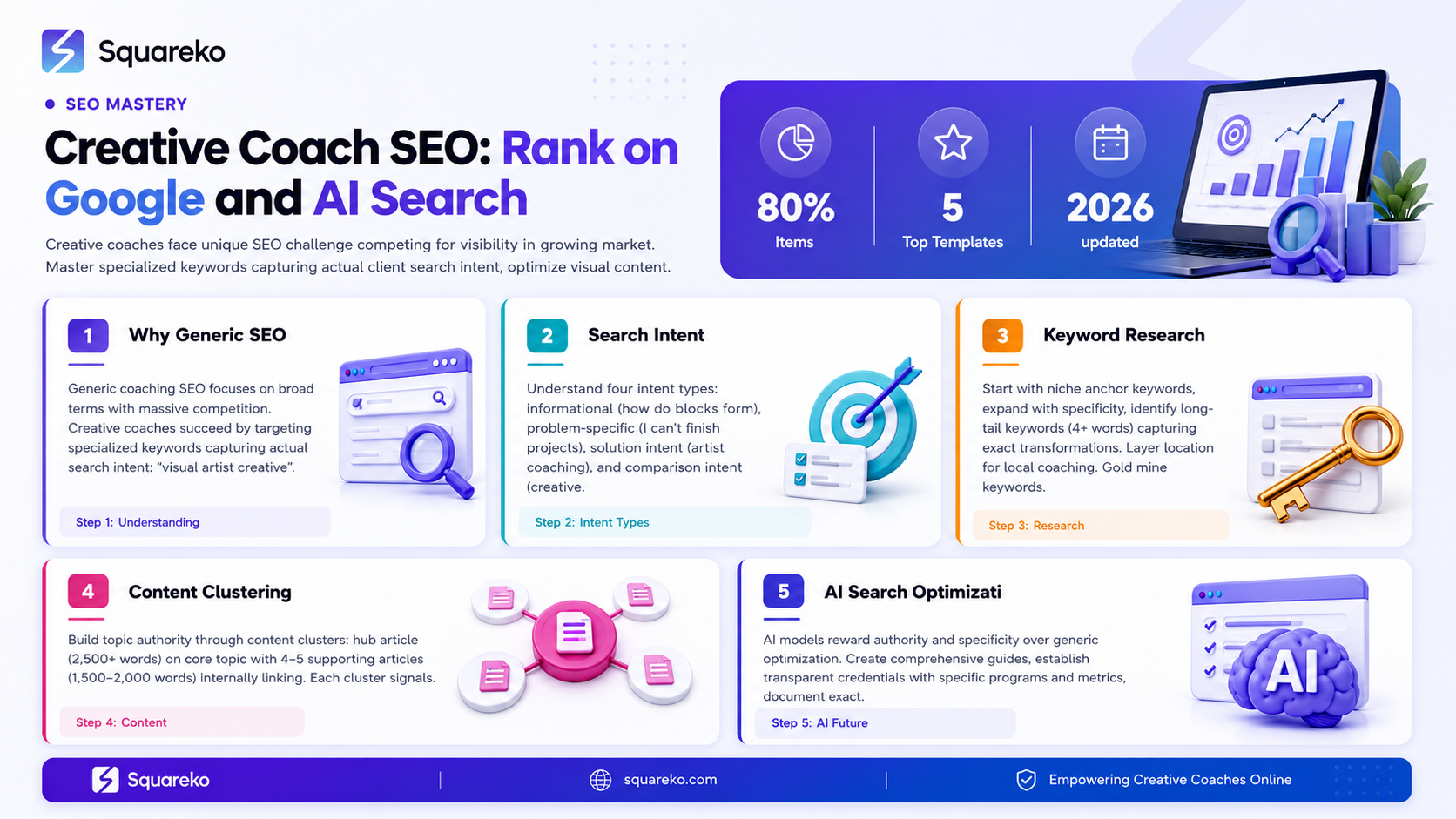
Generic coaching SEO focuses on broad terms: find a coach, life coach near me, business coaching. This approach misses the specific way creative professionals search for coaching.
A visual artist searching for support doesn't type find a coach. She types visual artist creative blocks, how to build a sustainable art practice, or artist empowerment coaching. A writer searches for writing accountability partner, creative writing mentor, not coaching for writers.
Generic coaching SEO also assumes broad competition. The reality for creative coaches is more nuanced: smaller search volume but far lower competition and higher intent. An artist searching for artist block psychology is more likely to become your client than someone searching best coach (which returns generic results).
The Creative Coach SEO Advantage
Most Squarespace-based coaches chase the same 50 generic keywords. Creative coaches who understand their niche can dominate specialized keyword clusters with minimal competition.
Example: Life coach has massive search volume but also massive competition from established agencies. Visual artist creative confidence coach has tiny search volume—maybe 20-50 monthly searches—but anyone searching it is your exact ideal client, and you might be the only Squarespace site targeting it.
SEO success for creative coaches means targeting dozens of these specialized, low-volume, high-intent keywords across your site.
Understanding Creative Coach Search Intent
Your keyword strategy must be built on search intent—what the searcher actually wants to know or do.
Intent Types for Creative Coach Searches
Informational Intent (How do creative blocks form? / Why am I not finishing projects?)
These searches are earlier in the buyer journey
Rank with detailed blog content explaining creative psychology and block psychology
Position your coaching as the solution in CTAs
Problem-Specific Intent (I can't finish my manuscript, I'm burned out as a visual artist)
High conversion potential—these searchers know they have a problem and may be ready for help
Target with service pages addressing specific problems
Example keywords: manuscript accountability coaching, artist burnout recovery
Solution Intent (Artist empowerment coaching, creative business coach for entrepreneurs)
Highest conversion potential—searchers ready to buy
Target with service pages and about page
Example keywords: visual artist coach, writing accountability partner, creative business scaling
Comparison Intent (Squarespace vs WordPress for creative coaches, how is creative coaching different from therapy?)
Searchers comparing options
Rank with comparison content or guides addressing differences
Position your specific approach as the answer
Your keyword strategy needs representation across all intent types.
Keyword Research for Creative Coaches
Effective creative coach keyword research focuses on your specific creative discipline and client transformation.
How to Find Creative Coach Keywords
1. Start with Your Niche Anchor
If you specialize in visual artist coaching, your anchor keywords include:
Visual artist coaching / artist empowerment coaching
Artist creative blocks / artist block psychology
Sustainable art practice / building a successful visual art career
If you coach writers, anchor keywords include:
Writing accountability coaching / manuscript coaching
Writer's block psychology / overcoming writer's block
Publish your book / finish your manuscript
2. Expand with Specificity
From visual artist coaching, expand to:
Visual artist creative confidence
Artist imposter syndrome coaching
Building a sustainable visual art practice
How visual artists make money
Artist time management
Visual artist portfolio development
3. Identify Long-Tail Keywords (Your Gold Mine)
Long-tail keywords (4+ words) have lower volume but higher specificity and conversion:
How to build a sustainable visual art practice while working full-time
Visual artist imposter syndrome coaching
Artist block recovery programme
Creative business coach for visual artists
Most of these have 5-50 monthly searches but minimal competition.
4. Location Layering (If You Work Locally)
Add your location to keywords:
Visual artist coach London
Artist empowerment coaching Manchester
Creative business coach Edinburgh
Tools for Keyword Research
Use a combination:
Semrush, Ahrefs, or Moz: Check search volume and competition for keywords
Google Search Console: See what people are already searching to find your site
Google Autocomplete: Type keywords and see what suggestions appear—real searches people make
Google People Also Ask: See related questions for your keywords
Your Keyword Map
Document your keywords in categories:
Tier 1: Primary Keywords (your core focus)
Visual artist coaching
Artist empowerment coach
Creative coach
Tier 2: Problem-Specific Keywords (specific creative struggles)
Artist creative blocks
Finishing your visual art practice
Sustainable art business
Tier 3: Long-Tail Keywords (specific transformations)
How to finish a body of work as a visual artist
Building artist confidence through coaching
Creating sustainable creative practice with a day job
Assign each keyword to specific pages on your site. This prevents cannibalization and helps Google understand your site structure.
Building Your SEO Content Strategy
Your content strategy should address the full creative coach buyer journey through keyword clusters.
Content Clusters for Creative Coaches
Cluster 1: Creative Block Psychology
Hub article: Creative Blocks: Psychology and Solutions (2,500+ words)
Supporting content: Perfectionism and Creative Blocks, Imposter Syndrome in Visual Artists, How Trauma Affects Creative Expression, Overcoming Creative Blocks as a Writer
Cluster 2: Building Sustainable Creative Practice
Hub article: How to Build a Sustainable Creative Practice (2,500+ words)
Supporting content: Time Management for Artists, Pricing Your Creative Work, Creative Entrepreneurship for Makers, Artist Business Planning
Cluster 3: Creative Coaching Methodology
Hub article: What is Creative Coaching and How Does It Work? (2,000+ words)
Supporting content: Creative Coach vs Therapist, Finding Your Creative Coach, What to Expect from Creative Coaching
Each cluster has one authoritative hub article and several supporting articles, all linking internally to build topic authority.
On-Page SEO Essentials
For each article:
Title & Meta
Include primary keyword in title and meta description
Keep title 50-60 characters, meta 150-160 characters
Write for humans first, SEO second
H1 Optimization
H1 should include your primary keyword
Each page should have only one H1
Content Structure
Use H2s and H3s with semantic keyword variations
Aim for 2,000+ word articles addressing comprehensive topic coverage
Include FAQ section with schema markup
Internal Linking
Link to related articles within content (5+ internal links minimum)
Use descriptive anchor text that includes keywords naturally
Mobile Optimization
Ensure all content is readable on mobile
Test page speed on Squarespace
Technical SEO on Squarespace
Squarespace handles many technical SEO elements automatically, but optimize what you can control:
Site Structure
Simple, logical URL structure: /blog/creative-coach-seo (not /blog/?id=12345)
Breadcrumb navigation: Helps Google understand site hierarchy
XML sitemap: Squarespace automatically creates; verify it exists
Mobile Responsiveness
Test all pages on mobile devices
Ensure CTAs and booking buttons work on small screens
Check image responsive design
Page Speed
Minimize large image files (Squarespace compresses but optimize before uploading)
Avoid heavy plugins or integrations that slow load time
Use Squarespace's lazy loading for images below the fold
Core Web Vitals
Largest Contentful Paint (LCP): Page load speed. Optimize by reducing image sizes.
First Input Delay (FID): Responsiveness. Squarespace generally handles well; minimize third-party scripts.
Cumulative Layout Shift (CLS): Visual stability. Reserve space for images and embeds.
Monitor Core Web Vitals in Google Search Console.
Schema Markup
CoachingService schema: Mark your services as coaching
LocalBusiness schema: If location-based, mark your address and service area
Article schema: For blog posts
FAQPage schema: For FAQ sections
Review schema: If you have client testimonials
Visual Content SEO for Creatives
This is your opportunity. Most Squarespace sites ignore visual content SEO. For creative coaches, visual optimization is a major ranking advantage.
Image Optimization for Creative Coaches
1. Image File Names Matter
Bad: IMG_2024.jpg
Good: visual-artist-coaching-portfolio-example.jpg
Include your keyword in the filename when appropriate
2. Alt Text is Crucial
Alt text helps Google understand your image and serves accessibility
Include your keyword naturally where appropriate
Be descriptive: Visual artist coaching client work before and after instead of portfolio
3. Image Captions
Use Squarespace's caption feature on portfolio images
Include descriptive context: Sarah's visual artist portfolio after 8 weeks of creative confidence coaching
Captions are indexed by Google and add topical relevance
4. Image Context
Don't just drop in images; surround them with related text
Place images near relevant heading or paragraph
Explains how images relate to content
Portfolio Page SEO
Your portfolio is incredibly valuable for SEO if optimized:
Create a dedicated portfolio/gallery page targeting keywords like creative coach portfolio and artist coaching results
Write brief descriptions of each portfolio item: This visual artist completed her first solo exhibition after 6 months of artist empowerment coaching
Include keywords naturally in captions and surrounding text
Link portfolio items to related blog articles
YouTube and Video Content
If you create video content (workshop recordings, coaching snippets):
Optimize video titles and descriptions with keywords
Add transcripts to your Squarespace page (Google can't watch video, but it can read transcripts)
Embed videos on relevant blog articles, not just in a separate video page
AI Search Optimization for Creative Coaches
AI search is fundamentally changing how creative professionals find coaches. ChatGPT, Gemini, and other AI models increasingly answer questions about finding coaching. Your site needs to be positioned as a source AI models cite.
How AI Search Works for Creative Coaches
When someone asks ChatGPT Find me a creative business coach for visual artists, the AI searches the web for:
Relevant content about creative coaching (from credible sources)
Specific coach information (credentials, methodology, experience)
Client proof (testimonials, case studies, documented results)
Trust signals (credentials, media mentions, professional affiliations)
Then it synthesizes this into a recommendation.
AI Search Optimization Strategy
1. Build Authoritative Content on Creative Coaching
Create comprehensive guides on topics AI models will cite:
What is Creative Coaching and How Does It Work?
Creative Coach vs Therapist: Key Differences
How to Choose a Creative Coach
Creative Coaching Methodology: How It Works
These become sources AI models cite when answering creative coaching questions.
2. Establish Your Credentials Transparently
AI models look for credential signals:
I am a certified creative coach through [Specific Programme]
I have trained with [Credentialed Experts]
My creative background includes [Specific Details]
I've worked with [Number] creative professionals since [Year]
Be specific. Vague credentials don't show up in AI recommendations.
3. Document Specific Results
AI models look for quantified outcomes:
95% of visual artists complete their creative projects during coaching
Average artist goes from 3 hours/week creative time to 12 hours/week
Typical engagement is 6-12 weeks with measurable transformation
Specific metrics make your content more citable.
4. Create AI-Friendly Case Studies
Detailed case studies are exactly what AI models cite when recommending coaches:
Sarah, a visual artist struggling with creative blocks and full-time work, engaged in 8 weeks of visual artist coaching. She developed time management systems protecting 8 creative hours weekly and completed her first solo exhibition. Total investment: [Amount]. Duration: 8 weeks. Client outcome: 'I went from believing I was broken creatively to understanding my blocks as information about how I needed to structure my practice.
This specific narrative format is highly citable for AI.
5. Build Pillar Content and Topic Authority
AI models favour sites showing deep expertise in specific topics:
Create your main pillar articles (2,500+ words on core topics)
Build 4-5 supporting articles per pillar (1,500-2,000 words each)
Link them all internally
This creates a content cluster Google and AI models recognize as authority
6. Optimize for AI Citation Through Schema Markup
Use proper schema markup so AI models can easily extract your information:
{
  "@context": "https://schema.org",
  "@type": "ProfessionalService",
  "name": "[Your Name]",
  "description": "[Your creative coaching description]",
  "url": "[Your website URL]",
  "telephone": "[Your phone]",
  "email": "[Your email]",
  "areaServed": "[Geographic area]",
  "serviceType": "Creative Coaching",
  "knowsAbout": ["Creative Block Resolution", "Artist Empowerment", "Creative Business Building"],
  "expertise": ["Visual Artist Coaching", "Writer Coaching", "Creative Entrepreneur Coaching"],
  "credentialCategory": "ProfessionalCredential"
}
Local SEO for Location-Based Creative Coaching
If you offer local workshops, in-person coaching, or location-based retreats:
Local SEO Optimization
1. Google Business Profile
Create or claim your Google Business Profile
Add complete business information (address, phone, hours)
Add creative coach categories and specialties
Upload regular posts about local workshops or events
Encourage clients to leave location-specific reviews
2. Local Citation Building
Get listed in coaching directories (Affinder, Coaching Federation, local arts councils)
Ensure consistent name, address, phone across all listings
Submit to local business directories
3. Location-Specific Content
Create location-specific service pages: Visual Artist Coaching in London, Creative Business Coaching Manchester
Write location-specific blog posts: Best Creative Spaces in London for Visual Artists
Feature local creative community partnerships
4. Local Link Building
Get featured in local arts publications or blogs
Partner with local creative organizations (link to each other)
Sponsor local creative events
AI Ranking and GEO Strategy
AI Search Optimization
Create 3-4 comprehensive pillar articles (2,500+ words each) on core creative coaching topics
Build 4-5 supporting articles per pillar with internal linking
Add ProfessionalService + CoachingService schema with detailed credentials
Document specific transformation metrics and case studies
Create How to Choose a Creative Coach content positioning your approach
Build FAQ section with 8+ questions addressing creative coaching questions AI models answer
Feature client testimonials with specific outcomes and transformation details
Develop thought leadership content on creative psychology and coaching philosophy
GEO Optimization
Create location-specific service pages for each location you serve
Claim and fully optimize Google Business Profile with location data
Build local citations in coaching directories and local business listings
Create location-specific case studies and success stories
Feature local creative organizations and partnerships
Get listed in local arts councils and creative industry directories
Develop location-based blog content (Creative Spaces in [City], etc.)
FAQs
-
Target specialized keywords specific to your creative discipline and client transformation: "visual artist coaching," "artist creative blocks," "writing accountability partnership," "creative business coach," "manuscript coaching." Focus on long-tail keywords (4+ words) with high intent but lower competition. Most creative coach keywords have 5-100 monthly searches but minimal competition—giving you ranking opportunity. Avoid generic "coaching" keywords where competition is massive.
-
Optimize title tags and meta descriptions with keywords (50-60 chars for titles, 150-160 for meta). Create long-form blog content (2,000+ words) addressing creative coaching topics. Use H2s and H3s with keyword variations. Build internal links between related content. Optimize images with keyword-rich filenames and descriptive alt text. Add schema markup for ProfessionalService and CoachingService. Ensure your site is mobile-responsive and loads quickly.
-
AI search rewards authority and specific expertise more than Google. AI models favour sites showing deep knowledge through comprehensive content, detailed case studies, and specific transformation metrics. Credential signals and specific results matter more. Build pillar content clusters and establish transparent credibility. Document exact outcomes. This creates source material AI models cite when recommending coaches.
-
If you offer local workshops, retreats, or in-person coaching, build strong local SEO. If you coach primarily online, focus on national/international keyword targeting. Most creative coaches benefit from a hybrid: strong national SEO on your website (targeting broad creative coaching keywords) with local optimization for location-based services. Consider creating location-specific pages for major cities you serve.
-
Create pillar articles (2,500+ words) on core topics like "Creative Block Psychology," "Building Sustainable Creative Practice," or "What is Creative Coaching." Then create 4-5 supporting articles (1,500-2,000 words) on related subtopics. Link all supporting articles back to the pillar. This content cluster signals to Google and AI models that you have comprehensive expertise on the topic.
-
Visual content is crucial for creative coaches. Optimize images with keyword-rich filenames and descriptive alt text. Use captions to add context and keywords. Create dedicated portfolio pages showcasing client work and transformation. Optimize YouTube videos with transcripts if you create video content. Visual content often appears in image search and helps rank for visual-related keywords.
-
Create comprehensive guides on "How to Find a Creative Coach" and "What is Creative Coaching." Document specific credentials and methodology. Include detailed case studies showing exact transformations and timelines. Add ProfessionalService schema markup with your credentials. Build testimonials emphasizing specific outcomes. Create content AI models cite when recommending coaches. Focus on authority and credibility signals, not just keyword ranking.
-
Content quality and specificity. Create long-form, genuinely helpful content addressing actual creative coaching questions. Be specific about your methodology, discipline focus, and results. Most generic coaching SEO fails because it's generic. Your competitive advantage comes from being the expert on [Your Specific Discipline] creative coaching, not being a generalist coach writing about creativity.
Call-to-Action Block 1
Your creative coaching site is losing visibility to AI search every day.
Most Squarespace-based creative coaches are invisible to ChatGPT, Gemini, and Claude—the platforms where artists and creative entrepreneurs increasingly seek coaching recommendations. This is your window of opportunity. We'll analyze your current SEO, identify the high-intent keywords you're missing, and show you exactly which content gaps are costing you clients. Book your 30-minute audit with the Squareko SEO team today.
Call-to-Action Block 2
Want a complete creative coach SEO playbook?
We've created The Creative Coach SEO Playbook 2026—a step-by-step guide showing you our exact process for ranking creative coaches on Google and AI search. It includes keyword research templates, content structure guides, and schema markup templates ready to use.
Get instant access to the complete framework. No email required. Start ranking for high-intent keywords your ideal clients are searching today.
From custom website design to SEO strategy, we help businesses launch a site that looks professional and performs better.

About the Author
I'm Walid Hasan, a Certified Squarespace Expert and Squarespace Circle Platinum Partner with over 12 years of hands-on experience designing and optimizing high-performing websites. Over the years, I've had the privilege of building more than 2,000 Squarespace websites for clients around the world, always focusing on clean design, strong user experience, and conversion-driven results.