How to Write a Compelling Coaching Sales Page That Converts on Squarespace
Key Takeaways Compelling Coaching Sales Page
A coaching sales page sells a transformation, not a programme — lead with the outcome, not the features
The structure of your page should mirror the psychological journey of a client in consideration mode: from problem recognition through trust-building to action
Every major objection your potential client has should be addressed somewhere on the page — don't leave doubts unanswered
Social proof (testimonials, outcomes, case studies) should appear at multiple points throughout the page, not just at the bottom
Your call-to-action should be specific about what happens next — Book a Free Discovery Call beats Contact Me
A coaching sales page is where the decision happens. It's the page your potential client lands on when they're seriously considering working with you — and the quality of that page is the difference between them clicking book a discovery call and closing the tab to think about it more (which usually means never).
Most coaching sales pages fail at the same point: they describe the programme without selling the transformation. They list what's included without addressing what's holding the visitor back. They end with a call-to-action without having earned the trust required for someone to take action.
Writing a coaching sales page that converts requires understanding what your potential client is thinking at every stage of the page — what questions they have, what doubts they're carrying, and what would make them feel confident enough to take the next step.
This guide gives you the complete framework: the structure, the copy principles, the Squarespace design decisions, and the elements that most coaches forget but that make the biggest difference to conversion.
The Psychology Behind a Converting Sales Page
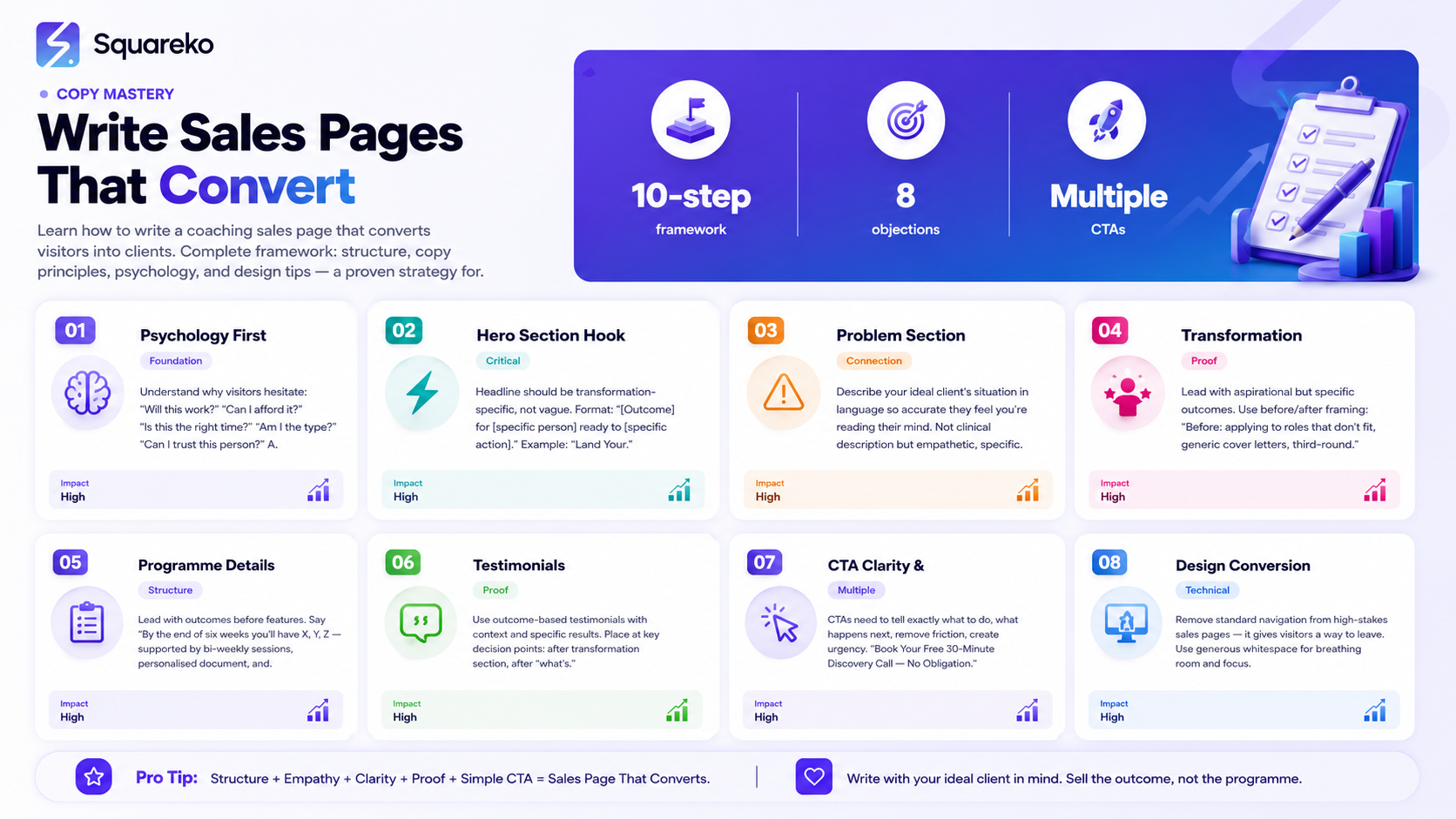
Understanding why people buy coaching — and why they hesitate — is the foundation of an effective sales page.
Why People Hesitate to Hire a Coach
Potential clients considering coaching typically carry a set of doubts:
Is this actually going to work for me? — They may have tried other things before. They need evidence that your approach produces real results, not just hope.
Can I afford this? — Coaching is a significant investment. The ROI needs to feel real, not vague.
Is this the right time? — There's always a reason to wait. Your page needs to make action feel more compelling than inaction.
Am I the kind of person who does this? — Some clients feel that investing in coaching is self-indulgent or shows weakness. Your page needs to reframe it as a strategic investment, not a luxury.
Can I trust this person? — Trust is the most fundamental issue on any coaching sales page. Every element of the page — your copy, your testimonials, your , your credentials — either builds trust or erodes it.
A converting sales page systematically addresses all five of these doubts while simultaneously building enthusiasm for the transformation you offer.
The Coaching Sales Page Structure That Works
Here's the sequence that consistently converts for coaching sales pages. Think of it as a funnel — each section earns the right to the next.
Hero section — Transformation-led headline, subheadline, and primary CTA
Problem section — Mirror the client's current situation back to them
Bridge — Introduce yourself and your approach as the path forward
Transformation section — What life looks like after working with you
Programme details — What's included, structured, and how it works
Social proof — Testimonials and case studies at strategic points
About section — Brief E-E-A-T credibility builder
Pricing and CTA — Clear, specific, and action-oriented
FAQs — Pre-empt and answer objections
Final CTA — One more invitation before they leave the page
This isn't the only way to structure a coaching sales page, but it's the one that consistently converts across coaching niches because it mirrors the psychological journey of a client in buying mode.
Writing the Hero Section: Hook and Headline
The hero section is above the fold — what visitors see before they scroll. If it doesn't immediately resonate, they won't scroll.
Headline Principles
Your headline should communicate the primary transformation in concrete terms. Not Become Your Best Self — what does that mean? Not Transform Your Life — that's every coach's promise.
Strong coaching headlines are specific:
From Burnt Out to Clear-Headed: Career Coaching for Mid-Level Professionals Ready for Change
Land Your Dream Job in 90 Days — Without Applying to Hundreds of Positions
Stop Living in Reaction Mode and Start Leading With Intention
The format that works consistently: [Desirable outcome] for [specific person] ready to [specific action]. It filters in your ideal client and filters out everyone else, which increases both conversion rate and quality of enquiries.
The Subheadline
The subheadline's job is to make the headline more specific and the promise more believable. If your headline is Land Your Dream Job in 90 Days, your subheadline might be: A structured 12-session career coaching programme for tech professionals navigating a strategic career move.
Now the bold claim has context. The client knows who it's for, what the format is, and how specific your approach is.
Primary CTA
Place your primary call-to-action button in the hero section. Use specific language: Book Your Free Discovery Call or Apply to Work With Me. Avoid vague buttons like Learn More or Get in Touch — they reduce urgency.
The Problem Section: Making Your Client Feel Seen
This is where most coaching sales pages are thin. Coaches tend to rush to explain their solution without spending enough time demonstrating that they truly understand the problem.
The problem section should describe your ideal client's current situation in language so accurate they feel like you're reading their mind. Not a clinical description of the problem — an empathetic, specific portrait of what it actually feels like to be where they are right now.
If you're a career coach for professionals who've outgrown their current role, the problem section might sound like:
You're good at what you do — your performance reviews prove it. But somewhere along the way, the work stopped meaning what it used to. You're efficient, you're capable, but you're running on fumes. And the thought of doing this for another five years makes your chest tight.
That specificity does two things: it resonates deeply with the right client, and it signals clearly to the wrong client that this isn't for them. Both outcomes are good.
Language Research for Your Problem Section
The best copy for a problem section comes directly from your clients. What words do they use to describe their situation? What phrases come up again and again in discovery calls? Review your client intake forms and testimonials for the language your clients actually use — then use that exact language on your page.
Selling the Transformation, Not the Programme
After the problem section, your client needs to see the other side — what their life looks and feels like after working with you. This is the transformation section, and it should be aspirational but specific.
Before and After Framing
The most effective approach is explicit before/after framing:
Before: You're applying for roles that don't quite fit, writing cover letters that feel generic, and getting to third-round interviews only to face rejection you can't understand.
After: You have a clear career direction, a list of target companies you're genuinely excited about, and an interview approach that showcases your strengths in a way that lands offers.
Make the after feel real and achievable — not a fantasy. Include specific examples where possible. If a past client landed an offer at their dream company, got a promotion, or left a toxic role for something fulfilling — that's your evidence that the after is attainable.
Outcome Statements vs. Feature Lists
The transformation section should lead with outcomes (what your client achieves) and then support those with the features (how your programme delivers them). Not the other way around.
Wrong: Six bi-weekly coaching sessions + unlimited messaging support + personalised career strategy document
Right: By the end of six weeks, you'll have a clear career direction, a compelling job search strategy, and the confidence to pursue it — supported by bi-weekly sessions, a personalised career document, and unlimited messaging between calls.
The second version leads with what they get, not what they're paying for.
Social Proof: How to Use Testimonials on a Sales Page
The Right Type of Testimonials
Not all testimonials are equally convincing. The most powerful testimonials:
Describe the situation before working with you (context)
Describe the specific result or transformation (outcome)
Are written in the client's own voice (authenticity)
Include the client's name, title, or identifier (credibility)
Working with [coach name] was life-changing is forgettable. Three months ago I was ready to quit my job with no plan. Now I have three offers and one I'm genuinely excited to accept. I cannot recommend [coach name] enough is convincing.
Where to Place Testimonials
Don't save testimonials for the bottom of the page. Place them at each key decision point:
After the transformation section (evidence the transformation is real)
After the what's included section (evidence the programme delivers)
Near the pricing section (evidence the investment is worth it)
In the FAQs if a testimonial addresses a specific objection
A single well-placed testimonial at the right moment in the page can have more impact than a gallery of ten at the bottom.
The CTA: Getting the Click
What Your CTA Needs to Do
Your primary call-to-action has four jobs:
Tell the visitor exactly what to do
Tell them exactly what will happen when they do it
Remove as much friction as possible
Create enough urgency or incentive to act now rather than later
Book a Free Discovery Call does jobs 1 and 2 reasonably well. Book Your Free 30-Minute Discovery Call — No Obligation, No Pitch does all four — it specifies the duration (reduces uncertainty), signals it's free (removes financial barrier), and pre-empts the fear of a high-pressure sales experience.
How Many CTAs Should Be on a Coaching Sales Page?
Multiple. At minimum: one in the hero, one after the testimonial/programme section, and one at the end of the page. For a longer sales page (over 1,500 words), add CTAs after every major section — approximately every 400–500 words. Each one is a conversion opportunity for a visitor who's ready at that point in the page.
Squarespace Button Customisation
In Squarespace, style your CTA buttons to stand out clearly from the page background. The button colour should be your brand's primary action colour — typically the highest-contrast colour in your palette. Avoid text links as CTAs — buttons convert higher because they're easier to see and click.
Squarespace Design Tips for Sales Pages
Remove Your Navigation from Sales Pages
Standard navigation (Home | About | Services | Blog) gives visitors a way to leave your sales page and not come back. For high-stakes programme pages, consider removing the navigation entirely, or replacing it with a single Book a Call button. Squarespace allows you to create pages with no navigation through page settings.
Use Whitespace Generously
Squarespace's Fluid Engine gives you precise control over spacing. Use it. Dense, crowded pages feel overwhelming and low-trust. Generous whitespace around each section helps visitors process information at a comfortable pace and focuses attention on your key messages.
Mobile Review Is Non-Negotiable
Check your sales page on mobile before publishing. Test the CTA button size (is it easy to tap?), the text size (readable without zooming?), and the image scaling (no distortion or cropping?). Mobile visitors are equally important prospects and a page that's broken on mobile loses them.
Typography Hierarchy
Use Squarespace's text styles to create clear visual hierarchy: a large, bold H1 for your headline, a slightly smaller H2 for section headers, and comfortable body text for paragraphs. Squarespace's Style Editor lets you set these globally so they're consistent across the page.
Stop Leaving Clients on the Table
Most coaches have a genuine, impactful programme. The gap between that reality and their conversion rate is almost always the sales page.
If you want a coaching sales page that reflects the quality of your work and actually converts visitors into clients, Squareko builds them as part of every custom Squarespace coaching website. We combine proven conversion copywriting frameworks with Squarespace design expertise to create pages that do their job.
FAQs
-
Long enough to address every significant question and objection your ideal client has — and no longer. For most coaching programmes, this is 1,200–2,500 words. Higher-ticket programmes (over £2,000/$2,500) typically warrant longer pages because the stakes are higher and more trust-building is required. Group programmes and courses with lower price points can work with shorter pages.
-
Yes, in most cases. Publishing pricing reduces time wasted on discovery calls with people who can't afford your programme, builds trust with clients who respect transparency, and saves you the awkward pricing conversation. Coaches who prefer to discuss pricing on discovery calls should still include a clear CTA with specific next steps rather than leaving pricing entirely mysterious.
-
The headline. If your headline doesn't immediately resonate with your ideal client — if it doesn't make them think "this is for me" — they won't scroll to see the rest of the page. Invest disproportionate time in your headline before perfecting other elements.
-
Ask for them at the right moment — when a client shares a win, completes a programme, or expresses satisfaction. Give them a prompt: "What was your situation before we worked together, and what's changed?" This produces specific, outcome-based testimonials rather than generic praise. For new coaches without testimonials, offer a beta programme at reduced cost in exchange for an honest testimonial at the end.
-
For high-converting sales pages, consider removing the standard site navigation. Navigation gives visitors a way to leave your sales page without taking action. Replace it with a single "Book a Discovery Call" button or a simplified header. Squarespace allows you to create pages with no navigation through page settings.
-
Connect Google Analytics 4 to your Squarespace site and track the booking/contact rate from your programme pages. If fewer than 2–3% of visitors are clicking your CTA, your page likely has conversion problems. Heatmap tools (like Hotjar) show exactly where visitors scroll to and where they drop off, which identifies which section of the page needs work.
-
Yes — especially if you're clear on your ideal client, your programme, and your outcomes. The structure in this guide gives you the framework. What you need to bring is honest language about the problem you solve and genuine evidence (testimonials) that your approach works. Many coaches find that writing their sales page clarifies their own thinking about their programme — a useful process in itself.
-
Review it every 6–12 months. As you refine your understanding of your ideal client, collect more testimonials, adjust your programme structure, or change your pricing, update the page to reflect current reality. A sales page that's six years old often has outdated testimonials, stale copy, and pricing that no longer reflects your market position.

From custom website design to SEO strategy, we help businesses launch a site that looks professional and performs better.

Author Bio
I'm Walid Hasan, a Certified Squarespace Expert and Squarespace Circle Platinum Partner with over 12 years of hands-on experience designing and optimizing high-performing websites. Over the years, I've had the privilege of building more than 2,000 Squarespace websites for clients around the world, always focusing on clean design, strong user experience, and conversion-driven results.