How to Build a Wellness Coaching Website on Squarespace That Fills Your Programme
Introduction
You've built a coaching practice. You understand transformation. You get what it feels like to help someone move from stuck to empowered. But if your website isn't pulling in enough enquiries, it's not because your coaching isn't good. It's because the path from prospect to client isn't clear enough.
A wellness coaching website has one job: to walk someone through the realisation that they need your help, then make it easy for them to take the next step. This guide shows you how to build that path on Squarespace — from the homepage through the discovery call, with every section designed to convert.
Key Takeaways
The wellness client journey has three distinct phases (awareness, consideration, decision) and your website must address all three, not just the final conversion
Five core pages are non-negotiable for any wellness coaching website: home, about (with credentials), signature programme, discovery call/contact, and testimonials
Programme sales pages require long-form copy and clear value breakdown — telling prospects exactly what they'll experience, who it's for, and why it matters
Email capture is your biggest asset — your website should create multiple opportunities to build your list before someone books a discovery call
Squarespace Scheduling integration removes friction from the discovery call booking process, directly increasing conversions
Trust signals (credentials, testimonials, author bio, clear scope) are essential for wellness coaching given the YMYL nature of health-related content
Understanding the Wellness Client Journey
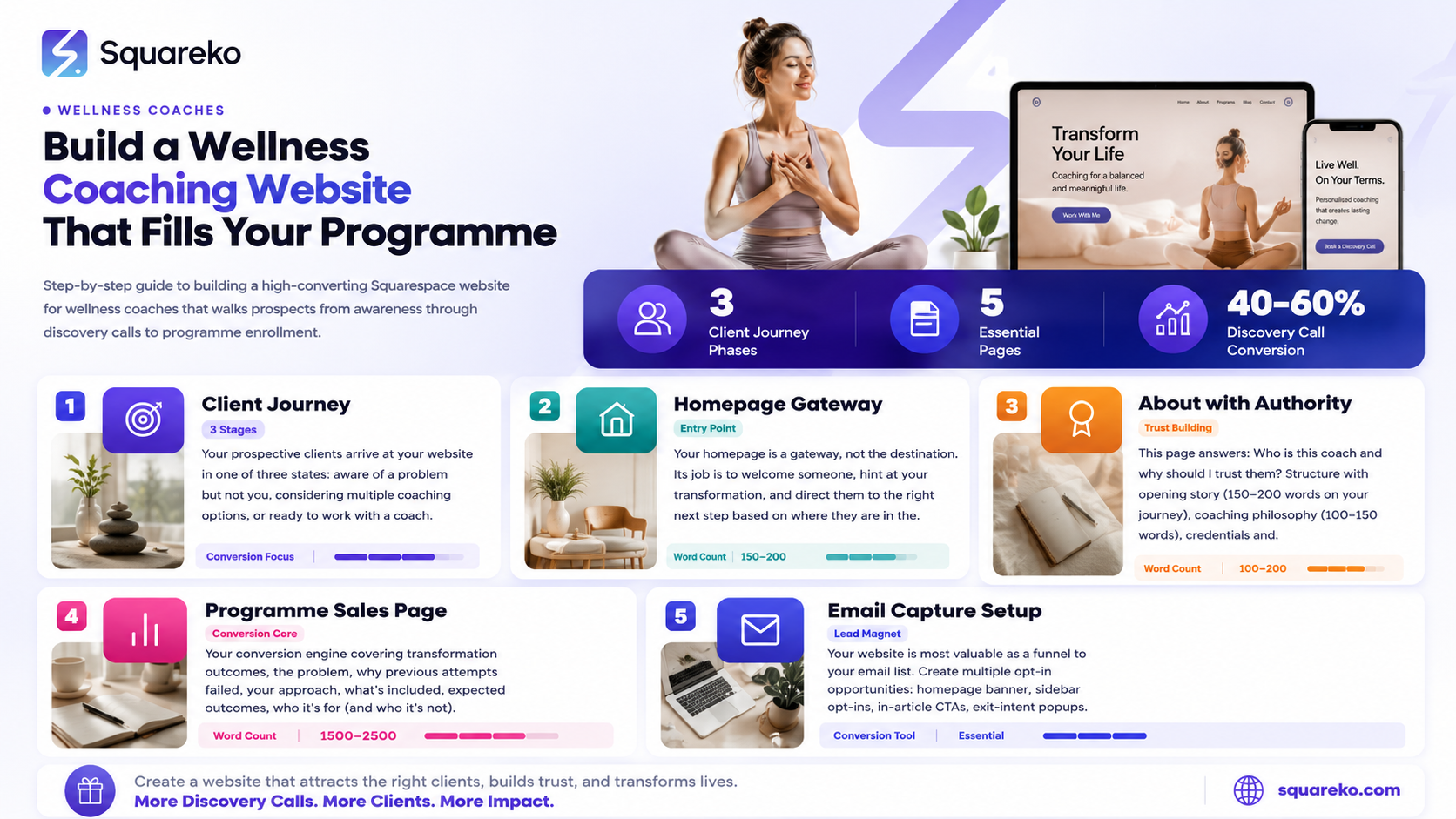
Your prospective clients don't arrive at your website ready to buy. They arrive in one of three states: they know something isn't right (but don't know you exist), they're considering a few options, or they've decided to work with a coach (and are comparing you against alternatives).
A website that fills your programme meets people at all three stages.
Stage One: Awareness
Someone is searching "what does a wellness coach do?" or "help with burnout" or "how to work with my body." They're not yet aware you exist. They're aware there's a problem.
Your website's job at this stage: Answer their questions. Teach them something valuable. Build your credibility so when they're ready to consider working with someone, your name comes to mind.
This is what your blog and resource pages do. Long-form content around topics like "signs you need a health coach," "how to recover from burnout," "nutrition and energy," "stress-resilience coaching" — these rank on Google, drive traffic, and position you as an expert.
Stage Two: Consideration
Now they know they want to work with a coach. They're comparing options. They might be looking at three coaches' websites, reading testimonials, trying to understand what they'll actually get.
Your website's job at this stage: Build trust. Show social proof. Make your approach crystal clear. Remove doubt.
This is what your about page, credentials section, testimonials, and methodology page do. Someone at this stage is asking: "Who is this coach? Will they understand my situation? Can I trust them?"
Stage Three: Decision
They've decided you're the one. Now they need to take the actual next step.
Your website's job at this stage: Make booking a discovery call painless. Remove every friction point.
One-click Squarespace Scheduling integration does this. A clear CTA does this. A simple form does this.
Mapping Your Content to the Journey
Your website needs content for all three stages:
Awareness content (80% of traffic, low conversion): Blog posts, resource guides, free resources, educational content
Consideration content (15% of traffic, medium conversion): About page, testimonials, programme page, methodology
Decision content (5% of traffic, high conversion): Clear CTAs, Scheduling, simple contact forms.
Most wellness coaches front-load their websites with decision content (big CTA buttons, sign-up prompts everywhere). This alienates people in stages one and two who just want to learn.
The best wellness coaching websites serve all three stages and trust the journey.
The Five Non-Negotiable Pages
Every wellness coaching website needs these five core pages.
Page 1: Homepage
Your homepage is a gateway, not the destination. Its job is to welcome someone, hint at your transformation, and direct them to the right next step based where they are in the journey.
Structure:
Hero section — Your core transformation offer in 1-2 sentences. Not "health coaching" but "recover from burnout without burning more energy trying to fix yourself" or "finally understand why diets fail you (and what actually works)."
Pain point acknowledgement — Show you understand the specific struggle. "You've tried everything. Diets don't stick. You know you're stressed. Nothing changes." This is empathy, not selling.
Brief methodology — Three sentences on how your approach works. "We don't focus on willpower. We focus on identity. When you understand how your brain works with habit, everything shifts." Something specific to you, not generic.
Testimonial/social proof — One powerful client quote or result.
CTA — "Book a discovery call" or "Learn about my programme" depending on your model. Make it a button, make it visible.
Secondary content — Blog links, free resource, or further exploration. For people in stage one/two.
Homepage should be 800-1,200 words with visuals, not a novel.
Page 2: About (With Credentials)
This page answers: "Who is this coach and why should I trust them?"
Structure:
Opening story — 150-200 words on your journey. Not your life story, but why you became a coach. "I spent 10 years in corporate, burned out completely, then learned what actually fixed it. Now I help others avoid the path I took." Something relatable.
Your coaching philosophy — 100-150 words on your approach. What's your core belief about change? "I believe transformation happens when you stop fighting yourself and start working with your brain and body." Make it specific to you.
Credentials and certifications — ICF accreditation, UKIHCA, AFPA certification, NBHWC — list them clearly with logos if you have them. If you're not formally certified, be honest: "I'm trained through [course], have 500+ coaching hours, and maintain ongoing professional development through [membership]."
Results/experience — "I've worked with 150+ clients over 8 years, specialising in burnout recovery and return-to-work transitions." Specific numbers matter.
Photo — Professional headshot or lifestyle photo. For wellness coaches, warmth matters more than corporate polish.
What makes you different — 100-150 words on what's unique about your approach. Why you, not the other coach? "Most coaches focus on motivation. I focus on nervous system regulation and habit architecture. That's what actually sticks."
About page should be 700-1,000 words.
Page 3: Signature Programme
This is your conversion engine. Whether you call it "Your 6-Week Health Transformation" or "The Burnout Recovery Protocol," this page is a full sales page.
See the detailed section below ("Writing a High-Converting Programme Sales Page") for full structure. Minimum 1,500-2,000 words.
Page 4: Discovery Call/Contact
Simple page. The point is to make booking frictionless.
Structure:
Brief intro — "Let's explore whether we're a good fit." 1-2 sentences.
Squarespace Scheduling embed — This is the core. Let them pick a time.
What to expect — "You'll tell me your situation, I'll explain my approach, and we'll see if working together makes sense. No pressure, no sales pitch."
FAQ about discovery calls — "How long is it?" (30-60 mins). "Is it free?" (yes, or £25 deposit). "What happens next?" (if aligned, you'll send programme info).
This page should be 300-400 words maximum.
Page 5: Testimonials (and Results)
A dedicated page (or strong section on homepage) for client results and testimonials.
Structure:
Results summary — Numbers if you have them. "Clients report 40% reduction in stress levels. 85% feel confident about their relationship to food after the programme."
Testimonials — 5-8 detailed client quotes. Not "5-star coach!" but specific transformation stories. "I came in exhausted, thinking I needed to push harder. This programme taught me the opposite. I'm now working less, earning more, and don't feel wired all the time. I couldn't recommend Walid more highly." - Sarah, Tech Executive.
Video testimonials (optional) — If you have clients willing to be on video, include them. These convert better than text.
This page should be 400-600 words with multiple testimonials.
Writing a High-Converting Programme Sales Page
Your programme sales page is the most important page on your website. Here's exactly how to structure it for conversion.
The Arc of a Programme Sales Page
Section 1: Hero/Headline (100-150 words) Open with transformation, not features. Not "6-week health coaching programme" but "Transform Your Relationship to Your Body in 6 Weeks — Without Restricting, Counting, or Fighting Yourself."
Include a subheading that addresses the specific pain point. "You've tried everything. You know what works. You just can't stick to it. Here's why — and how we fix that."
Section 2: The Problem (Empathy Dump)
Write 300-400 words on the specific struggle your programme solves. List the thoughts, feelings, failed attempts, and frustration.
"You're caught in a pattern. You eat clean for two weeks, feel deprived, then binge on everything. Or you hit the gym hard, burn out, stop for three months. You know what you're 'supposed' to do. The issue isn't knowledge. It's that nothing sticks because you haven't addressed the underlying belief about yourself and your body."
Get specific. Go deep. Let people feel seen.
Section 3: Why Previous Attempts Failed
Show that you understand why diets don't work, why willpower fails, why they've tried this before.
"Here's the truth: willpower is an unreliable energy source. When we rely on it, we eventually run out. And most health programmes are built on willpower — eat less, move more, just try harder. That's exactly the problem. You don't need harder. You need different."
This is positioning against competitor approaches while validating their experience.
Section 4: Your Approach (The Bridge)
Now introduce your methodology. What's different about how you work?
"This programme is built on three pillars: understanding how your nervous system drives behaviour, identifying the beliefs that run your health decisions, and building new habits from identity, not willpower. When you change how you see yourself, behaviour change becomes effortless."
Keep it clear, not overly technical. 200-300 words.
Section 5: What's Included (Be Granular)
List everything they'll get, not in bullet points but in story form. Paint a picture of the experience.
"You'll have four 1:1 coaching sessions over six weeks — live Zoom calls where we dive into your specific situation. Between calls, you'll have access to the online portal with video lessons on nervous system regulation, habit psychology, and nutrition science. You'll get a workbook to track your insights. You'll have email support for questions. And you'll be part of our private community with other clients, so you're not doing this alone."
Break this into subsections if needed.
Section 6: The Outcomes
What will be different? Be specific.
"By week three, you'll feel the physical shift — less cravings, more energy, better sleep. By week six, you'll have identified the belief about yourself that's been driving the old pattern. You'll have new habits that feel natural, not forced. And you'll understand yourself differently — which means you'll make different choices automatically."
Not hype, but real shifts.
Section 7: Who This Is For (And Who It's Not)
Be clear about fit. This actually increases conversions by filtering out bad-fit prospects.
"This programme is for people who are ready to change, not just know about change. You need to be willing to look at yourself honestly. You need to show up to four coaching sessions. And you need to be open to the idea that the problem isn't you — it's how you've been thinking about the problem.
This programme is not for people looking for a quick fix or a specific diet to follow. It's not for people not ready to make change. It's not for people expecting a coach to fix them — you're fixing yourself with my support."
Section 8: Investment
State the price clearly. Include payment options if relevant.
"The programme is £797 for the six-week cycle, or three payments of £299. Investment includes all sessions, materials, community access, and email support."
Then, critically, explain the value:
"Therapy costs £60-100/hour and usually takes months or years. This is six weeks of intensive coaching with someone who specialises in your specific challenge, plus structured resources and community. The cost is an investment in years of different behaviour and a different life."
Section 9: Testimonials + Results
Include 3-5 detailed client testimonials. Integrate them throughout if the page is long, or group them here. Include photos if possible.
Section 10: FAQ
Answer the five objections you hear most
"Will it work for me?" (Address their specific situation)
"How much time will it take?" (Be honest)
"What if I don't see results?" (Your guarantee/support)
"What happens after six weeks?" (Do they continue?)
"Do I need to have already tried therapy?" (No)
Section 11: Clear CTA
"Book Your Discovery Call" with Squarespace Scheduling embedded.
Include a confidence statement: "If we're a good fit, we'll know on the call. And even if we're not, you'll have clarity on next steps. No pressure."
Building Your About Page for Authority
Your about page is where trust compounds. It's not a biography. It's a credentials + story + differentiation page.
Structure:
Headline — "Meet [Your Name]" or "About [Your Name]'s Coaching Practice"
Opening narrative — 150-200 words. Your coaching origin story.
"I spent 12 years in corporate wellness, helping companies build health programmes. But I kept seeing the same pattern: employees would join the gym, attend one yoga class, then stop. The programmes worked. People's motivation didn't. I realised most coaches were trying to change behaviour without addressing belief. So I trained as a health coach, spent two years studying neuroscience and habit architecture, and rebuilt my entire coaching model around identity change, not willpower."
Your coaching philosophy — 100-150 words.
Specific to you, not generic wellness language.
Credentials section — With logos if available.
ICF Level 2 Coach (International Coaching Federation)
UKIHCA Registered Health Coach
Certified through [Institution], 200+ hours of training
5+ years coaching experience, 300+ clients
Ongoing CPD through [membership/training]
What makes you different — 150-200 words.
"Most health coaches focus on nutrition and exercise. I focus on the neuroscience and psychology underneath behaviour. I train your brain, not just your body."
Scope of practice disclaimer — Essential for YMYL.
"I am a health coach, not a doctor, therapist, or registered dietitian. My role is to support behaviour change and health optimisation within the scope of wellness coaching. If you have a clinical diagnosis, ongoing medical condition, or mental health concern, please work with your healthcare provider or therapist alongside our coaching."
Personal touch — 1-2 paragraphs on you outside of work.
Humanises you, builds connection.
"When I'm not coaching, I'm hiking in the Lake District, experimenting with recipes, and spending time with my dog, Pepper."
Relevant photo — Warm, professional headshot or lifestyle image.
Setting Up Email Capture and Lead Magnets
Your website is most valuable as a funnel to your email list. Email is where you build ongoing relationships before someone's ready to book.
Multiple Capture Points
Don't rely on one signup form. Create multiple opportunities:
Homepage banner — Sticky bar or prominent section. "Join 5,000+ wellness coaches building thriving practices" + email input.
Sidebar opt-in (if your template supports it) — "Free download: My 7-day stress reset plan"
In-article CTAs — Mid-blog-post: "This technique is covered in depth in my email series. Subscribe to get the full framework."
Exit-intent popup (use sparingly) — When someone's about to leave the blog: "Before you go, grab my free guide: [topic]"
Post-discovery-call — Autoresponder after someone books: "Looking forward to our call. Here's a worksheet to prep: [PDF]"
Lead Magnet Ideas for Wellness Coaches
Workbook/PDF — "The 7-Day Stress Reset" or "My 30-Day Habit Reset Protocol"
Video series — "3 Mistakes Health Coaches Make (And How to Fix Them)"
Assessment — "What's Your Coaching Readiness Score?" (Quiz that then asks for email to see results)
Checklist — "The 10-Point Health Audit"
Spreadsheet/template — "My Weekly Energy Tracking Spreadsheet"
The best lead magnets are:
Immediately useful — Someone can use it right now, not "someday"
Specific to your approach — Not generic wellness advice
Natural bridge to your coaching — If someone uses your lead magnet and loves it, they want to work with you
Integration on Squarespace
Use Squarespace's native email integration (Squarespace Email Campaigns) or connect a third party (Mailchimp, ConvertKit, ActiveCampaign).
For each opt-in, set up an autoresponder sequence:
Email 1 (immediate): Deliver the lead magnet + welcome
Email 2 (day 2): Share one insight related to the magnet
Email 3 (day 4): Tell a client story
Email 4 (day 6): Mention your programme (soft pitch)
Email 5 (day 8): Encourage discovery call with value statement
This nurtures without being pushy.
Integrating Squarespace Scheduling for Discovery Calls
Squarespace Scheduling is a native integration that removes one of the biggest friction points: "How do I book a call with this coach?"
Setup Steps
Go to Squarespace Scheduling (Settings > Scheduling)
Create a new appointment type — Name it "Wellness Coaching Discovery Call"
Set duration — 30, 45, or 60 minutes (most coaches do 30-45)
Set availability — Your actual available times, timezone
Set pricing (optional) — Free, or charge a £25 deposit (often increases seriousness)
Create a confirmation message — Autoresponder confirming the booking with "what to expect"
Embed the calendar — Add to your Contact page or Discovery Call CTA button
The Psychology of Scheduling
When someone can book instantly, they do. When they have to email you and wait for a response, many don't follow through. One-click booking removes the decision friction.
Pro tip: Offer multiple time slots (early morning, evening, weekends) to capture different schedules.
Trust Signals and Credentials
Wellness coaching is YMYL (Your Money, Your Life) territory. Google applies higher scrutiny to health claims. Your website must build trust through multiple signals.
Essential Trust Signals
Credentials and certifications — Display them prominently with logos.
ICF (International Coaching Federation)
UKIHCA (UK Institute of Health Coaching)
AFPA (American Fitness Professionals and Associates)
NBHWC (National Board for Health and Wellness Coaching)
Accredited training programmes
Scope of practice disclaimer — Essential. State clearly that you are a wellness coach, not a doctor or therapist.
"I do not diagnose, treat, or prescribe. Please consult your healthcare provider for medical concerns."
Testimonials with specifics — Not vague praise, but specific transformations.
"I couldn't focus at work. After 12 weeks of coaching, my energy is back and I'm performing better. I'd highly recommend." — Better than "Great coach!"
Experience statement — "5+ years coaching experience" or "300+ clients" or "specialising in [specific niche]"
Author bio on blog posts — Always include one. "About [Your Name], [Title], [Years Experience]"
Client-facing boundaries — Clearly describe what coaching is and is not.
State the difference between coaching and therapy
State the difference between coaching and medical advice
Be transparent about your scope
Professional photo — A headshot builds familiarity and trust.
Consistency across platforms — Same bio, same photo, same credentials on your website, LinkedIn, and social media.
Optimising for Mobile and Speed
Over 50% of wellness coach website visitors are on mobile. Your site must convert on small screens.
Mobile Checklist
Hero image is readable on mobile — Not a landscape photo that's unrecognizable on phone
CTA buttons are thumb-sized — At least 48x48px
Form fields stack clearly — Not cramped side-by-side
Typography is legible — Minimum 16px base font size
Squarespace Scheduling embed works on mobile — Test it
Images load quickly — Compress before uploading
Speed Optimisation
Image optimisation — Squarespace compresses images, but keep source files under 5MB
Fewer than 10 high-quality images on homepage — More than that slows load time
Minimal video embeds above the fold — Video slows perceived load time
No auto-play video — Kills speed and annoys visitors
Squarespace handles most of this natively, but you can check speed at Google PageSpeed Insights.
Ready to Fill Your Programme
You've built a clear path from visitor to client. But converting that path requires ongoing attention: updating testimonials, refreshing your blog, responding to enquiries quickly, and continuously improving your copy based on what you learn from discovery calls.
At Squareko, we help wellness coaches build and optimise these conversion-focused websites. We handle the strategy, design, copy, and ongoing optimisation so you can focus on coaching.
We've worked with burnout recovery coaches, integrative health practitioners, group programme facilitators, and 1:1 health coaches to design websites that actually fill their practices.
Frequently Asked Questions
-
As long as it needs to be to tell the full story — typically 1,500-2,500 words. A long-form sales page allows you to address objections, build trust, and describe transformation in detail. Short sales pages work for commoditised products. Coaching requires narrative.
-
Create a separate page for each programme, then link to them from a main "Services" or "Programmes" page. Each programme needs its own sales page tailored to that specific offering.
-
Blog content should be updated monthly (new posts or refreshes). Testimonials should be refreshed quarterly (add new ones as you get them). Core pages (home, about, programme) don't need constant changes, but review quarterly and update if your offer or positioning shifts.
-
Yes. Transparency builds trust. If you don't list pricing, prospects will assume you're expensive or hiding something. Post your price confidently. It filters out price-sensitive prospects early and respects prospects' time.
-
Track: (1) email signups per month, (2) discovery call bookings per month, (3) discovery-to-client conversion rate. Most wellness coaches see 30-50% of discovery calls convert to clients. If yours is lower, the issue is usually your discovery call experience, not your website.
-
It's possible but not ideal. If you coach both burnout recovery and relationship coaching, you're diluting your positioning. Better to pick one niche for your main website, or create separate websites for each speciality. Clarity converts better than breadth.
-
Warm, earthy colours (sage, warm taupe, soft brown) or calm blues work better than bright reds or oranges. Test different CTAs, but generally for wellness, "calm confidence" beats "urgent urgency."
-
Squarespace has built-in GDPR compliance for email capture. When someone signs up, they're confirming consent. You'll need: (1) a clear privacy policy linked in the footer, (2) a statement about how you'll use their email, (3) an unsubscribe option on every email. That's it.
Start Building Your High-Converting Wellness Coaching Website Today
Your website should work for you — pulling in qualified enquiries, building your email list, and turning prospects into clients. It shouldn't be a static brochure. It should be a conversion machine.
At Squareko, we build exactly that. We handle strategy, design, copy, Scheduling integration, email setup, and ongoing optimisation so you can focus on coaching.
We'll review your coaching model, audit your current website (if you have one), and outline a strategy to fill your programme through your website.Your website is your silent salesperson. Let's make sure it's working as hard as you do.

From custom website design to SEO strategy, we help businesses launch a site that looks professional and performs better.

About the Author
Walid Hassan is the founder of Squareko,
I'm Walid Hasan, a Certified Squarespace Expert and Squarespace Circle Platinum Partner with over 12 years of hands-on experience designing and optimizing high-performing websites. Over the years, I've had the privilege of building more than 2,000 Squarespace websites for clients around the world, always focusing on clean design, strong user experience, and conversion-driven results.