Squarespace SEO for Coaches and Educators: Rank on Google and AI Search in 2026
Key Takeaways Squarespace SEO for Coaches and Educators: Rank on Google and AI Search in 2026
Squarespace 7.1 handles the technical SEO basics well — but you still need to configure titles, descriptions, and URL structure correctly
The most important SEO investments for coaches are keyword-optimised service pages, a strategic blog, and Google Business Profile setup
AI search platforms increasingly surface coaching websites that are structured for direct answers and topical authority
Local SEO matters enormously for coaches who serve specific geographies — even if you work online
Consistent content production over 6–12 months produces compounding SEO returns that paid ads cannot replicate
If someone searches for life coach in London or career coach for mid-career professionals right now, does your website come up? If the answer is no — or I'm not sure — then your coaching website is invisible to the clients who are actively looking for someone exactly like you.
Search engine optimisation for coaches on Squarespace is more achievable than most people realise. But it's also changed significantly in the past two years. Google still matters, but AI-powered search platforms — ChatGPT, Perplexity, Gemini, and others — are becoming increasingly important channels for how potential clients discover services. Optimising for both is now part of a serious coaching website strategy.
This guide gives you a complete Squarespace SEO framework for coaches and educators in 2026. We'll cover the technical foundations, on-page optimisation, content strategy, and the emerging AI search signals that most coaches haven't started thinking about yet.
Squarespace SEO Foundations: What the Platform Does (and Doesn't Do)
What Squarespace Handles Automatically
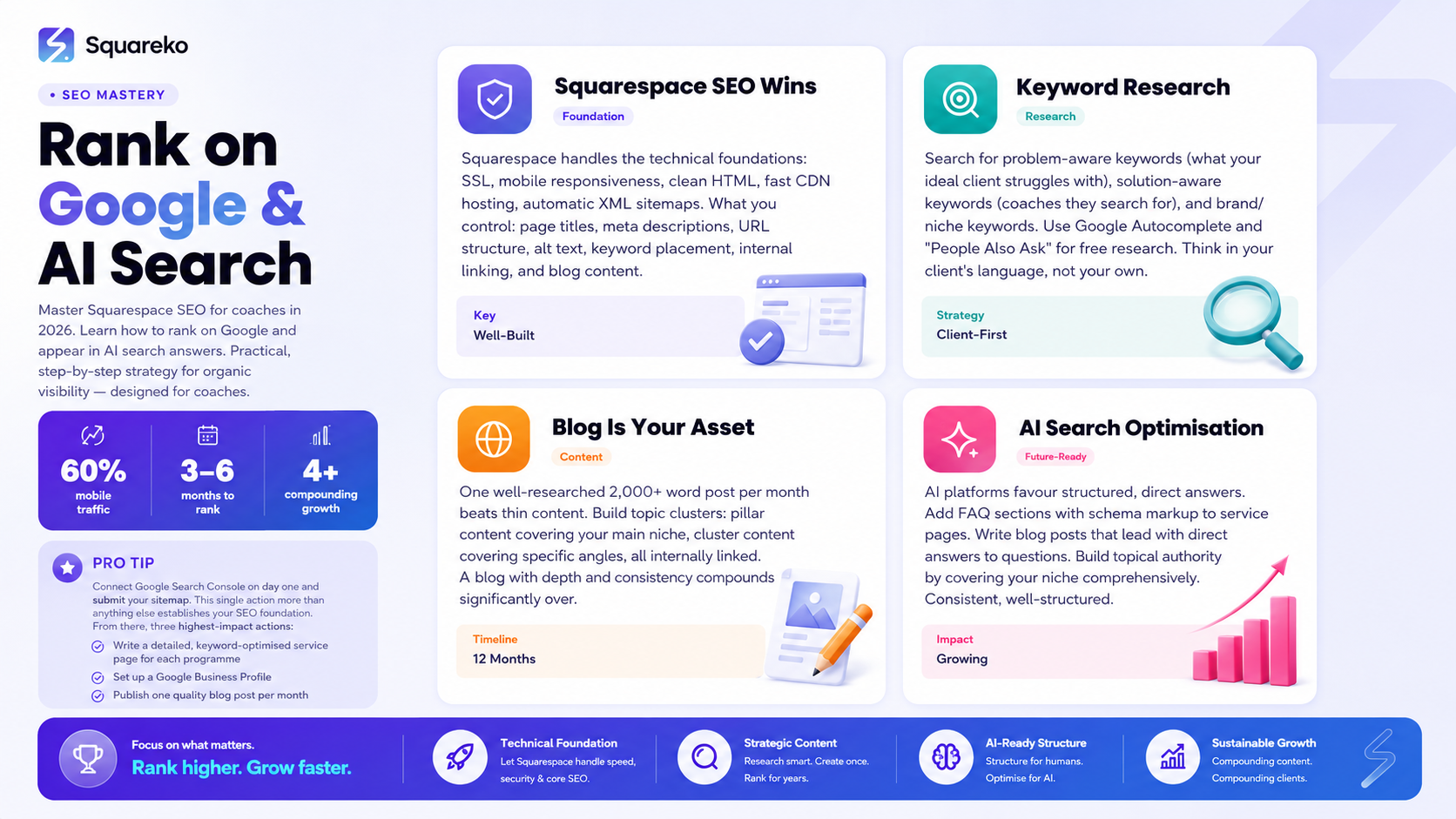
Squarespace takes care of several SEO fundamentals automatically:
SSL certificate — All Squarespace sites run on HTTPS by default. This is a basic Google ranking signal and is non-negotiable in 2026.
XML sitemap — Squarespace generates and updates your sitemap automatically. You can submit it to Google Search Console (which you should do on day one).
Mobile responsiveness — All Squarespace 7.1 templates are mobile-responsive. Google uses mobile-first indexing, so this matters.
Clean HTML structure — Squarespace generates semantic HTML with proper heading hierarchies, which helps search engines understand your page structure.
Fast hosting — Squarespace serves sites via a global content delivery network (CDN), which contributes to load speed — a confirmed Google ranking factor.
What You Have to Configure Yourself
The platform handles the foundations, but SEO strategy is your responsibility:
Page titles and meta descriptions for every page
URL slug structure (Squarespace creates URLs from page titles by default — you should customise them)
Alt text for every image
Internal linking structure
Keyword placement in headings and body copy
Blog content production
Google Search Console and Google Analytics setup
Without these, even a technically clean Squarespace site won't rank.
Keyword Research for Coaches: Finding What Your Clients Actually Search
Start With Your Client's Language, Not Yours
Coaches often think in terms of their methodology: somatic coaching, polyvagal-informed approach, kigai framework. Their potential clients search in terms of problems: why do I feel stuck in my career, how to stop people pleasing, find career direction in my 40s.
Your keyword strategy starts with your ideal client's search behaviour. What are they typing into Google when they're struggling with the exact problem you solve?
Think in three categories:
Problem-aware searches — why can't I move forward in my career, feeling lost in life at 35, how to get promoted at work. These are high-volume, top-of-funnel searches. Blog content serves them well.
Solution-aware searches — life coach for career change, executive coach for women, business coach London. These are your service page keywords — people who already know coaching is the answer and are looking for the right person.
Brand and niche searches — Squarespace coach website, coaching website design. These are for your specific positioning within the market.
Tools for Keyword Research
Google's own autocomplete is one of the most underused keyword research tools. Type your topic into Google and look at what it suggests — these are real searches people are making. Also check the People also ask box that appears in search results — these are question-format keywords that map directly to blog post topics and FAQ sections.
For more systematic research, tools like Ubersuggest, Semrush, or Ahrefs provide search volume data and competition analysis. Even the free version of these tools gives coaches enough data to build a solid keyword strategy.
On-Page SEO: Optimising Every Page That Matters
Homepage SEO
Your homepage title tag should include your primary keyword — typically something like Life Coach [City] or Career Coach for [Niche]. Keep it under 60 characters. Your meta description should tell the story: who you help, what transformation you offer, and why to click.
In the body of your homepage, your primary keyword should appear in the hero headline or the first paragraph — not forced, but naturally. Subsequent sections should include semantic variations.
Service and Programme Pages
Each service page needs its own keyword target. If you offer three programmes, each page should target a different, specific keyword phrase. Your page title, H1, and first paragraph should all include the target keyword naturally.
This matters more than most coaches realise: a single Services page targeting a dozen different services will rank for none of them. Individual pages targeting specific terms can rank for each.
URL Structure
Squarespace defaults to page-title-based URLs, but you can customise them. Best practice for coaching websites:
/life-coaching not /life-coaching-services-for-women-who-want-change
/career-coaching-programme not /career-coaching-package-90-day
/blog/how-to-change-careers-at-40 not /blog/post-1
Keep URLs short, keyword-relevant, and human-readable. Change them at launch before you build any external links — changing URLs later can cause ranking drops if not managed correctly with 301 redirects.
Image Alt Text
Every image on your site should have descriptive alt text. This serves two purposes: accessibility (screen readers use alt text) and SEO (Google uses alt text to understand image content). In Squarespace, add alt text when uploading images via the image settings panel.
Technical SEO on Squarespace: Settings You Must Configure
Connect Google Search Console
Google Search Console is free and essential. It shows you which keywords your site ranks for, which pages are indexed, and whether Google has crawled your site correctly. Connect it by verifying your Squarespace site in Search Console — Squarespace has a native Google Search Console integration in Settings > Advanced.
Submit your XML sitemap (your-domain.com/sitemap.xml) once verified. Check it monthly for indexing issues.
Set Up Google Analytics
Google Analytics 4 (GA4) is the current standard. Connect it via your Squarespace settings — you'll add your GA4 Measurement ID. GA4 shows you where your traffic comes from, which pages visitors spend time on, and where they drop off. For coaches, the most useful reports are: traffic sources, page engagement, and conversion events (form submissions, scheduling page views).
Configure 301 Redirects
If you ever change a URL (to fix a slug or restructure your navigation), set up a 301 redirect from the old URL to the new one. Squarespace has a built-in redirect manager under Settings > Advanced > URL Redirects. Without 301 redirects, changed URLs create dead pages that lose any ranking equity they'd built.
Page Speed
Squarespace's CDN means your core load speed is solid, but you can hurt it by uploading unoptimised images. Before uploading images to Squarespace, compress them using a tool like TinyPNG or Squoosh. Aim for images under 500KB for hero images and under 200KB for blog images. Slower pages rank lower and have higher bounce rates.
Content Strategy: The Blog as a Ranking Asset
Why Blogs Matter for Coaching Websites
A coaching website with only service pages is limited in its SEO potential. Service pages target solution-aware searches — people who already know they want a coach. A blog targets problem-aware searches — people who are in the situation you solve but haven't yet decided they need a coach.
This is a much larger audience. And it's a warm audience: people searching how to stop feeling stuck at work are excellent prospects for a career coach. A blog post that genuinely helps them builds enormous trust before they ever see your sales page.
What to Write About
Build your content calendar around three question categories:
Evergreen how-to content — guides that answer specific questions your clients have. How to change careers at 40, How to negotiate a pay rise, How to set goals that actually work. These rank and stay relevant.
Comparison and decision content — Life coach vs therapist: what's the difference?, Do I need a business coach or a mentor?. People in early research mode search these terms, and positioning your perspective builds authority.
Personal experience and case study content — posts that demonstrate your expertise through specific examples. How one of my clients went from redundancy to their dream career in four months (with permission and anonymity as needed) is both compelling and convincing.
Publishing Consistency
One well-researched, 2,000+ word post per month beats four thin posts per week for SEO. Google rewards depth and consistency. Set a realistic publishing schedule — and maintain it. The compounding effect of 12–24 in-depth posts over a year is significant.
AI Search Optimisation for Coaches in 2026
AI search platforms — ChatGPT, Perplexity, Gemini, Claude — are increasingly answering questions that used to send people to a Google search result. When someone asks who are the best career coaches for tech professionals? they may be asking an AI, not typing it into Google.
How do you show up in AI answers? The same way you build Google authority — but with a few additional considerations.
Structured, Direct Answers
AI platforms favour content that directly answers questions in a structured format. If your blog post about how to choose a life coach contains a clear, concise answer in the first few paragraphs — not buried after five paragraphs of preamble — AI search engines are more likely to cite it.
Entity Mentions and Topical Authority
AI systems build knowledge graphs around entities (people, businesses, topics). Having your name and Squareko mentioned across multiple authoritative pages — your website, guest posts, podcast appearances, press coverage — builds your entity prominence. The more AI systems know about you as an authority in your niche, the more likely you appear in AI-generated recommendations.
FAQ and Q&A Content
FAQs on your service pages and blog posts give AI search platforms pre-structured answers they can surface directly. Structure your FAQs as genuine questions your clients ask, with specific and helpful answers — not vague marketing language. AI Search Strategy for Coaches and Educators on Squarespace.
Local SEO for Coaches on Squarespace
If you serve clients in a specific city or region — even if many of your sessions are online — local SEO is essential. Life coach in Manchester or career coach Sydney searches have high intent and are far less competitive than national-level keyword targets.
Google Business Profile for Coaches
Set up and verify a Google Business Profile. Even coaches who work entirely online can claim a Business Profile using a service area setting (rather than a physical address). Publish your coaching specialty, add photos, collect client reviews, and post updates regularly. An active, well-maintained Google Business Profile significantly boosts your visibility for local searches.
Local Keywords on Your Squarespace Site
Include location-specific keywords on your homepage, in your meta title, and in your about page. Career coach for professionals in London or Online life coach for US clients are examples of location-specific keyword phrases that signal geographic relevance without being forced.
Your Coaching Website Should Be Your Best Client Acquisition Tool
SEO is long-term work — but it's also the most cost-effective client acquisition strategy available to coaches. A well-optimised Squarespace site that ranks for the right searches generates warm, inbound leads every week without ongoing ad spend.
If you want a Squarespace coaching website that's built with SEO in the architecture from day one — not added as an afterthought — Squareko can help. We build sites with SEO structure, strategic content frameworks, and proper technical configuration built in.
FAQs
-
Yes. Squarespace 7.1 provides a technically solid SEO foundation — clean code, automatic sitemaps, HTTPS, mobile responsiveness, and CDN-powered load speeds. The platform doesn't do your keyword research or content strategy for you, but it doesn't hold you back either. With proper configuration and consistent content, coaches can rank competitively on Squarespace.
-
Typically 3–6 months for initial rankings on lower-competition terms, and 6–12 months for meaningful traffic from competitive terms. SEO is a compounding investment — the results build over time. A coaching website that publishes quality content consistently for 12 months will significantly outperform one that has been live for three years without a content strategy.
-
If you can only do one thing, set up Google Search Console and submit your sitemap. From there, the highest-impact investments are: writing a detailed, keyword-optimised service page for each offering, setting up a Google Business Profile, and publishing one high-quality blog post per month targeting a question your ideal client asks.
-
Squarespace supports custom code injection in the head section of your site, which is where JSON-LD schema markup goes. You can add LocalBusiness, CoachingService, FAQPage, and other schema types via code injection. This is more manual than WordPress + Yoast, but it's achievable for any coach working with a Squarespace designer.
-
Both. Google still drives the majority of organic search traffic, and that won't change dramatically in the next few years. But AI search platforms are growing quickly and coaches should optimise for both simultaneously. The good news: the tactics overlap significantly. Content that's well-structured, specific, and genuinely helpful performs well in both environments.
-
Set up Google Search Console (free) and check the "Search results" report. It shows exactly which queries your site appears for, your average position, and how many clicks you're getting. For keywords you're actively targeting, Google Search Console is your primary performance tracker.
-
Target three types: niche + location keywords for service pages ("life coach for women London"), problem-based keywords for blog content ("how to find career direction at 40"), and comparison keywords for decision-stage readers ("life coach vs therapist"). Build your keyword list from your ideal client's actual search language — tools like Google Autocomplete, Ubersuggest, or Semrush help identify specific terms.
-
You can do the basics yourself — configuring titles, descriptions, image alt text, and publishing blog content. More advanced work — technical SEO auditing, schema markup, keyword gap analysis, and internal linking architecture — benefits from expert input. Squareko.com includes SEO foundations in every coaching website build, so the architecture is right from launch.
From custom website design to SEO strategy, we help businesses launch a site that looks professional and performs better.

Author Bio
I'm Walid Hasan, a Certified Squarespace Expert and Squarespace Circle Platinum Partner with over 12 years of hands-on experience designing and optimizing high-performing websites. Over the years, I've had the privilege of building more than 2,000 Squarespace websites for clients around the world, always focusing on clean design, strong user experience, and conversion-driven results.