How to Structure Education Consulting Case Studies That Win School Contracts on Squarespace
Key Takeaways How to Structure Education Consulting Case Studies That Win School Contracts on Squarespace
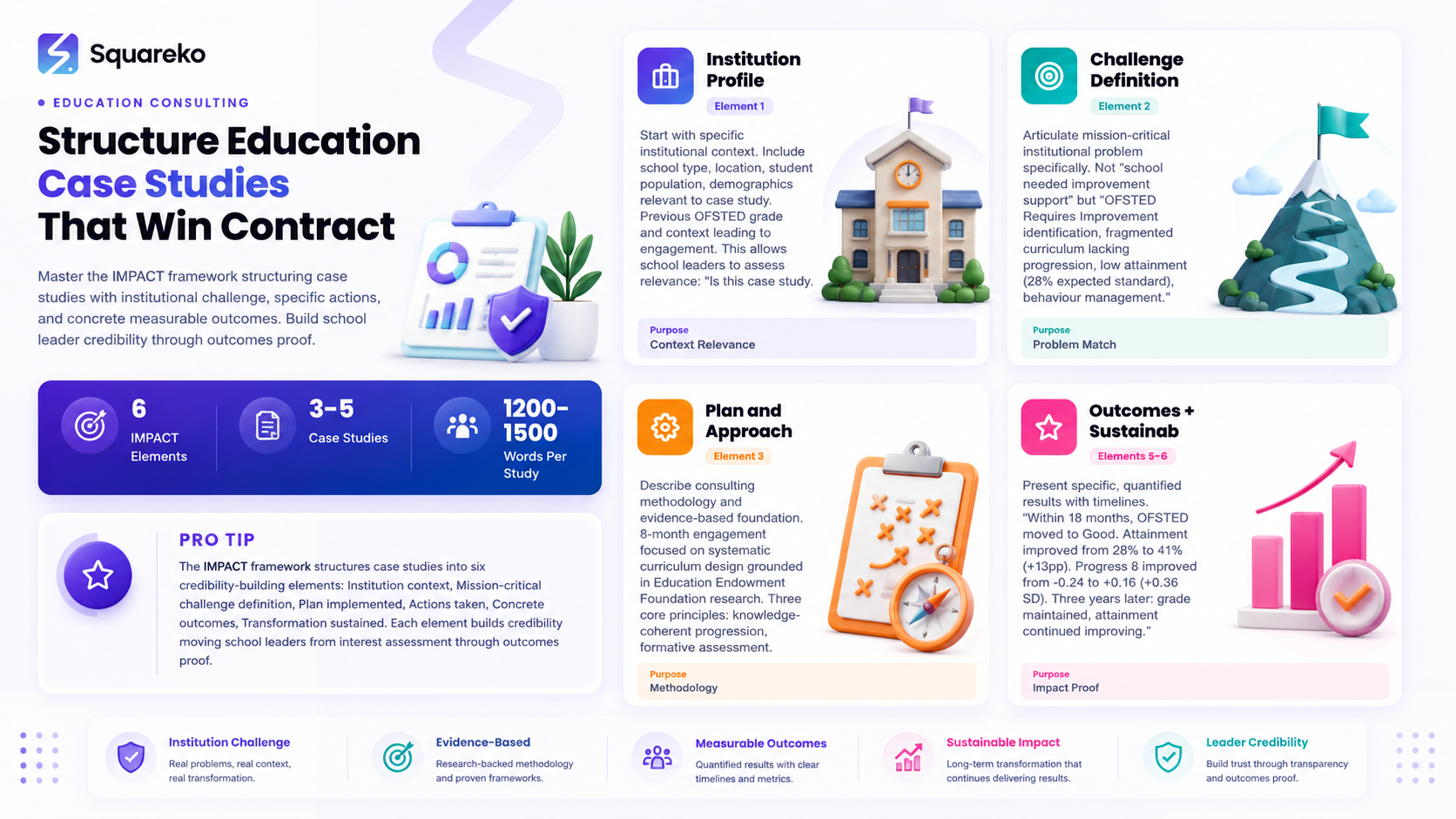
The IMPACT Framework structures education case studies in six elements: Institution profile, Mission-critical challenge, Plan implemented, Actions taken, Concrete outcomes, Transformation sustained—each building credibility toward measurable proof
Education-specific outcome metrics matter most to school leaders: OFSTED grade changes, attainment improvements (percentage point gains), progress scores (standard deviation changes), attendance/behaviour metrics, staff development evidence
Anonymised case studies remain powerful when paired with specific institutional context (school type, phase, catchment, student demographics) and detailed metrics, but named case studies built with school permission carry significantly higher credibility
Case study length should be 1,200-1,500 words—long enough to build institutional credibility through specific detail, short enough for headteachers and governors to complete reading during decision-making
Squarespace's native page templates, image blocks, and comparison tables allow professional case study presentation without custom design, making case study updates and additions quick and straightforward
School leaders evaluating education consultants need proof that you deliver measurable results. Not generic testimonials about "helping schools improve." Not vague case studies that avoid specific outcomes. They need transparent, structured examples showing: what institutional challenge existed, what you did, and what measurable outcomes resulted.
Most education consultant case studies fail because they follow business consulting frameworks that don't translate to institutional education contexts. They focus on process stories ("We implemented a six-month transformation programme") rather than outcome evidence. They avoid specific metrics, hide timelines, or present results so anonymised that school leaders can't assess relevance to their own context.
Education consulting case studies require a purpose-built structure that makes three things immediately clear: the institutional challenge, the specific actions taken, and the concrete measurable outcomes. This post introduces the IMPACT Case Study Framework, designed specifically for education consultants, and shows how to implement it on Squarespace websites that move school leaders from interest to qualified engagement.
The IMPACT Framework for Education Case Studies
The IMPACT Framework structures education consulting case studies into six evidence-building elements that move school leaders from interest through credibility assessment to confidence.
I = Institution: Context and background of the school or educational institution M = Mission-Critical Challenge: The institutional problem driving the need for external support P = Plan Implemented: Your consulting approach and methodology A = Actions Taken: Specific activities, interventions, and deliverables C = Concrete Outcomes: Measurable results with education-specific metrics T = Transformation Sustained: Evidence that improvements lasted beyond engagement
Each element serves a specific credibility-building purpose in school leader decision-making:
Institution lets school leaders assess whether this case study is relevant to their context
Challenge establishes whether you address their specific institutional problem
Plan clarifies your methodology is evidence-based and systematic, not ad-hoc
Actions demonstrates you deliver specific, tangible work, not vague consulting
Outcomes proves you deliver measurable, school-leader-comprehensible results
Sustained shows improvements aren't short-term fixes but institutional transformation
This structure moves systematically from context assessment through to outcomes proof, building credibility at each stage.
Element 1: Institution Profile and Context
Start by establishing the institutional context. This allows school leaders to assess whether the case study is relevant to their situation.
Institution Profile Template
Begin your case study with specific institutional framing:
"[School Name] or [Anonymous Descriptor]
[School Type]: [Primary school/Secondary academy/Multi-Academy Trust/Special education setting] [Location]: [Region/City] [Student Population]: [Number of students, key demographics] [Context]: [Urban/rural, catchment characteristics, student demographics relevant to case study] [Ofsted Background]: [Previous inspection grade, context that led to improvement engagement]"
Institutional Context Example
"Riverside Academy (Secondary School)
Secondary academy, 850 students, outer London catchment serving mixed demographic including 42% students with English as additional language, 28% students eligible for Free School Meals
Previous Ofsted grade: Requires Improvement (2019) Context: Academy had been through leadership transition with three headteachers in five years. Curriculum provision was fragmented across departments with inconsistent quality. Student attainment was below national averages, and behavior management across the school was inconsistent."
This institutional framing gives school leaders immediate context: Is this a school like mine? Do I face similar challenges? Can I learn from their experience?
Anonymized Institution Example
"Secondary Academy, Mixed Urban Catchment (London)
Secondary academy, 1,100 students, London mixed urban catchment serving student population with 68% English as additional language, 35% eligible for Free School Meals, significant student mobility (23% student turnover annually)
Previous Ofsted grade: Requires Improvement Context: Academy had experienced multiple staffing challenges and lacked curriculum coherence across departments. Student progress was significantly below national average, particularly for students with lower prior attainment. Behaviour management and attendance were below floor targets for the school's context."
Anonymized examples work when you provide enough institutional specificity that school leaders recognize relevance.
Element 2: Mission-Critical Challenge Definition
The challenge section should articulate the institutional problem that drove the school to seek external support. This is where school leaders assess whether you address their specific issue.
Challenge Framing (Problem-Focused, Not Process-Focused)
Avoid: "The school needed curriculum development support." Use: "The school's curriculum was fragmented across departments with inconsistent sequencing, assessment, and teaching quality. Students progressed through Key Stage 3 without coherent knowledge progression, leading to weak foundational understanding by Key Stage 4. Previous Ofsted inspection specifically identified 'inconsistent curriculum design' as an area requiring improvement. The school had attempted internal curriculum development but lacked external expertise and coherence, resulting in piecemeal changes that didn't address whole-school curriculum architecture."
Education-Specific Challenge Categories
School Improvement (OFSTED Focused) "The school had been identified as 'Requires Improvement' in their previous Ofsted inspection. The inspection report highlighted [specific areas: curriculum, behaviour, leadership, safeguarding, etc.]. The headteacher faced an 18-month timeline to demonstrate measurable progress toward 'Good.' The challenge was making systematic improvements across multiple areas while maintaining staff morale during intensive scrutiny."
Curriculum and Academic Achievement "Despite a strong-performing teaching staff, student attainment was significantly below national averages, particularly in [subjects/key stages]. The challenge was identifying curriculum design and pedagogical barriers limiting student progress and developing systematic approaches that would improve attainment sustainably, not through short-term intervention only."
Technology and Digital Transformation "The school had identified the need for digital transformation to improve [teaching and learning/administrative efficiency/student engagement] but lacked a systematic implementation plan. The challenge was moving from ad-hoc technology adoption to strategic digital transformation that integrated technology meaningfully across teaching, learning, and institutional processes without overwhelming staff."
Behaviour and Culture "The school experienced higher-than-expected behaviour incidents, fixed-term exclusions, and low attendance. The underlying challenge was that behaviour management approaches lacked consistency and coherence. The school needed systematic behaviour framework and restorative approaches training to address whole-school culture."
Element 3: The Plan Implemented
Describe your consulting approach. School leaders want to understand your methodology is evidence-based and systematic.
Plan Structure Template
"Our Approach
We implemented a X-month engagement focused on [primary focus areas]. Our approach was grounded in [evidence source: Education Endowment Foundation research, Ofsted framework priorities, academic research, etc.] and structured around [framework name: e.g., systematic curriculum design, school improvement framework, change management principles].
The engagement comprised [X phases/components]:
[Phase/Component 1]: [Brief description of work]
[Phase/Component 2]: [Brief description of work]
[Phase/Component 3]: [Brief description of work]
Our methodology prioritises [key principles: collaborative design, staff agency, evidence-based practice, sustainability, etc.]."
Plan Example
"Our Approach
We implemented an eight-month engagement focused on systematic curriculum design and staff professional development. Our approach was grounded in the Education Endowment Foundation research on effective curriculum design and structured around three core principles: knowledge-coherent curriculum progression, formative assessment integration, and teacher agency in implementation.
The engagement comprised four phases:
Audit and Analysis (4 weeks): We reviewed existing curriculum provision, assessed gaps in knowledge progression, and analysed student attainment patterns to identify curriculum design barriers
Curriculum Framework Development (8 weeks): Working collaboratively with subject leaders, we developed a coherent KS3-KS4 curriculum framework with clear knowledge progression, assessment touchpoints, and teaching sequence
Staff Professional Development (ongoing): We delivered 12 CPD sessions supporting subject leaders in curriculum implementation, provided template lesson planning resources, and embedded formative assessment practices
Implementation Support and Monitoring (6 weeks): We worked with the school to refine curriculum implementation, address emerging challenges, and embed sustainability practices"
This structured approach demonstrates you have a systematic methodology, not ad-hoc consulting.
Element 4: Concrete Actions Taken
Move from plan to specific deliverables and activities. School leaders want to understand exactly what you did.
Actions Template
"What We Did
Over the [timeframe], we completed the following specific activities and deliverables:
[Concrete activity 1]: [Specific deliverable or outcome] [Concrete activity 2]: [Specific deliverable or outcome] [Concrete activity 3]: [Specific deliverable or outcome] [Concrete activity 4]: [Specific deliverable or outcome] [Concrete activity 5]: [Specific deliverable or outcome]"
Actions Example
"What We Did
Over eight months, we completed these specific activities:
Curriculum Audit and Analysis: We reviewed all subject curriculum documents, analyzed student progression data from Key Stage 2 onwards, and identified knowledge gaps in curriculum sequencing. Delivered a detailed audit report identifying 23 curriculum coherence issues.
Curriculum Framework Design: Working with subject leaders, we designed a coherent KS3 curriculum framework with explicit knowledge progression, sequencing logic, and key concept coherence. We created subject-specific curriculum maps (English, Mathematics, Science, Humanities, Languages, Arts, PE).
Assessment Framework: We designed a formative and summative assessment framework aligned to curriculum progression, creating assessment items and success criteria that made curriculum progress visible to students and teachers.
Staff Training: We delivered 12 half-day CPD sessions with subject leaders and teaching staff, covering curriculum implementation, formative assessment, and evidence-based teaching strategies. 94% of teaching staff engaged with full CPD programme.
Template Resources: We provided 150+ lesson planning templates, assessment tools, and teaching resources aligned to the new curriculum framework.
Implementation Monitoring: We conducted six observation visits, reviewed student work samples, and provided coaching feedback to support consistent implementation.
Sustainability Planning: We trained curriculum leads in continuous curriculum improvement processes, established a whole-school curriculum committee, and built internal expertise for ongoing curriculum development."
This concrete action list shows exactly what work was completed, helping school leaders understand the scope of engagement.
Element 5: Concrete Outcomes with Metrics
This is the most critical section. School leaders need to see measurable, school-leader-comprehensible outcomes.
Outcome Metrics by Category
Inspection Grade Outcomes (if applicable) "Within 18 months of engagement completion, the school was re-inspected by Ofsted and moved from 'Requires Improvement' to 'Good.' The inspection report specifically praised 'a coherent, well-sequenced curriculum' and 'systematic assessment practices that inform teaching.'"
Attainment Outcomes "Student attainment improved significantly:
KS2-equivalent attainment increased from 34% meeting expected standard to 52% meeting expected standard (+18 percentage points)
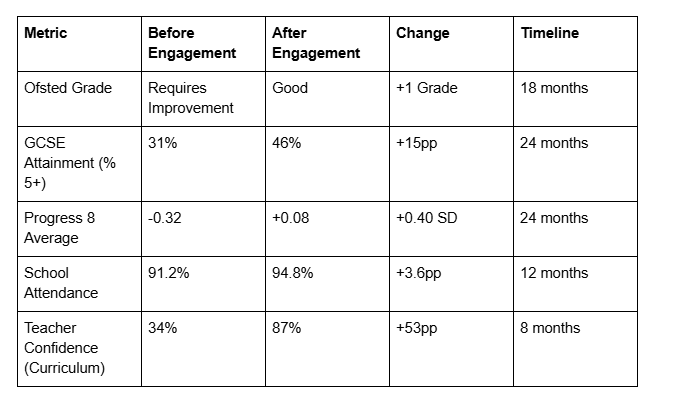
GCSE attainment (percentage of students achieving grades 5+ in English and Maths) improved from 31% to 46% (+15 percentage points)
Attainment improvement was sustained and even grew in subsequent years (52% in year 1, 55% in year 2)"
Progress Measure Outcomes "Progress measures improved across school:
Average Progress 8 score improved from -0.32 to +0.08 (+0.40 standard deviations)
Progress for disadvantaged student cohorts improved from -0.58 to -0.12 (+0.46 standard deviations)"
Behaviour and Attendance Outcomes "Whole-school culture metrics improved:
Fixed-term exclusions reduced from 156 (previous year) to 89 (-43%)
Permanent exclusions reduced from 4 to 0
School attendance improved from 91.2% to 94.8% (+3.6 percentage points)
Behavior incidents reported fell by 38% (measured through incident logging system)"
Staff Professional Development Outcomes "Staff confidence and capability improved significantly:
Teacher confidence in curriculum implementation: 34% pre-engagement, 87% post-engagement (+53 percentage points)
94% of teaching staff engaged with full CPD programmer
Staff retention improved among key curriculum staff
Staff satisfaction survey showed 71% agreement with 'I feel empowered to make curriculum decisions' post-engagement (vs. 22% pre-engagement)"
Outcome Metrics Presentation Format
Present outcomes in clear visual format on Squarespace using comparison blocks or tables:
Element 6: Transformation Sustained
School leaders want proof that improvements lasted beyond the initial engagement. Demonstrate sustained improvement over time.
Sustainability Template
"How the Transformation Has Held
Three years post-engagement, the school has sustained and extended improvements:
Ofsted Grade Maintained: The school was re-inspected in [year] and maintained its 'Good' grade with continued development in [specific areas]
Attainment Improvements Sustained and Extended: Attainment continued to improve: 52% in year 1, 55% in year 2, 58% in year 3
Curriculum Framework Evolved: The school has continued to refine the curriculum framework, incorporating new research insights and responding to policy changes
Staff Capacity Built: Subject leaders have taken full ownership of curriculum development, with new staff receiving curriculum induction and ongoing CPD
Culture Sustained: Behaviour improvements have been maintained through continued restorative practices training and whole-school behaviour framework emphasis
Internal Expertise Developed: The school no longer requires external curriculum support; curriculum leadership has become embedded internal capability"
Sustainability Evidence
Include specific evidence of sustainability:
Successive year attainment or progress data showing continued improvement
Subsequent Ofsted reports confirming maintained/improved grades
Internal documents showing curriculum continued evolution
Leadership development showing school leaders took ownership
New staff retention and development showing culture has embedded
Education-Specific Outcome Metrics
Different education consulting niches use different primary outcome metrics. Choose metrics that directly address school leaders' primary concerns.
School Improvement / OFSTED Consulting
Primary Metric: Ofsted grade improvement Supporting Metrics:
Attainment improvements (percentage point gains)
Progress measure improvements (standard deviation changes)
Behaviour/attendance metrics
Staff professional development engagement
Example: "63 schools supported. 52 moved from Requires Improvement to Good (83%). Average timeline: 18 months. Average Progress 8 improvement: +0.32 standard deviations."
Curriculum Development Consulting
Primary Metric: Student attainment or progress improvements Supporting Metrics:
Ofsted subject-specific praise (if available)
Teacher confidence in subject teaching
Student engagement/attitude improvements
Attainment progression across key stages
Example: "Curriculum implementation across 28 schools. Average attainment improvement: 6.8 percentage points. Teacher confidence in curriculum design: increased from 31% to 84%. Ofsted inspection reports specifically praised 'coherent curriculum design.'"
EdTech Implementation Consulting
Primary Metric: Teacher/student adoption rates; measurable learning improvements Supporting Metrics:
Reduction in teacher workload/time spent on administration
Student engagement/participation improvements
Ofsted praise for technology integration
Teacher professional development outcomes
Example: "40 schools supported with learning management system implementation. Average teacher adoption rate: 92% regular platform use. Average teaching time freed through automation: 2.3 hours weekly. Student engagement measured through platform usage increased 67%."
Student Admissions Consulting
Primary Metric: Acceptance rate or enrolment improvements Supporting Metrics:
Student quality/profile improvement
Admissions process efficiency gains
Student retention/completion rates
Admissions staff capability development
Example: "University partnerships: improved acceptance rates 12 percentage points average. Secondary schools: improved sixth form enrolment by average 18%. Student satisfaction with admissions process: 89% positive feedback."
Case Study Page Architecture on Squarespace
Implement case studies on Squarespace using this page structure:
Page Template Structure
Header Section: Case study title, institution, key metric callout
Institution Context Section: Background, challenge context, Ofsted/starting position
Challenge Detail Section: Institutional problem description (paragraph format)
Our Approach Section: Plan and methodology (text + bullet points)
Actions Completed Section: Specific deliverables (numbered list with brief description)
Outcomes Section: Results with metrics (use Squarespace comparison block or table)
Quote Section: Optional headteacher/leader testimonial
Sustainability Section: Evidence of sustained improvement
Call-to-Action Section: "Interested in similar transformation? Book a strategy consultation"
Squarespace Implementation Best Practices
Use Native Blocks:
Text blocks for narrative (institution, challenge, approach, sustainability)
Comparison blocks or tables for outcomes metrics
Quote blocks for testimonials
Spacer blocks to improve readability
Visual Hierarchy:
Use H2 and H3 headings to break up content into scannable sections
Bold key metrics so they're immediately visible
Use bullet points for action lists and outcomes
Add whitespace so the page feels readable rather than dense
Mobile Responsiveness:
Test case study pages on mobile devices
Ensure tables/comparison blocks display clearly on small screens
Ensure text is readable without zooming
Check that key metrics are visible in mobile view
Consistency:
Use consistent structure across all case studies for easy comparison
Use consistent terminology for metrics (e.g., always say "percentage points," never sometimes use "points")
Feature case studies at similar length (1,200-1,500 words)
Frequently Asked Questions
-
A: Feature 3-5 detailed case studies representing different institutional contexts you serve. Quality and relevance matter more than quantity. School leaders would rather review one highly relevant case study than ten generic examples. Rotate case studies annually to keep content fresh and show sustained, growing track record.
-
A: Work with the school to gather metrics retroactively if the partnership was recent. If metrics are unavailable, that case study isn't ready for public feature. Better to wait for strong evidence than publish weak case studies. Weak case studies undermine credibility more than having fewer case studies.
-
A: If the school gives written permission, feature named case studies—they carry significantly higher credibility. Anonymised case studies work when paired with specific institutional context and strong metrics, but named case studies remain more powerful. Always request permission; many schools will grant it because Ofsted improvement is public record.
-
A: If you worked on multiple initiatives (curriculum + behaviour + professional development), structure outcomes by impact area:
Academic Outcomes: Attainment, progress, subject-specific improvements Culture Outcomes: Behaviour, attendance, staff satisfaction Institutional Outcomes: Ofsted grade, leadership capability Sustainability: Evidence of sustained improvement
This structure lets school leaders clearly see impact across domains. -
A: Student testimonials can be included if you have appropriate consent from parents/guardians (for under-18s) or students themselves (for 18+). Keep testimonials focused on measurable experience rather than vague praise. Example: "The new curriculum helped me understand how concepts connect across topics—I felt more confident in my learning" rather than "This was amazing."
-
A: Feature case studies covering the past 3-5 years. Update annually to add new case studies and remove older examples (if you have strong recent case studies). Consider keeping a "Legacy Case Studies" page with older examples but newer case studies as primary features. Refresh outcome metrics annually as post-engagement data continues to arrive.

From custom website design to SEO strategy, we help businesses launch a site that looks professional and performs better.

Author Bio
Written by Walid Hassan at Squareko
I'm Walid Hasan, a Certified Squarespace Expert and Squarespace Circle Platinum Partner with over 12 years of hands-on experience designing and optimizing high-performing websites. Over the years, I've had the privilege of building more than 2,000 Squarespace websites for clients around the world, always focusing on clean design, strong user experience, and conversion-driven results.