How to Scale a 6-Figure Business with Squarespace Ecommerce
Introduction
Building a 6-figure ecommerce business is the dream of most online retailers. The good news? It's entirely possible with Squarespace. Many merchants assume they need to move to Shopify or enterprise solutions to reach six figures, but the reality is different. Squarespace has evolved significantly, and stores using the right combination of features, strategy, and support now routinely scale 6-figure business squarespace ecommerce operations without the complexity of switching platforms.
This post reveals exactly how—with real numbers, a proven formula, and a stage-by-stage roadmap. Whether you're at £5,000 in annual revenue or approaching six figures, this guide will show you the scaling strategies that separate successful Squarespace stores from those that plateau.
The difference between a £50K store and a £500K store isn't usually the platform. It's the strategy, the traffic source, and the conversion optimisation that most retailers miss.
Key Takeaways
The 6-Figure Squarespace Store Formula uses four metrics to predict revenue: traffic, conversion rate, average order value, and repeat purchase rate
Most Squarespace stores fail at scaling because they optimise only one variable—usually traffic—while ignoring the others
The Revenue Scaling Roadmap shows which Squarespace features unlock growth at each revenue stage: £0–£10K, £10K–£50K, £50K–£100K, and £100K+
Squarespace can absolutely support six-figure businesses without migrating to Shopify—but only if you align your product offering, pricing, and customer acquisition with the platform's strengths
The best time to consider upgrading to Shopify isn't a revenue milestone; it's when your operational needs exceed what Squarespace can deliver
The 6-Figure Squarespace Store Formula
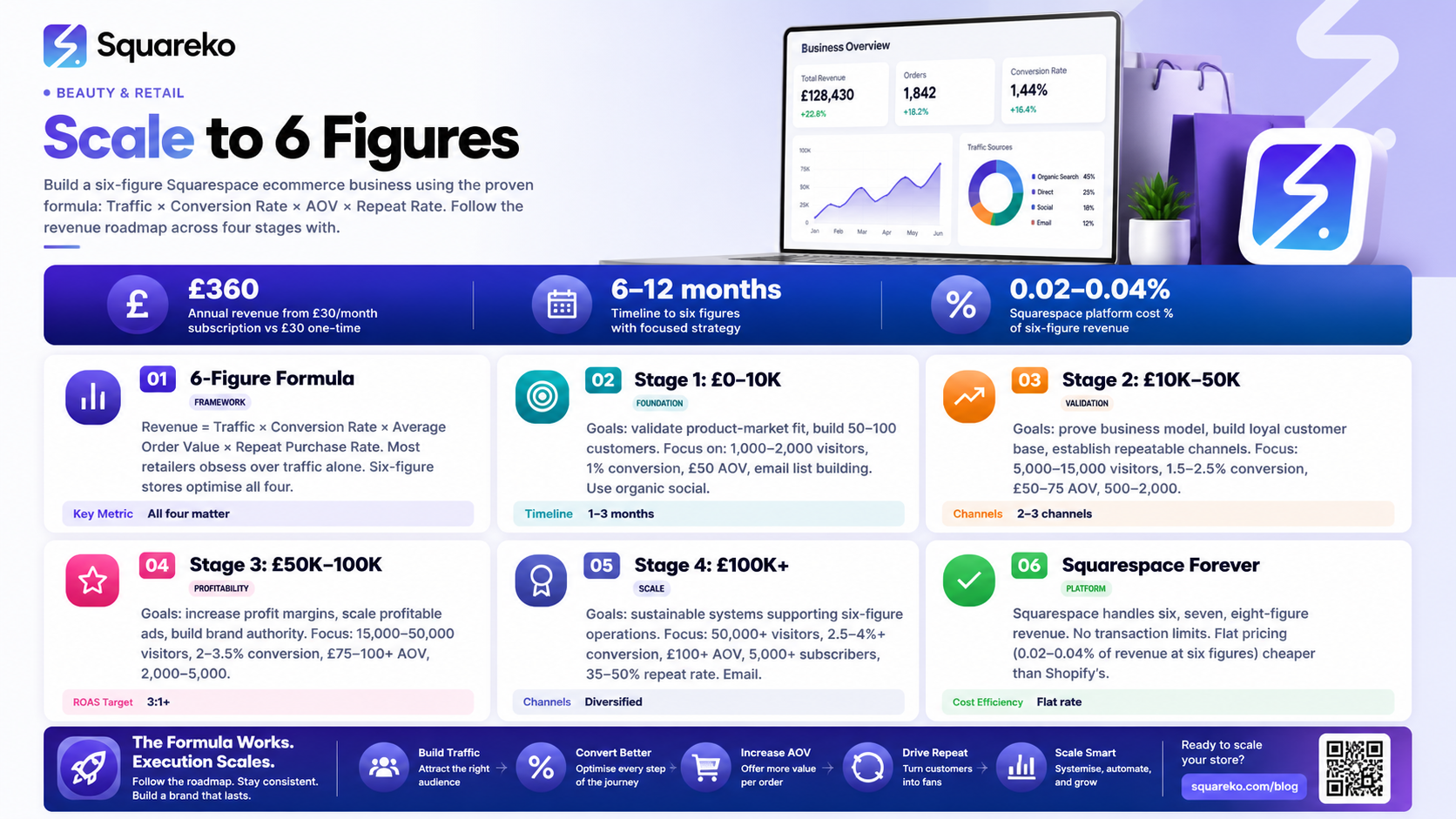
Every successful six-figure Squarespace store follows the same mathematical foundation, whether the owner realises it or not:
Revenue = Traffic × Conversion Rate × Average Order Value × Repeat Purchase Rate
This formula is the north star of ecommerce scaling. Let's break down what each component means and why it matters.
Traffic is the number of people who visit your store. This comes from organic search, paid ads, email, social media, referrals, or direct visitors.
Conversion Rate is the percentage of visitors who complete a purchase. If 100 people visit your store and 2 buy, your conversion rate is 2%.
Average Order Value (AOV) is how much each customer spends per transaction. If your AOV is £50 and you convert 2% of 100 visitors, you generate £100 in revenue from that traffic.
Repeat Purchase Rate is how many customers return to buy again. A 30% repeat rate means 30% of first-time buyers purchase again within a set period.
Here's why this formula matters for scaling: most retailers obsess over traffic. They spend thousands on Facebook ads to drive more visitors, but they ignore conversion rate, AOV, and repeat purchases. As a result, they burn cash on traffic that doesn't convert.
The retailers who reach six figures do the opposite. They optimise all four variables simultaneously. They might grow traffic by 50%, but they also increase AOV by 15% through bundling, improve conversion rate by 10% through testing, and increase repeat purchases by 20% through email marketing. Those small wins compound into six-figure revenue.
How the Formula Works in Real Revenue Scenarios
Let's use real numbers to show how the formula predicts revenue at different stages.
Scenario 1: A £10K/Year Store
Monthly traffic: 2,000 visitors
Conversion rate: 1.5%
AOV: £50
Repeat purchase rate: 10%
Monthly revenue from first-time customers: 2,000 × 0.015 × £50 = £1,500
Monthly revenue from repeat purchases: (2,000 × 0.015 × 10%) × £50 = £150 + organic repeat revenue = ~£200
Total monthly revenue: ~£1,700 (£20,400/year)
This store is healthy but growing slowly. To scale to £50K, they need to change at least two variables.
Scenario 2: The Same Store, Optimised
Monthly traffic: 4,000 visitors (doubled through paid ads and content)
Conversion rate: 2.5% (improved through A/B testing and copywriting)
AOV: £75 (upsells and product bundling)
Repeat purchase rate: 25% (email sequences and loyalty)
Monthly revenue from first-time customers: 4,000 × 0.025 × £75 = £7,500
Monthly revenue from repeat purchases: (4,000 × 0.025 × 25%) × £75 = £1,875 + compound repeat revenue = ~£3,000
Total monthly revenue: ~£10,500 (£126,000/year)
Same store, better strategy. The difference between £10K and six figures is rarely the platform—it's the optimisation of these four metrics.
The Revenue Scaling Roadmap: £0 to £500K+
Squarespace's feature set changes at different revenue levels. Below is the roadmap that shows which features unlock growth at each stage and how Squareko can support your journey.
Stage 1: £0–£10K – Build Foundations
Goals: Validate product-market fit, establish your brand, and build the first 50–100 customers.
Key Squarespace Features:
Inventory management and basic product pages
Abandoned cart recovery emails
Basic analytics dashboard
SSL security and payment processing
Email capture tools and simple popups
What's Working: At this stage, you're still finding your audience. Most retailers use a mix of organic social media, word-of-mouth, and some paid ads. Your conversion rate is probably low (0.5–1.5%) because you're still figuring out messaging and product fit.
Mistakes to Avoid:
Spending heavily on Facebook ads before you've validated your product
Overcomplicating your product range (stick to 5–20 products)
Ignoring email collection (start building your list from day one)
What You Should Focus On:
Get 1,000–2,000 website visitors through organic and low-cost channels
Achieve at least a 1% conversion rate (test product photos, copy, and pricing)
Set your AOV (price your products based on unit economics, not competitors)
Collect emails and create a simple welcome sequence
Squareko Support at This Stage: At Squareko, we help early-stage stores with product positioning, Squarespace setup, and the basics of conversion optimisation. We don't overcomplicate things—we focus on the fundamentals that move the needle.
Stage 2: £10K–£50K – Establish Repeatability
Goals: Prove your business model works, build a loyal customer base, and establish repeatable marketing channels.
Key Squarespace Features:
Advanced email campaigns (sequences and automations)
Customer tags and segmentation
Discount codes and promotion management
Integrated blog for SEO content
Advanced analytics and attribution
Pinterest and Instagram integration for organic reach
What's Working: You've found some product-market fit. You're getting consistent traffic from at least one channel (organic search, a profitable ad set, or community). Your conversion rate has improved to 1.5–2%, and you're starting to see repeat customers.
Key Metrics to Optimise:
Increase AOV through upsells, bundles, and product recommendations
Build email list to 500–1,000 subscribers
Achieve 15–20% repeat purchase rate through email nurture
Expand traffic channels (add Pinterest, content marketing, or referral programs)
Mistakes to Avoid:
Relying solely on Facebook ads (they're expensive and algorithm-dependent)
Neglecting your existing customers (repeat revenue is cheaper than new customer acquisition)
Ignoring SEO and organic traffic (it takes 6–12 months to pay off, but it's stable)
What You Should Focus On:
Build your email list aggressively (aim for 1,000+ subscribers)
Create email sequences: welcome, abandoned cart, post-purchase, win-back
Test your top 3 products and retire underperformers
Implement product recommendations and bundling
Start a content strategy (blog posts, guides, tutorials)
Squareko Support at This Stage: We help with email strategy, conversion rate optimisation, product page testing, and content planning. Many of our clients at this stage work with us on their first email marketing audit and help refine their AOV strategy.
Stage 3: £50K–£100K – Optimise for Profitability
Goals: Increase profit margins, scale profitable paid advertising, and build brand authority.
Key Squarespace Features:
Advanced reporting and custom dashboards
Inventory allocation and product variants
Multi-currency support (if selling internationally)
Advanced customer segments for targeted campaigns
API access for integrations (third-party tools)
Shipping automation and label integration
What's Working: You have a strong product range, a reliable email list (1,000–5,000 subscribers), and multiple traffic sources. Your conversion rate is 2–3%, and repeat customers make up 20–30% of revenue. Profitability is the focus now, not just growth.
Key Metrics to Optimise:
Increase AOV further (aim for £60–£100+ depending on product)
Achieve 25–40% repeat purchase rate
Scale paid ads while maintaining a 3:1+ return on ad spend (ROAS)
Improve email open rates and click-through rates
Mistakes to Avoid:
Scaling ads before your unit economics are solid
Increasing ad spend without improving conversion rate in parallel
Neglecting retention (repeat customers have higher lifetime value)
Overcomplicating your product range (quality over quantity)
What You Should Focus On:
Conduct a full profitability audit: cost of goods, ad spend, shipping, and overhead
Set a minimum ROAS target (at least 3:1 for sustainable growth)
Build advanced email sequences (win-back campaigns, VIP customers, loyalty)
Test higher price points and premium product tiers
Invest in brand building (photography, copywriting, brand voice)
Scale one paid channel profitably before adding others
Squareko Support at This Stage: We specialise in helping stores at this stage. We audit your conversion funnel, conduct A/B tests, optimise product pages, refine email strategy, and help scale paid advertising sustainably. Many of our best clients work with us on a retainer at this stage.
Stage 4: £100K+ – Scale Without Limits
Goals: Build a sustainable, scalable system that can handle 6+ figures in annual revenue and pursue compound growth.
Key Squarespace Features:
Advanced integrations (CRM, accounting software, fulfillment partners)
Bulk operations and inventory management tools
Advanced segmentation for hyper-targeted campaigns
Multi-page automation workflows
Custom webhooks and API development
Third-party app integrations via Squarespace App Marketplace
What's Working: You're at six figures. You have proven product-market fit, a loyal customer base, and efficient marketing channels. Your conversion rate is 2.5–4%, your repeat purchase rate is 35–50%, and your email list is large (5,000+). Most revenue comes from a combination of paid ads, organic search, and email.
Key Metrics to Optimise:
Customer lifetime value (LTV) becomes more important than individual order value
Email revenue should be 30–40% of total revenue
Organic traffic should make up 20–30% of visits (and growing)
Paid ads should maintain 4:1+ ROAS at scale
Mistakes to Avoid:
Growing so fast that you lose product quality or customer service
Spreading yourself too thin across too many products or markets
Moving platforms for the sake of it (Squarespace works at six figures)
Neglecting cash flow and profitability in pursuit of top-line growth
What You Should Focus On:
Build a customer acquisition model that's sustainable and profitable
Hire or contract support (customer service, content creators, ad managers)
Test new traffic channels and products carefully (don't dilute what's working)
Invest in brand building and customer retention systems
Set up accounting and business systems that scale (tax, VAT, bookkeeping)
Plan for the next level (international expansion, new product lines, licensing)
Squareko Support at This Stage: At six figures, you're likely working with multiple agencies or specialists. Our role is to ensure your Squarespace site is optimised for growth—conversion rate testing, email strategy, product development, and ensuring your tech stack supports your ambitions. Some of our highest-revenue clients use Squarespace as their core platform and work with us on continuous optimisation.
When to Upgrade from Squarespace to Shopify (and When Not To)
This is the question every successful Squarespace retailer asks: "When should I move to Shopify?"
The short answer: probably never, unless your needs fundamentally change.
Why Most Retailers Don't Need to Leave Squarespace:
Squarespace can handle six, seven, and even eight-figure revenue. The platform is fast enough, secure enough, and feature-rich enough for nearly every ecommerce operation. The cost is also favourable at scale (you're paying a fixed fee, not per transaction).
The common narrative—"move to Shopify to scale"—is largely a myth. It's perpetuated by Shopify advocates and agencies who build their business around Shopify migrations. The real reason most stores move isn't because Squarespace can't handle the revenue; it's because they need features or workflows Squarespace doesn't offer.
When You Might Actually Need to Leave Squarespace:
Complex B2B requirements: If you need wholesale portals, custom pricing per customer, or tiered accounts, Shopify is better suited.
Wholesale and drop-shipping: If you're managing thousands of SKUs across multiple suppliers, Shopify's inventory management is superior.
Highly custom workflows: If your business requires custom development that goes beyond Squarespace's API capabilities.
Global, multi-currency operations: While Squarespace supports multi-currency, Shopify's international features are more mature.
POS and retail integration: If you're running both online and offline retail, Shopify's POS system integrates better.
What Squarespace Does Well at Scale:
Hosting and performance (you don't manage servers)
Design and brand control (beautiful templates out of the box)
Email marketing integration (abandoned carts, sequences)
Customer service (Squarespace support is genuinely helpful)
Pricing (no per-transaction fees means more margin)
All-in-one platform (no need to cobble together tools)
The Real Metric: Operational Complexity
The best time to consider moving platforms isn't when you hit six figures—it's when your operational needs exceed what Squarespace can deliver. If your store is profitable, your customers are happy, and you're not hitting Squarespace's limits, stay. The cost and complexity of a platform migration are high, and the benefits are often overstated.
Six-Figure Store Metrics: By the Numbers
Below is a comparison of key metrics at each revenue stage to help you benchmark your performance:
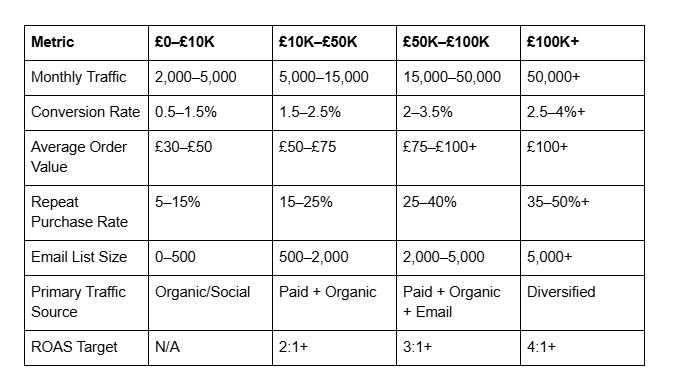
This table serves as a benchmarking tool. If your metrics fall below these ranges, focus on the specific variables that need improvement before scaling aggressively.
Common Mistakes Squarespace Retailers Make When Scaling
We've helped hundreds of stores scale on Squarespace, and we see the same mistakes repeatedly. Avoid these and you'll accelerate your path to six figures.
Mistake 1: Ignoring Conversion Rate Optimisation
Retailers obsess over traffic but ignore conversion rate. A store with 1,000 monthly visitors at a 1% conversion rate and a £50 AOV generates £500 in monthly revenue. Increase the conversion rate to 2% and you've doubled revenue without spending a penny on ads. Yet most stores never test their product pages, copy, or checkout process.
Mistake 2: Not Building an Email List
Email is the most valuable marketing channel at scale. It's owned (unlike Facebook ads), it's profitable (high ROI), and it builds customer loyalty. Yet many Squarespace stores neglect email until they're already at £50K+. Start building your list from day one.
Mistake 3: Trying to Sell Everything
Successful stores are focused. They sell to one market, solve one problem, and do it better than anyone else. Stores that try to sell ten different products to ten different audiences waste inventory, marketing budget, and brand clarity.
Mistake 4: Underpricing
Your price point communicates value and attracts the right customers. Stores that undercut competitors often attract price-sensitive customers who never return and demand discounts. Price for profitability and customer quality, not volume.
Mistake 5: Neglecting Repeat Customers
New customer acquisition is expensive. Repeat customers are profitable. Yet many stores spend 80% of their marketing budget on new customers and ignore retention. Build your repeat purchase rate and watch revenue scale.
Mistake 6: Not Measuring Profitability
Revenue and profit are not the same. A store can be doing £100K in annual revenue and losing money. Know your unit economics: cost of goods, ad spend, shipping, and overhead. Track your profit margin obsessively.
Mistake 7: Changing Platforms Too Early
Retailers often believe that switching to Shopify will solve their problems. It won't. Most stores that migrate do so because they've hit a specific operational need—not because Squarespace "can't scale." If you haven't optimised your current platform, switching won't help.
Frequently Asked Questions
-
Yes. Squarespace's infrastructure is enterprise-grade. Servers are distributed globally, pages load quickly, and the platform is designed to handle traffic spikes. We've worked with stores doing 10,000+ orders per month on Squarespace without performance issues. The real limiting factor isn't Squarespace—it's your ability to manage inventory, fulfillment, and customer service at scale.
-
There's no hard limit. We've seen Squarespace stores generate £500K, £1M, and beyond in annual revenue. The platform doesn't have transaction limits or revenue caps. What matters is operational complexity. If your business model requires wholesale portals, custom pricing, or complex integrations, you may eventually outgrow Squarespace. But for standard DTC ecommerce, Squarespace has no practical revenue ceiling.
-
Not automatically. Many six-figure stores thrive on Squarespace. Move only if Squarespace's features don't support your business needs. Common reasons to switch: managing 10,000+ SKUs, complex B2B workflows, global wholesale operations, or highly custom development. If your store is profitable and Squarespace isn't blocking growth, stay.
-
Squarespace's Commerce plan is £18–£33/month depending on annual or monthly billing. At six figures in annual revenue, your platform cost is roughly 0.02–0.04% of revenue—negligible. When you compare this to Shopify's per-transaction fees plus app costs, Squarespace is often cheaper at scale.
-
The best traffic source is whatever is most profitable for your business. Email is the highest-ROI channel at scale (often 40:1+). Organic search takes time but is stable and cost-free long-term. Paid ads (Facebook, Google, TikTok) are fast but require constant optimisation. Most six-figure stores use a mix: 30–40% email, 20–30% organic, 20–30% paid ads, and 10–20% other (referral, social, direct).
-
It depends on your product, market, and effort. Some stores reach six figures in 18 months; others take three years. The speed is determined by how quickly you optimise the four variables in our formula: traffic, conversion rate, AOV, and repeat purchases. Stores that focus on conversion and retention scale faster than those obsessed with traffic alone.
-
Not necessarily. Many solo operators run six-figure stores. What you need is systems and automation. Outsource tasks that don't require your personal touch (customer service, ad management, content creation). Focus your time on product development, strategy, and customer relationships. A lean team with good systems beats a large team without them.
-
Scale only after you've proven unit economics. You should have at least 50–100 sales before you significantly increase ad spend. Know your CAC (customer acquisition cost), your LTV (lifetime value), and your ROAS (return on ad spend). If your LTV is 3x+ your CAC and ROAS is 3:1+, you're ready to scale. If not, first improve conversion rate and AOV.
Call to Action
Scaling a Squarespace store to six figures requires more than just platform features—it requires strategy, data, and continuous optimisation.
At Squareko, we specialise in helping ecommerce retailers grow on Squarespace. Whether you're at £10K and trying to reach £50K, or you're at £100K and want to hit £500K+, we've built a system that works.
Our services include:
Conversion rate optimisation: Testing and refining your product pages, copy, and checkout
Email strategy: Building automated sequences that drive repeat purchases and customer loyalty
Product strategy: Helping you optimise your range, pricing, and positioning
Traffic and scaling: Developing profitable paid advertising and organic channels
Business strategy: Helping you think beyond revenue to profitability and sustainability
If you're serious about scaling your Squarespace store, let's talk. Visit Squareko to schedule a consultation and learn how we can help you build a profitable, scalable six-figure business.

From custom website design to SEO strategy, we help businesses launch a site that looks professional and performs better.

About the Author
I'm Walid Hasan, a Certified Squarespace Expert and Squarespace Circle Platinum Partner with over 12 years of hands-on experience designing and optimizing high-performing websites. Over the years, I've had the privilege of building more than 2,000 Squarespace websites for clients around the world, always focusing on clean design, strong user experience, and conversion-driven results.