How to Design a High-Converting Consulting Proposal Request Page on Squarespace
Key Takeaways Design a High-Converting Consulting Proposal Request Page
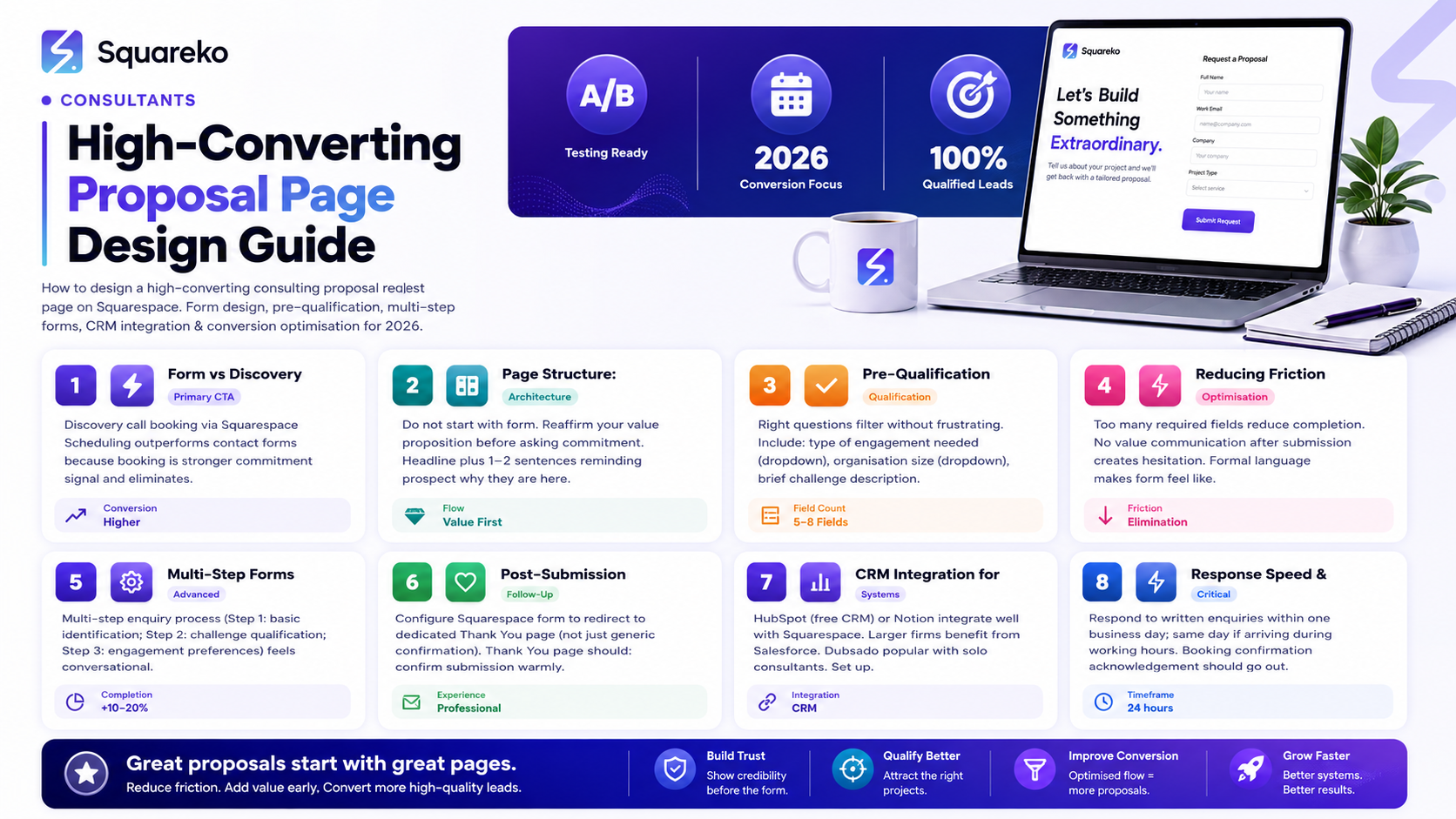
The proposal request page is the most commercially important conversion point on your consulting website
Most consulting contact pages underconvert because they're designed as generic forms, not as pre-qualified consultation entry points
Pre-qualification forms actually increase enquiry quality without significantly reducing volume when structured correctly
Squarespace Scheduling (discovery call booking) typically outconverts traditional contact forms for consulting engagements
The experience after form submission matters as much as the form itself — post-submission confirmation and follow-up sequence design affect conversion quality
Your consulting website can have exceptional design, compelling case studies, and outstanding thought leadership content — and still fail to convert if your proposal request page doesn't work.
The proposal request page is where motivated prospects become actual enquiries. It's the moment when someone who has done enough research to want a conversation has to take that final step. And most consulting websites make this step far harder than it needs to be.
This guide covers how to design a proposal request or discovery call booking page on Squarespace that converts motivated prospects at the highest possible rate — including form design, pre-qualification strategy, friction reduction, and CRM integration.
Why Most Consulting Contact Pages Fail
The standard consulting Contact Us page looks like this: a heading that says Get in Touch, three fields (Name, Email, Message), and a Submit button. This page design fails in three ways:
It doesn't communicate value before the ask. A prospect arrives at your contact page ready to reach out — but they've moved from the reassurance of your content into a bare form. No reaffirmation of your value, no indication of what happens next, no context that helps them write a better message.
It doesn't pre-qualify prospects. A blank Message field invites everything from serious £50,000 engagement requests to how much for a website? email enquiries. Both arrive looking the same, wasting your time and creating a poor experience for the enquirer.
It doesn't create momentum. The experience of filling in a three-field form and clicking Submit doesn't feel like the beginning of a significant professional relationship. It feels like submitting a support ticket.
Your proposal request page should feel like the beginning of a consultative conversation — because that's exactly what it is.
Form vs. Discovery Call Booking: Which Works Better?
For consulting websites, the answer is almost always: offer both, with discovery call booking as the primary CTA.
Discovery call booking (Squarespace Scheduling) outperforms contact forms for two reasons:
Commitment — Booking a specific date and time is a stronger commitment signal than submitting a form. Prospects who book a call show up. Prospects who submit a form sometimes don't respond to your follow-up.
Speed — Booking eliminates the back-and-forth email exchange that often delays or loses the momentum of an enquiry. A motivated prospect on Friday afternoon can book a Monday call without any human intervention.
Contact forms remain valuable for:
Prospects not ready for a direct call but wanting to make initial contact
Complex enquiries that require context before a call makes sense
Proposal requests where you need to assess fit before committing time to a call
The ideal setup: a primary CTA for scheduling (with embedded Squarespace Scheduling), and a secondary option for submitting a written enquiry.
The High-Converting Proposal Request Page Structure
Page Architecture
1. Headline + Restatement of Value Don't start with the form. Reaffirm your value proposition before asking for commitment. One or two sentences that remind the prospect why they're here.
Example: You've done the research. You know what needs to change. Let's discuss whether we're the right fit to work on it together.
2. What to Expect Set clear expectations for what happens after the prospect submits. We respond to all enquiries within one business day. If we schedule a discovery call, it typically runs 30 minutes and covers [X, Y, Z]. Uncertainty about what happens next is the most common reason motivated prospects hesitate at the final step.
3. The Primary CTA — Discovery Call Booking Embed your Squarespace Scheduling calendar here. Keep the booking widget above the fold for desktop visitors. Mobile visitors should see the booking CTA clearly without significant scrolling.
4. The Secondary Option — Written Enquiry Form Below (or alongside) the scheduling widget, offer a more detailed enquiry form for prospects who prefer to submit context before booking a call.
5. Social Proof Anchor One brief testimonial or outcome reference near the form — not a full case study, but a reminder that others have taken this step and found it valuable.
Pre-Qualification Form Design for Consulting
Your enquiry form should do two things: lower the barrier for genuinely qualified prospects and raise it (appropriately) for poor-fit enquiries.
The right questions filter without frustrating:
Recommended Fields for Consulting Proposal Request Forms
Type of engagement needed (dropdown)
Business strategy and transformation
Operations and process improvement
Marketing and growth strategy
Education and training
Other (please specify)
Organisation size (dropdown)
Sole trader / micro business (1-9 employees)
Small business (10-49 employees)
Mid-market (50-249 employees)
Enterprise (250+ employees)
Challenge description (open text) Briefly describe the challenge you're looking for support with — 200 character limit. This forces clarity without requiring an essay.
Preferred timeline for engagement (dropdown)
Immediate (within 30 days)
Near-term (1-3 months)
Planned (3-6 months)
Exploratory (no set timeline)
How did you find us? (dropdown + optional text)
Referral from client or colleague
Google search
LinkedIn
Article or blog post
Other
The how did you find us field is often overlooked but provides valuable data for understanding your most effective acquisition channels.
Reducing Friction on Your Consulting Proposal Page
Friction is anything that makes a motivated prospect hesitate, re-evaluate, or abandon the page before submitting.
Common Friction Points on Consulting Enquiry Pages
Too many required fields. Every required field reduces completion rate. Make fields optional where possible — and test the difference. Most prospects will complete optional fields if the form feels conversational rather than interrogative.
No clear value after submission. Thank you, we'll be in touch is not good enough. Tell prospects exactly what happens next and when. We'll review your enquiry and contact you within one business day to schedule your 30-minute discovery call.
Formal or corporate language. Please complete the following form to submit your inquiry for professional services consideration reads like a procurement document. Use natural, direct language that matches the tone of the rest of your site.
No mobile optimisation. Test your proposal request page on multiple device sizes. Form fields that are difficult to navigate on mobile create significant drop-off. Squarespace forms are generally mobile-responsive, but scheduling widgets need specific testing.
No indication of confidentiality. B2B clients who are submitting details about their business challenges may have concerns about confidentiality. A brief All enquiries are handled in confidence note near the form addresses this without over-engineering it.
Multi-Step Form Strategy for Consulting Lead Qualification
For consulting practices with highly differentiated service offerings, a multi-step enquiry process reduces friction by making the form feel like a conversation rather than a questionnaire.
Three-Step Consulting Enquiry Structure
Step 1: Basic Identification
Name
Email
Company name
Company size
Step 2: Challenge Qualification
Type of consulting needed
Primary challenge description (brief)
Timeline and urgency
Step 3: Engagement Preferences
Preferred meeting format (video call, phone, in-person)
Preferred contact time
How they found you
Anything else to share before your call
Multi-step forms typically show completion rates 10-20% higher than single-page forms of equivalent length, because the initial commitment (completing step 1) creates momentum that carries through to completion.
On Squarespace, you can approximate this with form sections and conditional logic via third-party form tools (Typeform, Jotform) embedded in your Squarespace page.
Post-Submission Experience Design
The experience after a prospect submits their enquiry is as important as the form itself.
Squarespace Thank You Page Design
Configure your Squarespace form to redirect to a dedicated Thank You page (not just a generic confirmation message). Your Thank You page should:
Confirm their submission with a warm, personalised tone
Set clear expectations for next steps (You'll receive an email from us within one business day)
Offer something of immediate value (a relevant article link, a resource download, a case study)
Provide a direct contact option if they have immediate questions or prefer not to wait
Email Auto-Response
Configure your Squarespace form to trigger an automatic response email. This email should:
Confirm receipt of their enquiry
Re-state your value proposition briefly
Include a scheduling link (for immediate booking if they want to move faster)
Set a clear response timeline
Most consulting websites send generic auto-responses or nothing at all. A warm, professional, personalised-feeling auto-response sets your practice apart from the first moment of contact.
CRM Integration for Consulting Pipeline Management
As your enquiry volume grows, managing proposals and discovery calls in your email inbox becomes unsustainable.
CRM Options for Consulting Firms
HubSpot (Free CRM): Integrates with Squarespace forms via Zapier or native connection. Good for small-to-mid consulting practices. Provides pipeline visibility, automated follow-up sequences, and deal tracking.
Notion: Many solo consultants use Notion for CRM-light pipeline management. A simple Squarespace → Notion integration via Zapier creates an organised enquiry database without subscription cost.
Salesforce: Appropriate for larger consulting firms with multiple consultants and complex pipeline management needs. The integration overhead is higher, but the capability depth is significant.
Dubsado: Popular with independent consultants for combined proposal management, CRM, and invoicing. Integrates with Squarespace forms and scheduling.
Setting Up Your Squarespace → CRM Pipeline
Configure Squarespace form notifications to a dedicated email address
Set up Zapier trigger: new Squarespace form submission → create CRM deal
Configure CRM pipeline stages: New Enquiry → Discovery Call Scheduled → Proposal Sent → Engaged / Not Proceeding
Set up automated follow-up sequences in your CRM for each stage
Want a proposal request page that actually converts your website visitors into consulting engagements?Squareko designs and builds proposal request pages specifically for consulting firms on Squarespace.
FAQs
-
Include: type of consulting needed (dropdown), organisation size (dropdown), brief challenge description (open text, limited characters), preferred timeline (dropdown), and how they found you (dropdown). Optional but valuable: budget range awareness, preferred meeting format, and specific context they want you to know before your call. Keep required fields to five or fewer — every additional required field reduces completion rate.
-
Yes, if worded correctly. "What is your approximate budget range for this engagement?" with options from "Under £10,000" to "£100,000+" helps pre-qualify enquiries and prevents discovery calls where budget fit is significantly misaligned. Frame it as optional rather than required — most prospects who answer honestly appreciate the transparency it signals.
-
Limit required fields to the minimum needed for qualification. Use conversational language throughout. Set clear post-submission expectations. Configure an automatic acknowledgement email with next steps. Include a social proof element near the form. For mobile visitors, ensure the form and any scheduling widgets render cleanly on small screens. Test your own form on different devices regularly.
-
For solo consultants and small boutique firms, HubSpot's free CRM or Notion provide adequate pipeline visibility. For mid-sized consulting firms with multiple partners and complex proposal management, Salesforce or Dubsado offer more sophisticated functionality. The right choice depends on your team size, proposal complexity, and how much time you want to invest in CRM management. Start simple and add complexity when your volume genuinely requires it.
-
Within one business day for all written enquiries; same day if the enquiry arrives during working hours. For booking confirmations, an automated acknowledgement should go out immediately. Response speed is a significant signal of professionalism for consulting clients who are simultaneously evaluating multiple firms. Slow response times — even a two-day delay — can cost you the conversation entirely.
Turn Your Website's Most Important Page Into a Conversion Machine
Your proposal request page is where website visitors become clients. Most consulting websites treat it as an afterthought — a three-field form buried in a navigation menu.
The consultants who take this page seriously — who design it around the psychology of a motivated prospect at the final step, who set clear expectations, who make the booking experience effortless — consistently generate more and better-quality enquiries from the same level of traffic.

From custom website design to SEO strategy, we help businesses launch a site that looks professional and performs better.

Author Bio
I'm Walid Hasan, a Certified Squarespace Expert and Squarespace Circle Platinum Partner with over 12 years of hands-on experience designing and optimizing high-performing websites. Over the years, I've had the privilege of building more than 2,000 Squarespace websites for clients around the world, always focusing on clean design, strong user experience, and conversion-driven results.