How Consulting Firms Use Squarespace to Win Retainer Clients and Long-Term Engagements
Key Takeaways Consulting Firms Use Squarespace to Win Retainer Clients and Long-Term Engagements
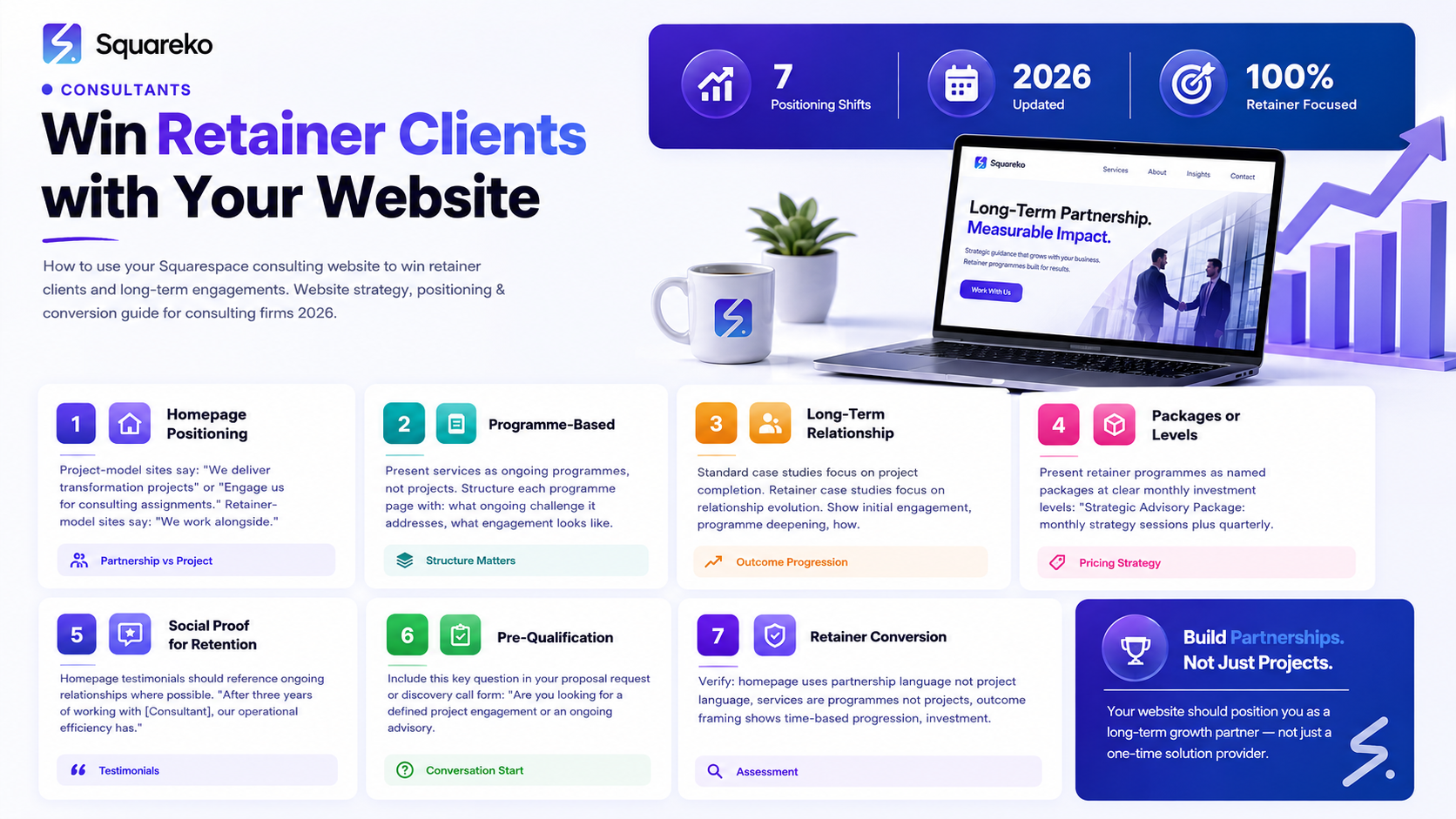
Retainer clients require different website signals than project clients — the architecture, language, and case study types all need adjusting
The most effective retainer positioning emphasises ongoing advisory relationships, not one-time deliverables
Case studies should demonstrate long-term outcome sustainability, not just initial results
Programme-based service pages (not just services) signal retainer engagement model thinking
Your discovery call or proposal page should position your ongoing engagement model clearly before first contact
Project-based consulting work keeps the lights on. Retainer consulting relationships transform your practice.
The difference between a consulting practice that constantly chases new clients and one that operates from a position of predictable revenue and deep client relationships is often a single structural decision: whether you've built your business model — and your website — around ongoing advisory relationships or one-off project engagements.
Your Squarespace consulting website plays a more significant role in this than most consultants realise. The signals you send through your site architecture, your service descriptions, your case studies, and your CTAs all communicate whether you see yourself as a project vendor or a trusted advisor. Getting these signals right is the difference between attracting clients who want a quick fix and attracting clients who want a long-term thinking partner.
Why Retainer Clients Change Your Practice
Before diving into website strategy, it's worth being clear about what retainer consulting actually delivers for your practice:
Predictable revenue — Instead of starting every quarter wondering where the next project is coming from, you have a baseline of committed revenue that allows you to plan ahead, hire where needed, and focus on delivery quality rather than constant business development.
Deeper client impact — The most meaningful consulting work happens over time. A six-month project can identify and begin solving a problem; a two-year advisory relationship can see the transformation through to embedded, sustainable change.
Better referrals — Clients who have an ongoing relationship with you refer differently than project clients. They know you deeply, understand your full capability, and advocate for you with their networks from a position of genuine ongoing relationship rather than faded project memory.
Premium pricing justification — Retainer clients are paying for availability and priority access, not just deliverables. This justifies a premium over project-equivalent day rates.
Your website needs to position your consulting practice in a way that makes retainer engagement feel natural — even preferred — for the right prospects.
Retainer Positioning on Your Homepage
The language and imagery of your homepage communicates your consulting model before a prospect has read a single service description.
Project-Model Homepage Language (Avoid)
We deliver business transformation projects
Engage us for strategic consulting assignments
Book a consulting engagement
Retainer-Model Homepage Language (Use)
We work alongside leadership teams as their trusted strategic advisors
Ongoing advisory relationships for ambitious businesses
Your thinking partner for complex, long-term business challenges
The distinction is between transactional delivery language and relationship-oriented partnership language. Retainer clients — particularly at the C-suite level — are looking for a trusted advisor they can call on consistently, not a supplier they can bring in for specific projects.
Social Proof on Your Homepage
The testimonials and outcome references on your homepage should reflect ongoing relationships where possible. After three years of working with [Consultant], our operational efficiency has improved year-on-year is more compelling for retainer prospects than The project delivered on time and on budget.
Programme-Based Service Pages vs. Project Service Pages
One of the clearest signals on a consulting website is whether you describe your services as projects or as programmes.
Projects have a defined start, end, and deliverable. They're transactional. They attract clients who want a specific output.
Programmes have an ongoing structure, recurring engagement, and evolving objectives. They attract clients who want an advisor, not a vendor.
How to Structure Retainer Programme Pages on Squarespace
Create dedicated service pages for each retainer programme you offer. Structure each page with:
Programme Description — What ongoing challenge does this programme address? Frame it around the client's ongoing need, not your deliverables.
What the Ongoing Engagement Looks Like — Frequency of sessions (monthly strategy review, quarterly deep-dive, weekly implementation support), access model (email, call, on-site), and how the engagement evolves over time.
Programme Outcomes Over Time — Frame outcomes as cumulative and compounding: In the first 90 days, we establish the baseline and diagnostic. By month six, the primary improvement initiatives are embedded. By year one, you're operating with a transformed decision-making framework that your team continues to use independently.
Investment Level — If you show pricing, present it as a monthly or annual investment, not a day rate or project fee. This further reinforces the ongoing relationship model.
Case Studies That Convert Retainer Clients
Standard consulting case studies focus on the project and its immediate outcome. Retainer-converting case studies focus on what happened over time — how the relationship developed, how challenges evolved, and how ongoing engagement delivered compounding value that no single project could have achieved.
The Long-Term Relationship Case Study Structure
The Situation and First Engagement — Describe why the client initially engaged you and what the presenting challenge was.
The Programme Evolution — Show how the engagement deepened over time. What new challenges emerged? How did the relationship adapt? What access and trust developed that allowed you to deliver work that couldn't have been done in an initial project?
Compounding Outcomes Over Time — Present outcomes with a timeline: In month 3, X. By month 12, Y. At the two-year mark, Z. This structure directly counters the client's implicit concern that ongoing fees aren't justified by ongoing value.
The Ongoing Relationship — If the engagement continues, say so. If the client has referred you to their network, mention it. Long-term client retention is the most compelling social proof for retainer prospects.
Retainer Case Study Example Framing
We began working with [Company Type] in Q1 2023 as a project engagement for operational efficiency improvement. Within six months, the leadership team had seen enough from the initial programme to want ongoing advisory support. By the end of year two, we had embedded a continuous improvement culture that their internal team now maintains — with quarterly advisory sessions to keep the strategic evolution on track. In that period, operational costs reduced by 34%, and the programme paid for itself within the first eight months.
This structure demonstrates transformation, relationship depth, and ROI in a way that project case studies can't.
Pricing Page Strategy for Retainer vs. Project Consulting
Many consultants avoid showing fees on their websites entirely. But for retainer-oriented consulting practices, a thoughtfully structured pricing or investment page can actively support conversion.
Option 1: Packages Page
Present your retainer programmes as named packages at clear monthly investment levels:
The Strategic Advisory Package: Monthly strategy sessions + unlimited email access + quarterly deep-dives — from £X/month
The Implementation Support Programme: Weekly check-ins + fortnightly on-site visits + monthly executive briefing — from £X/month
The Transformation Partnership: Full advisory integration — from £X/month, minimum 12-month commitment
This approach pre-qualifies clients on investment level and attracts those who have already decided they want an ongoing relationship, not a project.
Option 2: Investment Range Communication
If specific pricing is too variable for packages, communicate ranges:
Our advisory retainers typically range from £X,XXX to £XX,XXX per month depending on engagement model, access level, and scope. We'll establish your investment level in our discovery conversation.
This filters out poor-fit prospects without eliminating motivated clients who are price-sensitive but genuinely need your work.
The Retainer Client Conversion Checklist
Use this checklist to assess whether your Squarespace consulting website is positioned for retainer client conversion:
Positioning (4 items)
Homepage language uses partnership/advisory framing, not project/delivery framing
Headline references ongoing relationship model, not one-time outcomes
Value proposition emphasises access, availability, and long-term thinking partnership
No language that implies your engagements end when a deliverable is complete
Service Architecture (4 items) 5. Dedicated programme pages (not just a services list) 6. Programme descriptions include ongoing engagement model details 7. Outcome framing uses time-based progression (month 3, month 6, year 1) 8. Investment presented as monthly/annual, not day rate or project fee
Case Studies (3 items) 9. At least one case study shows an ongoing relationship of 12+ months 10. Case study outcomes include time-based progression of results 11. Client quotes reference the relationship value, not just the project output
Proposal/Discovery Process (3 items) 12. Discovery call booking page positions retainer engagement as a primary option 13. Proposal request form asks about timeline and ongoing advisory needs 14. Post-enquiry communication references your advisory engagement model
Proposal Request Design for Retainer Consulting
Your discovery call or proposal request page should signal your retainer model from the outset.
Pre-Qualification Form for Retainer Prospects
Include these questions in your proposal request or discovery call form:
What is the primary challenge you're seeking ongoing advisory support for?
How long have you been working on this challenge?
What does success look like in 12 months? In 3 years?
Have you worked with external consultants or advisors previously?
Are you looking for a defined project engagement or an ongoing advisory relationship?
The last question directly segments retainer prospects from project prospects — and signals that you offer both while specialising in the ongoing model.
Squareko builds consulting sites that communicate ongoing advisory value from the first scroll.
FAQs
-
If retainer engagements are part of your consulting model, your website should make this explicit — not bury it in a general services description. Dedicated programme pages with retainer-oriented language, case studies showing long-term relationship outcomes, and a discovery process that asks about ongoing advisory needs all actively drive retainer enquiries. Clients who want an ongoing advisor won't infer that option exists if your site only describes projects.
-
Three shifts drive retainer positioning: language (advisory partnership vs. project delivery), case study structure (time-based outcome progression vs. project completion), and service architecture (named programmes vs. service lists). Your discovery process should also explicitly discuss whether a project or retainer model better serves the client's needs — framing the conversation around their needs rather than your offerings.
-
After a successful project engagement, content that demonstrates the compounding value of ongoing advisory support is the primary conversion mechanism. Email sequences, case studies showing long-term outcome progression, and invitations to review ongoing needs 90 days post-project are the most effective post-project retainer conversion tools.
-
Create a named packages page or investment section that presents your retainer programmes at monthly investment levels. If exact pricing is variable, communicate ranges ("from £X,XXX/month") with a note that the specific investment is established in a discovery conversation. Framing investment as monthly (rather than day rate or project fee) reinforces the ongoing relationship model.
Build a Practice That Retains, Not Just Acquires
The consulting practices that grow most sustainably aren't the ones with the largest client acquisition pipelines — they're the ones with the deepest, longest-lasting client relationships.
Your Squarespace website is where that positioning begins. From the language of your homepage to the structure of your case studies to the questions in your discovery call form — every element should communicate that you're in the business of long-term advisory relationships, not one-off project delivery.
From custom website design to SEO strategy, we help businesses launch a site that looks professional and performs better.

Author Bio
I'm Walid Hasan, a Certified Squarespace Expert and Squarespace Circle Platinum Partner with over 12 years of hands-on experience designing and optimizing high-performing websites. Over the years, I've had the privilege of building more than 2,000 Squarespace websites for clients around the world, always focusing on clean design, strong user experience, and conversion-driven results.