How to Build a Consulting Website on Squarespace That Wins More Clients and Contracts
Key Takeaways Build a Consulting Website on Squarespace
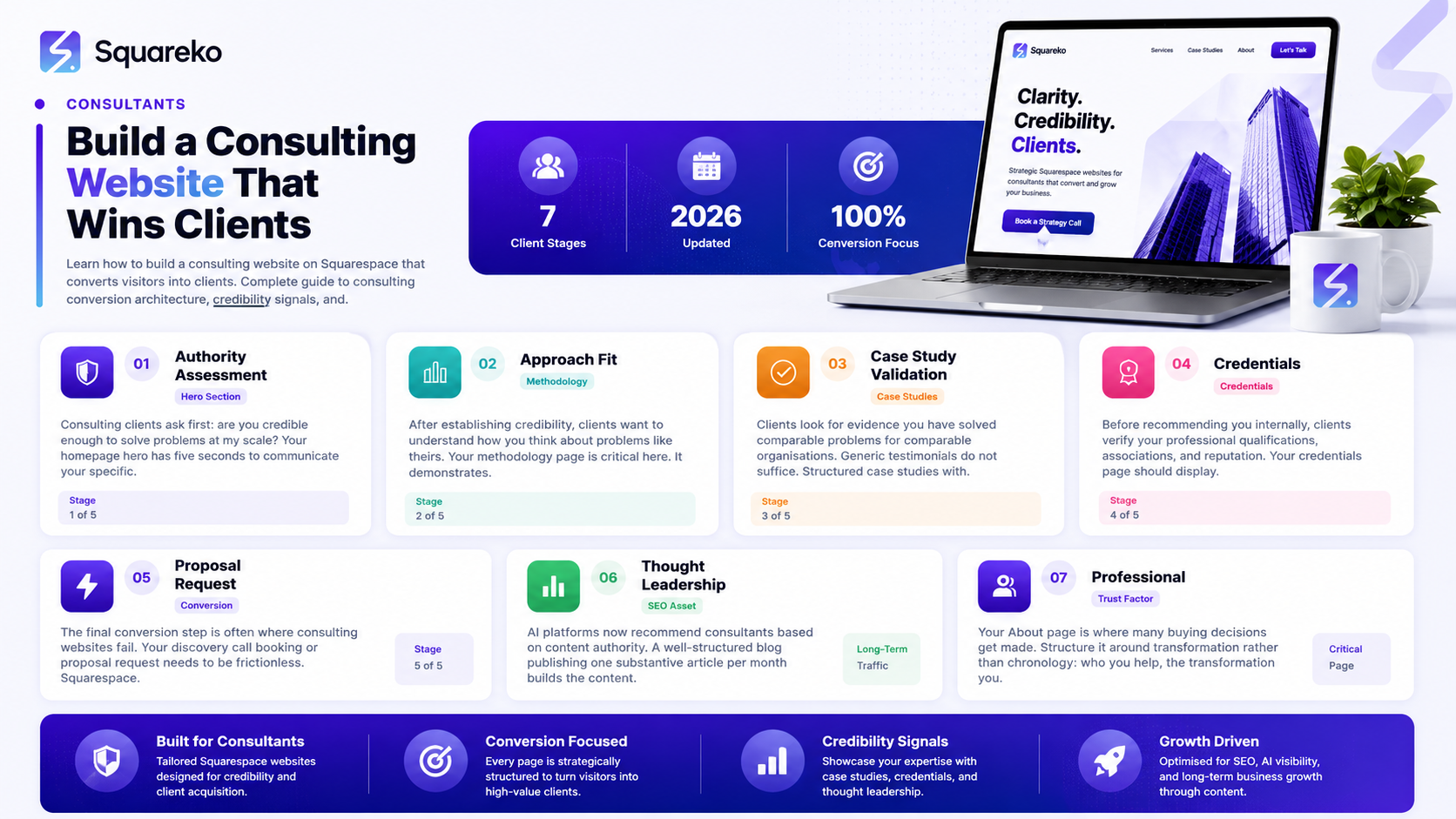
Consulting websites should map directly to the client decision journey, not just describe services
Authority signals (case studies, methodology, credentials) must appear early and prominently
A proposal request or discovery call booking mechanism is the primary conversion goal
Squarespace's built-in tools (Scheduling, Forms, Blog) are well-suited for consulting client acquisition
The difference between a website that generates enquiries and one that doesn't is rarely design — it's structure and credibility architecture
Most consulting websites are built backwards. The consultant focuses on describing what they do — their services, their background, their process — and somewhere near the bottom, there's a contact form. This approach misses the fundamental truth about how consulting clients actually make hiring decisions.
Consulting buyers don't read your website like a brochure. They read it like a due diligence document. They're evaluating you against a specific problem they need solved, a specific budget they have available, and a specific risk threshold they're not willing to exceed. Your website needs to address all three, in the right order, in a way that makes booking a conversation feel like the obvious next step.
This guide covers how to build a consulting website on Squarespace that actually wins clients — not just looks good.
Understanding the Consulting Client Decision Journey
Before you build a single page, you need to understand how your clients actually make hiring decisions. The consulting purchase journey is fundamentally different from consumer buying behaviour.
A typical B2B consulting client goes through five stages before they make contact:
Stage 1: Authority Assessment. They want to know immediately whether you have the credibility to solve a problem at their scale. This happens in the first 15 seconds on your homepage. If your headline doesn't communicate your specific expertise clearly, most visitors leave.
Stage 2: Approach Fit. They want to understand how you work — your methodology, your frameworks, your way of thinking about their type of problem. This is where your Methodology or Approach page does critical work.
Stage 3: Case Study Validation. They're looking for evidence you've solved comparable problems for comparable organisations. Generic testimonials don't cut it here — they want outcomes, metrics, and context.
Stage 4: Credentials Verification. They want to confirm your professional qualifications, associations, and reputation signals before they risk their own credibility recommending you internally.
Stage 5: Proposal Request. They've done enough research to want a conversation. This is where your discovery call booking or proposal request form needs to be as frictionless as possible.
Your Squarespace website needs to serve every one of these stages effectively. Miss one, and you lose clients at that point in the funnel.
Setting Up Your Squarespace Consulting Foundation
Choosing the Right Squarespace Plan
For most consulting practices, Squarespace's Business or Commerce plans are appropriate. The Business plan includes everything you need for a professional consulting site — custom domain, SSL, unlimited storage, and Squarespace Scheduling integration. If you plan to sell consulting packages or digital products, the Commerce plan adds useful payment functionality.
Domain and Branding Setup
Your domain should be your business name or your personal name if you're a solo consultant building a personal brand. Avoid keyword-stuffed domains (like "londonmanagementconsultant.com") — they look like SEO spam to sophisticated B2B buyers.
Your Squarespace site should use a professional email address matching your domain (not a Gmail or Hotmail address visible anywhere on the site). This is a surprisingly common credibility signal that consulting clients notice.
Template Selection
Choose a template with clean, professional aesthetics and strong content architecture. The specific template matters less than the strategic structure you build on top of it. See our guide to the [best Squarespace templates for consultants →] for specific recommendations by specialty.
Building Your Authority Architecture
The most important page on your consulting website isn't your services page. It's your homepage — specifically the above-the-fold section.
Homepage Hero: The Five-Second Test
Your homepage hero needs to pass the five-second test: can a visitor understand exactly who you help, what problem you solve, and what makes you qualified to solve it — in five seconds or less?
A consulting homepage hero should include:
A specific, benefit-led headline — not "Strategic Business Consulting" but "I help mid-market manufacturers reduce operational costs by 20-40% in 90 days"
A one-sentence credibility statement — your most impressive credential, client outcome, or professional association
A single, clear CTA — "Book a Free Discovery Call" or "Request a Proposal"
The Methodology Page: Your Most Underused Asset
Most consultants have a homepage and a services page, and they wonder why they're not winning higher-value clients. The methodology page is what's missing.
Your methodology page answers the question that consulting clients ask before they ask price: "How do you think about problems like mine?" When you can articulate your approach clearly and demonstrate why it's superior to alternatives, you justify premium fees and pre-qualify better clients.
On Squarespace, your methodology page should include:
A named framework or process (proprietary frameworks justify premium fees and aid AI search citation)
A step-by-step visual representation of your approach
Why your methodology specifically addresses your clients' most common failure points
A brief case study or outcome reference anchored to the methodology
Professional Biography: More Than a Resume
Your About or Team page is not where you list your qualifications in reverse chronological order. It's where you make the case that you are the right person for the highest-value engagements in your niche.
Structure your consulting biography around:
Who you've helped (types of clients, sectors, scale of challenge)
The specific transformation you deliver (not "I improve operations" but "I've helped three FTSE 250 manufacturers reduce defect rates by an average of 47%")
Your credentials (presented as evidence, not decoration)
Your professional associations (these are trust signals, not formalities)
A human element — one sentence that makes you a person, not just a credential
The Case Study Engine
Case studies are the single most powerful conversion tool on a consulting website. Consulting clients hire based on evidence of solved similar problems. But most consulting case studies are either non-existent, too vague to be useful, or presented as a generic "portfolio" that doesn't speak to the consulting evaluation process.
The Consulting Case Study Structure
Effective consulting case studies follow a specific narrative arc:
1. The Situation — Set the context: industry, scale, the specific challenge the client faced, and what was at stake if the problem wasn't solved.
2. The Analysis — Briefly explain how you diagnosed the root cause of the problem. This is where your methodology demonstrates its value.
3. The Approach — Describe what you implemented, why, and how your approach differed from what had been tried before.
4. The Outcome — Specific, quantified results. Revenue impact. Cost reduction. Efficiency improvement. Timeline to result. Be as specific as your client's confidentiality agreement allows.
5. The Ongoing Relationship — If the engagement extended beyond the initial project, note this. It signals that your work delivered enough value that the client wanted more.
Handling Confidentiality in Case Studies
Many consulting clients prefer not to be named publicly. You can still write compelling case studies with anonymised client details — "a FTSE 250 automotive manufacturer" tells a prospective client more than they might expect about your relevant experience, even without a company name.
On Squarespace, build a dedicated Case Studies section (not just a blog category) that uses a consistent layout for every case study. This communicates professional rigour and makes it easy for evaluating clients to compare multiple engagements.
Proposal Request and Discovery Call Conversion
The proposal request or discovery call booking mechanism is where most consulting websites quietly lose clients who were ready to engage.
Squarespace Scheduling for Consulting Discovery Calls
Squarespace Scheduling (powered by Acuity) lets you embed a booking calendar directly into your website. For consultants, this is one of the highest-ROI features available.
Configure your scheduling for:
30-minute discovery calls as your primary entry point
A pre-call qualifier form — ask three to five questions that help you assess whether the prospect is a good fit and help them articulate their challenge before the call
Automated reminders — reduce no-shows, which are common in B2B scheduling
A follow-up confirmation email that reinforces your professionalism and sets clear expectations
Proposal Request Form Design
If you prefer a proposal request form over calendar booking, structure it to pre-qualify prospects rather than just collect contact details. Include fields for:
Type of consulting needed
Size of organisation or challenge
Timeline and urgency
Budget range (optional, but useful for early qualification)
Specific outcome they're hoping to achieve
This approach filters out poor-fit enquiries while giving you the context you need to personalise your initial response — demonstrating consultative thinking from the very first interaction.
Thought Leadership That Drives Organic Traffic
Why Consultants Need a Blog in 2026
In 2026, AI platforms (ChatGPT, Gemini, Claude, Perplexity) are actively recommending consultants to people who ask "find me a business consultant who specialises in post-merger integration" or "what questions should I ask a financial consultant?" These recommendations are generated from content — specifically, from content that demonstrates genuine expertise on specific consulting topics.
Consultants who publish consistent, authoritative thought leadership content on Squarespace are building the content authority that AI platforms need to recommend them with confidence.
What to Blog About as a Consultant
Your blog should address the specific questions your ideal clients are asking at each stage of their evaluation journey:
Top of funnel: Educational content about the problems your consulting addresses ("Why most manufacturing efficiency projects fail in year two" / "The three signs a business needs financial restructuring now")
Middle of funnel: Methodology and approach content that demonstrates how you think ("How we diagnose operational inefficiency before recommending any solution")
Bottom of funnel: Social proof and outcome content ("How a regional law firm reduced client onboarding time by 60% in one quarter")
Publishing Frequency
Consistency matters more than volume. One well-researched, genuinely insightful article per month is more valuable for consulting authority building than four rushed posts per week. Quality thought leadership that earns a backlink from a relevant professional association is worth more than any quantity of generic content.
Squarespace Features That Matter for Consultants
Scheduling — Already discussed, but worth repeating. Discovery call booking embedded in your site is a direct conversion lever.
SEO Settings — Squarespace's built-in SEO tools are adequate for most consulting websites. Use page-level SEO titles, meta descriptions, and structured URL slugs for every page. Add schema markup via code injection for best results.
Member Areas — If you offer high-value content resources (templates, assessment tools, strategic frameworks) as lead magnets, Squarespace's Member Areas feature lets you gate this content in exchange for contact details.
Blog — Squarespace's blog tool is clean and functional for thought leadership content. Use categories to segment by consulting specialty and audience type.
Forms — The built-in form builder handles proposal request, contact, and qualification forms well. Integrate with email marketing tools (Mailchimp, ConvertKit) for lead nurturing.
CTA Strategy for Consulting Websites
Mid-Post CTA
If you're building authority through blog content, every article should have a CTA that converts engaged readers into enquiries.
Is your Squarespace consulting website sending the right signals to the clients you want to win? Squareko builds conversion-architected Squarespace sites for consultants across all specialties. Book a free 20-minute website strategy call →
FAQs
-
Start by choosing a professional template suited to your consulting specialty, then build your site architecture around the five stages of consulting client evaluation: authority assessment, approach fit, case study validation, credentials verification, and proposal request. Your homepage, methodology page, case studies, biography, and discovery call booking mechanism are the five most critical elements to get right.
-
Discovery call booking consistently outperforms generic contact forms on consulting websites. When a motivated prospect can see your calendar and book a 30-minute call in seconds, the friction between interest and engagement drops dramatically. Supplement this with a proposal request form for prospects who aren't ready for a direct conversation. Both CTAs should appear multiple times throughout your site — not just on a single contact page.
-
This depends on your consulting model and client type. For consultants with packaged offers (fixed-price strategy sessions, retainer programmes), showing pricing can actually improve conversion by pre-qualifying clients and eliminating the pricing conversation from early discovery calls. For bespoke engagement consulting where every project is scoped individually, showing fees isn't realistic — but communicating the typical investment range helps manage expectations and improves enquiry quality.
-
Create a dedicated section in your Squarespace navigation for Case Studies or Client Results. Build each case study as a separate page using a consistent template: challenge, approach, outcome, and client quote. Use a professional layout with clear headings and quantified results. Avoid listing case studies as blog posts — it conflates your thought leadership content with your evidence base.
-
A management consulting homepage should immediately communicate: who you specifically help (industry, company size, type of challenge), what transformation you deliver, what makes you qualified to deliver it (key credential or outcome), and a single clear CTA (book a discovery call or request a proposal). Below the hero, include a brief case study reference, your most compelling credential, and a pathway to your Methodology page and Case Studies section.
-
A professionally designed consulting website on Squarespace typically takes 4-8 weeks when built by an experienced Squarespace agency. This includes design, development, content structure, case study formatting, and SEO foundations. DIY approaches can take longer and often result in websites that look good but don't convert — because conversion architecture requires strategic experience that goes beyond design.
-
Consulting website SEO requires three components: technical foundations (proper title tags, meta descriptions, schema markup), on-page content optimisation (keyword-targeted service pages and thought leadership blog content), and authority signals (professional association mentions, quality backlinks, E-E-A-T demonstration through credentials and authorship). See our dedicated [Squarespace SEO guide for consultants →] for a comprehensive checklist.
Your Consulting Expertise Deserves Better Than a Template Website
Building a consulting website that genuinely wins clients isn't about finding the right template and filling in the blanks. It's about understanding how your clients make decisions, and building a site that guides them through every stage of that process with confidence.
At Squareko, we build Squarespace websites for consultants who are serious about digital client acquisition. Every site we build is designed around your specific consulting buyer, your methodology, and your conversion goals — not a generic professional services template.
Ready to build a consulting website that actually converts? Book a free strategy call with Squareko →squareko.com/contact

Author Bio
This post was written by the team at Squareko a professional Squarespace web design agency specialising in websites for consultants and professional service firms. Squareko has designed and built Squarespace websites for management consultants, financial advisors, education consultants, operations specialists, marketing consultants, and strategy advisors across the UK and internationally. Every Squareko consulting website is built with B2B client acquisition, conversion architecture, and AI search visibility at its foundation.