How to Build a Business Consulting Website on Squarespace That Wins Enterprise Clients
Key Takeaways Build a Business Consulting Website on Squarespace That Wins Enterprise Clients
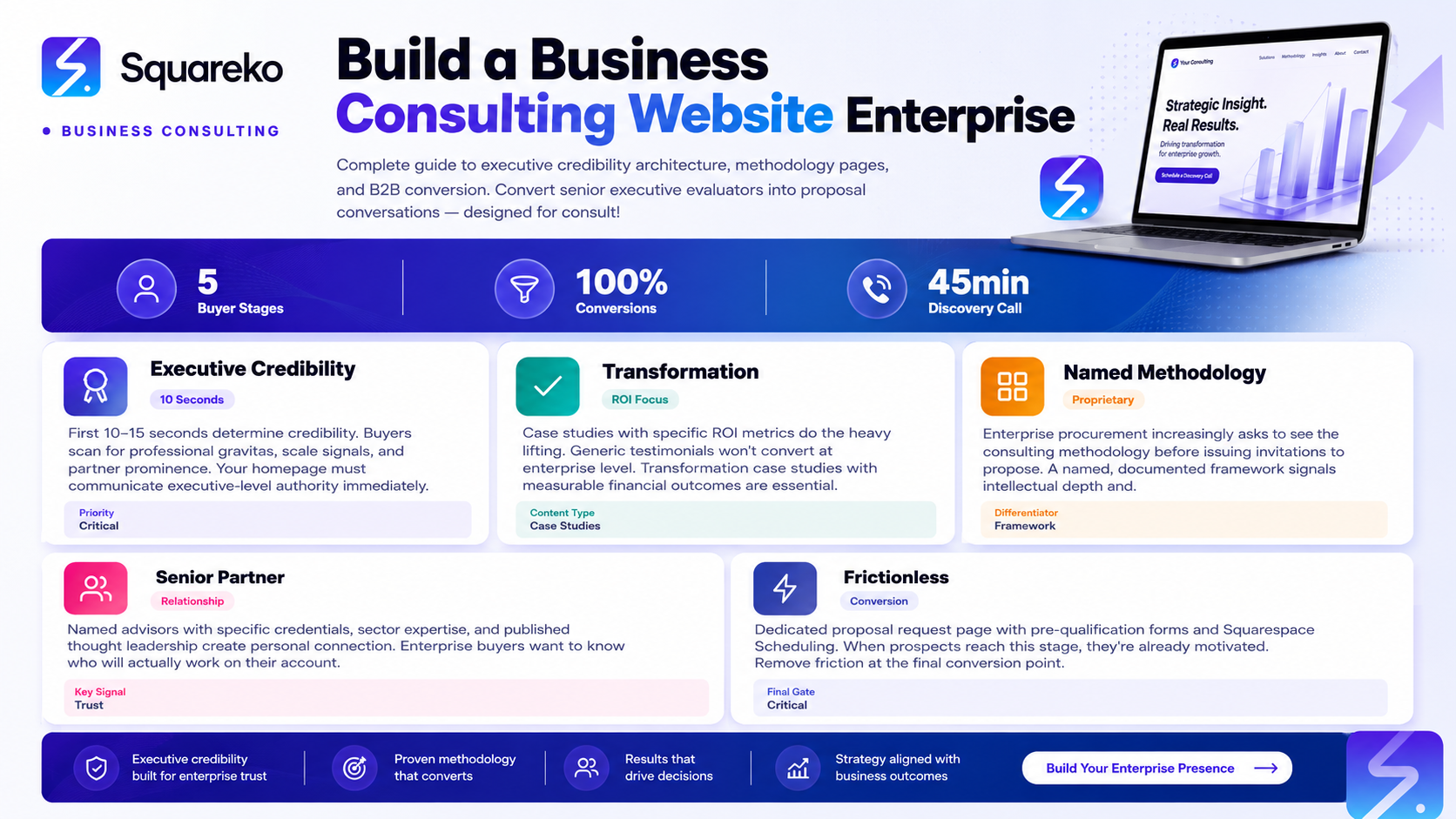
Enterprise clients use your website to verify, not discover — it needs to confirm capability immediately
The enterprise B2B buyer journey has five distinct stages, each requiring specific content
Methodology pages are the highest-credibility conversion tool on a management consulting website
Transformation case studies with ROI metrics convert enterprise buyers more effectively than any other content type
Technical foundations (schema markup, page speed, mobile optimisation) directly affect enterprise credibility perception
Enterprise clients don't hire management consultants from a cold website visit. They use websites to verify what they've already heard — to confirm that the firm they've been recommended, or found through an AI search result, or saw mentioned in an industry publication, has the capability and credibility their challenge requires.
That's the enterprise B2B consulting website reality. And it means your Squarespace consulting website has a specific job: to convert the evaluation curiosity of senior executives and procurement teams into a proposal conversation.
Most management consulting websites fail this job — not because they look unprofessional, but because they're not built around the enterprise evaluation journey. They present service descriptions where transformation evidence should be. They show generic what we do content where a named methodology should communicate intellectual depth. They bury case studies in a blog section where they belong on a dedicated, structured case study page that enterprise clients can evaluate systematically.
This guide covers how to build a management consulting website on Squarespace that does the right job for enterprise client acquisition — from first impression to booked proposal call.
Understanding the Enterprise Management Consulting Buyer Journey
Before building a single page, you need to understand how enterprise clients actually evaluate management consultants. The journey has five stages — and your website needs to serve each one.
Stage 1: Board-Level Credibility Check
The first thing a C-suite buyer or their EA does is check whether your firm is credible at their level of challenge. This happens in the first 10-15 seconds. They're scanning for: professional gravitas (design and typography quality), scale signals (client list, engagement size), and partner prominence (named senior advisors with serious credentials).
Stage 2: Transformation Track Record Assessment
Once credibility is established, buyers move to evidence: Have they solved problems like mine? This is where your case studies — specifically, transformation case studies with measurable ROI — do the heavy lifting. Generic testimonials won't convert at enterprise level; specific transformation narratives with financial outcomes will.
Stage 3: Methodology Fit Evaluation
Enterprise procurement increasingly asks to see the consulting methodology before issuing an invitation to propose. Buyers are evaluating whether your approach is rigorous, named (not generic), and differentiated from alternatives. Your methodology page is the answer to this question.
Stage 4: Senior Partner Assessment
For most enterprise engagements, the buyer wants to know who will actually be working on their account. Named senior partner profiles — with specific credentials, sector expertise, and published thought leadership — are essential for converting enterprise evaluators.
Stage 5: Proposal Request
If all four previous stages are satisfied, the buyer reaches out. This transition should be frictionless — a dedicated discovery call booking page or proposal request form that makes the next step obvious and easy.
Your Squarespace website needs content and architecture for every one of these stages.
The Executive Credibility Architecture Framework
Executive credibility architecture is the term we use at Squareko for the specific set of website design decisions that make a management consulting website feel credible to C-suite buyers.
The framework has three layers:
Visual Credibility Signals
Typography: Serious, considered typefaces (not trendy display fonts)
Colour palette: Restrained, professional — navy, charcoal, warm grey, and white work consistently
Photography: Partner headshots only — no stock photography of handshakes, boardrooms, or anonymous silhouettes
White space: Premium brands use more white space, not less
Content Credibility Signals
Named senior consultants with specific credentials and background
Client types and engagement scales mentioned explicitly (without naming confidential clients)
Industry and sector experience articulated with specificity
Published research, articles, or speaking record visible on the homepage
Structural Credibility Signals
Clear practice area architecture (not a list of 14 services)
Case study depth and ROI specificity
Methodology page with a named proprietary framework
Professional association memberships and qualifications displayed visually
Homepage Design for Enterprise Business Consulting
The management consulting homepage has one primary job: pass the five-second credibility test with a senior executive evaluator. Everything else is secondary.
The Enterprise Consulting Homepage Structure
Hero Section: Transformation Statement Your headline should state the specific transformation you deliver, for whom, and at what level of impact. Not Expert Business Consulting Services — something more like: Helping mid-market manufacturers achieve operational excellence and EBITDA improvement through embedded management advisory.
The hero section should also include one social proof element — either a named client type with an outcome reference, or a professional body credential that signals executive-level engagement.
Evidence Block: Credibility Signals Without Showing Off Below the hero, a compact evidence block showing: engagement scale (typical project values or client sizes, not specific clients), sector breadth, senior partner tenure, and one or two professional body credentials. Keep this section spare — it's not a feature list, it's a quiet confidence statement.
Practice Areas Overview A structured presentation of 3-5 focused practice areas with brief, transformation-oriented descriptions. Each should answer the question: What does working with us in this area actually achieve for clients like you?
Featured Case Study One prominently displayed transformation case study — ideally with a headline that names the sector, the challenge, and the measurable outcome. This is your most powerful conversion element. Place it high.
Senior Partner Introduction Brief named partner profiles with professional photographs. This humanises the firm and creates the personal connection that enterprise buyers need before they're willing to invest time in a proposal conversation.
The Proprietary Methodology Showcase Page
If you do one thing to improve your management consulting website's conversion rate, create a named, publicly visible methodology page.
The methodology page answers the question enterprise buyers increasingly ask before issuing an invitation to propose: What is your specific approach to this type of challenge, and why should I trust it over the alternatives?
What a Management Consulting Methodology Page Needs
A Named Framework Give your methodology a name. Not Our Approach or How We Work — a specific, ownable name like The TRANSFORM Advisory Method or The Enterprise Value Acceleration Framework. A named framework is searchable, citable by AI platforms, and signals intellectual investment in your craft.
The Problem Context Start with the problem your methodology addresses: why conventional approaches fail at this type of challenge, and what specifically your methodology was developed to overcome.
The Framework Stages Walk through each stage of your methodology with clear stage names, the diagnostic question each stage answers, the key activities, and what good looks like at completion. This level of transparency builds confidence rather than revealing proprietary secrets.
The Evidence of Results Brief case study references showing the methodology in action — linking through to full case studies where available.
A Visual Representation A simple visual diagram of the methodology stages — even a linear progression graphic — significantly improves the page's scannability and AI extractability.
Enterprise-Grade Case Study Architecture
Case studies are the primary conversion tool for enterprise management consulting websites. But generic case studies don't convert enterprise buyers — they need to be structured as transformation narratives with specific, measurable outcomes.
The TRANSFORM Case Study Framework
T — The Situation Context and stakes: client type (sector, scale, leadership level), the specific challenge, and why it mattered at that time.
R — Root Cause Analysis The diagnostic insight: what was actually causing the problem (often different from what the client initially presented).
A — Approach Designed How your methodology was applied to this specific challenge — what made your approach different from conventional alternatives.
N — New Strategy Implemented What you actually did: the key interventions, the stakeholder management, the change management required.
S — Shift in Performance The first measurable improvements: leading indicators of transformation success.
F — Financial Outcome The specific financial impact: cost reduction percentage, revenue improvement, efficiency gain, risk quantification. This is what converts enterprise buyers.
O — Organisation Impact The structural or capability change embedded in the organisation beyond the financial metrics.
R — Results Maintained Evidence of outcome sustainability — what prevented regression after the engagement ended.
M — Metrics Summary A compact box at the top or bottom of the case study: [Client Type] | [Sector] | [Engagement Duration] | [Key Outcome Metrics]. Enterprise evaluators scan this box first.
Want to see this enterprise consulting website architecture applied to your specific management consulting practice? Squareko builds Squarespace consulting websites that win enterprise clients.
Senior Partner Profile Design
For enterprise management consulting, the people page often determines the proposal decision more than the services page. Enterprise buyers are selecting advisors, not procurement vendors.
The Enterprise Senior Partner Profile Structure
Professional Photography High-quality, executive-calibre headshots. Not casual office photographs — formal professional images that signal the level of engagement the partner typically works at.
Credentials-Forward Biography The bio should open with the partner's specific consulting expertise and most impressive credentials — not with a chronological career summary. Former McKinsey engagement manager with 15 years specialising in post-merger integration for manufacturing sector clients tells enterprise buyers immediately whether this person can handle their challenge.
Sector and Challenge Expertise Specific sector experience (not cross-industry experience), specific challenge types handled, and approximate engagement scale. The specificity demonstrates genuine depth.
Published Thought Leadership Links to articles, papers, speaking engagements, or podcast appearances. Published work is the most credible signal of intellectual authority for C-suite buyers.
E-E-A-T Compliance From an AI search perspective, senior partner profiles need full name, professional credentials, years of experience, and verifiable achievements. Google and AI platforms use this information to assess the E-E-A-T (Experience, Expertise, Authoritativeness, Trustworthiness) of your consulting content.
Enterprise Lead Capture and Proposal Process
The enterprise proposal request page is where all the credibility-building work converts into an actual business conversation. Most management consulting websites treat this as an afterthought.
Squarespace Scheduling for Enterprise Consulting
For management consultants serving enterprise clients, Squarespace Scheduling should be configured with:
Pre-call qualifier form fields:
Company name and sector
Approximate company scale (headcount or revenue range)
Nature of the challenge (brief description)
Decision timeline
How they found you
This pre-qualification doesn't reduce enquiry volume from genuine prospects — it increases the quality of discovery calls and reduces time wasted on misaligned enquiries.
Call length configuration: Enterprise discovery calls typically run 45-60 minutes (longer than SME consulting). Configure your calendar accordingly.
Automated confirmation sequence: Send a confirmation with a brief preparing for our call document — a one-page summary of relevant case studies and your methodology overview. This primes the prospect and demonstrates the level of preparation your engagements always involve.
Technical SEO Foundations for Management Consulting
Enterprise clients who find you through AI search or Google require specific technical foundations on your Squarespace website.
Schema Markup for Management Consulting Websites:
Professional Service schema with consulting specialisation
Consultant schema with named principal details
FAQ Page schema on FAQ sections
Article schema with named author attribution on blog posts
Page Speed Optimisation: Enterprise buyers evaluating multiple firms on mobile may abandon slow-loading sites. Target under 3 seconds load time on mobile.
Google Search Console Verification: Submit your sitemap and verify your property. Monitor Search Console data for the management consulting query terms where you should be appearing.
Google Business Profile: Even B2B management consultancies benefit from a verified GBP listing — it provides a knowledge panel in Google search results that adds credibility signals for executive buyers conducting due diligence.
FAQs
-
Enterprise clients use websites to verify, not discover. The most effective approach: lead with transformation outcomes (not service descriptions), provide structured case studies with ROI metrics, create a named methodology page, display senior partner credentials prominently, and make the proposal request process frictionless. Enterprise buyers who've been recommended your firm or found you through AI search need to find confirmation quickly.
-
A compelling transformation statement (specific outcome, specific client type), a credibility evidence block (partner tenure, engagement scale, professional credentials), 3-5 focused practice areas with transformation descriptions, a featured case study with measurable outcomes, and named senior partner profiles. Below the fold: thought leadership highlights, professional association credentials, and a clear CTA for discovery call booking.
-
For enterprise management consulting, showing fee ranges is generally more effective than showing nothing. "Engagements typically range from £X to £X" or "Day rates from £X" pre-qualifies enquiries and prevents discovery calls where budget is significantly misaligned. Full transparency (specific fee schedules) is rarely appropriate at enterprise level — but complete silence on fees can create unnecessary friction for motivated prospects.
-
Yes — it's the highest-converting page most management consulting websites are missing. Enterprise procurement increasingly asks to see consulting methodology before issuing invitations to propose. A named, publicly visible methodology page positions your approach as proprietary, rigorous, and differentiated from alternatives, and it's the primary content that AI platforms extract when recommending management consultants for specific challenge types.
-
400-700 words for each individual case study page, plus a 50-word metrics summary box. The challenge-approach-outcome-metrics structure should be clear enough that a C-suite buyer can evaluate relevance in 90 seconds, while providing sufficient depth for thorough due diligence. Always include: sector/industry context, engagement duration, and specific financial or operational outcome metrics.
-
Schema markup — specifically, Consultant and ProfessionalService schema with named principal details, specialisation, and geographic service area. This is the primary mechanism by which AI search platforms (ChatGPT, Gemini, Perplexity) identify and recommend management consultants for relevant queries. Most management consulting websites have zero schema markup — implementing it correctly creates immediate competitive advantage in AI search visibility.
Build the Enterprise-Ready Management Consulting Website Your Practice Deserves
The management consultants who consistently win enterprise engagements aren't always the most qualified — they're often the ones whose websites make the strongest case for their qualification. The credibility architecture, the methodology showcase, the transformation case studies — these aren't just design decisions. They're business development infrastructure.
Squareko builds management consulting websites specifically for enterprise client acquisition — every page, every element, every conversion decision informed by how C-suite and senior executive buyers actually evaluate management consulting firms.
From custom website design to SEO strategy, we help businesses launch a site that looks professional and performs better.

Author Bio
I'm Walid Hasan, a Certified Squarespace Expert and Squarespace Circle Platinum Partner with over 12 years of hands-on experience designing and optimizing high-performing websites. Over the years, I've had the privilege of building more than 2,000 Squarespace websites for clients around the world, always focusing on clean design, strong user experience, and conversion-driven results.