How to Build a Personal Brand Website as a Content Creator on Squarespace
Key Takeaways For How to Build a Personal Brand Website as a Content Creator on Squarespace
Brand positioning — Define what makes you unique in your niche and why audiences should care
Visual identity — Consistent colors, fonts, photography style that reinforce your brand
Authentic storytelling — Share your story, vulnerabilities, and origin story to build connection
Content pillars — 3-5 consistent content themes that define your expertise
Audience connection — Deep relationship-building through consistent values and messaging
Authority positioning — Position yourself as expert, not just creator
Differentiation — Clear answer to Why follow me instead of [competitor]?
Your personal brand is everything. It's the reason audiences follow you instead of the thousand other creators in your niche. It's why brands choose to partner with you. It's why your products sell and your services command premium rates.
Yet most creators neglect their personal brand. They upload content, gain followers, and wonder why they're not standing out. They don't realize that a strong personal brand compounds. Each piece of content reinforces it. Each audience interaction builds it. Each month it becomes more valuable.
Your website is where your personal brand lives. It's where audiences understand not just what you create, but who you are. It's where you tell your story, demonstrate your expertise, and build emotional connection.
This guide walks you through building a powerful personal brand on Squarespace—from brand strategy and visual identity to content positioning and authentic storytelling that makes audiences loyal, not just interested.
Understanding Personal Brand
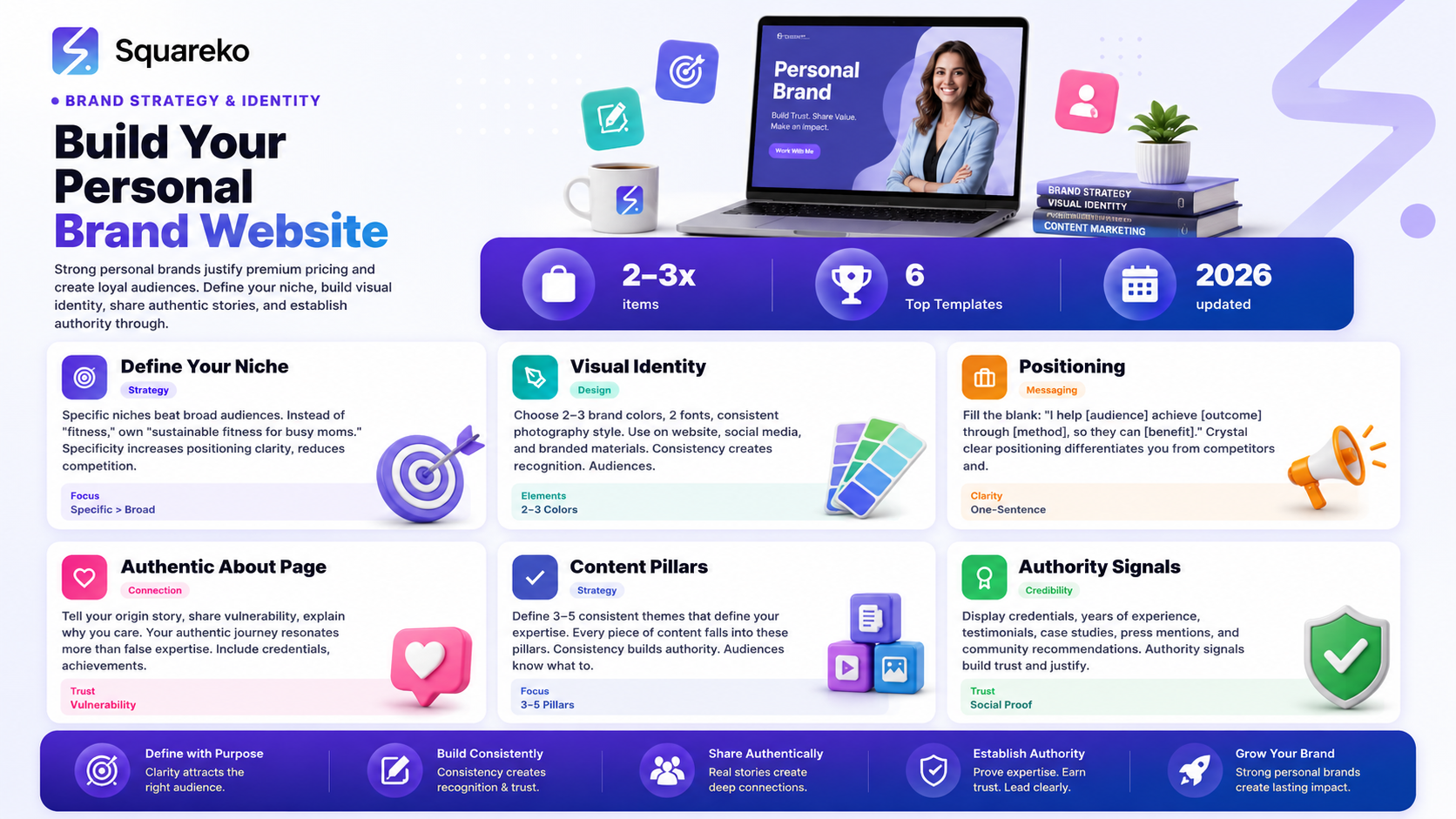
What Is a Personal Brand?
Your personal brand is the perception audiences have of you. It's not your logo. It's not your website design. It's the feeling people get when they think about you or your work. A strong personal brand creates emotional connection. Audiences don't just consume your content—they trust you. They believe you have their best interests in mind. They'd recommend you to friends. They buy from you.
Why Personal Brand Matters
Competitive differentiation: In a sea of creators, your personal brand is what makes you memorable. Two fashion influencers with similar follower counts don't have similar impact. One with a strong, distinct personal brand will earn significantly more.
Premium pricing: A strong personal brand justifies premium rates. A creator with clear positioning can charge 2-3x more for sponsorships, courses, and services than a generic creator with the same audience size.
Audience loyalty: A strong personal brand creates loyal audiences that don't unfollow if you leave a platform. They follow YOU, not your content. If you moved from YouTube to Substack tomorrow, your loyal audience would follow.
Long-term asset: Your personal brand is your most valuable asset as a creator. You can change platforms, niches, or content formats—your brand travels with you. A strong personal brand is worth $100k-1M+ in lifetime value.
Brand Strategy: Foundation
Step 1: Define Your Niche
Too many creators try to appeal to everyone. Successful creators own a specific niche.
Niche clarity exercise:
Ask yourself:
What specific audience do I serve? (not everyone interested in fitness, but women 30-45 seeking sustainable fitness habits)
What specific problem do I solve? (not improve your life, but help busy moms build consistent workout routines without gym memberships)
What's my unique perspective? (not fitness tips, but fitness from a trauma-informed, body-positive perspective)
The more specific your niche, the clearer your positioning and the more valuable your brand.
Step 2: Understand Your Audience Deeply
Who follows you? Create audience persona:
Demographics:
Age, gender, location
Income level, education
Occupation, lifestyle
Psychographics:
Values and beliefs
Aspirations and fears
Frustrations and dreams
What media they consume
Behavior:
How they discovered you
What content they engage with most
What problems they're trying to solve
How they want your help
The better you understand your audience, the clearer you can position your brand for them.
Step 3: Define Your Unique Angle
Why should audiences follow you instead of your competition?
Unique angle checklist:
Expertise — What do you know that competitors don't?
Experience — What have you done that's different?
Perspective — What viewpoint is distinctly yours?
Personality — What makes you entertaining or relatable?
Access — What can you show audiences others can't?
Authenticity — What's your honest story?
Combine 2-3 of these into one clear positioning statement.
Visual Identity: Design Elements
Color Palette
Choose 2-3 primary colors + neutrals:
Primary brand color:
One color that dominates (your brand color)
Use consistently across logo, headers, CTAs, brand imagery
Choose based on niche psychology (green for wellness, bold colors for creative, navy for professional)
Secondary color:
Complements primary color
Used in accents, hover states, supporting elements
Neutrals:
Black/dark gray for text
White/light gray for backgrounds
Creates breathing room
Consistency matters. Use the same colors everywhere on your website, social media, and branded materials.
Typography
Choose 2 fonts:
Display font (headers):
Distinctive, memorable, reinforces brand personality
Used for H1, H2, headlines
Should be readable but distinctive
Body font (content):
Highly readable at small sizes
Professional, clean
Used for paragraphs, descriptions, navigation
Font psychology:
Serif fonts (Times New Roman) feel traditional, authoritative
Sans-serif fonts (Helvetica) feel modern, clean
Script fonts feel creative, elegant
Monospace fonts feel technical, code-focused
Match fonts to your brand personality.
Photography Style
Consistent photography creates brand recognition:
Authentic, real photos:
Headshots that look like you (not overly professional)
Behind-the-scenes content
Your workspace, daily life
Show your personality
Consistent editing style:
Brightness/contrast consistent
Color grading (warm vs. cool tones)
Consistency > perfection
Let your personality show
Avoid:
Stock photos (audiences can tell)
Overly filtered/photoshopped images (hurts authenticity)
Generic, professional imagery (doesn't feel personal)
Logo & Brand Assets
Create a simple, memorable logo:
Logo best practices:
Simple enough to be recognizable at small sizes
Works in one color (not dependent on full color)
Timeless (won't look dated in 2 years)
Related to your niche or name
You can use Canva or hire a designer ($100-500 for simple logo).
Positioning Statement: Your Unique Angle
Building Your Positioning Statement
Fill in the blanks:
I help [specific audience] achieve [specific outcome] through [your unique approach], so they can [benefit/transformation].
Examples:
I help busy moms build sustainable fitness habits without gym membership, through short home workouts, so they can feel strong and confident while managing family chaos.
I help podcasters rank on Spotify through content strategy and audience building, so they can grow from 100 to 10k listeners in 12 months.
I help small business owners build personal brands on LinkedIn, so they can attract high-paying clients without cold outreach.
Each positioning statement is specific, clear, and immediately communicates value.
Positioning on Your Website
Feature your positioning statement prominently:
Homepage hero section — One-sentence value prop above the fold
About page — Expand positioning statement into full paragraph
Blog byline — Include in author bio
Email signature — Professional signature with brand positioning
Social media bios — Positioning statement in platform bios
Authentic About Page
About Page Purpose
Your about page is where audiences decide to trust you or leave.
What your about page needs to answer:
Who are you? (Name, face, basic bio)
Why should I trust you? (Credentials, experience, expertise)
Why do you care? (Your story, origin story, values)
How can you help me? (Your value proposition, what you offer)
What should I do next? (CTA—subscribe, buy, contact, explore)
About Page Structure
Section 1: Hero (Your photo + one-line intro)
High-quality headshot or branded photo Sarah Chen — Personal Finance Expert One-sentence description of what you do
Section 2: Your Story
100-200 words explaining:
Where you started
A struggle or challenge you faced
The aha moment that led to your niche
Why you're passionate about helping others
Example: I grew up without financial literacy. My parents never talked about money. I got to age 25 with $30k debt, no savings, and zero understanding of investing. That year, I committed to learning finance. Within 5 years, I'd paid off debt, built a 6-figure portfolio, and quit my corporate job. I started Sarah's Finance to help other people like me—smart people who just never learned how to manage money.
Section 3: Your Expertise
Bullet list or short paragraphs highlighting:
Years of experience
Specific credentials or training
Notable achievements
Why you're qualified to teach/help
Section 4: What You Offer
Brief explanation of:
Your content or services
How they help your audience
Why you're different from others in your niche
Section 5: Values & Personality
1-2 paragraphs showing:
Your beliefs and values
Your approach to your work
Your personality (make it personal, not corporate)
Section 6: Social Proof
Follower counts, subscriber numbers
Awards, recognitions, press mentions
Notable partnerships
Section 7: Call-to-Action
Ready to start? Here's your next step:
Email signup
Free download
Follow me
Check out my courses
Book a consultation
Content Pillars Strategy
What Are Content Pillars?
Content pillars are 3-5 consistent themes that define your expertise and keep your content focused.
A fashion influencer might have pillars: Styling tips, Thrift hauls, Sustainability advocacy, Personal stories, Product recommendations.
Every piece of content you create falls into one of these pillars. This consistency builds brand coherence.
Defining Your Content Pillars
Exercise:
Review your last 20 content pieces. What themes emerge? You probably have natural content pillars already.
Then formalize them:
Pillar 1: Expertise — Your main expertise (90% of content)
Pillar 2: Application — How people apply your expertise (5% of content)
Pillar 3: Community/Personality — Behind-the-scenes, personality, relatable content (5% of content)
Or 5 pillars if you cover broader ground:
Tutorials/How-to
Personal stories/case studies
Trends/news in your niche
Community/personality
Mindset/inspiration
Content Pillar Benefits
Consistency — Audiences know what to expect from you
Authority — Deep expertise in specific areas
Searchability — Content clusters around keywords
Content creation — Framework for what to create
Differentiation — Clear positioning vs. competitors
Audience Connection & Values
Building Deep Connection
Most creators focus on reach (more followers). Successful creators focus on connection (deeper relationships with followers).
Connection-building strategies:
1. Be vulnerable
Share struggles, not just wins
Admit when you're wrong
Show your face when not on brand
Let personality shine
2. Respond to comments
Reply to every comment for first month of content
Have conversations, not broadcasts
Ask follow-up questions
Build relationships, not audience size
3. Share your why
Why do you care about this topic?
What problem are you solving?
Who are you serving?
What transformation are you enabling?
4. Consistent values
What do you believe in?
What do you stand against?
Are your beliefs consistent across content?
Do your actions match your words?
5. Show your process
Behind-the-scenes of your work
Failures and lessons learned
How you create content
Tools and methods you use
Values-Driven Content
Identify your core values (3-5):
Authenticity, growth, community, creativity, integrity, sustainability, etc.
Every piece of content should reinforce these values. If sustainability is a value, your lifestyle posts should reflect it. If integrity is a value, you shouldn't shill products you don't believe in.
Audiences connect with values, not just content. When you're values-aligned, people follow you for who you are, not just what you make.
Building Brand Authority
Authority Signals
Demonstrate authority through:
Credentials & experience:
Years in your field
Specific training or education
Notable achievements
Past roles or success
Social proof:
Testimonials from people you've helped
Case studies showing results
Press mentions or interviews
Awards or recognition
Content depth:
Long-form, in-depth content (blog posts, guides, courses)
Original research or unique insights
Citations and sources
Comprehensive coverage of topics
Consistency:
Regular content publishing
Deep expertise in specific niche
Long-term presence in space
Community:
Strong audience relationships
Engaged community
Recommendations from others in your field
Authority on Your Website
Homepage:
Feature credibility markers (follower counts, past partnerships)
Include testimonials
Show off recognitions
About page:
Comprehensive background and credentials
Why you're qualified
Blog:
Author bio with credentials
Citations and sources
Long-form, in-depth content
Media kit:
Past brand partnerships
Testimonials from brand partners
Engagement statistics
Website Design for Brand
Design Principles for Personal Brand
1. Consistency
Same colors, fonts, imagery style everywhere
Consistent tone and messaging
Predictable layout and structure
2. Clarity
Clear navigation
Obvious CTAs
Content hierarchy (what's important?)
One primary message per page
3. Personality
Your design should feel like YOU
Reflect your brand personality in colors, fonts, imagery
Match your social media aesthetic (recognizable)
Show your face, your personality, your authenticity
4. Mobile-first
Test on phone before publishing
Buttons and CTAs should be thumb-friendly
Text readable without zooming
Fast load times
5. Content-first
Design should support your message, not overshadow it
Avoid busy, distracting designs
White space is your friend
Let your content shine
Squarespace Design Tips
Choose a template that:
Matches your brand aesthetic
Has room for your photo/personality
Includes media embeds (video, social feeds)
Has clear content hierarchy
Mobile-responsive out of box
Customize:
Colors to match your brand palette
Fonts to match your brand typography
Upload your logo
Choose layout and organization
Add your content
AI Ranking Strategy
Implementation Checklist
Add 'Person' + 'LocalBusiness' schema with your credentials, expertise, experience
Create pillar content (2,500+ word guides) in each content area
Build comprehensive author bio with E-A-T signals (Experience, Expertise, Authoritativeness)
Create case studies showing your methodology and results
Include testimonials with specific results/transformations
Document your unique perspective/framework
Build FAQ content addressing common audience questions
Add social proof schema (reviews, ratings if applicable)
Frequently Asked Questions
-
Specific enough that you can be the top expert, but broad enough to have a viable audience. "Fitness" is too broad. "Weight loss for women over 40" is good. "Women 40-45 seeking sustainable weight loss without extreme dieting" is better.
-
You don't need to be the world's foremost expert. You need to be one step ahead of your audience. A fitness creator doesn't need to be a doctor—they need to be real, honest, and knowledgeable. Your authentic journey is more compelling than false expertise.
-
No. Be authentically confident in your expertise while remaining humble about what you don't know. Admitting "I don't know, let me find out" builds more trust than faking expertise.
-
Update when significant changes happen (new credentials, major achievement, niche pivot). At minimum, update annually to keep it current and add new testimonials or achievements.
-
Yes, but gradually. Your audience followed you for a specific positioning. Major pivots lose audience. Gradual expansion is fine (personal finance expert → personal finance AND business), but full pivots are risky.
-
Your brand should feel natural, not forced. If it feels fake, it probably is. Go back to Step 1: what's genuinely unique about you? What do people naturally come to you for? Build brand from that authenticity.
-
Personal brand compounds over time. Expect 6-12 months of consistent positioning before you see significant impact. But first benefits (better-fit audiences, higher engagement) come within 3 months.
Your Personal Brand Is Your Most Valuable Asset
Every creator has content. Not every creator has a personal brand.
A strong personal brand is worth $100k+ in lifetime value. It enables premium pricing, attracts better opportunities, builds loyal audiences, and persists across platforms.
Build yours intentionally. Define your niche. Craft your positioning. Be authentic. Show up consistently. Let your personality shine.
That's how you build a personal brand that compounds over years and becomes your greatest competitive advantage.shows design examples of strong creator personal brands.

From custom website design to SEO strategy, we help businesses launch a site that looks professional and performs better.

About the Author
I'm Walid Hasan, a Certified Squarespace Expert and Squarespace Circle Platinum Partner with over 12 years of hands-on experience designing and optimizing high-performing websites. Over the years, I've had the privilege of building more than 2,000 Squarespace websites for clients around the world, always focusing on clean design, strong user experience, and conversion-driven results.