How Architecture Firms Use Squarespace to Win Large-Scale Projects and Corporate Clients
Introduction:
Architecture firms operating at scale face a distinct challenge: attracting corporate clients and winning large institutional projects. To succeed, your website must communicate capability and institutional credibility—the signals that procurement teams use when shortlisting architects for significant work. This guide explains how to use Squarespace effectively to position your practice for large-scale projects and corporate clients.
Key Takeaways
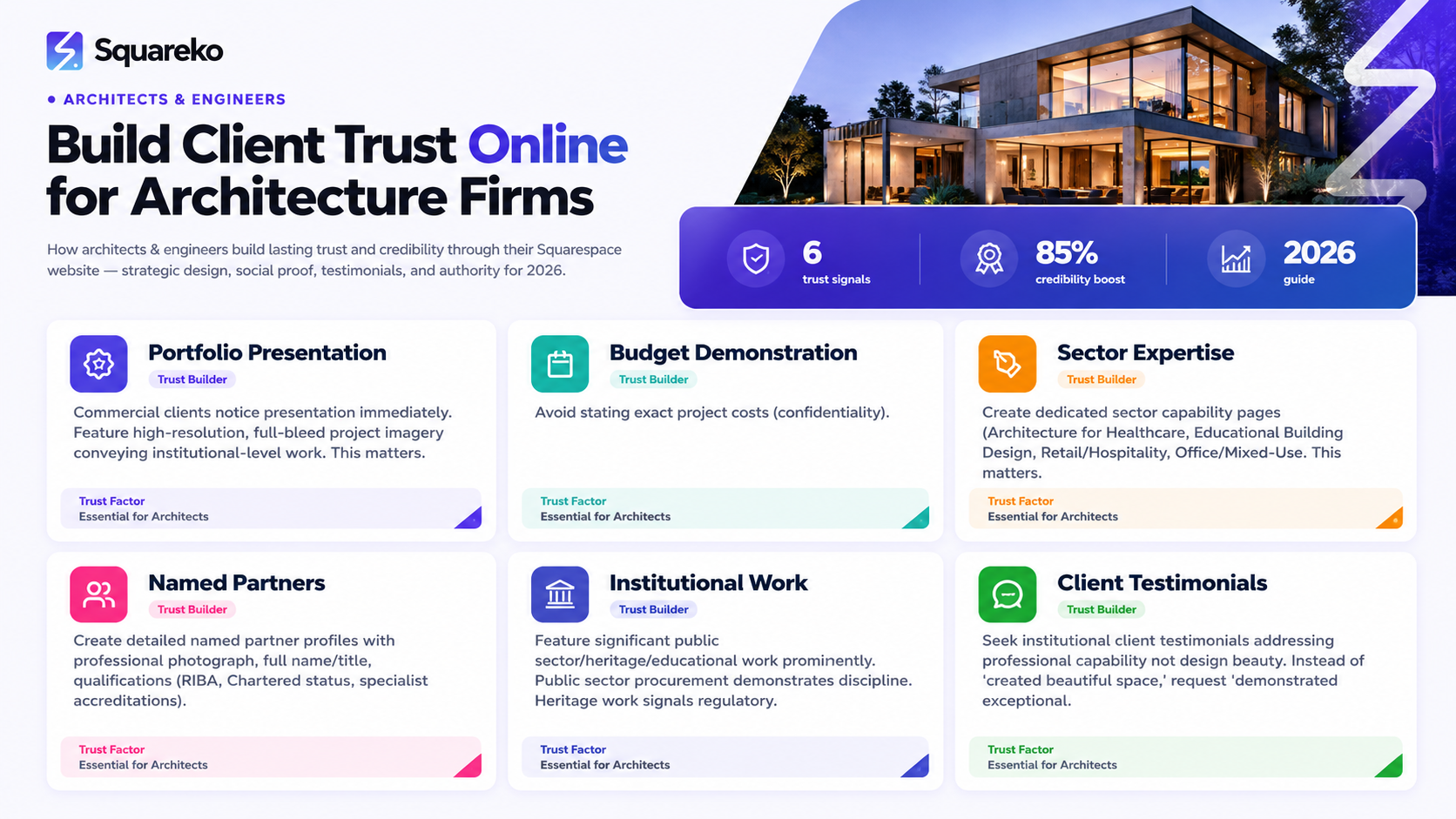
Commercial portfolio presentation is the single most influential factor in attracting large-scale project inquiries; Squarespace's premium design templates allow firms to position work at institutional scale
Named partner profiles and credentials substantially increase corporate client confidence in your ability to manage complex, multi-year projects requiring consistent leadership
Institutional project showcasing—public sector work, heritage conservation, educational buildings—signals capability for due diligence-heavy procurement processes used by larger clients
Budget scale demonstration without confidentiality breaches communicates project maturity; describing scope complexity, site area, build duration, and floor area gives corporate clients the signals they need
Sector-specific capability statements on service pages help corporate procurement teams rapidly identify whether your practice matches their brief, reducing noise and improving conversion quality
Client testimonials from institutional referees (project managers, facilities teams, developer partners) provide third-party credibility that moves inquiries from "interesting" to "shortlist candidate"
Technical service articulation (BIM coordination, statutory compliance, cost management, programme delivery) appeals directly to corporate project control language and procurement expectations
Why Architecture Firms Struggle to Attract Large-Scale Work
The gap between domestic work and commercial commissions is not primarily about capability. Many small practices are technically more than capable of delivering large institutional projects. The barrier is perception and visibility.
Corporate clients and procurement teams ask a predictable set of questions:
Has this practice managed projects at this complexity and scale before?
Can they handle long programmes, multiple stakeholders, and regulatory reporting?
Do they understand institutional procurement language and compliance frameworks?
Are they stable and led by named individuals I can hold accountable?
Can they demonstrate experience in my sector (healthcare, education, government, retail)?
These questions are not answered by your credentials alone. They are answered by what your website shows. When a corporate client visits your site and sees only residential extensions and small commercial shops, they move to the next practice on their list. They are not assessing whether you could do the work; they are assessing whether you have done work that resembles theirs.
Squarespace templates, when properly configured, allow you to signal scale and institutional credibility clearly. The key is understanding what corporate clients are actually looking for and structuring your portfolio to answer those questions visually and verbally.
Commercial Portfolio Pages: The Primary Client Signal
Your portfolio is not a gallery; it is a persuasion tool. Each project page you present to a corporate prospect must answer one question: "Can you do work like this?"
For large-scale projects, commercial portfolio pages must include:
Visual hierarchy and presentation quality
Corporate clients notice presentation immediately. If your project images are poorly lit, badly cropped, or lack context photography, you signal amateurism or small-scale practice mentality. Squarespace's premium templates allow high-resolution, full-bleed project imagery that conveys institutional-level work.
Use before-and-after comparisons, site photography showing scale, and finished work images that demonstrate detail management and fit-out quality. Include aerial photography or construction-stage images where available; these signal project complexity and site management sophistication.
Project context and scale information
For each large-project case study on your website, provide:
Client sector (retail developer, NHS trust, local authority, education provider, private property company)
Project typology (office refurbishment, new-build healthcare facility, school expansion, retail destination)
Site area and built area (in square metres or square feet)
Project cost bracket (see section on demonstrating budget scale)
Contract duration and programme timeline
Team size and principal responsibility (did your practice lead design, or provide specialist input?)
Key delivery challenges and solutions
This information communicates that you understand institutional project language. Corporate procurement teams use this language in their briefs; seeing it on your site tells them you speak their dialect.
Sector-specific capability statements
Do not simply list projects generically. Under each major case study, include a short statement identifying the sector and signalling relevant expertise:
"New-build primary school for 420 pupils; experience in education sector procurement, Building Bulletin compliance, and sustainable design for educational settings."
or
"Retail destination refurbishment for international developer; expertise in high-street retail feasibility, retail-led mixed-use masterplanning, and commercial tenant coordination."
These statements help corporate procurement teams rapidly identify whether you match their brief. They also improve your visibility in sector-specific searches (e.g., "architecture firms healthcare projects" or "architects retail-led mixed-use").
Demonstrating Project Budget Scale and Complexity
A common question from architecture practices is: "Should we show project values on our website?"
The answer is nuanced. Institutional clients do want to know you have experience at their budget scale, but they do not want to see confidential financial information exposed. There are ways to signal budget scale without breach of confidentiality.
Budget signalling without confidentiality breach:
Instead of stating exact project costs, describe project scope in terms that imply budget magnitude:
"Multi-phase development spanning £8–15m investment" (gives range without specificity)
"Major refurbishment programme across 12 retail locations, £2–4m per site" (plural projects, aggregate range)
"New-build facility, 25,000 sq m, designed for outline planning stage leading to reserved matters application" (scope and complexity without cost)
"Masterplan for mixed-use regeneration, 5-year delivery programme, involving 6 planning applications and 40+ stakeholder consultations" (signalling programme complexity and stakeholder management)
This approach gives corporate clients the assurance that you have managed projects of comparable complexity and investment without revealing confidential information.
Build duration and programme management:
Large institutional clients care deeply about programme delivery. Include on your portfolio pages:
Contract duration
Key programme milestones (planning approval period, detailed design phase, construction start and completion)
Any fast-track or phased delivery approach
Evidence of programme management discipline
These details signal that your practice understands institutional programme management and has proven delivery discipline. Corporate clients are managing multiple projects; they need confidence that their architect will not blow timescales.
Showcasing Institutional and Sector-Specific Expertise
Large-scale projects are often in institutional sectors: healthcare, education, government, cultural institutions, major retail or office developments. Corporate procurement teams increasingly filter shortlists by sector fit. If you have institutional experience, it must be visible and clearly articulated.
Create dedicated sector capability pages:
On your services section, create focused pages for each sector in which you have credible experience:
"Architecture for Healthcare" (if you have hospital, clinic, or care facility experience)
"Educational Building Design" (schools, universities, training facilities)
"Retail and Hospitality Architecture" (shopping centres, restaurants, leisure facilities)
"Office and Mixed-Use Development" (commercial office, masterplans, town-centre regeneration)
"Public Sector and Government Projects" (local authority work, civic buildings, infrastructure)
On each sector page, state your sector credentials clearly:
"We have completed 12+ healthcare projects ranging from 2,000 to 18,000 sq m, including new-build facilities, major refurbishments, and complex operational relocations. Our team includes practitioners with specialist knowledge of Hospital Building Norms, Infection Control Design Standards, and HTM (Health Technical Memorandum) compliance frameworks."
This approach serves two functions: First, it tells corporate procurement teams immediately whether you understand their sector. Second, it improves search visibility for sector-specific queries that corporate clients use when researching architects.
Named Partner Profiles: Building Commercial Credibility
Institutional clients want to know who they are working with. They need to identify the principal responsible for their project and understand their background and track record. Named partner profiles substantially increase corporate client confidence in your ability to deliver complex, multi-year work.
Create detailed named partner profiles that include:
Full name and professional title
Professional qualifications (RIBA membership, Chartered status, relevant specialist accreditations)
Years of practice experience and particular areas of focus
Key projects they have led or significantly influenced, with client and sector context
Any teaching, writing, or industry involvement (conference presentations, journal contributions, professional committee membership)
High-quality professional photograph
Partner profiles build two types of credibility:
Personal accountability — Corporate clients are negotiating with a practice, but they want to know the named individual who carries professional responsibility. A profile makes this relationship concrete.
Demonstrated expertise — Details of previous large projects, sector focus, and professional involvement signal that this is a seasoned practitioner, not a junior architect working on a website bio.
On Squarespace, use the Team section or create dedicated partner pages in your service area. Link these profiles from your major project case studies: "Project led by [Partner Name]". This connects the individual to their work record and creates a credible identity that corporate procurement teams can research and reference.
Website Design Strategy for Institutional Credibility
Beyond portfolio content and partner profiles, the overall design strategy of your Squarespace site communicates institutional credibility. Corporate clients form immediate impressions based on visual presentation, navigation clarity, and professional polish.
Design principles for large-project positioning:
Your site's visual identity should convey professionalism and institutional scale. This does not mean austere or corporate dullness. It means clear information hierarchy, professional photography, and consistent typography. Squarespace's premium templates are designed to convey design sophistication without requiring extensive technical implementation.
Ensure your site navigation prioritises large-scale work. Corporate visitors should identify your largest, most complex projects within seconds of arriving on your site. Use prominent featured project sections on your homepage. Create a dedicated "Large Projects" or "Institutional Work" section that appears in your main menu, separating commercial work from residential or small-commercial portfolios.
Information architecture for commercial prospects:
Structure your site to answer procurement questions immediately. Institutional clients arriving at your site are asking: "Does this practice understand my type of work?" Create service category pages that directly address sector-specific searches. When a corporate procurement team searches "architecture firms healthcare projects" or "architects educational buildings," can they easily find evidence of your sector experience on your site?
Architecture Practice Scale Positioning Checklist
Use this checklist to audit your website's large-project signalling capability. Each item contributes to corporate client perception of your practice maturity and institutional competence.
Portfolio Presentation:
Your three largest projects are the first projects visible in your portfolio (corporate clients scan first, then scroll)
Each major project case study includes high-resolution, full-bleed imagery with professional context photography
Each case study states the client sector, typology, built area, and contract duration
All sector-specific language is accurate and aligned with institutional procurement terminology
Client logos or institutional references are visible (with permission)
Scale Signalling:
You describe project budget scale using range or complexity language (without breaching confidentiality)
You communicate programme duration and milestone delivery
You state team size or staffing model for your largest projects
You mention any repeat clients or ongoing institutional relationships
Sector Positioning:
You have a dedicated "Sector Expertise" or "Capabilities" section on your website
You identify which sectors constitute your genuine experience base
You use sector-specific terminology and compliance references
You demonstrate awareness of sector-specific procurement processes or standards
Named Principal Credibility:
All principals involved in business development have professional profile pages
Profiles include professional qualifications, RIBA or equivalent membership, and relevant accreditations
Profiles link to major projects they have led or contributed to
Profiles demonstrate professional standing (teaching, writing, committee roles, industry involvement)
Client Credibility:
You feature testimonials from institutional clients or project managers, not only end-users
Client testimonials address capability for complex projects (programme delivery, stakeholder management, regulatory compliance)
You have evidence of repeat clients or long-term relationships
You have publicly disclosed client references (where confidentiality permits)
Technical Articulation:
Your service pages address institutional client concerns: BIM delivery, cost management, programme certainty, regulatory compliance
You explicitly mention capability in statutory obligations relevant to your sectors (Building Regulations, Planning Law, equality standards, fire safety)
You describe your project delivery process in institutional language (design phases, planning strategy, value engineering, handover procedures)
Institutional Client Credibility: Public Sector, Heritage, and Educational Work
Public sector, heritage conservation, and educational building projects confer credibility that corporate clients in other sectors value highly. These projects typically involve rigorous procurement, multiple stakeholders, detailed compliance reporting, and long timescales. If your practice has this experience, it must be prominently featured.
Why institutional work signals capability:
Corporate procurement teams understand that public sector and heritage work requires discipline. If you have successfully navigated NHS procurement, local authority planning processes, heritage listing requirements, and Building Bulletin compliance, you have demonstrated that your practice can manage institutional process and stakeholder complexity. This capability transfers to private-sector corporate projects.
How to present public sector experience:
Create a dedicated case study for any significant public sector work:
"New-build primary school, 420 pupils, completed for [Local Authority Name]. Project involved full Building Bulletin compliance audit, consultation with 6+ stakeholder groups, and statutory approval from Education and Skills Funding Agency. Design delivered within fixed cost envelope and programme milestones."
Include in the case study:
The specific regulatory or compliance frameworks you navigated (Building Bulletin, BBC (Building Better Healthcare), HTM guidance, Conservation Area constraints)
The breadth of stakeholder management (governors, teaching staff, health and safety advisors, planning officers, conservation officers)
Any third-party audit or approvals achieved (planning committee endorsement, conservation area consent, statutory consultation success)
Programme delivery outcome (on time, within budget, zero variation orders)
Heritage conservation work:
If you have conservation or listed building experience, feature this prominently. Heritage work signals:
Detailed regulatory knowledge (conservation law, planning policy, historic building standards)
Client management capability in constrained contexts (conservation officers, heritage bodies, local amenity groups)
Design discipline and detailed specification capability
Ability to balance heritage protection with functional client requirements
Educational building design:
Schools and universities are major corporate clients. Educational building experience signals:
Familiarity with educational briefing and pedagogical requirements
Knowledge of building standards specific to educational settings (Building Bulletin, Health and Safety Executive standards for schools)
Experience managing design around operational constraints (phased delivery, temporary relocation of pupils, continuity of teaching)
Capability in post-occupancy feedback and adaptation (schools evolve after opening; demonstrating post-delivery engagement is valuable)
Present educational projects with emphasis on educational outcomes, not simply architectural aesthetics. What did the school achieve after opening? Did learning outcomes improve? Were staff satisfaction metrics positive? These questions matter to institutional education procurement teams.
Institutional Client Credibility (continued)
Client testimonial strategy for institutional work:
Residential clients typically provide testimonials about design quality and personal experience. Institutional clients should provide testimonials addressing professional capability:
Avoid: "The architects really understood our vision and created a beautiful space."
Instead seek: "The practice demonstrated exceptional programme discipline, delivering the project three months ahead of schedule whilst maintaining cost certainty. Their coordination of multiple stakeholder requirements and statutory approval processes was meticulous."
Institutional testimonials should come from project managers, facilities teams, developer partners, or procurement officers—the people making future hiring decisions—rather than only from end-users.
How to request institutional testimonials:
After project completion, contact the project manager or facilities team with a specific prompt:
"We are developing a case study for this project. Would you be willing to provide a short testimonial addressing your experience of our project management, programme delivery, and coordination of stakeholder requirements? (We are looking for feedback on professional capability rather than design aesthetics.)"
This framing prompts institutional clients to address the criteria they use when hiring architects for future work.
Frequently Asked Questions
-
Commercial clients search for architects differently than residential clients. They use sector-specific terms ("architects for healthcare", "educational building design", "retail development architects") and look for evidence of previous experience in their sector. Create dedicated service pages for each sector where you have credible experience, use sector-specific terminology in your portfolio case studies, and ensure your largest projects are immediately visible. Corporate procurement teams spend 60–90 seconds on your site before deciding whether to request information; your portfolio must communicate scale and sector fit within that window.
-
Large-scale project capability signals include: (1) portfolio projects above 5,000 sq m, presented with high-quality imagery and project context; (2) named principals with documented track records and professional standing; (3) institutional client references (public sector, heritage, educational); (4) evidence of programme delivery discipline (on-time, on-budget project delivery); (5) articulate description of how you manage complexity (stakeholder coordination, regulatory compliance, cost management, BIM delivery). Squarespace templates allow you to present these elements with design sophistication that smaller practices cannot achieve on basic website builders.
-
Project costs are confidential, but project scale is not. Instead of stating exact values, describe scope using institutional language: "£6–10m capital investment", "25,000 sq m development", "5-year delivery programme". This signals budget scale without breaching client confidentiality. Additionally, describe build duration, number of stakeholders managed, and programme delivery outcome ("zero variation orders", "delivered ahead of schedule"). These indicators communicate project maturity to corporate procurement teams.
-
Be honest about experience whilst emphasising relevant capability. If you have only one significant institutional project, feature it prominently and highlight the specific skills you developed: "Although we have limited large-scale project history, this healthcare facility project required us to develop specialist knowledge in clinical briefing and HTM compliance, which we now apply to all healthcare work." Alternatively, highlight team members' experience at other practices before joining yours. Partner with established firms on your first few large projects to build capability and references for independent practice.
-
Institutional client testimonials are among the highest-impact credibility signals on your website. They are more persuasive than any marketing copy you can write. Testimonials from project managers, facilities directors, or developer partners—individuals who manage ongoing procurement decisions—are significantly more valuable than end-user testimonials about design beauty. Seek testimonials that address professional capability and programme delivery rather than aesthetic experience.
-
Corporate clients speak the language of project management, cost control, and risk mitigation. Use terminology such as: "programme certainty", "cost management and value engineering", "BIM coordination and information management", "stakeholder consultation and approvals strategy", "phased delivery", "contractor coordination", "statutory compliance and building control liaison". This language appears in corporate procurement briefs; using it on your website signals that your practice understands institutional project requirements.
-
Create a separate "Major Projects" or "Institutional Work" section alongside your general portfolio. As you complete larger projects, feature these in the dedicated section whilst maintaining your residential and small-commercial work in the general portfolio. This allows corporate prospects to identify large projects immediately whilst preserving your complete work history. Use Squarespace's category and filtering features to allow visitors to navigate by sector or project size.
-
Yes, where appropriate. Naming the lead designer, project architect, and any specialist consultants builds human credibility and allows large clients to understand the seniority and expertise applied to their type of work. For institutional projects, ensure the named lead has visible professional credentials and track record on your team pages.
Conclusion
The transition from residential and small-commercial work to large-scale institutional projects requires more than technical capability. It requires visible, credible signals that corporate procurement teams can assess quickly. Your website is the primary venue where these signals are communicated.
Squarespace provides the design sophistication and template flexibility needed to present your practice at institutional scale. By implementing the strategies outlined here—prominent display of large projects, named partner credibility, sector-specific capability statements, institutional client testimonials, and articulate description of complexity management—you create a website that attracts corporate clients and procurement teams.
The firms winning large-scale work today are not necessarily the most technically accomplished; they are the firms whose websites make their institutional capability visible and credible within 90 seconds of a corporate prospect's first visit. A thoughtfully designed Squarespace site, configured with large-project signalling principles, allows you to compete effectively for work that was previously inaccessible to your practice.
The ambition to grow from domestic extensions to large institutional commissions is realistic. The pathway is visible: a website that demonstrates scale, institutional experience, and named leadership. Build that signal clearly, and the corporate inquiries will follow.
Call to Action
If your practice is ready to position itself for large-scale projects and corporate clients, the starting point is a website that communicates institutional capability effectively. Squareko specialises in architecture websites that attract commercial work and corporate procurement teams.
Explore Squareko's architecture website solutions to see how other practices are using Squarespace to win larger commissions. Or book a free Squarespace consultation with our team to discuss your practice's growth ambitions and how we can help you signal large-scale capability to corporate clients.
Your next institutional project may depend on whether your website makes the case that you can deliver it.

Author Bio
Squareko Editorial Team
Squareko specialises in website design and digital strategy for architecture practices, design studios, and creative professionals. Our team includes architects, designers, and business development specialists who understand the unique challenges of positioning creative practices for growth. We have worked with 200+ architecture firms to develop websites that attract institutional clients, win larger commissions, and support practice expansion. Our expertise spans portfolio strategy, corporate positioning, search visibility, and Squarespace configuration for professional service practices.
For more information about our architecture service, visit Squareko's architecture service page.