Squarespace SEO for Architecture and Engineering Firms: Rank on Google and AI Search in 2026
Introduction:
Architecture and engineering firms operate in a crowded digital ecosystem. Alongside major competitors and directory aggregators, you're competing for project inquiries from homeowners, developers, and commercial clients searching for specialist expertise. In 2026, ranking on Google requires more than a well-designed website—it demands structured data, visual search optimisation, and strategic positioning across both traditional and AI-powered search channels.
This pillar article provides a complete SEO framework for architecture and engineering practices using Squarespace. Whether you specialise in residential design, structural engineering, planning consultation, or building services, these strategies will help your firm appear prominently when prospects search for your services.
Key Takeaways
Squarespace supports full SEO capability for architecture firms, including custom schema markup, image optimisation, and XML sitemaps—though technical implementation requires careful configuration.
AI search optimisation requires strong professional signals: verified credentials, project portfolio schema, professional body memberships, and structured data that identifies your specific expertise.
Visual search dominance is critical for architecture firms; optimised project images outperform text on Pinterest, Google Images, and AI visual search engines, driving qualified leads.
Geo-targeting and area expertise keywords capture high-intent local searches and differentiate you from large national firms.
Schema markup strategy combining Architect, Engineering Service, Organization, and Local Business schema creates multiple touch-points for both Google and AI systems to understand and rank your practice.
Specialisation signals (residential design, listed building work, passive house, net-zero) appear in both traditional SERP features and AI project recommendations when competitors lack equivalent expertise documentation.
Content architecture matters: category pages for practice areas, filterable project portfolios, and expertise landing pages create SEO foundations that Squarespace's limitations require you to build manually.
Why Squarespace for Architecture Firm SEO?
Squarespace occupies a middle ground for professional services SEO. It's more controlled than WordPress (reducing technical risk) yet more flexible than off-the-shelf portfolio builders. For architecture firms, the critical factor is whether your website can carry the structured data and content architecture necessary for SEO success.
Squarespace advantages for architecture SEO:
Squarespace's native capabilities include mobile responsiveness (critical for image-heavy architecture portfolios), built-in image optimisation, clean URL structures, and the ability to add custom code blocks for schema markup. The platform's blogging functionality allows firms to publish expertise content around specific project types and techniques—essential for ranking in both Google and AI-powered recommendation systems.
The Squarespace limitation:
Squarespace lacks native category taxonomy, faceted navigation, and the ability to generate dynamic templates. For an architecture firm with 30+ projects, this means you cannot easily create automatically-filtered pages like 'Residential Projects', 'Projects in London', or 'Sustainable Design Work'. These limitations require manual content management and creative solutions.
When Squarespace is appropriate for your firm:
Choose Squarespace if your practice has 20 or fewer completed projects, you're comfortable adding custom code (or hiring a developer), and you prioritise design quality and user experience. If you operate at a larger scale with 100+ projects, complex filtering requirements, or a distributed team updating content frequently, custom development or a more extensible CMS is worth considering.
Understanding AI Search and Architecture Firms in 2026
Google's introduction of AI Overviews (formerly SGE) and the rise of specialised AI search engines has created a new ranking paradigm. For architecture and engineering firms, this means appearing not just in traditional organic search, but in AI-generated summaries and project recommendation systems.
How AI systems evaluate architecture firms:
AI search engines use different signals than traditional Google ranking algorithms. While backlinks still matter, AI systems increasingly rely on:
Structured professional credentials: Verified memberships with RIBA (Royal Institute of British Architects), IStructE (Institution of Structural Engineers), or equivalent bodies.
Specialisation documentation: Clear, schema-marked information about practice areas. An AI system asked 'recommend an architect for sustainable residential design' will identify firms with explicit expertise signals more readily than from reading unstructured website text.
Project portfolio metadata: Each completed project should include client type, building regulations standard met, cost scale, timeline, and measurable outcomes.
Geographic precision: AI systems that understand 'I need a structural engineer in Manchester within my budget' use location schema combined with geo-targeted content.
Professional authority signals: Published case studies, third-party reviews on professional directories, and expertise content focused on specific design challenges.
Why this matters for your Squarespace site:
Traditional SEO optimisation is necessary but insufficient. Your architecture firm's website must function as both a prospect-facing marketing tool and a data source that AI systems can reliably extract information from. This requires investment in structured data beyond basic on-page optimisation.
How Architecture and Engineering Firms Appear in AI Project Recommendations in 2026
When a developer or homeowner asks ChatGPT 'recommend an architecture firm specialising in sustainable residential design in London', the AI system draws from multiple sources: direct training data, real-time search results, and structured information it can rapidly parse from indexed websites.
The role of practice expertise signals:
Firms with clear, schema-marked expertise dominate AI recommendations because they reduce the AI system's task of evaluating credibility. If your website explicitly states (via structured data) that you specialise in sustainable residential design, have 15 relevant completed projects, are RIBA-registered, and operate in London, an AI system can confidently recommend you. Without these signals, the AI must infer your expertise from text content, which introduces uncertainty.
Architect and EngineeringService schema implementation:
Squarespace allows custom code blocks. Use one to implement comprehensive Architect schema within your site header or homepage footer:
{
  "@context": "https://schema.org",
  "@type": "Architect",
  "name": "Your Firm Name",
  "image": "https://yoursite.com/logo.jpg",
  "description": "Award-winning architecture firm specialising in sustainable residential design and listed building conservation in London and the South East.",
  "url": "https://yoursite.com",
  "telephone": "+44 (0)20 XXXX XXXX",
  "email": "hello@yourfirm.com",
  "address": {
    "@type": "PostalAddress",
    "streetAddress": "Studio Address",
    "addressLocality": "London",
    "addressRegion": "England",
    "postalCode": "XXXX XXX",
    "addressCountry": "GB"
  },
  "geo": {
    "@type": "GeoShape",
    "box": "51.50 -0.20 51.65 -0.05"
  },
  "areaServed": [
    {
      "@type": "City",
      "name": "London"
    },
    {
      "@type": "City",
      "name": "Manchester"
    }
  ],
  "knowsAbout": [
    "Sustainable residential design",
    "Listed building conservation",
    "Loft conversions",
    "Passive house design"
  ],
  "memberOf": {
    "@type": "Organization",
    "name": "Royal Institute of British Architects",
    "url": "https://www.architecture.com"
  },
  "award": [
    "RIBA National Award 2024",
    "Sustainable Architecture Award 2023"
  ],
  "jobTitle": "Architect"
}
This schema tells AI systems and search engines:
Your professional qualifications and certifications
The geographic areas you serve
Specific areas of expertise (practice specialisms)
Your professional body memberships
Recognition and awards received
For engineering firms, use EngineeringService schema similarly, but focus on structural engineering, MEP design, or building services expertise as appropriate.
Project-level schema:
Each portfolio project should have its own schema block documenting:
Project type (residential, commercial, heritage, etc.)
Client category (homeowner, developer, local authority)
Key specialisms applied (sustainable design, listed building work, etc.)
Budget scale (used by AI systems to match client capacity)
Completion date and current status
Implement this per-project using Squarespace's code block functionality within each project case study page.
Keyword Research Strategy for Architects and Engineers
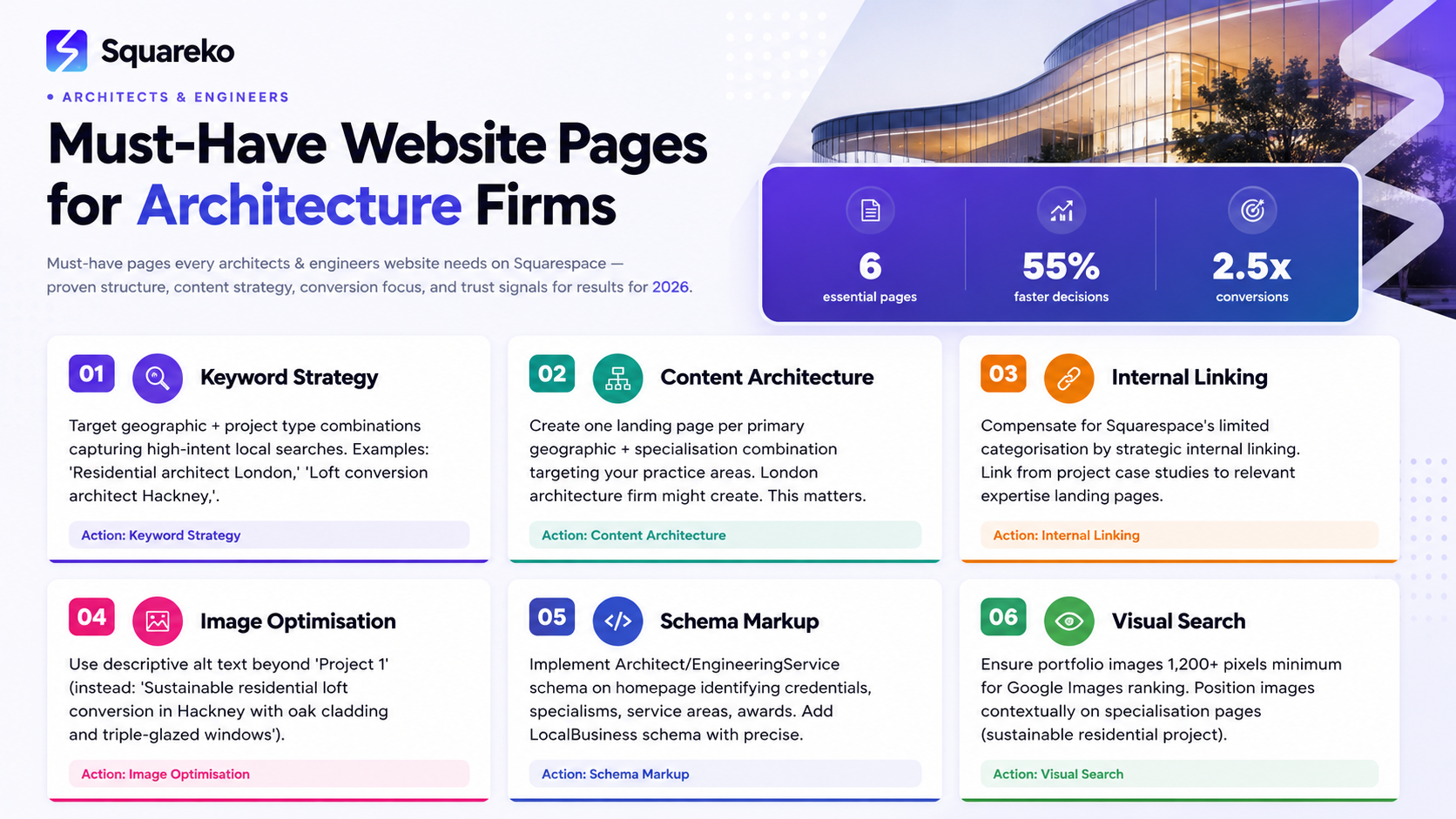
Architecture and engineering SEO keyword research differs fundamentally from most other sectors because prospects search for specific combinations of geography, project type, and expertise.
Primary keyword categories for your practice:
Geographic + project type (high intent, high value)
'Residential architect London'
'Loft conversion architect Hackney'
'Structural engineer Manchester'
'[City] planning consultant'
'Sustainable architect [region]'
Specialised expertise (medium intent, less competition)
'Passive house architect UK'
'Listed building architect'
'Architect for home extension'
'Structural engineer for listed building'
'Building services engineer London'
Problem-solution (high intent, varied competition)
'Who do I need for a loft conversion'
'How to plan a building extension'
'Architect cost for residential project'
'Structural engineer report cost'
Service-specific (mixed intent)
'Architect near me'
'Architects in [postcode]'
'Engineering consultancy [town]'
Squarespace implementation:
Create one landing page per primary geographic + specialisation combination you target. An architecture firm in London might create:
/london-residential-architect/ (general residential work)
/loft-conversion-architect-london/ (specialised high-value keyword)
/listed-building-architect-london/ (heritage specialisation)
/sustainable-architect-london/ (growing practice area)
Each page should have:
Unique, expertise-focused content (800–1,200 words minimum)
3–5 relevant portfolio projects embedded
Client testimonials specific to that specialisation
Schema markup including the target specialisation in knowsAbout field
Internal links to your main practice page and blog expertise content
This approach creates multiple entry points for prospects and signals to AI systems that you have genuine expertise across these areas.
Squarespace Technical SEO for Architecture Practices
Squarespace handles many SEO fundamentals automatically: mobile responsiveness, HTTPS, XML sitemaps, and page speed optimisation. However, three technical areas require active management for competitive architecture firm SEO.
1. Internal linking architecture
Squarespace's navigation is limited; you cannot create sophisticated categorisation structures. Compensate by:
Linking from project case studies to relevant expertise landing pages (a residential extension project should link to /extensions/ and /residential-architect/)
Creating a 'Related Projects' section on each case study page with manual links to similar work
Using blog posts to link to relevant service pages (an article on 'Planning Permission for Loft Conversions' should link to your /loft-conversion-architect/ page)
Adding a sidebar or footer 'Specialisations' menu that links to all practice area pages from every page on your site
2. Image optimisation beyond basic alt text
Architecture firms live or die by visual search. Generic alt text is insufficient. For each portfolio image:
Descriptive alt text: Rather than 'Project 1', use 'Sustainable residential loft conversion in Hackney with oak cladding and triple-glazed windows'
File naming: Save images as sustainable-loft-conversion-hackney-oak-cladding.jpg, not IMG_2847.jpg
Image metadata: Add photographer credits and project details in EXIF data where Squarespace supports it
Image sitemap: Ensure Squarespace is generating image sitemaps (confirm in Google Search Console)
Responsive images: Verify that Squarespace is serving appropriately-sized images at different viewport widths (essential for mobile SEO)
3. Structured data validation and coverage
Use Google's Rich Results Test (search.google.com/test/rich-results) to validate your schema markup implementation. Run tests on:
Your homepage (should validate Organization and Architect/EngineeringService schema)
A representative project case study (should validate Project or PropertyValue schema if applicable)
Your contact/about page (LocalBusiness schema)
Ensure 100% validation. Warnings or errors reduce AI system confidence in your data.
Squarespace Configuration for Architecture and Engineering SEO
Technical configuration matters as much as content strategy. When setting up your Squarespace site for architecture firm SEO, several configuration choices impact your visibility directly.
Squarespace Configuration for Architecture and Engineering SEO (continued)
Squarespace's settings interface includes several options that directly affect SEO performance. Enable all of the following:
Search Engine Indexing: Ensure that your Squarespace site's search engine indexing is enabled. This sounds obvious, but some practices accidentally disable indexing during site development and forget to re-enable it for launch. Verify in Site Settings > Advanced > Search Engine Visibility that your site is set to "Search engines can index this site."
XML Sitemaps: Squarespace generates XML sitemaps automatically. Confirm that your sitemap includes all pages, projects, and blog posts. Submit your sitemap to Google Search Console and Bing Webmaster Tools.
Mobile Responsiveness: Architecture firms publish image-heavy websites. Squarespace handles mobile responsiveness automatically, but verify that your portfolio images render correctly on iOS and Android devices. Test your site using Chrome Dev Tools or physical devices before launching.
Page Speed Optimisation: Squarespace is reasonably quick, but large portfolio images can slow page load times. Use Google Page Speed Insights to test your homepage, a typical project case study page, and a blog post. Target scores of 75+ on mobile and desktop. If scores are lower, optimise images using compression tools or reduce image dimensions slightly.
Visual Search Optimisation for Architecture Images
Architecture and engineering firms benefit disproportionately from visual search because their services are inherently visual. A homeowner searching for 'loft conversion design ideas' on Pinterest or Google Images is demonstrating genuine interest; capturing those searches drives qualified leads.
Google Images optimisation:
Image quality standards: Ensure all portfolio images are at least 1,200 pixels on the longest dimension; Squarespace should handle this automatically, but verify in your site analytics.
Contextual relevance: Images rank in Google Images based on page relevance. An image of a completed sustainable residential project ranks better if it appears on a page about sustainable residential design, not your homepage.
Structured image metadata: Implement the ImageObject schema on key portfolio images:
{
  "@context": "https://schema.org",
  "@type": "ImageObject",
  "url": "https://yoursite.com/images/sustainable-loft-hackney.jpg",
  "name": "Sustainable Loft Conversion in Hackney",
  "description": "Award-winning loft conversion with passive house insulation, triple glazing, and integrated solar thermal heating in a Victorian terraced house.",
  "author": {
    "@type": "Person",
    "name": "Your Architect Name"
  },
  "datePublished": "2025-06-15",
  "creditText": "Photographer Name"
}
Pinterest strategy: Architecture is Pinterest's highest-performing vertical. Create Pinterest boards for each specialisation and practice area. Link from your website's project pages to relevant Pinterest boards. Pinterest links carry SEO value and drive referral traffic from a highly-qualified audience.
AI visual search preparation: AI systems increasingly understand image content without relying on captions. However, they still benefit from explicit schema markup. An image tagged as a 'residential loft conversion with oak cladding' will be correctly identified by AI systems evaluating 'loft conversion design ideas'.
Video content for architecture firms:
Squarespace supports embedded video. Short project walkthroughs (1–2 minutes) showing completed work perform well on both Google and YouTube. These videos should be embedded on project case study pages and optimised with:
Descriptive titles
Full transcripts embedded below the video
Schema markup including Video Object structured data
Frequently Asked Questions
-
A: Prioritise keywords combining geography, project type, and specialisation. Examples: 'residential architect London', 'loft conversion architect Hackney', 'sustainable architect UK'. Avoid broad, low-intent keywords like 'architecture firm' or 'architect near me'—focus on specific geographic + specialisation combinations where you have real expertise. Target 15–25 primary keywords across your site, with additional long-tail variations in blog content.
-
A: Squarespace is appropriate for architecture firms with 20–50 projects, strong design priorities, and willingness to manually implement technical SEO (schema markup, custom code). It handles core SEO fundamentals well but lacks native category taxonomy, faceted filtering, and dynamic template generation. For larger practices with 100+ projects, custom development is preferable. Squarespace's visual presentation quality is a genuine competitive advantage for architecture marketing.
-
A: Large national firms dominate broad searches ('architect UK'). Instead, own specific combinations: geographic + specialisation (your city + your specialism). A 5-person firm cannot outrank large practices for 'residential architect', but can easily rank for 'loft conversion architect [your town]' by creating dedicated expertise content, embedding relevant projects, and targeting that specific keyword cluster. Scale this approach: if you specialise in sustainable design, list building, and extensions, create distinct content pillars for each.
-
A: Yes, but selectively. RIBA and IStructE directories carry high authority weight with Google and AI systems because they verify credentials. Local directories (Yell, Trustpilot) carry value for local SEO. Incentivise satisfied clients to leave reviews on professional directories first, then consumer platforms. Review content should mention specific project types and outcomes (e.g., 'Professional and responsive throughout our loft conversion project').
-
A: Implement LocalBusiness schema with precise geographic information. Create geo-specific landing pages ('Architects in London', 'Architects in Manchester') that list your office locations, service areas, and telephone numbers. Squarespace's limited location functionality means you'll likely build these as regular pages rather than true location pages. Ensure your Google Business Profile is fully completed and linked from your website.
-
A: AI systems (ChatGPT, Claude, Gemini with search integration) draw recommendations from a mix of training data, real-time web search results, and structured information they can parse from websites. A firm ranking #5 on Google for 'residential architect London' has significant probability of appearing in AI recommendations for similar searches. However, AI systems also weight professional credibility signals (RIBA membership, published case studies, third-party reviews) more heavily than traditional SEO algorithms. The two are complementary; invest in both.
-
A: Completed project case studies should be added monthly as you finish work. Blog content should be published bi-weekly minimum if you're competing in crowded local markets. For smaller practices in less-competitive areas, monthly blog publications suffice. Consistency matters more than frequency; a monthly schedule maintained reliably outperforms sporadic bursts of activity.
-
A: Enable search engine indexing in Site Settings, submit XML sitemaps to Google Search Console and Bing Webmaster Tools, verify mobile responsiveness across iOS and Android, and test page speed using Google PageSpeed Insights targeting scores of 75+. Configure Squarespace settings for image optimisation and ensure all portfolio images are at least 1,200 pixels on the longest dimension.
Conclusion
Ranking your architecture or engineering firm on Google and AI search platforms in 2026 requires moving beyond traditional website design. Squarespace provides adequate technical foundations, but competitive advantage comes from deliberate investment in structured data, specialisation signals, and expertise documentation.
The firms winning project inquiries are those that communicate their credibility directly to both human visitors and AI systems. This means explicit schema markup for your professional qualifications, detailed portfolio documentation with project-level metadata, and content architecture that reinforces your specific areas of expertise.
Your competitive advantage lies in specificity. Rather than competing nationally for 'architect', own your local market and specialisations. Become the undisputed authority for sustainable loft conversions in Hackney, or listed building work in Manchester. Create content that directly addresses the challenges your ideal clients face. Implement schema markup that tells AI systems exactly what you specialise in and where you operate.
Squarespace enables this approach when configured thoughtfully. The platform's design quality is a genuine asset for architecture practices. Visual presentation matters in your industry, and Squarespace delivers this better than many alternatives. Combine strong design with systematic technical SEO implementation, and you create a competitive advantage that attracts both direct leads and AI-powered recommendations.
Get Your Free Squarespace SEO Consultation
Is your architecture or engineering firm's Squarespace website optimised for Google and AI search? The Squareko team specialises in helping design practices rank for high-value local searches and establish expertise signals that resonate with both prospects and AI recommendation systems.
Book a free, no-obligation consultation with our Squarespace SEO specialists. We'll audit your current site, identify quick wins for visual search and schema markup implementation, and provide a roadmap for reaching your target clients.
Visit Squareko.com for your free consultation
Architecture Firm Squarespace SEO Checklist 2026
Download your complete checklist below:
Technical SEO Foundation
Implement Architect or EngineeringService schema on homepage
Add Local Business schema with precise geographic information
Verify all schema markup in Google Rich Results Test
Enable XML sitemaps in Squarespace settings
Submit sitemap to Google Search Console and Bing Webmaster Tools
Implement image sitemaps for all portfolio images
Verify mobile responsiveness across iOS and Android devices
Test page speed using Google Page Speed Insights (target: 75+ score)
Content Architecture
Create 3–5 specialisation landing pages
Create 3–5 geographic landing pages
Write 1–2 pillar blog posts (1,500–2,000 words) per specialisation
Create cluster content (500–800 word posts) supporting each pillar
Add internal links from blog posts to relevant service/specialisation pages
Implement 'Related Projects' section on each case study page
Portfolio Optimisation
Add project-level schema markup to all case studies
Create descriptive alt text for all portfolio images
Rename image files to include keywords
Add image metadata (photographer credits, project dates)
Verify images are 1,200+ pixels on longest dimension
Create project testimonials that mention specific specialisations
Visual Search Strategy
Create Pinterest boards for each specialisation
Pin 3–5 project images to relevant Pinterest boards monthly
Link from your website project pages to relevant Pinterest boards
Create 1–2 minute project walkthrough videos
Embed videos on relevant case study pages
Add VideoObject schema markup to embedded videos
Ensure all portfolio images are indexed in Google Images
AI Search Positioning
Document all professional qualifications and memberships
Add professional credential fields to Architect/EngineeringService schema
List all practice specialisations in schema knowsAbout field
Document geographic service areas in schema areaServed field
Add completed projects and awards to schema markup
Encourage client reviews on RIBA and IStructE directories
Publish case studies emphasising client outcomes and project impact
Local SEO
Complete and verify Google Business Profile
Ensure address, telephone, and hours are consistent across all platforms
Implement location pages for each office location
Build local citations in relevant directories
Collect reviews on professional directories
Ongoing Management
Publish blog content bi-weekly (or monthly in less competitive markets)
Add new project case studies monthly
Review Google Search Console for new keyword opportunities monthly
Audit backlinks quarterly; pursue relevant architectural and design directories
Update schema markup when credentials, specialisations, or service areas change
Re-validate all schema markup quarterly using Rich Results Test

Author Bio
I'm Walid Hasan, a Certified Squarespace Expert and Squarespace Circle Platinum Partner with over 12 years of hands-on experience designing and optimizing high-performing websites. Over the years, I've had the privilege of building more than 2,000 Squarespace websites for clients around the world, always focusing on clean design, strong user experience, and conversion-driven results.