How to Build a Nutritionist Website on Squarespace That Converts Visitors to Clients
Introduction
A nutritionist website that converts is built around the client journey, not around you. Prospective clients arrive at your site with a problem—unexplained fatigue, weight gain, IBS, hormonal imbalance, poor athletic performance—and they're searching for someone qualified to help. Your job is to remove friction at every step from first click to consultation booking. This requires strategic page structure, compelling outcome-focused copy, credibility signals that build trust, and frictionless booking systems. On Squarespace, this conversion-first approach is entirely achievable without coding knowledge, and the results speak for themselves: nutrition professionals using these principles consistently report 30-40% higher consultation booking rates than generic websites.
This guide walks you through building a Squarespace nutrition website from homepage structure to booking integration, with specific copy and design strategies proven to move visitors toward action.
Key Takeaways
Structure your site around the client journey, not your credentials: Clients care about whether you can solve their problem. Build pages for each problem or goal you specialise in.
Credibility signals must be visible immediately: Professional registration (HCPC, ANutr, RNutr), university degree, and professional body membership should appear above the fold on your homepage and within the first 100 words of your About page.
Frictionless booking is non-negotiable: Squarespace Scheduling should be integrated on your homepage, services page, and as a prominent CTA throughout your site.
Copy must be outcome-focused, not credential-focused: Avoid "I have a degree in nutrition." Instead, say "I help women aged 35-50 resolve IBS and reclaim energy through personalised nutrition plans."
Trust is built through specific evidence, not generic claims: Reference peer-reviewed research, name the conditions you specialise in, and feature detailed client testimonials.
Professional photography matters: A headshot, your workspace, and food preparation imagery create connection. Stock photos feel impersonal and undermine trust.
Understanding the Nutrition Client Journey
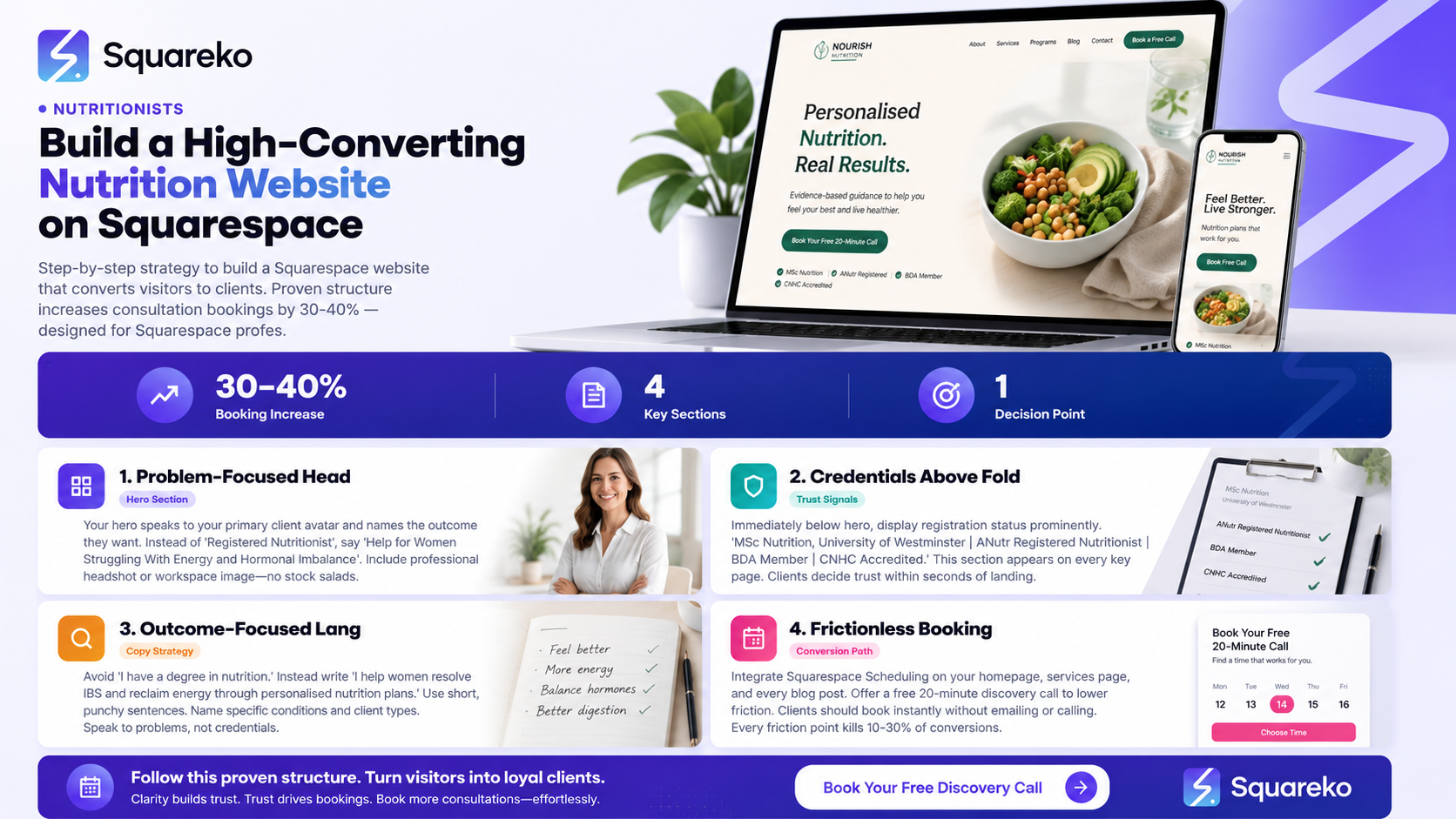
Your prospective client's journey has four distinct stages. Each stage requires a different type of content and design to move them forward:
Awareness: The client recognises they have a problem. They search "why am I always tired," "how to reduce IBS bloating," or "sports nutrition for runners." At this stage, they don't know you exist.
Consideration: The client recognises they need professional help. They search "dietitian for IBS," "nutritionist near me," or "sports nutritionist London." Now they're evaluating whether professionals like you can help.
Decision: The client is ready to work with someone. They're on your website, reading your About page, checking your credentials, and deciding whether to book.
Action: The client books a consultation. Your job is to remove friction—they should not need to email back and forth or fill out a lengthy form to book a 15-minute call.
Your website structure must support this journey. Your homepage must speak to awareness and consideration (what problems you solve, whether you're credible). Your About page must build decision-stage trust (your credentials and approach). Your services page must speak to the decision stage for each specific problem. Your booking page must make action effortless.
Homepage Structure That Converts
Your Squarespace homepage is your first and often only chance to convince a visitor to stay. Use this structure:
Hero Section (above the fold): A headline that speaks directly to your primary client avatar, followed by a subheading that names the outcome they want. Example: "Help for Women Struggling With Energy, Weight, and Hormonal Imbalance" instead of "Registered Nutritionist." Include a clear CTA button: "Book a Free 20-Minute Consultation."
Hero Imagery: Use a professional headshot or image of you in your workspace. Avoid generic stock photos of salads or happy clients; these undermine authenticity. If you're just starting and don't have professional photos yet, a clean, simple background with you visible and warm is better than any stock photo.
Trust Section (immediately below hero): Display your professional credentials prominently. If you're HCPC-registered (dietitian) or ANutr/RNutr registered (nutritionist), feature this with the registration logo and number. Add your university degree and any relevant certifications. Use short, specific language: "MSc Nutrition, University of Westminster | ANutr Registered Nutritionist | BDA Member | CNHC Accredited."
Problems/Goals Section: Create cards or a list showing the specific problems or client types you specialise in. Instead of vague "nutrition support," be specific: "IBS Management," "PCOS Nutrition," "Sports Nutrition for Endurance Athletes," "Postpartum Nutrition for Breastfeeding Mothers." Each card should be clickable and link to a dedicated service page.
Social Proof Section: Feature 3-5 client testimonials. These should be detailed, naming the transformation: "Sarah, age 42: 'After 10 years of IBS symptoms and doctor appointments, I felt hopeless. Within 3 months of working with [Your Name], my symptoms reduced by 80%. I finally have energy again.'" (Always use first name and age only with consent; never use full names without explicit permission.)
CTA Section: A secondary call-to-action, perhaps with slightly different copy: "Ready to take the first step? Book your free consultation now. No obligation, no commitment—just an initial chat to understand your situation and see if we're a good fit."
Blog/Resources Preview: Show your 3-4 most recent or most-viewed blog posts. This signals active content creation and authority. Search engines reward fresh content; having a blog preview on your homepage encourages regular blog updates.
Your About Page: Credentials and Relatability
Your About page must balance credibility and relatability. Too many credentials feel clinical; too much personal story feels unprofessional. Use this structure:
Opening Paragraph (Relatability): Start with why you became a nutritionist. Not "I studied nutrition at university" but something like: "After struggling with my own energy and digestion issues, I discovered how powerfully nutrition can transform health. That's when I knew I had to train as a nutritionist—to help others experience the same shift." This creates connection.
Credentials Section (Credibility): Follow immediately with a dedicated paragraph on qualifications. Be specific and prominent:
"I'm a registered nutritionist (ANutr, Association for Nutrition) with an MSc in Applied Human Nutrition from the University of Westminster. I'm also accredited by CNHC (Complementary and Natural Healthcare Council) and hold a diploma in Sports Nutrition from the International Society of Sports Nutrition. My work is informed by current peer-reviewed research and evidence-based practice."
Professional Memberships: List professional body memberships. If you're a member of BDA, BANT, or CNHC, say so prominently. These memberships signal accountability and adherence to professional standards.
Approach Section: Explain your nutrition philosophy. "I don't believe in restrictive dieting or quick fixes. My approach is personalised, flexible, and built on understanding your unique health history, lifestyle, and goals. I work collaboratively with you to create sustainable changes—not temporary solutions."
Specialisms: Detail the conditions or client types you work with. "I specialise in digestive health (IBS, FODMAP management), women's hormonal health (PCOS, perimenopause, postpartum), and sports nutrition for endurance athletes."
Photo: Include a professional headshot of you. This is critical for trust-building and humanising your practice. If you're just starting out, invest in a professional headshot before your website launch.
Personal Touch (Optional): A brief paragraph on hobbies or interests outside nutrition can humanise you further, but keep this to one sentence. "Outside of work, I'm a keen runner and nutrition is always on my mind when fuelling my training."
Services Page: Problem-to-Solution Framework
Rather than listing services generically ("Individual Consultations: £75/hour"), create dedicated pages or sections for each main problem or client type you serve. Structure each like this:
Service Title: Use outcome-focused language. Not "Weight Management Consultation" but "Sustainable Weight Loss Without Restrictive Dieting."
For Whom: Be specific about your ideal client for this service. "This service is ideal for women aged 25-45 who are tired of dieting, want to understand their hunger and fullness cues, and are ready to build a sustainable approach to eating and movement."
What You'll Address: Bullet-point the specific topics you'll cover. "Hormonal influences on hunger and satiety, understanding your metabolism, breaking restrictive eating patterns, sustainable meal planning, building a healthy relationship with food."
How It Works: Step-by-step explanation. "1. Initial consultation (30 minutes): We discuss your health history, current eating patterns, and goals. 2. Follow-up sessions (8-10 weeks, fortnightly): We implement personalised strategies, adjust as needed, and build sustainable habits. 3. Ongoing support: Optional maintenance sessions to support long-term success."
What Results Look Like: Be honest about realistic outcomes. "Most clients report feeling more energised, less preoccupied with food, and experience gradual, sustainable weight changes (typically 0.5-1kg per week). More importantly, they report improved relationship with food and confidence in their ability to eat intuitively."
CTA Button: A prominent button at the end: "Book Your Initial Consultation."
Testimonial for This Service: If you have a detailed client testimonial specific to this service, feature it. "Sarah, age 38: 'I'd been dieting for 20 years. Within 3 months of working with [Your Name], I stopped counting calories and actually enjoyed eating. Six months in, I've lost weight without restriction, and I feel in control for the first time.'"
Booking and Consultation Page Strategy
Your booking page is where conversion happens. Design it around removing friction:
Clear Headline: "Book Your Free Consultation" or "Schedule a Free 30-Minute Discovery Call." The word "Free" is powerful here; it lowers the barrier.
What to Expect Section: Briefly describe what happens on the call. "In our initial consultation, we'll discuss your health history, current concerns, and goals. I'll ask questions to understand your situation, and you'll have the opportunity to ask any questions about how I work. At the end, we'll decide together whether working together is the right fit."
Consultation Options: Offer multiple options if possible. "Initial consultations are available as 20-minute calls (complimentary, no obligation) or as full paid consultations (45 minutes, £95). If you book the complimentary call, we can discuss a package that suits your needs."
Squarespace Scheduling Integration: Embed your Squarespace Scheduling calendar directly on this page. Ensure time slots are available and timezone is clearly stated. Make the booking process visible and easy—no requirement to email or WhatsApp.
What to Prepare: Give prospective clients guidance on preparation. "If possible, have a pen and paper ready to jot down any notes. If you're booking a paid consultation, we'll have sent you a brief health questionnaire to complete before the call; this helps me prepare."
Timezone Information: If you serve international clients, clearly state your timezone and which times you offer consultations.
What You Need from the Client: Be clear about what information you'll request. "During the consultation booking, you'll be asked for your email address, phone number, and any specific health concerns you'd like to discuss. We keep all information confidential in accordance with GDPR."
Cancel/Reschedule Policy: Clearly state your policy. "We understand life happens. You can cancel or reschedule up to 24 hours before your consultation with no penalty. Cancellations within 24 hours will be charged at 50% of the consultation fee."
Testimonial: A compelling testimonial specific to your consultation booking process: "Mark, age 45: 'I was unsure if booking a consultation was the right step. The initial call was pressure-free, and I left with a clear understanding of my options. That's when I decided to work with [Your Name] for three months.'"
Writing Copy That Converts for Nutrition
The difference between a website that converts and one that doesn't is copy. Follow these principles:
Outcome-Focused, Not Service-Focused: Don't write "I offer individual nutrition consultations." Write "I'll help you understand why you're always tired and create a personalised plan to reclaim your energy."
Specific, Not Generic: "Nutritional support" is meaningless. "Help for women with PCOS who want to stabilise blood sugar without medication" is specific and conversion-focused.
Evidence-Informed, Not Unsubstantiated: Make claims based on evidence. Instead of "This diet will transform your body," say "Evidence shows that increasing fibre intake and reducing refined carbohydrates can significantly improve digestive health and energy levels in most individuals."
Client-Centred Language: Use "you" more than "I." Instead of "I studied nutrition at university," say "You deserve professional guidance based on the latest evidence."
Avoid Banned Phrases: Do not use delve into, leverage, game-changer, seamlessly, robust, cutting-edge, best-in-class, synergy, paradigm shift, holistic, empower, navigate, "In conclusion," "Furthermore," "It is worth noting," "In today's digital landscape," or "In the ever-evolving world of." These feel corporate and distance you from your audience.
Short Sentences and Varied Rhythm: Mix short, punchy sentences with longer ones. "You're exhausted. You've seen doctors. Tests come back normal. Nothing makes sense. That's where nutrition comes in—a missing piece many people overlook."
Specific Case Studies Over Generic Benefits: Instead of "Improved energy and wellbeing," write "Emma's fatigue improved so dramatically in the first month, she started running again for the first time in five years."
Trust Signals Specific to Nutrition Professionals
Build trust through specific signals tailored to nutrition:
Professional Registration and Credentials: If you're HCPC-registered (dietitian), ANutr or RNutr registered (nutritionist), place registration logos and numbers prominently on your homepage, About page, and consultation booking page. Clients increasingly understand the distinction between registered and unregistered practitioners; registration is your strongest trust signal.
University Degree: Name the university and degree. "MSc Applied Human Nutrition, University of Westminster" is more credible than "nutrition qualification." Clients often research universities; specific names build confidence.
Continuing Professional Development: Mention recent training. "Recently completed advanced training in gut microbiome assessment (Microbiome Labs, 2024)" signals current knowledge.
Professional Memberships: BDA, BANT, CNHC, Association for Nutrition—display logos and membership numbers.
Insurance: Professional indemnity insurance is standard for nutrition professionals. Mention it: "Fully insured with professional indemnity cover through [Provider]." This protects clients and signals accountability.
Evidence-Based Approach: Link your content to peer-reviewed research. In your About section or blog, reference studies. "My approach is informed by current research, including studies on the gut-brain axis (Nature Neuroscience, 2023) and the effects of ultra-processed foods on metabolic health."
Condition-Specific Expertise: The more specific, the more trustworthy. "I specialise in managing PCOS through nutrition and blood sugar regulation" is stronger than "Women's health support."
Client Testimonials with Specifics: Generic testimonials ("Great nutritionist!") don't convert. Detailed ones do: "Sarah, 41: 'For years, I felt hopeless about my IBS. After three months with [Name], my symptoms improved 70%, and I actually understand what foods work for my body. I no longer fear eating.'"
GDPR and Health Data in Consultation Forms
Nutrition is health data. Under GDPR, health information is a special category of personal data and requires heightened protection. Ensure your website and consultation booking process are compliant:
Consultation Intake Form: When booking, avoid asking sensitive health questions through your booking form. Instead, ask only: name, email, phone, and brief health concern summary ("I have IBS symptoms," "I want to improve my sports nutrition"). More detailed health questions should happen during the consultation, not in a public web form.
Data Protection Statement: On your booking page, include a brief statement: "We take your privacy seriously. All health information you provide is treated as sensitive personal data and protected under GDPR. We will never share your information with third parties without your explicit consent."
Separate Privacy Policy: Create a dedicated Privacy Policy that specifies:
What data you collect (name, email, phone, health information from consultations).
How you store it (encrypted, password-protected consultation notes in [Zoom recording, secure cloud folder, consultation management software]).
How long you retain it (typically 6 years for UK practitioners for liability purposes).
Your lawful basis for processing (consent: the client consents when they book a consultation).
Client rights (they can request to view, correct, or delete their data).
Squarespace Settings: Squarespace has built-in privacy settings. Ensure GDPR compliance is enabled in your account settings, and that booking forms include a checkbox: "I consent to processing my health information as outlined in our Privacy Policy."
Third-Party Tools: If you use tools like Calendly, Zoom, or email for consultations, ensure they're GDPR-compliant and that clients know this. Mention in your Privacy Policy: "Consultations are conducted via Zoom, which is GDPR-compliant for health data under their Business Associate Addendum."
Photography and Imagery Strategy
Professional photography dramatically increases conversion rates. Here's what to shoot:
Professional Headshot: This is essential. Invest in a professional photographer (£150-300 for a 1-2 hour session with 20-30 edited images). Key elements: warm lighting, professional clothing (business casual, nothing too trendy), neutral background, genuine smile, eye contact with camera.
Workspace Imagery: A photo of you in your consultation space (home office, clinic, etc.) humanises your practice. This should be tidy and professional but real—not a stock photo set.
Food and Meal Preparation: If you use food imagery, show real meals, not styled stock photos. Photos of you preparing a meal, diverse meals on plates, or realistic grocery shopping work well. Avoid overly styled, unattainable food photography that could trigger eating disorder concerns.
Avoid Stock Photos: Stock images of salads, smiling women, or generic "health" imagery undermine trust. Real photos are always better.
Eating Disorder Awareness in Imagery: Avoid before-and-after body transformation photos unless you specifically work with weight management and have explicit client consent. Avoid food restriction imagery (extreme salads, tiny portions). Avoid fitness transformation imagery that ties food to body composition in a moralistic way.
Mid-Post CTA
You now understand the structure and strategy for a nutrition website that converts. But implementation is where most practitioners struggle—the technical setup, copywriting, credibility signal placement, GDPR compliance, booking integration. This is why many nutritionists build websites that look professional but fail to convert visitors into clients.
Squareko specialises in building high-converting Squarespace websites for nutrition professionals. We've built 100+ websites for registered dietitians, ANutr/RNutr nutritionists, sports nutritionists, and nutrition coaches. We know exactly how to structure your site for conversion, write copy that moves prospective clients toward booking, integrate Squarespace Scheduling, ensure GDPR compliance, and optimise for local SEO so clients in your area find you first.
Start your Squareko nutrition website project today. We'll handle the design, structure, copy, credibility signals, booking integration, and compliance—so you can focus on doing what you do best: helping clients through nutrition.
Frequently Asked Questions
-
For a free initial consultation, 15-30 minutes is ideal. It's long enough to build rapport and understand the client's situation, but short enough that clients feel comfortable committing with no obligation. For paid initial consultations, 45-60 minutes is standard, allowing deeper assessment and initial recommendations. Many practitioners offer a free 15-20 minute call to determine fit, then move to a paid 45-minute assessment if both parties want to proceed.
-
This depends on your practice model. If you're new and building your client base, a free initial consultation reduces friction and builds your testimonial bank. If you're established with consistent demand, charging for the initial consultation (typically £50-100) attracts serious clients and covers your time. A hybrid approach—free 20-minute consultation, paid 45-minute assessment—works well.
-
Ask clients for specific details: their age (or age range with consent), their main problem before working with you, the specific change they noticed, and how it affects their daily life now. Instead of "Great nutritionist," capture: "Mark, 48: 'I had zero energy and couldn't understand why. After six weeks with [Your Name], I identified my triggers, changed my meal timing, and can run 10km again. I actually look forward to eating now.'"
-
Ask your first clients if they'd be willing to provide detailed feedback in exchange for a discount on future sessions. Be explicit about what you're asking: "I'm building my testimonials. Would you be willing to share how your experience with me has changed your health? I'd offer you 20% off your next package in return." Most clients are happy to do this.
-
Use research-backed language: "Evidence shows that increasing fibre intake can improve digestive comfort." Avoid absolute claims: Instead of "This will cure your IBS," say "Many clients report significant improvement in IBS symptoms through these evidence-based strategies." Avoid medical terminology: Instead of "treat" or "cure," use "support," "manage," "improve," or "address." When in doubt, include a disclaimer: "This is not medical advice. Always consult with your GP before making dietary changes."
-
No. Keep the booking form minimal: name, email, phone, brief summary of their concern. Longer health assessments should happen during the consultation itself, not in a public web form (which isn't securely encrypted by default). This also reduces friction—people are more likely to book if the form takes 30 seconds, not 5 minutes.
-
Update your blog at least monthly (ideally fortnightly) with nutrition content relevant to your specialism. Update testimonials and case studies as you work with new clients. Refresh your services pages annually or when your service offerings change. Review your homepage monthly to ensure CTAs are working and booking paths are frictionless. Most practitioners see stable conversion after the first three months of launch.
-
Create a dedicated service page for each specialism. This improves SEO (clients searching "IBS nutritionist" will find your IBS page) and increases conversion (clients see a page built specifically for their problem, not a generic services list). Use Squarespace's navigation to keep main menu clean; secondary services can live under a "Services" dropdown or have their own menu items if space allows.
Build Your High-Converting Nutrition Website
You now have a complete strategy for building a Squarespace website that converts visitors into clients. Implementation is where the real work begins—and where most nutrition professionals struggle. Choosing a template is one thing; structuring your site for conversion, writing copy that moves prospective clients toward booking, integrating frictionless scheduling, ensuring GDPR compliance, and building trust through credibility signals requires expertise and attention to detail.
Squareko specialises in exactly this work. We design and launch Squarespace websites for nutrition professionals that are professionally designed, fully compliant, and generate consistent client bookings. We handle:
Strategic site structure and page hierarchy built around the client journey.
Outcome-focused copywriting that speaks to your ideal client's problems.
Prominent credibility signals (registration numbers, professional memberships, university degrees).
Frictionless Squarespace Scheduling integration.
Full GDPR compliance for health data.
Professional photography guidance and integration.
Blog strategy and content planning.
Local SEO optimisation so clients in your area find you first.
From custom website design to SEO strategy, we help businesses launch a site that looks professional and performs better.

About the Author
Walid is the founder of Squareko.com,
I'm Walid Hasan, a Certified Squarespace Expert and Squarespace Circle Platinum Partner with over 12 years of hands-on experience designing and optimizing high-performing websites. Over the years, I've had the privilege of building more than 2,000 Squarespace websites for clients around the world, always focusing on clean design, strong user experience, and conversion-driven results.