
BDA, ANutr and GDPR Compliance for Nutritionist Websites on Squarespace
Introduction
Professional credibility in nutrition rests on more than expertise—it rests on regulatory compliance and adherence to professional standards. In the UK, the distinction between a registered dietitian (HCPC-regulated) and a nutritionist (unregulated but may hold ANutr/RNutr registration) is legally and professionally significant. Your website must reflect this distinction accurately and honestly. Simultaneously, your website must comply with GDPR when handling client health data, follow BDA marketing standards if you're a registered dietitian, adhere to ANutr standards if registered with the Association for Nutrition, and comply with health claims regulations that govern what you can and cannot claim about nutrition and health. This is complex territory, and compliance mistakes can result in professional censure, client legal action, and reputational damage. This guide walks nutrition professionals through the compliance landscape, with specific guidance for Squarespace website implementation.
Please note: This guide is educational and not legal advice. For specific legal questions, consult a solicitor specialising in health professional regulation or GDPR.
Key Takeaways
Dietitian vs. nutritionist distinction is legally binding: HCPC-registered dietitians must clearly identify as such. Unregistered practitioners calling themselves nutritionists must not claim credentials they don't hold.
BDA advertising standards apply to registered dietitians: Marketing materials must be accurate, evidence-based, not misleading, and must not make unsubstantiated health claims.
ANutr and RNutr registration requires standards compliance: Registered nutritionists must adhere to Association for Nutrition standards and declare registration status on websites.
Health data under GDPR is special category data: Nutritional and health information requires heightened protection, explicit consent, and careful data handling protocols.
Health claims regulations limit what you can state on a nutrition website: EU and UK nutrition and health claims regulations restrict claims about disease prevention, treatment, or cure.
Professional indemnity insurance is essential and must be disclosed: Display insurance details on your website to signal accountability and protect both you and your clients.
Registered Dietitian vs. Nutritionist: Legal and Professional Distinction
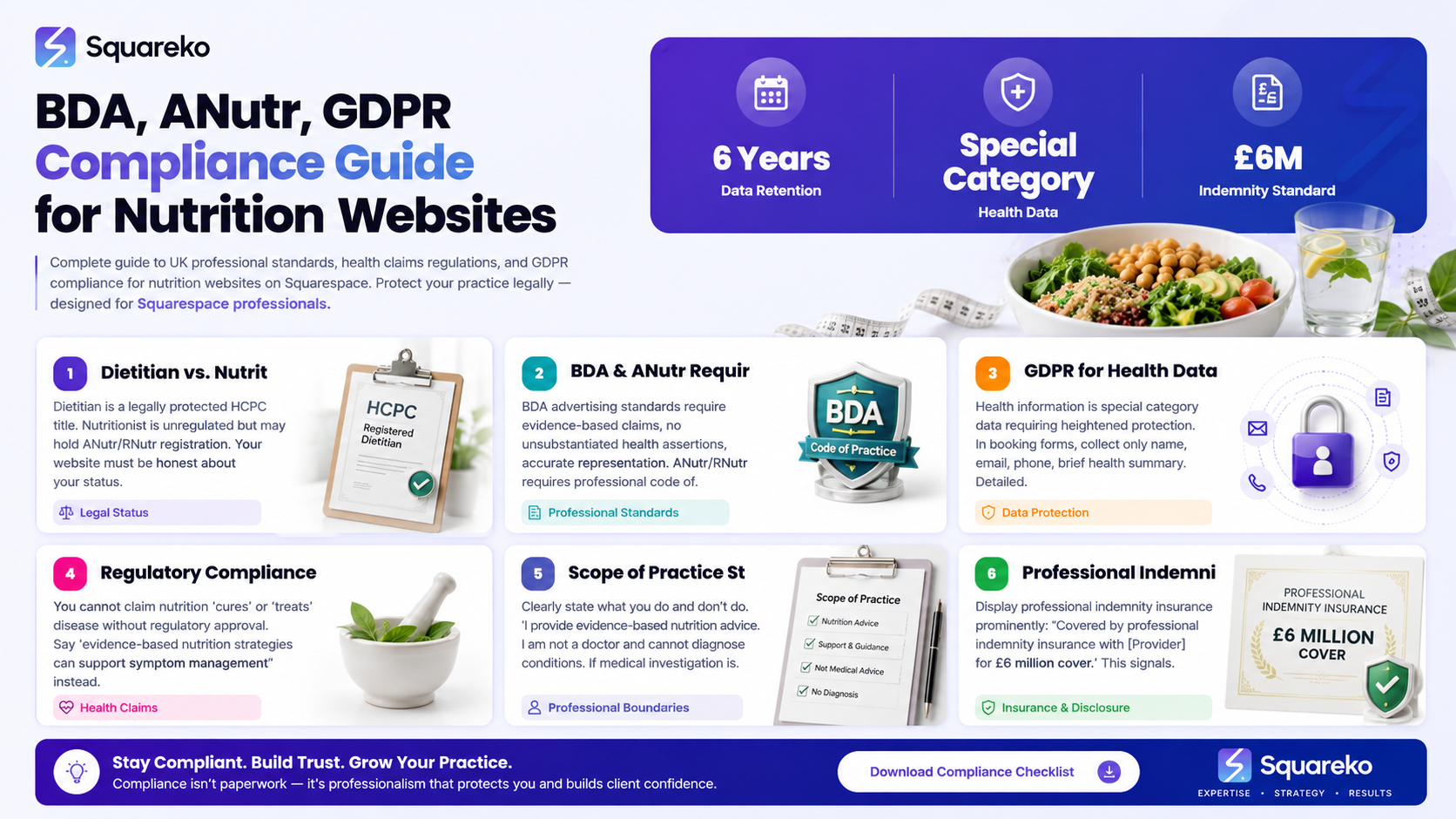
In the UK, "dietitian" is a legally protected title. Only HCPC-registered professionals may call themselves dietitians. This distinction must be clearly communicated on your website.
Registered Dietitian (HCPC): If you're HCPC-registered, your website must clearly state this. Include your HCPC registration number (e.g., "HCPC Registered: DT12345678"), the professional designation "Registered Dietitian," and the HCPC logo (available from HCPC or through HCPC's design guidelines). Your qualifications typically include a degree accredited by the British Dietetic Association and supervised practice experience.
BDA members often display both their HCPC registration and BDA membership. Example: "Jane Smith, MSc Applied Clinical Nutrition, University of Reading | Registered Dietitian (HCPC: DT98765432) | British Dietetic Association Member."
Nutritionist (Unregistered): If you're not HCPC-registered, you cannot use the title "Registered Dietitian." You may use "Nutritionist" if you hold credentials from a recognised nutrition qualification programme, but the title itself is not regulated. You may, however, hold registration from the Association for Nutrition (ANutr or RNutr), which is a voluntary professional registration scheme.
If you're ANutr/RNutr registered, state this on your website: "Jane Smith, MSc Applied Clinical Nutrition, University of Westminster | ANutr Registered Nutritionist | Association for Nutrition Member."
If you're unregistered (no HCPC, no ANutr/RNutr), you must avoid implying credentials you don't hold. Acceptable: "Jane Smith, Certified Nutrition Coach, Institute of Functional Medicine." Not acceptable: "Jane Smith, Clinical Nutritionist" (implies clinical registration you don't have) or claiming qualifications you don't hold.
Why This Matters: Clients increasingly understand the regulated/unregulated distinction. Many health insurance companies and referral networks require HCPC registration. Your website must be honest about your credentials—misrepresenting them is unprofessional, potentially illegal (under Consumer Protection from Unfair Trading Regulations), and damages trust.
BDA Advertising Standards and Marketing Compliance
If you're a BDA member, your advertising and marketing (including your website) must comply with BDA Advertising Standards. These standards require that:
Marketing is Accurate and Evidence-Based: Claims must be supported by current scientific evidence. Don't claim "This diet cures IBS" when the evidence shows "Evidence-based nutrition strategies can significantly improve IBS symptoms for many individuals."
Marketing is Not Misleading: Avoid language that implies certainty when the reality is probabilistic. Instead of "You will lose weight," say "Most clients experience gradual, sustainable weight changes through these evidence-based strategies."
No Unsubstantiated Health Claims: You cannot claim a dietary intervention treats, cures, or prevents disease without robust evidence and appropriate regulatory approval. Avoid language like "Detox your liver," "Cleanse your system," or "Cure your bloating."
Professional Photographs and Honest Representation: If you feature before-and-after client photos, ensure they represent realistic outcomes and have explicit client consent. Avoid exaggerated or unrealistic transformations that set unrealistic expectations.
No Comparison or Denigration of Other Practitioners: Your marketing should not criticise other healthcare providers or practitioners or imply that nutrition is a substitute for medical care when medical care is appropriate.
Clear Professional Boundaries: Your website must make clear that nutrition is a complementary healthcare approach and that clients should continue to work with their GP or medical team for diagnosed conditions.
BDA Membership Logo: If you're a BDA member, you can display the BDA logo on your website, provided you meet current membership standards. The logo signals professional standards compliance to prospective clients.
Example of BDA-compliant claim: "Evidence shows that increasing fibre intake and reducing refined carbohydrates can improve digestive health in many individuals. I work with evidence-based strategies to support your digestive wellness, always in consultation with your medical team."
Association for Nutrition (ANutr/RNutr) Professional Standards
If you're registered with the Association for Nutrition (ANutr for associate members, RNutr for registered members), your website must reflect adherence to their professional standards:
ANutr/RNutr Registration Must Be Prominent: Display your registration status clearly. Include your registration number if you have one (e.g., "ANutr Reg: 12345"). The Association for Nutrition provides guidance on how to display registration credentials on your website.
Professional Code of Conduct Compliance: ANutr/RNutr members must adhere to the Association for Nutrition's Code of Professional Conduct, which covers:
Practice and conduct based on evidence.
Honest and accurate representation of qualifications and experience.
Respect for client confidentiality and privacy.
Professional boundaries and appropriate referral to medical professionals.
Your website should reflect this: Use evidence-based language, avoid overstated claims, and include a statement about when you recommend medical referral. Example: "If I identify signs that medical investigation is needed, I'll recommend you speak with your GP to rule out underlying health conditions."
Continuing Professional Development (CPD): ANutr and RNutr require ongoing professional development. If you've completed recent CPD (which you should, to maintain registration), mention it on your website. "Completed advanced training in the FODMAP approach (BANT, 2024)" signals current knowledge.
Scope of Practice: Your website should make clear the scope of what you offer. ANutr/RNutr registration doesn't extend to medical diagnosis or treatment; your website should reflect this. "I work with you to understand your current eating patterns and recommend evidence-based nutrition strategies to support your health goals. If medical conditions are present, I recommend working alongside your medical team."
What Must Appear on Your Nutrition Professional Website
Regulatory bodies and professional standards require specific information on nutrition professional websites. Ensure your Squarespace site includes:
Professional Qualifications and Registration:
University degree(s) with institution name (e.g., "MSc Applied Clinical Nutrition, University of Westminster").
HCPC registration number (if applicable).
ANutr/RNutr registration number (if applicable).
BDA membership (if applicable).
Any other relevant professional qualifications or accreditations.
Professional Memberships and Accreditations:
BDA, BANT, CNHC, Association for Nutrition, or other professional body memberships.
Display logos of these bodies (if permissions are obtained).
Professional indemnity insurance provider and cover level (e.g., "Insured with [Provider] for £6 million professional indemnity cover").
Services and Scope:
Clear description of what you do offer (e.g., "One-on-one nutrition consultations for digestive health").
Clear description of what you don't do (e.g., "I don't provide medical diagnosis or treatment. If you have diagnosed medical conditions, I recommend working with both your GP and a dietitian").
Professional Boundaries:
A statement about when you recommend medical referral: "If I identify signs that medical investigation is needed, I recommend you speak with your GP."
A clear disclaimer about the limitations of nutrition advice: "Nutrition advice is not a substitute for medical care. Always consult your GP before making significant dietary changes, especially if you have diagnosed medical conditions or take medications."
Contact Information:
Professional email address.
Phone number (optional, but useful for client contact).
Professional address (can be a registered office, not necessarily a home address).
Hours of availability (e.g., "Available for consultations Monday-Friday, 9am-5pm GMT").
Privacy and Data Protection
Link to your Privacy Policy (required under GDPR).
Link to your Cookie Policy (required under UK PECR).
Statement about how you protect client health data.
GDPR Compliance for Health Data
Health information—including nutritional assessments, dietary patterns, and health history—is classified as "special category personal data" under GDPR. This means you must adhere to heightened data protection requirements.
Lawful Basis for Processing: You can process health data only if you have a lawful basis. For nutrition professionals, the lawful basis is typically explicit consent: the client explicitly agrees to you processing their health information as part of the nutrition consultation.
Implement this in your Squarespace booking form: Include a checkbox that reads, "I consent to Your Name processing my health information as outlined in the Privacy Policy, for the purposes of providing nutrition support." Clients must actively check this box; it cannot be pre-ticked.
Data Minimisation: Collect only the health information you need. In your booking form, ask only: name, email, phone, and brief health summary. More detailed health assessment happens during the consultation, not in a public web form.
Secure Storage: Consultation notes containing health information must be stored securely:
Encrypted folders on secure cloud storage (Google Drive, Dropbox, iCloud, with two-factor authentication).
Password-protected files.
Never stored in unencrypted email.
Never stored on a personal or unsecured computer.
Specify in your Privacy Policy where you store health data: "Consultation notes are stored in encrypted cloud storage Provider and are password-protected. Only you and I have access to your information."
Data Retention: Decide how long you'll retain health data and state this in your Privacy Policy. Most UK practitioners retain consultation notes for 6 years (for liability purposes if a client later brings a complaint). Example: "I retain consultation notes for 6 years after our final session, then securely delete them."
Subject Access Rights: Under GDPR, clients can request to see all their personal data within 30 days. Ensure you can provide this. Example statement: "If you request to see your information, I will provide a copy within 30 days."
Data Breach Notification: If a client's health data is breached (e.g., email hacked), you must inform the client and potentially the ICO (Information Commissioner's Office) within 72 hours. Include a statement in your Privacy Policy: "In the unlikely event of a data breach, I will notify you within 72 hours and take immediate steps to remediate."
Right to Erasure ("Right to be Forgotten"): Clients can request deletion of their data. Be clear about your policy: "You can request deletion of your information at any time. If you request deletion before our consultation relationship ends, we'll discuss whether this affects our ability to work together."
Third-Party Sharing: You cannot share a client's health information with anyone (including family members, other practitioners, or medical professionals) without explicit consent. Your Privacy Policy must state this clearly: "I will never share your health information with third parties without your explicit written consent."
Nutrition and Health Claims Regulations
Under UK and EU nutrition and health claims regulations, you cannot make claims about nutrition preventing, treating, or curing disease without robust evidence and appropriate regulatory approval. These regulations are enforced by the Food Standards Agency (FSA) and Trading Standards.
Examples of Non-Compliant Claims:
"Detox your liver" (implies treatment of disease; not substantiated).
"This plan cures IBS" (medical claim without regulatory approval).
"Our supplement prevents heart disease" (disease prevention claim without approval).
"Eliminate inflammation" (unsubstantiated and absolute claim).
Examples of Compliant Claims:
"Evidence shows that increasing fibre intake can support digestive comfort" (evidence-based, uses "support" rather than medical terminology).
"Many clients report improved energy and digestion after implementing these evidence-based strategies" (references research, acknowledges individual variation).
"A balanced diet rich in vegetables and whole grains is associated with better health outcomes" (supported by evidence, uses association rather than causation).
Scope Limitations: If a client has a diagnosed medical condition (IBS, PCOS, diabetes), be clear that you provide nutritional support, not medical treatment:
"I provide evidence-based nutrition support for IBS. If you have a diagnosed medical condition, I recommend working with your medical team alongside our nutrition work."
"I can support your PCOS management through nutrition strategies. These work best alongside medical care from your GP or gynecologist."
Disclaimer Placement: Include a prominent disclaimer on your website, ideally in multiple places:
On your services pages: "Nutrition support is not a substitute for medical care. Always consult your GP before making dietary changes, especially if you have diagnosed medical conditions."
In your booking confirmation email: "Our nutrition consultations are complementary to, not a replacement for, medical care."
In your About section: "I work in partnership with medical professionals when medical conditions are present."
Privacy Policy Requirements for Nutrition Websites
Your Privacy Policy must clearly explain how you handle client data, especially health information. Squarespace provides a template, but you must customise it for nutrition-specific requirements. At minimum, include:
What Data You Collect:
Personal data: name, email, phone, address.
Health data: health history, dietary patterns, current health concerns, food sensitivities, medications.
How You Collect It:
Booking form (minimal health questions).
Consultation intake form (detailed health assessment during consultation).
Consultation notes (documented during consultation).
Why You Collect It (Lawful Basis):
Explicit consent: "You explicitly consent to me processing your health information when you book a consultation and agree to my Privacy Policy."
Contract: "Processing is necessary to provide the nutrition consultation service you've requested."
How You Store It:
Encrypted cloud storage: [specify provider, e.g., "Google Drive with two-factor authentication"].
Password-protected files.
Not in unencrypted email.
How Long You Keep It:
Consultation notes retained for 6 years (or your chosen period) after final session.
Contact details retained as long as you're in contact; deleted upon client request.
Who Has Access:
Only you (and if you work in a group practice, other practitioners with explicit consent).
Never shared with third parties without explicit consent.
Possible exception: Required by law (e.g., a court order), with notice to the client where legally possible.
Client Rights:
Right to access: Request to see all their data (within 30 days).
Right to correct: Request to correct inaccurate data.
Right to erasure: Request deletion of their data.
Right to data portability: Request their data in a portable format.
Right to object: Object to processing in certain circumstances.
Right to complain: Contact the ICO if they believe their rights are violated.
Data Processor (if applicable)
If you use a consultation management system, email provider, or video platform for consultations, name them. Example: "Consultations are conducted via Zoom, which acts as a data processor. Zoom is GDPR-compliant under their Data Processing Agreement."
Cookie Policy and Consent Management
Squarespace uses cookies for analytics and functionality. You must have a Cookie Policy and comply with UK PECR (Privacy and Electronic Communications Regulations).
Squarespace Default Cookies: These include:
Functionality cookies (remember login, cart items).
Analytics cookies (Google Analytics, tracking user behaviour).
Your Obligation: Inform visitors about cookies and obtain consent before setting non-essential cookies (analytics). Squarespace provides a cookie consent banner; ensure it's enabled on your site (Settings → Legal → Cookie Policy).
Cookie Policy Statement: Add to your website footer or privacy section: "This website uses cookies to improve your experience. Functionality cookies are essential and cannot be turned off. Analytics cookies help us understand how visitors use our site and are optional. By continuing to browse this site, you consent to the use of cookies as described in our Cookie Policy."
Consent Banner: Squarespace's built-in consent banner allows visitors to accept or decline non-essential cookies. Ensure it's active: Settings → Advanced → Cookie Policy → Enable Cookie Policy Banner.
Professional Indemnity Insurance Disclosure
Professional indemnity insurance protects you and your clients in case of client complaints or claims of negligence. It's standard for nutrition professionals and signals accountability.
Mandatory Disclosure: Many professional bodies (CNHC, BANT) require members to display insurance details on their website. Even if not mandatory, it's professionally appropriate.
What to Display:
Insurance provider name (e.g., "Insured with ProfessionalCover®").
Cover limit (e.g., "£6 million professional indemnity cover").
Year policy is current (e.g., "2024-2025").
Where to Display:
Homepage footer.
About page.
Contact/booking page.
Any page with your credentials.
Example Statement: "I hold professional indemnity insurance with [Provider] for £6 million cover. My insurance policy is current and reviewed annually."
This signals to clients that you're professionally accountable and that they're protected if issues arise.
Mid-Post CTA
Professional compliance is not optional—it's the foundation of a trustworthy nutrition practice. However, navigating BDA advertising standards, ANutr/RNutr requirements, GDPR health data regulations, and health claims restrictions is complex. Many nutrition professionals build websites that are professionally designed but non-compliant with regulations, which can result in client complaints, professional censure, or legal action.
Squareko specialises in building fully compliant Squarespace websites for UK nutrition professionals. We understand BDA, ANutr, HCPC, GDPR, and health claims regulations. We ensure your website:
Accurately displays your registration status and credentials.
Complies with professional standards (BDA, ANutr, CNHC, BANT).
Includes proper GDPR compliance for health data handling.
Uses evidence-based, legally compliant health claims language.
Features required professional disclosures (insurance, qualifications, professional boundaries).
Start your compliant Squareko nutrition website today. We'll review your credentials, ensure your website reflects professional standards, integrate compliant booking and data handling, and build a site that protects both you and your clients legally and professionally.
Frequently Asked Questions
-
Yes, but only if you hold relevant nutrition credentials. "Nutritionist" is not a legally protected title, but you must not misrepresent your qualifications. If you're ANutr/RNutr registered, state this prominently. If you have a relevant degree (e.g., MSc Nutrition), name it. If you're completely unqualified and just interested in nutrition, you cannot legally call yourself a nutritionist. Use "Nutrition Coach" or "Nutrition Consultant" only if you have some formal training or certification.
-
ANutr (Associate Member of the Association for Nutrition) is for practitioners with a relevant first degree (not necessarily in nutrition) and who are working towards registration. RNutr (Registered Member of the Association for Nutrition) is for practitioners with a relevant nutrition degree or equivalent experience and full professional registration. RNutr is stronger from a credibility perspective. Both require adherence to the Association for Nutrition Code of Professional Conduct and CPD.
-
Yes. It's professionally responsible and often required by professional standards. A clear disclaimer reduces client confusion about the scope of nutrition support and protects you legally if a client claims they relied on nutrition advice instead of seeking medical care. Example: "Nutrition support is complementary to, not a replacement for, medical care. Always consult your GP before making significant dietary changes, especially if you have diagnosed medical conditions."
-
You can ask for basic information in your booking form: name, email, phone, and brief summary of their concern. More detailed health assessment (medical history, medications, food sensitivities, current eating patterns) should happen during the consultation itself, not in a public web form. This protects the client's data security and respects data minimisation principles.
-
Cloud storage is safer and GDPR-compliant if encrypted and password-protected. Local storage on a personal computer is risky: if your computer is lost, stolen, or hacked, client health data is exposed. GDPR requires "security appropriate to the risk." Encrypted cloud storage (with two-factor authentication) is the professional standard. Never store health data in unencrypted email.
-
Depending on the severity, you could face: Trading Standards enforcement action, professional body censure (if a member of BDA, BANT, CNHC, etc.), client complaints, or reputational damage. Common issues include claims like "Detox your system," "Cure IBS," or "Prevent disease," which are either unsubstantiated or breach health claims regulations. If you're unsure whether a claim is compliant, avoid it or rephrase using evidence-based, qualified language.
-
Yes. Under GDPR, you cannot share a client's health information with anyone (including their GP, family members, or other practitioners) without explicit written consent. You can ask during your initial consultation: "If your GP or another healthcare provider needs information about our nutrition work, may I share relevant notes with them?" Most clients consent to this, but you must ask first and document their consent.
-
Professional indemnity insurance protects you and your clients if a client claims you provided negligent advice that harmed them. It's essential for nutrition professionals and is required or strongly recommended by professional bodies (CNHC, BANT). Displaying it on your website signals accountability and professional standards compliance. It also assures clients that they're protected if issues arise.
Ensure Your Website is Fully Compliant
Professional compliance isn't something to address "later"—it's the foundation of a trustworthy practice. Yet many nutrition professionals build beautiful websites that lack critical compliance elements: accurate credential display, proper disclaimer language, GDPR-compliant data handling, or professional indemnity insurance disclosure.
Squareko specialises in building fully compliant Squarespace websites for UK nutrition professionals. We understand the regulatory landscape and build sites that:
Accurately display your registration status and credentials (HCPC, ANutr, RNutr, BDA, CNHC, etc.).
Comply with BDA advertising standards and ANutr/RNutr professional standards.
Implement GDPR compliance for health data handling and storage.
Use evidence-based, legally compliant health claims language.
Feature all required professional disclosures.
Protect your practice and your clients legally and professionally.
Start your compliant Squareko nutrition website today. We'll audit your credentials, ensure full compliance with professional standards and regulations, and build a website that's professional, trustworthy, and legally sound.

From custom website design to SEO strategy, we help businesses launch a site that looks professional and performs better.

About the Author
Walid is the founder of Squareko,
I'm Walid Hasan, a Certified Squarespace Expert and Squarespace Circle Platinum Partner with over 12 years of hands-on experience designing and optimizing high-performing websites. Over the years, I've had the privilege of building more than 2,000 Squarespace websites for clients around the world, always focusing on clean design, strong user experience, and conversion-driven results.
