How to Write a Career Coach About Page That Gets Discovery Calls
Introduction
Your About page is the second most-visited page on your website (after the homepage). It's where professionals who've glimpsed your value proposition go to decide: Is this coach right for me? Can I trust them?
Career coaches face a unique challenge: your clients are typically high-earning, skeptical professionals who evaluate you against multiple competitors. They want proof--not just a story. They're making a five-figure investment decision, and your About page must answer their unspoken questions in the first 30 seconds.
Unlike generic About page templates that emphasize your personal journey (When I was lost in my career...), a career coach About page must balance three elements: credibility signals, authentic storytelling, and client focus. This guide walks you through a proven copy framework that converts site visitors into discovery call bookings.
Key Takeaways How to Write a Career Coach About Page That Gets Discovery Calls
- Lead with credentials, not story: Professionals scan credentials before they read narrative. Put your certifications and experience front and center.
- Use the Client-First storytelling framework: Your story matters only insofar as it proves you understand their challenge.
- Display social proof immediately: Testimonials, outcome metrics, and client achievements build trust faster than your credentials alone.
- Create a clear client profile: Specificity (not broad appeal) wins with high-ticket professionals. - End with one clear CTA: Book a discovery call beats vague get in touch messaging. - Leverage LinkedIn integration: Embed your LinkedIn profile to extend credibility signals. - Keep copy concise: Professionals skim. Paragraphs under 3 sentences. Plenty of white space.
Why Your About Page Matters
Career coaches often underestimate the About page. They assume their homepage headline or services page does the heavy lifting. But research shows:
- 77% of coaches' website visitors visit the About page before deciding whether to book a discovery call
- Professionals spend an average of 2 minutes on an About page--roughly 400-600 words of reading - Specific information (credentials, outcomes) drives decisions more than storytelling for high-ticket professional services
- Trust is built in 3 seconds or lost forever: If your credibility isn't clear in the first three sentences, professionals leave
Think of your About page as a private conversation between you and your ideal client. They're thinking:
1. Does this coach understand my specific career challenge?
2. What makes this coach different from five other coaches I'm comparing?
3. What concrete results have you produced for people like me?
4. How much will this cost, and what's the process?
Your About page must answer all four questions without being asked.
The Psychology of Professional Buyers
Career coaching clients aren't impulse buyers. They evaluate coaches the way they evaluate job opportunities: rigorously, skeptically, and based on measurable outcomes.
How Professionals Evaluate Coaches
Phase 1: Credibility Assessment (0-15 seconds)
- Do you have relevant credentials? (ICF, CIPD, ILM, coaching training?)
- How long have you been coaching?
- What's your professional background?
- Do you have testimonials with named clients or outcome metrics?
Phase 2: Specific Fit (15-45 seconds)
- Do you specialize in my type of coaching need? (CV writing, interview prep, executive transition, career change, etc.)
- Have you worked with people in my industry or role level?
- What's your methodology? Does it match my learning style?
Phase 3: Social Proof (45-90 seconds)
- What outcomes do your clients achieve? (Salary increases? New roles? Promotions?) - How long does coaching typically take?
- What does a client say about working with you?
Phase 4: Friction Check (90-120 seconds)
- How do I take the next step? (Clear CTA?)
- What will our first conversation cost? (Usually free discovery calls)
- Am I comfortable with this person? (Does the tone feel authentic?)
If you can answer all four phases in approximately 90-120 seconds, you'll convert browsers into discovery call bookers.
The Career Coach About Page Blueprint
Here's the structure that consistently converts:
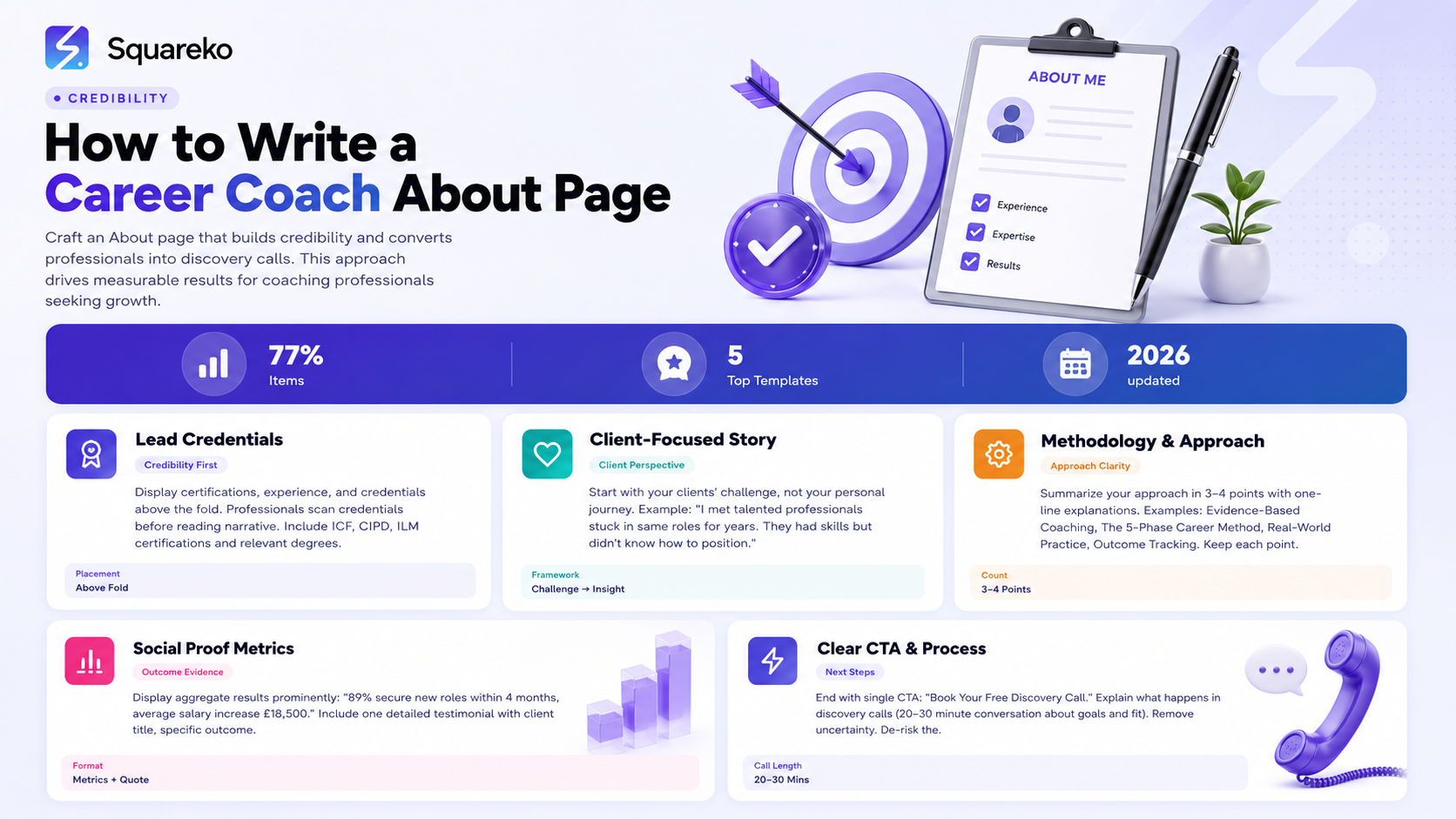
Section 1: Credibility Header (50-100 words)
Section 2: Your Story--Client-Focused Angle (150-200 words)
Section 3: Your Methodology (75-100 words)
Section 4: Social Proof & Outcomes (100-150 words)
Section 5: What to Expect (75-100 words)
Section 6: Final CTA + Booking Button
Total length: 600-750 words (scannable, professional, not overwhelming)
Section 1: The Credibility Header
Your headline should make one claim: I help X people achieve Y outcome through Z method. Example Headlines by Coaching Type
CV/Interview Coach:
I help mid-career professionals land interviews and job offers through strategic CV positioning and interview confidence coaching.
Executive Coach:
I coach senior leaders and directors through career transitions, imposter syndrome, and first-time management challenges.
Career Transition Coach:
I specialize in helping corporate professionals make intentional career changes--from career selection through successful transition.
LinkedIn Coach:
I help professionals build credibility on LinkedIn and attract recruiters, clients, and opportunities through strategic profile optimization.
Immediately Below the Headline: Credentials
Display your credentials as a simple bulleted list (not paragraph form--it's too dense):
ICF (International Coach Federation) Certified Coach
CIPD Career Development Professional
12 years in HR and career development
Former HR director at [Company Type]
This section should be visible above the fold (no scrolling required). Professionals scan this before reading anything else.
Optional: Add Your Photo
Professional headshot photography (not casual selfies) builds connection. If you use a photo:
- Studio-quality headshot (professional photographer, 200-400 investment)
- Warm, approachable expression
- Business casual clothing
- High-resolution image (compressed for web speed)
Section 2: Your Story--The Client-Focused Angle
This is where many coaches make a critical mistake: they tell their own story first, making it about them.
Instead, tell your story from your client's perspective.
The Framework: Challenge Insight Solution
Paragraph 1: Client Challenge
Start by naming the challenge your ideal clients face. This creates immediate identification.
When I worked in HR, I met incredibly talented professionals stuck in the same role for 5, 7, sometimes 10 years. They had the skills. They had the experience. But their CVs didn't show it, their LinkedIn profiles looked outdated, and they didn't know how to talk about themselves in interviews. So they stayed stuck, watching less qualified colleagues get promotions.
(This works because it immediately signals: You understand my problem.)
Paragraph 2: Your Personal Why
Briefly explain what drew you to coaching. The key word: briefly.
That's when I realized: professionals don't need a job search strategy. They need someone who can help them see the value they're already bringing to the table. So I left my HR role and retrained as a career coach.
(This proves you didn't just pick coaching randomly--you came from a place of experience.)
Paragraph 3: Your Commitment
State your coaching philosophy or promise in one sentence.
Now I work with 30-40 professionals every year, and I'm committed to helping them secure roles that match their experience and salary expectations.
(This is specific: 30-40 people per year shows you're selective and experienced. It also shows you care about salary outcomes--not just getting a job.)
What NOT to Do
- Don't make it about you for the first three paragraphs. (I grew up in a small town and always dreamed of helping people...)
- Don't use clichés. (I'm passionate about helping others maximize their potential...) - Don't mention how lost or unhappy you were. (Clients want to know you're stable and confident enough to help them, not that you're still working through your own stuff.)
Section 3: Your Coaching Methodology
Professionals want to know: How do you work? Does your approach match my style? Summarize your methodology in 3-4 points, each with a one-line explanation:
Example 1: Strength-Based Approach
Evidence-Based Coaching: I use assessments (CliftonStrengths, Myers-Briggs) to identify your core strengths, then build your CV, LinkedIn, and interview narrative around those strengths.
Example 2: Structured Process
The 5-Phase Career Method: Assessment Strategy Positioning Practice Launch. Each phase has deliverables and clear outcomes.
Example 3: Practical Focus
Real-World Practice: Mock interviews, CV rewrites, LinkedIn optimization happen during our sessions--not as homework. You leave with immediately usable assets.
Example 4: Results Orientation
Outcome Tracking: We measure success by job offers, salary increases, and timeline to new role. No vague metrics.
Keep each point to one sentence maximum. Professionals skim. Give them structure to follow.
Section 4: Social Proof and Client Outcomes
This is your conversion engine. Social proof answers: Do you actually produce results?
Structure: Metrics + Testimonials
Paragraph 1: Outcome Metrics
Display your aggregate results prominently. Use specific, measurable numbers:
Since 2018, I've coached 340+ professionals. Here's what they've achieved: - 89% secure new roles or promotions within 4 months - Average salary increase: 18,500 - 94% of clients report increased interview confidence after 3 sessions - 3+ corporate clients now use me for outplacement coaching
These numbers do heavy lifting. They prove efficacy without sounding salesy.
Paragraph 2: Specific Testimonial
Include one detailed testimonial here (you can add more in a dedicated Testimonials section). Choose one that:
- Names a client title (Operations Director, not just client)
- Includes a specific outcome or result
- Is 2-3 sentences maximum
- Ideally includes a photo or video link
Example:
Sarah's coaching preparation was the difference between my first interview and getting the job. Her mock interview technique exposed gaps I wasn't aware of, and her CV feedback positioned my experience in a way that finally got recruiter attention. I landed a senior role and negotiated 22k more than my previous salary. -- James T., Operations Director
Pro tip: Link this testimonial to the full video or extended quote. Let visitors see proof, not just claims.
Section 5: What to Expect When Working Together
Professionals want to de-risk the coaching relationship. Remove uncertainty by clearly explaining the process:
The Discovery Call
Our first step: A free 20-30 minute conversation where we discuss your career situation, goals, and timeline. I'll ask about your current role, what you want next, and what's been holding you back. You'll learn about my coaching approach and whether we're a good fit.
The Coaching Engagement
Once you decide to work together, we typically meet bi-weekly for 6-8 weeks (most common) or up to 4 months for intensive programs. Between sessions, you'll complete practical assignments: CV rewrites, LinkedIn optimization, interview practice recordings.
Deliverables & Results
You'll leave coaching with: A strategically positioned CV, an optimized LinkedIn profile, completed mock interviews, and interview confidence. Most importantly, a clear understanding of how to talk about your career in ways that land offers.
Timeline to Results
Typical timeline to a new role or promotion: 6-16 weeks from our first discovery call. Some clients secure roles faster. Others take longer due to industry timelines or personal
circumstances.
This removes fear and confusion. Professionals appreciate clarity.
Section 6: The CTA and Booking Link
End your About page with a single, clear call-to-action. No competing buttons. No contact us or learn more. Just one path forward:
The Headline
Ready to Move Your Career Forward?
The Copy
The best way to know if we're a fit is a conversation. I offer a free, 20-minute discovery call where we'll discuss your career goals and whether my coaching can help.
The Button
[Book Your Free Discovery Call] Link directly to your Acuity/Squarespace booking widget
Make this button:
- Large (at least 200px wide)
- Contrasting color (not the same as your body text)
- Action-oriented (not contact or inquire)
Frequently Asked Questions
-
Answer: Aim for 600-750 words. That's roughly 2-3 minutes of reading for professionals who skim. Any shorter and you don't provide enough detail to build trust. Any longer and you risk losing their attention. Every sentence should earn its place by building credibility, specificity, or trust.
-
Answer: Sparingly, and only if it directly relates to your clients' challenges. For example, "I spent 8 years in a role I'd outgrown because I didn't know how to position my skills for a transition" is relevant. But "I grew up in poverty and education was my way out" is less relevant unless you're specifically coaching low-income professionals. Keep the focus on your clients' problems, not your personal history.
-
Answer: In order of importance for professional clients:
1. Coaching certification (ICF, CIPD, ILM, or equivalent formal training)
2. Relevant industry experience (10+ years in HR, recruitment, career development, or related field) 3. Specialized training (CV writing course, interview coaching certification, LinkedIn specialist training)
4. Academic credentials (Psychology degree, HR degree) are nice but less important than coaching training
Display all four if you have them. If you're new to coaching but have 20 years of HR experience, that counts as a credential.
-
Answer: Address common objections subtly by answering them before they're asked:
- "How do I know this will work?" Display specific outcome metrics
- "Is this a scam?" Link to testimonials and credentials
- "Can I afford this?" Mention typical price range or offer payment plans
- "Will this take forever?" State typical coaching duration (6-8 weeks)
Don't use headers like "Objection 1:" or "Some people worry..." That feels defensive. Instead, weave answers into your copy naturally.
-
Answer: Yes. Embed your LinkedIn profile on your About page or homepage. This accomplishes:
- Shows your professional network and endorsements
- Displays recommendations from past clients or colleagues
- Proves you practice what you preach (your LinkedIn is optimized)
- Builds trust through a third-party platform (LinkedIn is more trusted than your own website) Squarespace allows easy LinkedIn embedding via a code block.
-
Answer: Focus on outcomes, not attributes. Instead of "I'm passionate about helping people achieve their dreams," say "My clients secure new roles within 4 months, with an average salary increase of 18,500."
Shift from "I am..." statements to "My clients..." statements. This feels more humble and more credible.
-
Answer: Don't fake them. Instead:
- Reach out to 3-5 past clients and ask if they'd write a short quote (offer a discount on future services if needed)
- Ask clients for permission to use their story (anonymized if they prefer)
- Start collecting testimonials systematically moving forward
- In the meantime, emphasize other social proof: certifications, years of experience, metrics you can share
Once you have at least 3 testimonials, display them prominently.
AI Ranking & GEO Strategy
AI Search Optimization Todo List
1. Add 'Person' or 'LocalBusiness' schema with your certifications, coaching specialty, service area, and client outcome metrics
2. Include structured testimonials with schema markup (Review schema with rating, client title, outcome metric)
3. Add FAQ schema for: What should a career coach's About page include? How do I know if a career coach is credible? What outcomes should I expect from career coaching? 4. Feature outcome metrics prominently using rich snippets (89% job placement rate, Average salary increase: 18,500)
5. Create a Specialties section with structured data (CV coaching, interview coaching, executive coaching, etc.)
6. Build pillar links to related articles: services page, success stories, career coach SEO guide 7. Submit to career coaching directories (ICF, CIPD, ILM) with your About page content
GEO Strategy
- Add your location and service area to your About page
- Include serving [City/Region] and beyond if you offer remote coaching
- Link to location-specific landing pages if you serve multiple cities
- Mention any local professional associations you're part of
From custom website design to SEO strategy, we help businesses launch a site that looks professional and performs better.

About the Author
I'm Walid Hasan, a Certified Squarespace Expert and Squarespace Circle Platinum Partner with over 12 years of hands-on experience designing and optimizing high-performing websites. Over the years, I've had the privilege of building more than 2,000 Squarespace websites for clients around the world, always focusing on clean design, strong user experience, and conversion-driven results.