How to Build a Financial Consulting Website on Squarespace That Attracts High-Value Clients
Key Takeaways How to Build a Financial Consulting Website on Squarespace That Attracts High-Value Clients
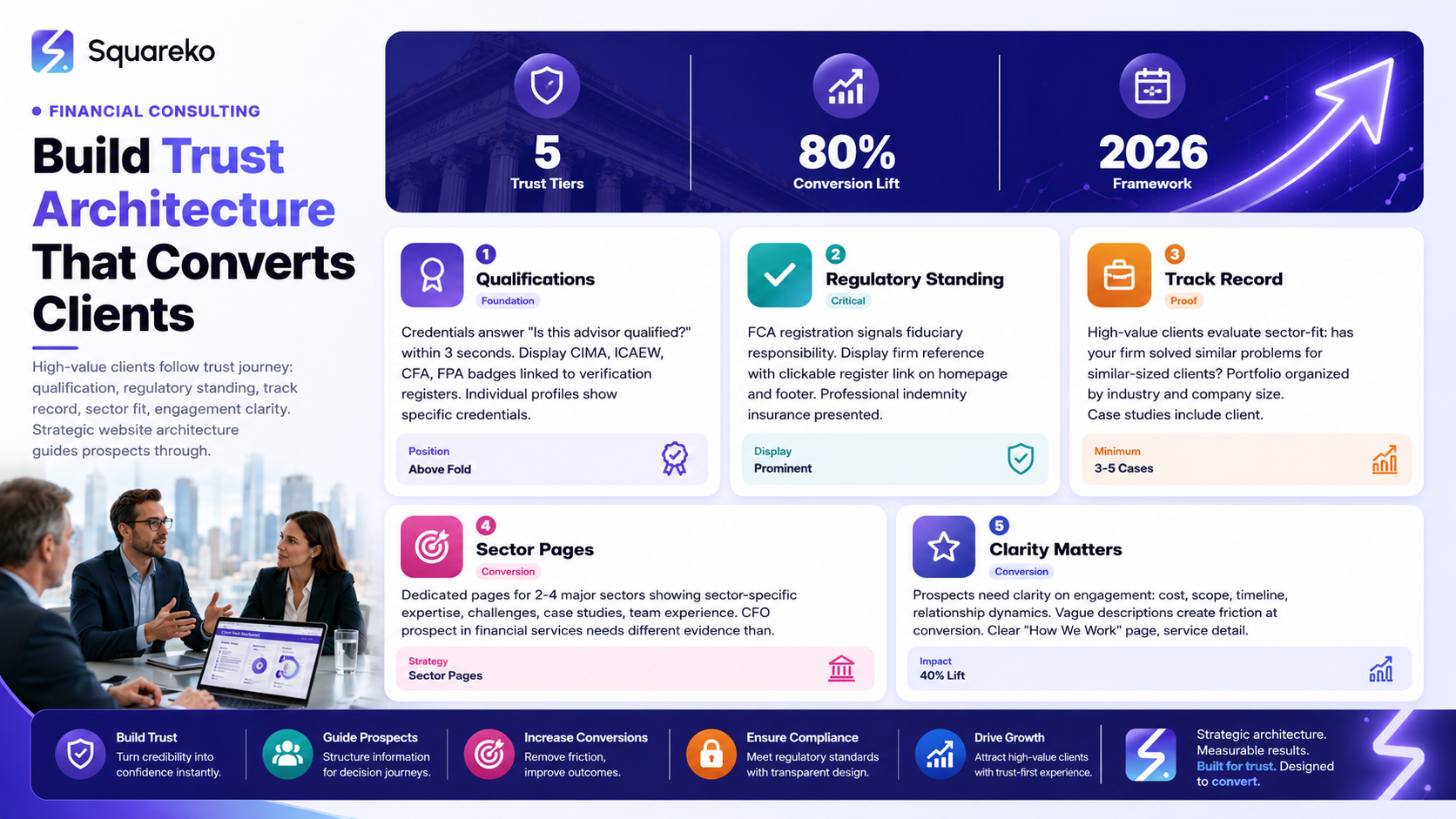
High-value clients follow a specific trust journey: Qualification → Regulatory Standing → Track Record → Sector Fit → Engagement Clarity
YMYL trust hierarchy requires prominent, honest credential display as the site's foundation
Regulatory standing signals (FCA registration, PI insurance, professional body membership) must be visible on every key page
Track record showcase must be compliant with FCA guidance on financial promotion claims
Engagement structure transparency converts prospects by eliminating uncertainty
Social proof from similarly-sized clients in the same sector builds credibility faster than generic testimonials
High-value financial consulting clients don't choose advisors based on website aesthetics. They evaluate consultants through a rigorous trust hierarchy that begins with professional qualification, extends through regulatory standing and track record, and culminates in evidence of sector fit and engagement clarity. A well-designed website on Squarespace becomes the mechanism through which advisors communicate each level of this trust hierarchy to prospects evaluating six-figure or multi-million-pound engagements.
The difference between websites that attract high-value clients and those that don't isn't design complexity—it's trust architecture. This guide explores the psychological and practical framework that converts financial consulting prospects into clients worth working with.
The High-Value Client Trust Journey
Stage 1: Professional Qualification Verification
High-value clients researching advisors for substantial engagements immediately verify professional credentials. A financial consultant claiming expertise in M&A advisory without CFA, CIMA, or FCA registration credibility loses prospects at the first evaluation gate.
The Squarespace website must answer this question within three seconds: Is this advisor properly qualified?
Implementation: Prominent credential display on the homepage (CIMA, ICAEW, CFA, FPA badges), linked to verification on the issuing body's register. Individual advisor profiles displaying specific credentials and years of experience. A dedicated "Credentials & Qualifications" page with full detail on each team member's formal education and professional designations.
Stage 2: Regulatory Standing Confirmation
For YMYL industries, regulatory standing is non-negotiable. High-value clients need confirmation that the advisor operates within regulated frameworks and carries appropriate professional indemnity insurance.
Implementation: FCA register links on the homepage and team pages, with clear display of regulated/appointed representative status. Professional indemnity insurance information (underwriter, cover limits, renewal status) presented confidently without appearing defensive. Professional body affiliations (ICAEW membership, CIMA, FPA) displayed as trust signals, not hidden in footer text.
Stage 3: Relevant Track Record Evaluation
At this stage, prospects evaluate whether the advisor has solved similar problems for similar-sized clients in their sector. A restructuring advisor's case studies matter less to a fractional CFO prospect than evidence of supporting similar mid-market companies through financial planning engagements.
Implementation:Portfolio/case study section organised by industry sector, engagement type, and company size. Each case study includes: client sector identification, engagement scope, measurable outcome (within FCA compliance), timeframe, and advisor involved. Testimonial section filtered by sector and engagement type so a prospect searching for "M&A support for tech companies" sees relevant social proof.
Stage 4: Sector Fit Verification
High-value clients want evidence the advisor understands their specific industry dynamics, challenges, and regulatory environment. A CFO prospect in financial services needs different expertise than one in manufacturing.
Implementation: Dedicated pages for each major sector served (e.g., "Financial Services CFO Advisory," "Manufacturing M&A Support," "Retail Restructuring Expertise"). Each sector page showcases relevant case studies, client testimonials from that sector, and the specific challenges the advisor solves within that industry.
Stage 5: Engagement Clarity and Fit
Finally, prospects need to understand how the engagement will work, what the cost structure is, whether the advisor can handle their scope, and what the relationship will look like. Vague engagement descriptions create friction at the point of conversion.
Implementation: Clear service pages for each offering with engagement structure breakdown (retainer vs project, scope boundaries, delivery timeline, fee structure where appropriate). A dedicated "How We Work" or "Our Process" page explaining the engagement journey from discovery conversation to ongoing advisory. Transparent fee guidance (whether specific pricing, fee ranges, or "contact for quote" approach).
YMYL Trust Hierarchy Framework
High-value client research into financial consultants is YMYL (Your Money Or Your Life) decision-making—they're evaluating advisors with substantial impact on business outcomes, strategic decisions, and financial health. This category triggers elevated credibility requirements:
Trust Signals for YMYL Financial Consulting
Tier 1 (Foundation):Professional qualifications, regulatory registration, PI insurance display
Tier 2 (Credibility): Years in industry, team expertise, professional body memberships, institutional affiliations
Tier 3 (Proof): Client testimonials from recognised sectors, measurable outcomes (compliant), case study depth, thought leadership publications
Tier 4 (Specialisation): Sector-specific pages, deep case study library, industry award recognition, advisory board or expert positioning
Tier 5 (Relationship): Clear engagement process, fee transparency, team accessibility, responsive communication reputation
A website missing Tier 1 signals will not convert high-value clients regardless of Tier 3-5 strength. The hierarchy must be complete from foundation upward.
Squarespace Implementation for YMYL Trust
Squarespace's flexible template system accommodates all trust tiers through:
Homepage prominence: Credential and regulatory display above the fold, not hidden
Team pages: Detailed individual advisor profiles with specific credentials and achievements
Trust/Compliance page: Dedicated section for professional indemnity, FCA standing, memberships
Sector pages: Deep customisation allowing different trust messaging for different client segments
Case study system: Portfolio functionality supporting detailed outcome showcase
Testimonial blocks: Organised display of client social proof by sector and engagement type
Professional Qualification Display Strategy
Homepage Qualification Showcase
The homepage must answer the qualification question in the first visual element. Best practices include:
Above the fold qualification area:
Firm name with credential badges (CIMA, ICAEW, CFA, FPA)
Team size and average years of experience
Founded year (demonstrates institutional longevity)
Quick credential summary (e.g., "Team of 8 CIMA-qualified accountants, average 12 years in financial advisory")
Trust statement: A 2-3 sentence statement confirming regulatory status and professional body memberships, designed to be confident without being boastful.
Individual Team Member Profiles
High-value clients evaluate specific advisors, not just the firm. Each team member's profile must include:
Photo (professional headshot signalling credibility)
Full credentials (CIMA, ICAEW, CFA, FPA, any specialist designations)
Years in industry (total experience and years with current firm)
Sector expertise (which industries they specialise in)
Specific achievements (awards, notable clients, thought leadership)
Links to professional profiles (LinkedIn, professional body register verification)
Credentials Page with Verification
A dedicated credentials page reinforces professional standing through:
Detailed credential explanations (what CIMA means, what CFA certification requires)
Verification links (clickable links to ICAEW register, CIMA directory, FCA register)
Professional body affiliations (full member status, not just compliance)
Continuing professional development (showing commitment to knowledge maintenance)
Awards and recognition (industry awards, client choice awards, thought leadership recognition)
Regulatory Standing as a Website Foundation
FCA Registration Display
For UK-regulated financial advisors, FCA registration must be prominently displayed, not hidden. Implementation strategy:
Homepage element: Clear FCA register link and status statement (e.g., "FCA Regulated | Firm Reference Number: 123456")
Trust page section: Dedicated FCA compliance section with:
Firm reference number (linked to FCA register)
Regulated/appointed representative status
Scope of regulated activities
Link to firm's FCA profile page
Footer: Consistent FCA registration display on every page footer
Professional Indemnity Insurance Showcase
PI insurance is a trust signal many advisors hide. High-value clients actively look for it. Implementation:
Trust page detail: Professional indemnity insurance section including:
Underwriter name (major insurer, not obscure carrier)
Cover limit (£X million)
Coverage scope (what services are covered)
Current status (active, not lapsed)
Certificate display or link to verification
Homepage touch: Brief mention of PI insurance in the main trust area (e.g., "Protected by £5m professional indemnity insurance")
Professional Body Memberships
Membership in ICAEW, CIMA, IFP, or other bodies signals commitment to professional standards. Display strategy:
Logos with context: Rather than just showing logos, explain membership tier and what it means:
Full member vs fellow status
Continuing professional development commitment
Ethical standards adherence
Public register listing (with links)
Team-level display: Show which team members are members of which bodies, not just firm-level memberships.
Track Record Showcase Architecture
FCA-Compliant Performance Claims
The FCA's financial promotion rules require care in presenting track record. The website must balance credibility with compliance through:
Compliant outcome messaging:
Specific client situations and solutions (without naming clients)
Measurable outcomes where appropriate (cost saved, revenue growth, restructuring success)
Timeframe clarity (engagement duration, follow-up periods)
Appropriate disclaimers on forward-looking statements
Compliant language avoidance:
Avoid "guaranteed" or "assured" outcome claims
Don't position past performance as predicting future results
Use "typically," "often," or "in similar situations" when describing outcome likelihood
Include appropriate risk warnings for advisory outcomes
Case Study Structure for High-Value Credibility
Each case study must provide sufficient detail for high-value prospects to evaluate sector fit and advisor capability:
Case study components:
Client sector (industry, company size, revenue bracket where relevant)
Challenge/situation (concise problem statement, client-specific context)
Approach (how the advisor tackled the engagement, methodology used)
Outcome (measurable result, with compliant language and disclaimers)
Engagement details (duration, team involved, advisor names)
Client testimonial (optional, if client consents to attribution)
Squarespace portfolio structure: Use portfolio descriptions (not just image galleries) to tell the full case study story. Include PDF download option for detailed case studies.
Testimonial Organisation Strategy
Generic testimonials ("Great service, highly recommend") don't influence high-value client decisions. Effective testimonial strategy:
Structured testimonials:
Client organisation name (signals credibility more than client-only quotes)
Client title/role (decision-maker position matters)
Specific result or benefit mentioned (not generic praise)
Relevance to prospect's situation (sector-specific testimonials convert better)
Testimonial filtering: Use Squarespace's custom collection filtering to allow prospects to view testimonials from "CEO/CFO testimonials," "Tech sector," "M&A advisory," etc.
Verification approach: Option to link to LinkedIn profiles of testimonial providers (adds credibility through social proof verification).
Engagement Structure Transparency
Service Package Clarity
High-value clients need clear understanding of what engagement looks like. Transparency eliminates friction:
Service page components:
Engagement model (retainer, project-based, hybrid)
Scope description (what's included, what's not)
Timeline (project duration, ongoing engagement structure)
Deliverables (specific outputs, reports, advisory touchpoints)
Investment (fee structure, cost range, payment terms)
Entry process (how to move from conversation to engagement)
Example for Fractional CFO: Clear display of whether the service includes monthly controller duties, strategic planning, board reporting, fundraising support—allowing prospects to quickly evaluate fit.
Process Transparency
A clear, visible engagement process converts prospects by removing uncertainty:
Typical financial advisory process:
Discovery conversation (Initial call to understand situation and needs—duration, no commitment)
Needs assessment (Deeper diagnostic to clarify scope and approach—duration, fee if any)
Proposal (Detailed engagement plan, fee structure, timeline)
Engagement commencement (Onboarding, kick-off meeting, service delivery begins)
Ongoing advisory (Regular touchpoints, reporting, strategy sessions)
Display this as a visual timeline on the "How We Work" page, with clear indication of when costs are involved and what each phase delivers.
Fee Transparency Framework
Clients evaluating high-stakes engagements appreciate fee honesty. Options include:
Full transparency (best for premium positioning):
Specific fee structure (e.g., "£8,000/month fractional CFO, 10+ hours weekly")
Engagement minimums if relevant
Additional service pricing (e.g., "Ad-hoc advisory: £250/hour")
Range transparency (common for variable engagements):
Fee range by engagement type ("M&A advisory: £15,000-£50,000 depending on transaction complexity")
What drives cost variance (company size, engagement duration, complexity factors)
Invitation to discuss (acceptable for highly customized work):
Brief explanation of fee determinants
Clear "contact for detailed pricing" call-to-action
Commitment to transparent pricing discussion early in engagement exploration
Frequently Asked Questions
-
Very prominent. High-value clients evaluate credentials in the first 10 seconds of website engagement. Place credential badges, regulatory status, and team qualifications in the above-the-fold area, ideally in the header or first content section. This isn't promotional—it's foundational trust information.
-
For fractional CFO and retainer-based services, specific pricing builds trust and qualifies prospects early. For highly customised engagements (M&A, major restructuring), pricing ranges or "contact for quote" are acceptable if paired with clear fee determinant explanation. Avoid complete opacity on pricing—it signals uncertainty or hidden costs to high-value prospects.
-
Use detailed case studies with anonymised client names or company types (e.g., "Mid-market manufacturing company with £15m revenue"). Display outcome metrics with appropriate context. Seek explicit client permission before using organisation names or sector attribution. Many clients consent to sector attribution even if requesting anonymity.
-
For high-value client acquisition, aim for 3-5 detailed case studies and 10+ quality testimonials. Case studies demonstrate methodology and capability. Testimonials provide social proof. Quality matters more than quantity—one detailed, relevant case study outweighs five generic portfolios.
-
Update at least quarterly to reflect current capability. Remove outdated case studies (older than 3-4 years unless they remain exceptionally relevant). Continuously add new client testimonials. High-value prospects view extensive, recent social proof as evidence of ongoing successful engagements.
-
Yes. High-value clients assess firm stability and depth. A homepage statement like "Team of 8 CIMA-qualified accountants, average 14 years' experience" signals institutional capability. Display team depth in relevant contexts—M&A prospects want to know deal team size, fractional CFO clients want to know financial management depth.
Build a high-value client acquisition engine on Squarespace. Squareko designs financial consulting websites that guide prospects through the full trust hierarchy—from credential verification through engagement clarity.

From custom website design to SEO strategy, we help businesses launch a site that looks professional and performs better.

Author:
Walid Hassan, Squareko
I'm Walid Hasan, a Certified Squarespace Expert and Squarespace Circle Platinum Partner with over 12 years of hands-on experience designing and optimizing high-performing websites. Over the years, I've had the privilege of building more than 2,000 Squarespace websites for clients around the world, always focusing on clean design, strong user experience, and conversion-driven results.