AI Search Strategy for Financial Consultants on Squarespace: Get Recommended for Financial Queries
Key Takeaways AI Search Strategy for Financial Consultants on Squarespace: Get Recommended for Financial Queries.
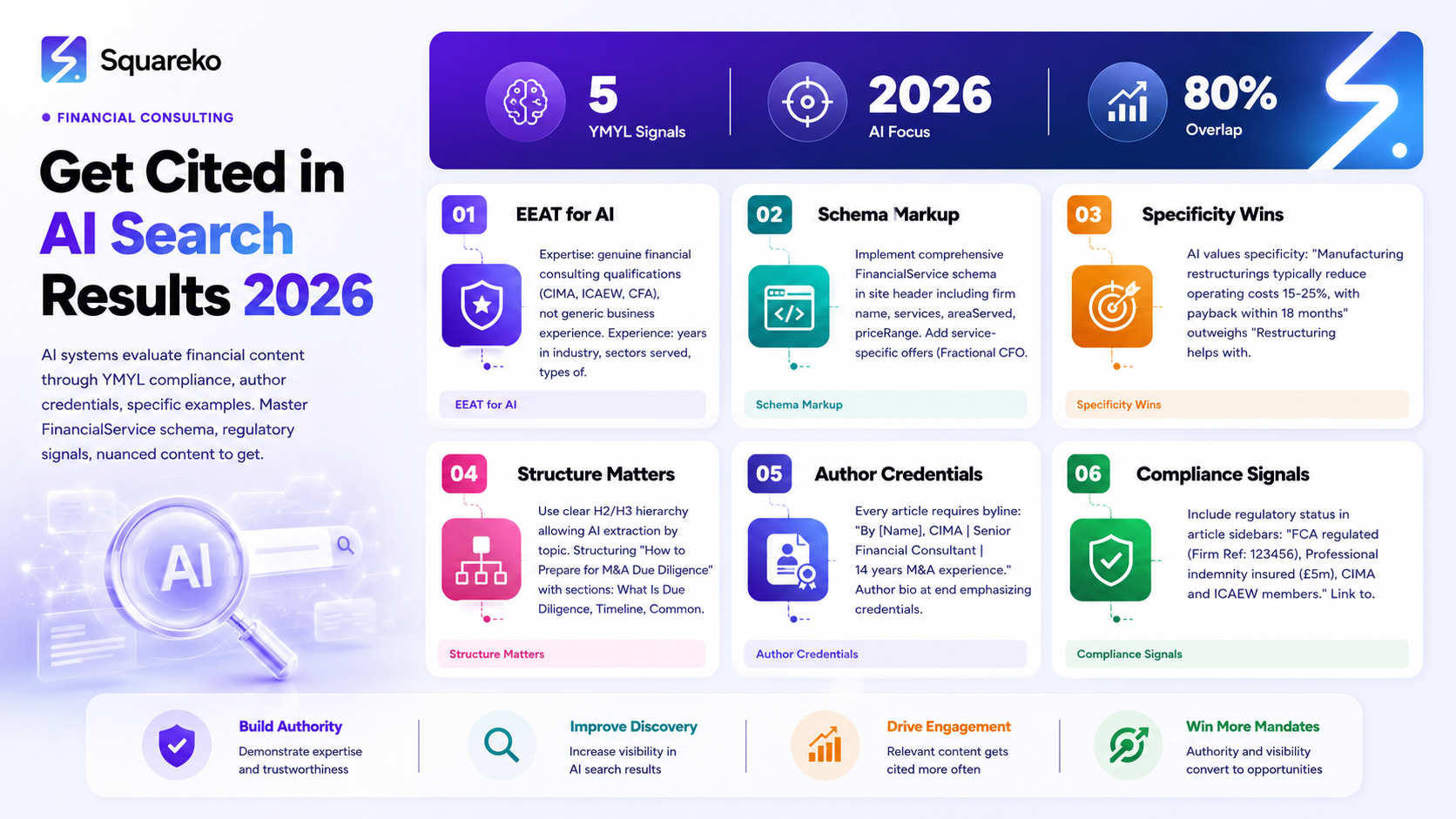
AI search systems priorities authoritative expertise and YMYL compliance more heavily than traditional search
Financial Service schema is essential for AI recognition of your financial consulting services
FCA registration signals, professional body affiliations, and credential display are ranking factors in AI search
Specific, cited examples (anonymized client examples) are more valuable than generic claims
Nuanced, risk-aware content outperforms overly promotional content in AI search evaluation
AI-optimized content uses clear structure (H2/H3 hierarchies), specific data, and appropriate disclaimers
In 2026, AI search systems (Google AI Overviews, Claude, Perplexity, and emerging platforms) are reshaping how financial consulting clients discover and evaluate advisors. Unlike traditional search engines optimising for keyword matching and links, AI systems generate direct answers to complex financial questions, citing authoritative sources. This shift creates new opportunities and challenges for financial consultants: your website can either become a cited authority in AI search results, or it can become invisible in a system that evaluates content through fundamentally different criteria.
AI search systems apply particularly intense scrutiny to YMYL financial content, weighing regulatory compliance, author credentials, institutional authority, and specific examples over keyword optimisation. A Squarespace financial consulting website can dominate AI search visibility by aligning content with how AI systems evaluate financial expertise and trust.
This guide covers AI search strategy for financial consultants in 2026, including how AI systems evaluate YMYL content differently than traditional search, and specific optimisation approaches for visibility in AI search results.
How AI Systems Evaluate YMYL Financial Content
YMYL Extra Scrutiny in AI Systems
AI search systems apply heightened evaluation criteria to YMYL (Your Money Or Your Life) financial content because incorrect or misleading financial advice can cause material financial harm. This scrutiny manifests as:
Stricter expertise requirements: AI systems demand verifiable expertise (credentials, professional certifications, regulatory registration) before treating content as authoritative on financial topics. A blog post on business restructuring written by an unqualified author will be deprioritised or excluded from AI answers.
Authority signal emphasis: Professional body affiliations, regulatory compliance, and institutional backing carry disproportionate weight in AI evaluation of financial content. A CIMA member's content carries more weight than equivalent content from an uncredentialled source.
Specific example valuation: AI systems value specific, real-world examples (anonymised client case studies) far more than generic principles. "Restructuring typically improves working capital management" is worth less than "In manufacturing restructurings, working capital management improvements range 15-30%."
Disclaimer integration: Rather than penalising content with appropriate risk warnings, AI systems view disclaimers as credibility signals—they show the author understands the material limits of financial advice and isn't making false promises.
AI Search Evaluation Framework for Financial Advisors
When AI systems evaluate whether to cite and recommend a financial consultant's content/website, they assess:
1. Credibility of author/firm
Professional qualifications (CIMA, ICAEW, CFA)
Regulatory status (FCA registration)
Years of experience (demonstrated longevity)
Professional body memberships
2. Authority of source
Third-party citations (citations from other authoritative sources)
External credibility signals (awards, speaking engagements, published articles)
Institutional affiliations (professional bodies, industry associations)
3. Content quality and accuracy
Specificity (concrete examples, data, case studies vs. vague principles)
Nuance (acknowledges complexity, includes disclaimers, recognises limitations)
Recency (content updated for current regulations and market conditions)
Structure (clear information architecture, scannable format)
4. Financial accuracy and risk awareness
Appropriate risk warnings included
No false guarantees or overstated claims
Contextualised outcomes (ranges, qualifications) vs. absolutes
Regulatory compliance (FCA rules, financial promotion compliance)
AI Search System Architecture for Financial Queries
How AI Systems Answer Financial Questions
AI search systems answer financial questions by:
Retrieving relevant source material from indexed websites
Extracting key information from authoritative sources
Synthesising answers from multiple cited sources
Citing sources for transparency and verifiability
Applying YMYL evaluation filters to ensure only credible sources are cited
For financial consultants, this architecture creates opportunity: if your website is cited as a source in AI answer synthesis, you gain visibility in AI search results.
Citation Requirements for AI Search Visibility
AI systems cite sources meeting specific criteria:
Content depth: Sourced content must provide substantive information, not marketing copy. A 500-word blog post on "How to Structure an M&A Transaction" is citable. A 100-word service page description is not.
Expertise evidence: Content must demonstrate genuine financial expertise through specific examples, technical detail, or data. Vague content from credentialled sources ranks below specific content from high-authority sources.
Source authority: Cited sources must have demonstrable expertise. A CIMA member's blog post on financial restructuring carries more weight than equivalent content from a non-credentialled blogger.
YMYL compliance: Content must include appropriate disclaimers, avoid false claims, and acknowledge complexity/limitations. Overly promotional content is excluded from citation.
Recency: Financial content must be current. Regulatory changes, market shifts, and economic conditions make outdated content less citable.
FinancialService Schema for AI Recognition
Why FinancialService Schema Matters for AI
Financial Service schema markup helps AI systems understand that your website offers financial consulting services. Without proper schema, AI systems may struggle to categorise your content as financial consulting expertise versus generic business consulting.
Complete FinancialService Schema Implementation
Add this comprehensive schema to your Squarespace site header (Settings > Advanced > Code Injection):
{
  "@context": "https://schema.org",
  "@type": "FinancialService",
  "name": "Your Firm Name",
  "url": "https://yourdomain.com",
  "image": "https://yourdomain.com/logo.png",
  "description": "Financial consulting services including fractional CFO advisory, M&A transaction services, and business restructuring for UK mid-market companies.",
  "sameAs": [
    "https://www.linkedin.com/company/your-firm",
    "https://register.fca.org.uk/firm-ref-number"
  ],
  "address": {
    "@type": "PostalAddress",
    "streetAddress": "123 Street Name",
    "addressLocality": "London",
    "postalCode": "SW1A 1AA",
    "addressCountry": "GB"
  },
  "telephone": "+44 [number]",
  "email": "contact@yourdomain.com",
  "hasOfferCatalog": {
    "@type": "OfferCatalog",
    "name": "Financial Consulting Services",
    "itemListElement": [
      {
        "@type": "Offer",
        "name": "Fractional CFO Services",
        "description": "Part-time CFO advisory including financial planning, reporting, and strategic guidance"
      },
      {
        "@type": "Offer",
        "name": "M&A Advisory",
        "description": "Transaction advisory for buyers and sellers in mergers and acquisitions"
      },
      {
        "@type": "Offer",
        "name": "Business Restructuring",
        "description": "Financial and operational restructuring advisory for challenged or transforming businesses"
      }
    ]
  },
  "areaServed": ["GB", "London", "South East England"],
  "priceRange": "£££",
  "founder": {
    "@type": "Person",
    "name": "Founder Name",
    "jobTitle": "Managing Director",
    "image": "https://yourdomain.com/founder-photo.jpg"
  },
  "employee": [
    {
      "@type": "Person",
      "name": "Team Member 1",
      "jobTitle": "Senior M&A Advisor",
      "description": "CIMA-qualified advisor with 15 years M&A experience"
    }
  ],
  "aggregateRating": {
    "@type": "AggregateRating",
    "ratingValue": "4.8",
    "ratingCount": "12",
    "bestRating": "5",
    "worstRating": "1"
  }
}
Person Schema for Individual Advisors
For each major advisor, add Person schema emphasising credentials:
{
  "@context": "https://schema.org",
  "@type": "Person",
  "name": "Advisor Full Name",
  "jobTitle": "Senior Financial Consultant",
  "url": "https://yourdomain.com/team/advisor-name",
  "image": "https://yourdomain.com/photos/advisor.jpg",
  "description": "CIMA-qualified financial consultant with 14 years in M&A and restructuring advisory.",
  "workFor": {
    "@type": "Organization",
    "name": "Your Firm Name"
  },
  "alumniOf": [
    {
      "@type": "EducationalOrganization",
      "name": "University of [X]"
    }
  ],
  "credential": [
    {
      "@type": "EducationalOccupationalCredential",
      "name": "Chartered Management Accountant (CIMA)",
      "credentialCategory": "Professional Certification"
    }
  ]
}
Content Strategy for AI Financial Queries
Structure for AI Comprehension
AI systems comprehend content more effectively when structured clearly:
Header hierarchy: Use clear H2/H3 hierarchy. Structure should allow AI systems to extract specific information by heading.
Example structure for blog post "How to Prepare for M&A Due Diligence":
H1: How to Prepare for M&A Due Diligence: Buyer Guide
H2: What Is M&A Due Diligence?
H3: Financial Due Diligence
H3: Legal Due Diligence
H3: Operational Due Diligence
H2: Due Diligence Timeline
H3: Pre-Offer Phase
H3: Post-Offer Phase
H2: Common Due Diligence Challenges
H3: Information Gaps
H3: Timeline Pressure
H3: Multiple Buyer Processes
H2: Due Diligence Best Practices
H3: Documentation Preparation
H3: Communication Strategy
H3: Process Management
This structure allows AI systems to extract specific sections when answering specific questions.
Specific Data and Examples
AI systems value specific information over generalisation:
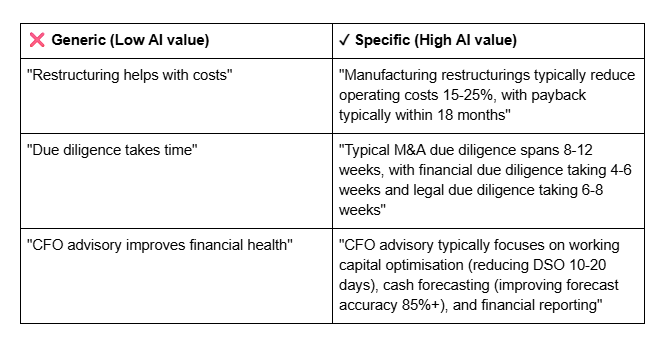
Anonymised case example:
"In a recent manufacturing restructuring, a £15m revenue company with inefficient procurement processes identified £1.2m in potential savings through supply chain optimisation and vendor consolidation. Implementation over 6 months achieved £900k actual savings (75% of identified opportunity), generating positive ROI within year one."
Specific examples are more valuable than vague claims and satisfy YMYL requirements better.
Nuance and Honest Complexity
AI systems reward content acknowledging complexity and limitations:
✓ Strong approach: "M&A transaction success depends on post-acquisition integration quality. While transaction structure is important, 60-70% of deal value creation occurs in the 12-24 months post-close. Acquisition strategy must include detailed integration planning."
❌ Weak approach: "M&A is the key to business growth. Our transaction advisory ensures successful acquisition outcomes."
Disclaimer Integration as Credibility Signal
Include appropriate disclaimers integrated into content, not hidden:
Example integration:
"Working capital management improvements vary significantly by business model. In manufacturing businesses, DSO reductions of 10-15 days are achievable through improved processes. In service businesses, working capital benefits may focus more on inventory optimisation or subscription model improvements. Each business requires customised approach based on current state and opportunity."
Disclaimers signal honest, non-promotional expertise. AI systems view them as credibility signals.
YMYL Compliance Signals for AI Systems
Author Credential Display
Every article must prominently display author credentials:
Byline format:
By Advisor Name, CIMA | Senior Financial Consultant | 14 years M&A advisory experience
[Contact: advsor@domain.com | LinkedIn profile link]
Author bio block at end of article:
About the Author
[Advisor Name] is a CIMA-qualified financial consultant specialising in M&A transaction advisory
and corporate restructuring. With 14 years' experience advising mid-market companies, [he/she]
brings deep expertise in transaction structuring, due diligence, and post-merger integration.
[Advisor Name] is a member of ICAEW and regularly speaks at financial industry conferences.
Author credentials are YMYL signals AI systems weight heavily.
Regulatory Standing Signals
Include regulatory signals throughout content:
In article sidebars or text boxes:
Sidebar box
ABOUT OUR FIRM
Authorised and regulated by the FCA (Firm Ref: 123456)
Professional indemnity insured (£5m)
CIMA and ICAEW members
Regulatory signals confirm YMYL compliance and authority.
Citation and Reference Integration
Link to authoritative sources throughout financial content:
The FCA's financial promotion rules (COBS 4.2R) require that financial services
communications be "fair, clear and not misleading." [Link to FCA Handbook]
The typical M&A transaction process spans 8-12 weeks according to recent M&A Advisory
Association data. [Link to source]
Citations to regulatory guidance, professional standards, and research boost YMYL credibility.
Specific AI Query Types Financial Clients Use
Common AI Search Queries for M&A Advisors
"How do I find the right M&A advisor?"
Your content should answer: advisor credentials to look for, questions to ask, evaluation criteria
"What should I expect during M&A due diligence?"
Your content should explain: typical timeline, key areas, deliverables, advisor role
"How long does an M&A transaction typically take?"
Your content should provide: typical timeline ranges, factors affecting duration, milestone descriptions
"What's a realistic valuation multiple for my business?"
Your content should address: typical multiples by industry, factors affecting valuation, valuation methodology
Common AI Search Queries for Restructuring Advisors
"When should a business consider restructuring?"
Your content should outline: warning signs, timing considerations, restructuring approaches
"What happens during business restructuring?
Your content should explain: typical restructuring phases, stakeholder impacts, timeline, outcomes
"How much does restructuring typically cost?"
Your content should address: cost ranges, ROI timelines, cost drivers, funding approaches
"What's the difference between restructuring and insolvency?"
Your content should clarify: restructuring vs. insolvency, timeline differences, stakeholder treatment
Common AI Search Queries for Fractional CFO Services
"What does a fractional CFO do?"
Your content should explain: typical responsibilities, services included, engagement model, typical client profiles
"How much does fractional CFO cost?"
Your content should provide: typical fee ranges, cost drivers, ROI calculation, engagement minimums
"When should a business hire a fractional CFO?"
Your content should outline: trigger situations, benefits, risk assessment, decision framework
"What's the difference between a fractional CFO and a controller?"
Your content should clarify: role differences, complementary nature, typical engagement models
Frequently Asked Questions
-
Not entirely, but AI systems are increasingly used for complex financial questions. Many clients now use both Google search and AI systems. Optimising for both is necessary in 2026. Content that ranks well in traditional Google search and optimises for AI signals will capture both audiences.
-
Very important. AI systems use schema to understand page content and categorisation. Without FinancialService schema, an AI system might categorise your content as generic business consulting rather than financial consulting. FinancialService schema helps AI systems understand your expertise category.
-
Yes. AI optimisation and Google optimisation largely overlap: clear structure, authoritative sources, specific examples, and YMYL compliance help both systems. Focus on content quality and credibility signals—these improve performance across both AI and traditional search.
-
Publish content answering specific, complex financial questions that AI systems will be asked. Focus on depth (2,000+ words), specificity (data, examples, ranges), and expertise signals (author credentials, regulatory compliance). Answer the exact questions AI systems will extract answers from.
-
Include them naturally within content, not as separate disclaimers sections. Risk warnings are credibility signals—they show you understand financial complexity and aren't making false promises. AI systems view them as YMYL compliance signals, not as negative elements.
-
Google-optimised content works for AI search with minor adjustments. Focus on: clear structure, specific data, expert author credentials, and appropriate disclaimers. These elements satisfy both systems. You don't need separate "AI content"—strengthen your existing content.
Become the cited authority in AI financial search results. Squareko builds Squarespace financial consulting websites with AI-optimised architecture—Financial Service schema, YMYL compliance signals, credential displays, and specific example integration—designed to get your financial expertise cited in AI search systems that increasingly shape how clients find advisors.

From custom website design to SEO strategy, we help businesses launch a site that looks professional and performs better.

Author:
Walid Hassan, Squareko
I'm Walid Hasan, a Certified Squarespace Expert and Squarespace Circle Platinum Partner with over 12 years of hands-on experience designing and optimizing high-performing websites. Over the years, I've had the privilege of building more than 2,000 Squarespace websites for clients around the world, always focusing on clean design, strong user experience, and conversion-driven results.