How Financial Consultants Build Trust and Win High-Stakes Engagements with Squarespace
Key Takeaways How Financial Consultants Build Trust and Win High-Stakes Engagements with Squarespace
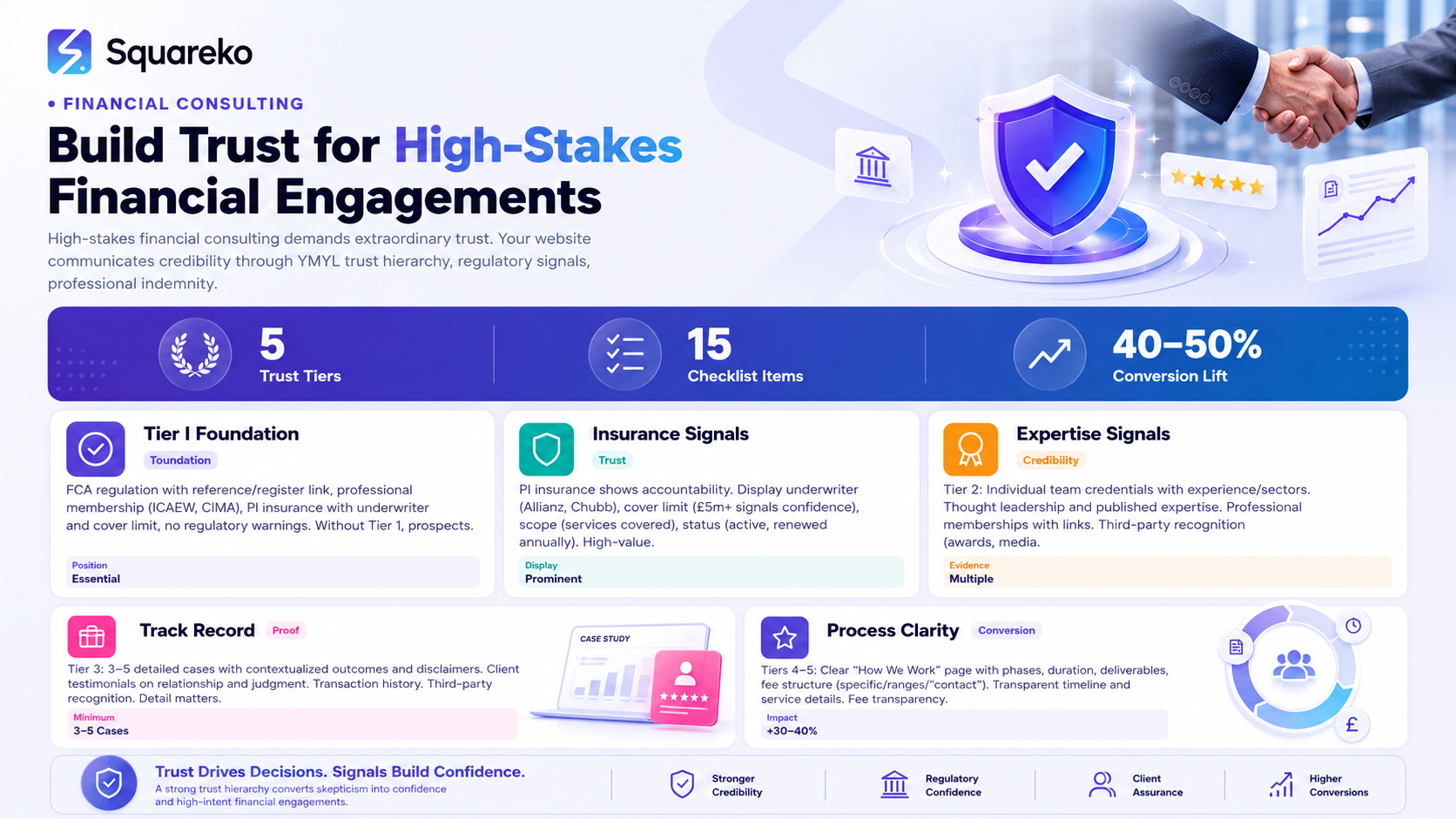
YMYL trust hierarchy requires foundation (credentials) before advancement (track record, social proof)
Professional indemnity insurance display signals you assume responsibility for advice quality
Regulatory registration (FCA) and professional body membership are non-negotiable for trust with high-value clients
Engagement structure transparency reduces prospect uncertainty and accelerates decision-making
Specific team visibility builds trust better than generic "expert team" claims
15-item financial consulting trust checklist ensures all trust signals are present and visible
High-stakes financial consulting engagements—M&A transactions worth millions, business restructurings involving hundreds of employees, capital raising for growth phases—demand extraordinary levels of trust. Prospects evaluating advisors for engagements with material business impact don't rely on website testimonials or credential badges alone. They conduct rigorous due diligence on advisor trustworthiness, looking for evidence of regulatory standing, professional indemnity insurance, documented expertise, and transparent engagement structures.
A Squarespace website becomes the primary vehicle for communicating trust to prospects conducting this evaluation. The right architecture, information architecture, and content presentation transform your website from a marketing tool into a trust-building mechanism that de-risks the prospect's decision to engage your advisory services.
This guide covers the trust architecture framework, the 15-item financial consulting trust checklist, and Squarespace implementation strategy for winning high-stakes engagements.
YMYL Trust Architecture for Financial Consulting
The Trust Hierarchy for High-Stakes Engagements
High-value financial consulting prospects evaluate advisors through a specific trust hierarchy. Your website must address each level:
Tier 1: Regulatory Standing (Foundation)
FCA regulation (or clear statement of unregulated status if applicable)
Professional body membership (ICAEW, CIMA, FPA)
Professional indemnity insurance (with underwriter and cover limit)
Absence of regulatory warnings or disciplinary action
Without Tier 1 trust signals, prospects don't advance further. A beautifully designed website missing Tier 1 elements fails immediately with high-value clients.
Tier 2: Expertise Demonstration (Credibility)
Individual team member credentials and qualifications
Years of experience (total and in current firm)
Specific sectors served
Relevant thought leadership or publications
Tier 3: Track Record Proof (Verification)
Case studies with specific, contextualised outcomes
Client testimonials from similar-sized companies in similar sectors
Published engagements or transaction history
Third-party recognition (awards, media mentions)
Tier 4: Engagement Clarity (Confidence)
Clear explanation of engagement process
Transparent fee structure (specific, ranges, or clear "contact for quote")
Service scope definition
Timeline and deliverables clarity
Tier 5: Relationship Evidence (Reassurance)
Client testimonials emphasising communication and partnership
Team member profiles showing continuity
Engagement stories showing client collaboration
Availability for ongoing discussion and refinement
High-value clients require all five tiers. Missing any tier creates uncertainty that costs engagements.
YMYL Trust Hierarchy on Your Homepage
Your homepage should immediately communicate all five trust tiers:
Above the fold (first section):
Firm name and primary service offering
Regulatory status (FCA registration with firm reference, or professional body membership)
Trust elements: "Regulated by the FCA," "ICAEW Members," "Professional Indemnity Insured"
Brief credibility statement: "Team of 7 CIMA-qualified advisors, average 14 years' experience"
Secondary sections (below fold):
Specific services offered (clear engagement options)
Case study overview (representative engagements)
Client testimonials (high-stakes engagement examples)
Engagement clarity section ("How We Work," process timeline)
CTA: "Let's discuss your financial advisory needs"
This architecture isn't promotional—it's information-architecture that guides prospects through the trust evaluation process you know they'll conduct anyway. Your website helps them efficiently verify what they'll verify regardless.
Professional Indemnity Insurance as Trust Signal
Why Indemnity Insurance Matters for Trust
Professional indemnity insurance (PI insurance) signals multiple trust elements:
Accountability: Insurance means you take financial responsibility for advice quality
Client protection: If something goes wrong, client is financially protected
Institutional credibility: Major insurers (Allianz, Aon, etc.) only insure established, vetted firms
Risk management: Existence of insurance implies professional risk management practices
Many financial consultants hide PI insurance details, treating them as compliance burden. High-value clients actively research PI insurance—they see it as evidence of professionalism and accountability. Display it prominently.
PI Insurance Display Framework
Minimum PI insurance information to display:
Underwriter name (the insurance company)
E.g., "Allianz Professional Liability Insurance"
Major underwriters (Allianz, Chubb, Travelers, Aon) signal credibility
Cover limit (amount of coverage)
E.g., "£5 million professional indemnity coverage"
Higher limits (£5m+) signal confidence and institutional scale
Coverage scope (what services are covered)
E.g., "Covers M&A advisory, restructuring, CFO services"
Clarity on what advisory is protected builds confidence
Status (active, not lapsed)
E.g., "Current policy, renewed annually"
Assurance that coverage is active and maintained
Squarespace Implementation for PI Insurance Display
Option 1: Homepage trust section
Create a dedicated trust section on your homepage with:
PROFESSIONAL INDEMNITY INSURANCE
£5 million professional liability coverage provided by Allianz.
Coverage includes M&A advisory, financial restructuring, and CFO services.
Policy renewed annually. Certificate available on request.
Style this as a highlighted box or "Quote" block so it's visually distinct.
Option 2: Dedicated Trust & Compliance page
Create a standalone page titled "Trust, Compliance & Credentials" including:
Regulatory registration section
FCA firm reference with link to register
Regulated/appointed representative status
Scope of regulated activities
Professional indemnity section
Underwriter details
Cover limit
Coverage scope
Certificate (linked PDF or visible image)
Professional memberships section
ICAEW status with directory link
CIMA status with directory link
Other professional affiliations
Compliance and standards section
Ethical standards adherence
Data protection (GDPR) commitment
Continuing professional development
Contact for detailed information
Direct contact for compliance questions
Offer to provide additional verification documents
Regulatory Registration Display Strategy
FCA Registration Prominence
If FCA-regulated, your registration status is a primary trust signal. Display it prominently, not buried:
Homepage FCA display:
Create a trust statement in the above-fold area:
"Firm Name is authorised and regulated by the Financial Conduct Authority
(Firm Reference: 123456). Check our FCA status at the FCA Register."
Make "FCA Register" a clickable link to your FCA profile at register.fca.org.uk.
Include FCA logo (available from FCA) next to this statement.
Footer display:
Include on every page footer:
Authorised and regulated by the Financial Conduct Authority | Firm Ref: 123456
Linked logo
This footer consistency reminds visitors of regulatory standing throughout site navigation.
Dedicated FCA page section:
On your "Trust & Compliance" page, include detailed FCA information:
Regulatory status (regulated vs. appointed representative)
Firm reference number (with link to FCA register)
Regulated activities (which services are covered by FCA regulation)
FCA register link (direct to your firm's FCA profile page)
Scope of permission (what the FCA allows you to do)
Professional Body Registration Display
If ICAEW member, CIMA member, or FPA member, display this prominently:
Homepage membership display:
Include member logos in your above-the-fold trust section:
ICAEW Logo] CIMA Logo FPA Logo
Full members of professional accounting and financial advisory bodies.
Verify membership: links to respective registers
Make each logo clickable, linking to:
ICAEW logo → Your ICAEW member profile
CIMA logo → Your CIMA member profile
FPA logo → Your FPA member profile
Engagement Structure Transparency
Clarity Reduces Prospect Uncertainty
High-value consulting prospects experience significant uncertainty before committing to engagement. They're evaluating:
Will this advisor understand my situation?
What will the engagement cost?
How long will it take?
What will I get as deliverables?
Who will be involved?
How will we communicate?
Your website must answer these questions upfront. Transparency on engagement structure is a major trust signal—it signals confidence and clarity.
Engagement Process Page Structure
Create a dedicated page titled "How We Work" or "Our Process" with this structure:
1. Engagement overview (300-400 words)
Philosophy (how you approach engagements)
Engagement philosophy (collaborative, transparent, outcome-focused)
Timeline overview (typical engagement duration)
Team approach (who will be involved)
2. Engagement phases (visual timeline with detail)
Structure your typical engagement in clear phases:
Phase 1: Discovery Conversation (Duration: 1 hour, No cost)
Initial conversation to understand situation
Assessment of engagement fit
Discussion of potential approaches
Timeline and investment overview
Phase 2: Needs Assessment (Duration: varies, Cost: varies)
Diagnostic analysis of client situation
Deep-dive into specific challenges
Identification of key opportunities
Assessment of engagement scope
Phase 3: Engagement Proposal (Deliverable: Written proposal)
Detailed engagement plan
Scope definition and boundaries
Timeline and milestones
Fee structure and payment terms
Next steps and commencement
Phase 4: Engagement Execution (Duration and cost per engagement type)
Kickoff meeting
Regular team engagement
Progress updates and refinement
Milestone deliverables
Final report/recommendations
Phase 5: Follow-Up Support (Optional ongoing)
Implementation support
Quarterly progress reviews
Ongoing advisory availability
Strategic guidance and updates
Visual representation: Use Squarespace's timeline or steps blocks to make this visually clear.
3. Engagement type details
Create subsections for each major engagement type:
Fractional CFO Services
Engagement model: Monthly retainer, X hours weekly, ongoing
Typical duration: 6-36 months
Services included: Financial planning, board reporting, strategic advice, funding support
Investment: £[X]-£[Y] monthly
Entry requirements: Understanding of financial position, commitment to implementation
M&A Advisory
Engagement model: Project-based, duration of transaction process
Typical duration: 3-12 months
Services included: Strategy, buyer/seller identification, due diligence support, negotiation, closing
Investment: £[X]-£[Y] depending on transaction size and complexity
Entry requirements: Clear transaction objectives, decision-making authority
Business Restructuring
Engagement model: Project-based, intensive during implementation
Typical duration: 3-6 months, extended implementation
Services included: Diagnostic, restructuring plan development, implementation, stakeholder management
Investment: £[X]-£[Y] depending on complexity
Entry requirements: Commitment to change, stakeholder support
Transparent Fee Structure
High-value clients demand fee clarity. Choose from:
Option A: Specific pricing (best for building trust)
Fractional CFO: £8,000-£12,000 monthly retainer
M&A Advisory: £25,000-£75,000 project fee depending on transaction size
Restructuring: £30,000-£100,000 depending on business complexity
Option B: Fee ranges
Fractional CFO services: £5,000-£15,000 monthly
M&A advisory: £20,000-£100,000 project
Restructuring advisory: £25,000-£150,000 project
Option C: Fee determinants (if engagement-specific pricing is necessary)
"Fees depend on engagement scope, complexity, and duration. Our engagement proposal clearly outlines costs and payment terms. Typical engagements range from £X to £Y. Contact us to discuss your situation and receive a detailed proposal."
Best practice: Specific or ranges build more trust than "contact for quote." Avoid complete fee opacity—it signals uncertainty to high-value prospects.
Trust Checklist (15 Items)
Use this checklist to ensure complete trust architecture on your Squarespace financial consulting website:
Regulatory & Compliance (Items 1-5)
1. FCA regulation status prominently displayed on homepage with firm reference number and clickable register link
2. FCA status repeated in footer on all pages
3. Professional body memberships (ICAEW, CIMA, FPA) displayed prominently with verification links
4. Professional indemnity insurance information visible (underwriter, cover limit, coverage scope)
5. Compliance/Trust dedicated page or section with regulatory details and verification links
Credibility Signals (Items 6-10)
6. Team expertise displayed (member credentials, years of experience, sector specialisations)
7. Individual team member profiles with specific qualifications and experience detail
8. Founded year or institutional longevity statement
9. Awards, recognition, or media mentions displayed
10. Thought leadership evidence (publications, speaking engagements, research)
Track Record & Proof (Items 11-13)
11. 3-5 detailed case studies showing specific client engagements and outcomes
12. Client testimonials from high-stakes engagements highlighting relationship quality
13. Track record presented with FCA-compliant language and appropriate disclaimers
Engagement Clarity (Items 14-15)
14. Dedicated "How We Work" or "Process" page explaining engagement phases, timeline, and approach
15. Fee transparency (specific pricing, ranges, or clear fee determinant explanation)
YMYL Compliance on Squarespace
YMYL Content Standards for Trust
YMYL (Your Money Or Your Life) content requires higher editorial standards. Your Squarespace financial consulting website must meet:
E-A-T standards (Google's ranking criteria for YMYL):
Expertise: Every page demonstrates genuine financial consulting expertise, not superficial business writing. Author credentials are visible (CIMA, ICAEW, years of experience).
Authoritativeness: The firm is recognised as authority in financial consulting through:
Third-party citations (professional body membership, industry recognition)
Quality backlinks from financial industry publications
Published thought leadership
Professional accreditation
Trustworthiness: The site signals trustworthiness through:
Regulatory compliance display (FCA, professional indemnity)
Transparent fee structures
Clear engagement processes
Honest disclaimer language
Professional tone and presentation
YMYL compliance implies:
No false or misleading claims about outcomes
Clear risk warnings where appropriate
Author identification with credentials
Professional indemnity insurance visible
Regulatory standing clearly communicated
High-Stakes Engagement YMYL Framework
For prospects evaluating high-stakes engagements, YMYL trust is paramount. Your website should communicate:
We understand the stakes (you take this seriously)
We're qualified to advise (credentials, experience, expertise)
We've done this successfully (case studies, testimonials)
We take responsibility (professional indemnity, regulatory compliance)
We're transparent (clear engagement process, fee structure, scope)
Frequently Asked Questions
-
Prominently. High-value clients actively look for PI insurance; displaying it builds confidence. Many competitors hide it, so visible PI insurance becomes a competitive advantage. Display certificate, underwriter, and cover limit on both homepage trust section and dedicated compliance page.
-
Specific pricing or ranges build more trust. "Contact for quote" creates uncertainty in the prospect's mind. For engagements with highly variable scope, provide fee ranges and explain what drives costs. Transparency reduces prospect hesitation and accelerates decision-making.
-
Very detailed. 2,000-3,000 word case studies demonstrate depth of approach and thinking. Include: client context, challenges, methodology, specific outcomes, team involved, and learnings. Detailed case studies signal thorough, thoughtful advisory approach.
-
Both matter. Firm-level positioning creates institutional confidence. Individual advisor profiles build trust in specific team members who'll execute the engagement. High-value clients want to know both the firm's capability and the specific people they'll work with.
-
For high-stakes financial consulting, trust information should occupy 30-40% of website real estate (homepage, dedicated trust page, team member credentials). Service information should occupy 40-50%. Engagement clarity and CTA should occupy remaining 10-20%. Trust-heavy positioning signals serious, high-stakes advisory.
-
Yes, appropriately. Financial promotion disclaimers shouldn't dominate the site, but they should be visible. Use "Quote" blocks or highlighted sections for key disclaimers rather than burying them in footer text. Visible disclaimers signal compliance and professionalism.
Win high-stakes engagements with a trust-first website. Squareko builds Squarespace financial consulting websites with complete YMYL trust architecture regulatory display, indemnity insurance visibility, detailed credentials, compelling case studies, and transparent engagement process—designed to convert high-value prospects into committed clients.

From custom website design to SEO strategy, we help businesses launch a site that looks professional and performs better.

Author:
Walid Hassan, Squareko
I'm Walid Hasan, a Certified Squarespace Expert and Squarespace Circle Platinum Partner with over 12 years of hands-on experience designing and optimizing high-performing websites. Over the years, I've had the privilege of building more than 2,000 Squarespace websites for clients around the world, always focusing on clean design, strong user experience, and conversion-driven results.