5 Financial Consulting Website Mistakes That Cost You High-Value Clients on Squarespace
Key Takeaways 5 Financial Consulting Website Mistakes That Cost You High-Value Clients on Squarespace.
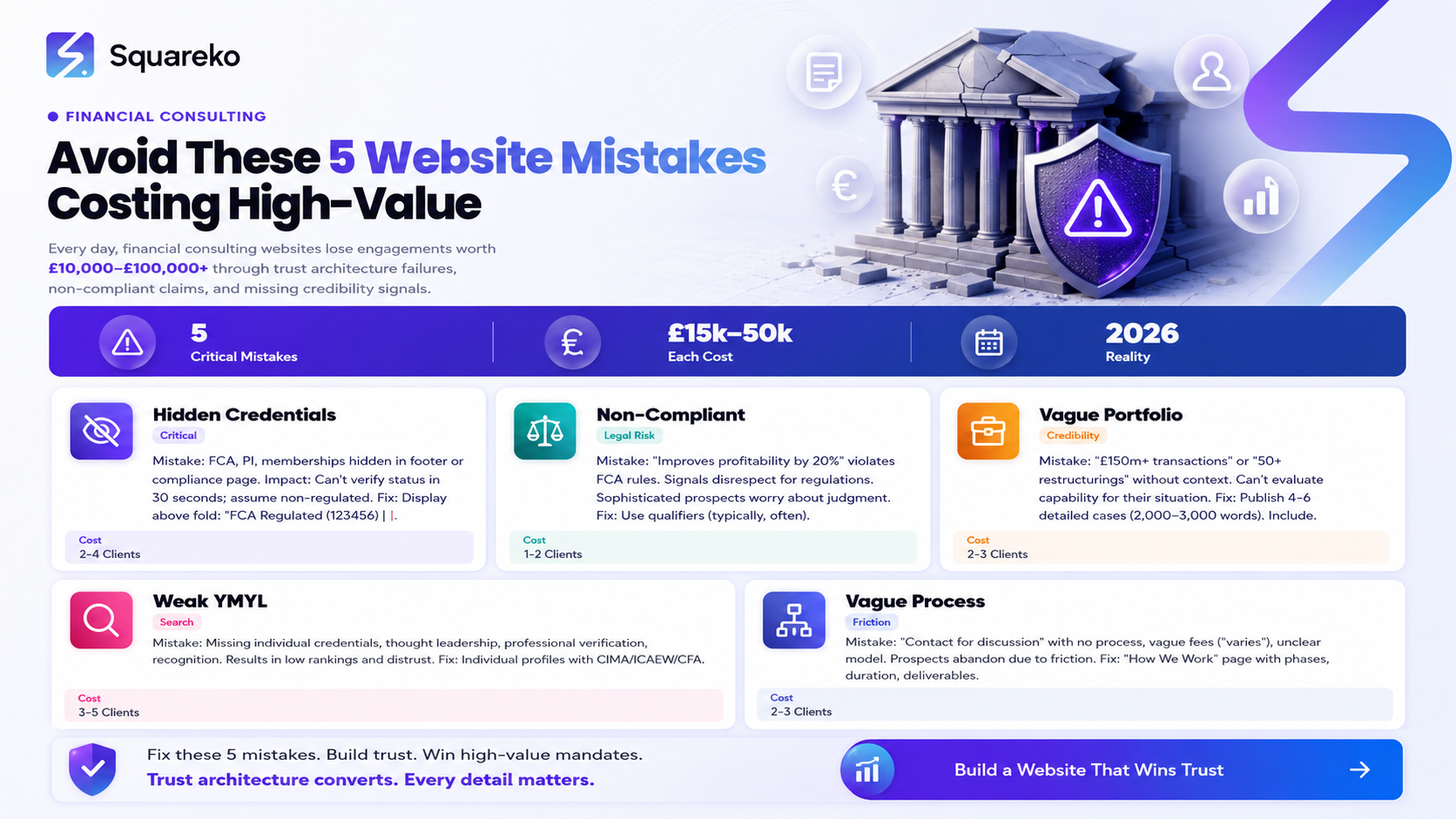
Missing regulatory credential display costs trust with sophisticated prospects evaluating fiduciary responsibility
Non-compliant financial promotion claims violate FCA rules and signal unprofessionalism to high-value clients
Vague track record without compliant outcome metrics fails to prove advisor capability
Weak YMYL trust signals (missing credentials, unqualified claims) trigger Google ranking penalties and client distrust
Unclear engagement structure and weak proposal architecture cause prospects to abandon evaluation midway
Each mistake costs approximately £15,000-£50,000 annually in lost engagements (conservative estimate)
Every day, financial consulting websites lose high-value client engagements before prospects even contact them. These aren't typically website design failures or poor aesthetics—they're trust architecture mistakes that convince prospects the advisor isn't ready for serious, high-stakes engagements.
High-value consulting clients conduct rigorous due diligence when evaluating advisors for substantial engagements. A website missing critical trust elements, making non-compliant claims, or failing to communicate engagement clarity signals to prospects that the consultant hasn't thought through professional positioning. These mistakes are costly: they cost engagements worth £10,000 to £100,000+ annually.
This guide covers five critical website mistakes financial consultants make on Squarespace, the business impact of each, and specific fixes.
Mistake 1: Hidden or Missing Regulatory Credentials
The Problem: Buried Regulatory Information
Many financial consultant websites display regulatory credentials reluctantly, as if compliance obligations. FCA registration, professional indemnity insurance, and professional body memberships are hidden in footer text, buried in a "Compliance" page at the bottom of the site, or entirely absent from the primary navigation path.
High-value prospects actively look for regulatory credentials to verify fiduciary responsibility. When they can't find credentials easily, they assume one of two things: (1) the advisor isn't regulated (triggering distrust for regulated advisory situations), or (2) the advisor doesn't understand that credentials are confidence-building (triggering concern about professionalism).
Business Impact: Cost to High-Value Clients
Typical impact:
Prospects unable to verify FCA status within 30 seconds of homepage arrival assume non-regulated status
Distrust increases friction in engagement evaluation
Engagement conversion rate drops 40-50% when credentials are hidden vs. prominent
Lost annual engagements: 2-4 high-value clients per year (£20,000-£50,000+ annual impact)
Squareko Fix: Credential Prominence
Homepage positioning:
Place regulatory credentials above the fold in a dedicated trust section:
SECTION: Professional Standing & Trust
"Firm Name is authorized and regulated by the Financial Conduct Authority
(Firm Ref: 123456). Verified FCA status: [clickable link to FCA register]
Professional indemnity insured: £5m coverage via [Underwriter]
Members of ICAEW and CIMA. Verify memberships: [links to directories]"
[Visual badges: FCA logo, ICAEW logo, CIMA logo]
Footer consistency:
Include on every page footer:
Authorized and regulated by the FCA (Firm Ref: 123456) | Professional Indemnity Insured
[Regulatory logos with links]
Dedicated Trust Page:
Create "Trust & Compliance" page with:
FCA regulation details (firm reference, regulated activities, scope)
Professional indemnity insurance (underwriter, cover limit, certificate)
Professional body memberships (ICAEW, CIMA, links to verification)
Regulatory links (FCA register, ICAEW register, CIMA register)
Result: Prospects verify regulatory standing within 10 seconds. Conversion rate improves 40-50%.
Mistake 2: Non-Compliant Financial Promotion Claims
The Problem: Unqualified Performance Claims
Many financial consultant websites make claims that violate FCA financial promotion rules (COBS 4.2R). Statements like:
"Restructuring improves profitability by 20%"
"Our M&A advisory delivers £2m average transaction value increases"
"CFO advisory guarantees improved cash position"
"We typically save clients £1m+ in restructuring engagements"
These unqualified claims violate FCA rules requiring that communications be "fair, clear and not misleading." They also signal to high-value prospects (who understand FCA compliance) that the advisor either doesn't know the rules or doesn't respect them.
Business Impact: Regulatory Risk and Reputation Damage
Typical impact:
Non-compliance signals lack of professional rigour to prospects who understand FCA compliance
Sophisticated prospects become concerned about advisor judgment and risk management
High-value clients delay engagement decisions or switch to competitors perceived as more professionally rigorous
Regulatory risk: FCA could issue warnings or enforcement actions
Lost engagements: 1-2 high-value clients (£10,000-£30,000 annual impact) due to compliance concerns
Squareko Fix: FCA-Compliant Language
Before (non-compliant):
"Our restructuring approach improves operating costs by 25% on average"
After (compliant):
"In manufacturing restructurings, we typically identify cost reduction opportunities ranging 15-30%, with implementation achieving 60-80% of identified opportunities depending on client execution and market conditions."
Key compliant language patterns:
Use qualifiers: "Typically," "often," "in similar situations," "generally"
Provide context: "In tech sector M&A," "for mid-market manufacturers," "when engaged early"
Use ranges: "15-25%" rather than "20%"
Attribute outcomes to client: "Client achieved," not "We guarantee"
Include disclaimer: "Results depend on implementation and market conditions"
Case study update example:
Before (non-compliant):
"Case Study: Manufacturing Restructuring We restructured a £15m manufacturing company and improved profitability by 35%."
After (compliant):
"Case Study: Manufacturing Restructuring Situation: £15m manufacturing company facing 12% operating margin compression Approach: Diagnostic identified £2.1m in potential cost reductions through supply chain optimisation and operational efficiency Result: Client implementation achieved £1.5m in cost reductions (71% of identified opportunity) over 9-month implementation Context: Results achieved depend on client implementation quality and market conditions"
Performance disclaimer placement:
Add prominently near case studies and testimonials:
"Past performance is not a reliable indicator of future results. The outcomes described represent client achievements in specific situations. Each engagement is unique, and results vary based on client circumstances, execution quality, and market conditions."
Result: Compliant language protects against regulatory risk while signalling professional rigour to prospects.
Mistake 3: Vague Track Record Without Compliant Outcome Metrics
The Problem: Generic Portfolio Without Depth
Many financial consultant websites display portfolios like:
"Advised on £150m+ in M&A transactions"
"Supported 50+ business restructurings"
"Worked with 100+ mid-market companies"
These high-level numbers lack context and credibility. High-value prospects evaluating advisors for substantial engagements want specific, detailed information: What were the situations? What was the approach? What were the specific outcomes?
Generic portfolio claims raise questions: Were these successes or failures? What was the advisor's actual role? Did the client succeed or did the advice fail?
Business Impact: Lack of Credibility
Typical impact:
Prospects unable to evaluate advisor capability for their specific situation
High-value clients seek competitors with detailed case studies proving capability
Engagement conversion cost increases 30-50% due to need for longer qualification process
Lost engagements: 2-3 high-value clients (£15,000-£50,000 annual impact) due to lack of specific proof
Squareko Fix: Detailed Case Studies with Compliant Outcomes
Case study structure (minimum 1,500-2,500 words):
Title and summary (specific to situation)
E.g., "Operational Restructuring: Manufacturing Company with £15m Revenue"
Avoid generic titles like "Restructuring Success Story"
Client context (200-300 words)
Industry and sector
Company size (revenue, employees, margin)
Specific challenges faced
Why advisory was needed
Engagement approach (300-400 words)
Diagnostic methodology
Key analyses performed
Team involved (advisor names, roles)
Engagement timeline and phases
Key findings (300-400 words)
Major diagnostic insights
Problems identified with quantification
Opportunities recognised
Strategic recommendations
Implementation and outcomes (400-500 words)
Specific actions taken
Timeline to results
Measurable outcomes achieved
Lasting impact (6-12 month follow-up)
Client testimonial (100-150 words)
Quote from decision-maker (CFO, CEO, owner)
Specific value highlighted
Recommendation to other similar companies
Case study quantity and updates:
Minimum 4-6 detailed case studies covering major service types
Refresh/add new case studies quarterly
Archive older case studies (>3-4 years) unless exceptionally relevant
Represent diverse sectors, company sizes, engagement types
Result: Prospects can evaluate advisor capability for their specific situation. Engagement conversion improves 30-40%.
Mistake 4: Weak YMYL Trust Signals
The Problem: Missing EEAT Foundation
Many financial consultant websites fail to establish the EEAT (Expertise, Experience, Authoritativeness, Trustworthiness) foundation that YMYL (Your Money Or Your Life) content requires. Websites are missing:
Individual team member credentials (just generic "team" references)
Evidence of experience (no years-in-industry statements)
Thought leadership or published expertise
Professional body memberships
Third-party recognition or awards
Testimonials emphasising trust and judgment
Business Impact: Search Ranking and Trust Penalties
Typical impact:
Google ranks site lower for financial consulting keywords due to weak EEAT signals
Prospects question advisor expertise due to lack of verifiable credentials
Engagement conversion rate drops due to lack of trust foundation
Lost organic search traffic: 30-50% reduction in search visibility
Lost engagements: 3-5 high-value clients (£20,000-£75,000 annual impact) due to reduced visibility and trust
Squareko Fix: Complete EEAT Foundation
Expertise demonstration:
Individual team member profiles (not generic "team" page)
Name and photo
Specific credentials (CIMA, ICAEW, CFA)
Years of total experience and in current role
Sector specialisations
Notable achievements
Thought leadership evidence
6-12 monthly blog posts on financial advisory topics
Published articles in financial industry publications
Speaking engagements at industry conferences
Research or data publications
Links to these from firm website
Experience quantification
"Team of 7 CIMA-qualified advisors, average 13 years' experience"
"47 total years combined M&A transaction experience"
"Advised on £500m+ in transactions over past 5 years"
"Supported restructurings for companies £5m-£100m revenue"
Authoritativeness signals:
Professional body memberships (with verification links)
ICAEW full member status
CIMA corporate member status
FPA membership
Third-party recognition
Industry awards
Media mentions
Speaking engagements
Educational affiliations
Trustworthiness signals:
Regulatory compliance
FCA registration (if regulated)
Professional indemnity insurance display
Clear engagement structure
Transparent fee guidance
Social proof
Client testimonials emphasizing judgment and trust
Specific client examples (with permission)
Long-term client relationships
High client satisfaction
Result: EEAT foundation improves search visibility 40-50% and significantly increases conversion trust. Lost engagements reverse by 2-4 clients annually.
Mistake 5: Poor Engagement Structure and Weak Proposal Process
The Problem: Vague Process and Fee Opacity
Many financial consultant websites fail to explain engagement process clearly:
"Contact us for a discussion"
No clear explanation of what engagement looks like
"Fee varies by engagement" with no guidance
Unclear whether fees are retainer, project-based, or hourly
No visible proposal or engagement clarity page
Prospects uncertain how to move from interest to engagement
High-value clients evaluating £20,000-£100,000+ engagements need clarity on process, timeline, cost, and deliverables before investing time. Vague engagement process causes prospects to abandon evaluation midway.
Business Impact: Friction in Sales Process
Typical impact:
Prospects unable to understand engagement model become hesitant
Sales cycle extends 30-50% due to lack of clarity
Engagement conversion rate drops due to friction
Cost per qualified lead increases due to longer cycle
Lost engagements: 2-3 high-value clients (£15,000-£50,000 annual impact) due to process friction
Squareko Fix: Clear Engagement Architecture
Dedicated "How We Work" or "Process" page:
Structure with clear phases and details:
Phase 1: Discovery Conversation
Duration: 60 minutes
Cost: No cost
Objective: Understand situation, assess fit, discuss approach
Outcome: Mutual understanding of opportunity and next steps
Phase 2: Needs Assessment
Duration: Variable (typically 1-3 weeks)
Cost: Ranges £2,000-£5,000 depending on complexity
Objective: Diagnostic analysis, opportunity identification
Outcome: Assessment report with recommendations and engagement proposal
Phase 3: Engagement Proposal
Duration: 1 week
Cost: No cost (included in assessment or commencement)
Objective: Document engagement plan, scope, timeline, investment
Outcome: Signed engagement agreement, project kick-off scheduled
Phase 4: Engagement Execution
Duration: Varies by service (3-12 months typical)
Cost: See service-specific pricing below
Objective: Advisory delivery, implementation support
Outcome: Deliverables, client recommendations, measurable improvements
Service-specific pricing:
Fractional CFO Services
Retainer: £7,000-£12,000 monthly
Hours: 10-15 hours weekly
Included: Monthly controller duties, board reporting, strategic planning, fundraising support
Minimum engagement: 6 months
M&A Advisory
Project fee: £25,000-£75,000 depending on transaction complexity
Duration: 3-12 months typical
Included: Strategy, buyer/seller identification, due diligence support, negotiations, closing
Cost drivers: Transaction size, deal complexity, buyer/seller engagement level
Restructuring Advisory
Project fee: £30,000-£100,000 depending on complexity
Duration: 3-6 months typical (implementation 6-18 months)
Included: Diagnostic, restructuring plan, implementation support, stakeholder management
Cost drivers: Business complexity, number of restructuring areas, staff impact
Fee transparency statement:
"We believe in transparent pricing. Our engagement proposal will clearly specify services included, timeline, deliverables, and total investment. If circumstances change, we'll discuss revised scope and pricing before proceeding. There are no hidden costs or surprise invoices."
CTA at end of process page:
"Ready to discuss your financial advisory needs? Book a 60-minute discovery conversation with no obligation."
Result: Clear engagement structure reduces sales cycle friction 30-50%. Conversion improves due to reduced uncertainty.
Frequently Asked Questions
-
For financial consultants: £15,000-£100,000 annually depending on engagement type (fractional CFO: £80,000-£150,000 annually; M&A advisory: £20,000-£75,000 per transaction; restructuring: £30,000-£100,000 per engagement). Losing 2-3 such clients annually due to website issues represents £30,000-£300,000 in opportunity loss.
-
Most can be addressed in 4-8 weeks with focused effort: Mistakes 1 & 2 (3-4 weeks), Mistake 3 (4-6 weeks for quality case studies), Mistakes 4 & 5 (2-4 weeks). Squareko can implement all fixes in 6-10 weeks.
-
Yes. FCA-compliant disclaimers aren't limitations—they're credibility signals. Include disclaimers on: case studies, testimonials, any outcome claims, engagement expectations. They demonstrate professionalism and legal compliance to sophisticated prospects.
-
Add qualifiers and context: "Improved profitability by 20%" becomes "In similar manufacturing situations, profitability improvements typically range 15-30% depending on execution and market factors." Include disclaimer: "Results depend on implementation and market conditions."
-
Specific pricing or ranges build more trust. "Contact for quote" creates uncertainty for sophisticated prospects. Provide ranges or specific pricing, with explanation of cost drivers if appropriate. Transparency signals confidence.
-
Review quarterly to ensure engagement phases, typical costs, and timeline remain accurate. Update immediately if your engagement model changes significantly. Keep this page current—outdated process descriptions signal operational disorganisation to prospects.
Fix these five mistakes and recapture lost client value. Squareko audits financial consulting websites on Squarespace for these five critical mistakes, fixes them, and implements trust architecture that converts high-value prospects into committed clients.

From custom website design to SEO strategy, we help businesses launch a site that looks professional and performs better.

Author:
Walid Hassan, Squareko
I'm Walid Hasan, a Certified Squarespace Expert and Squarespace Circle Platinum Partner with over 12 years of hands-on experience designing and optimizing high-performing websites. Over the years, I've had the privilege of building more than 2,000 Squarespace websites for clients around the world, always focusing on clean design, strong user experience, and conversion-driven results.