How to Build a Financial Advisor Website on Squarespace That Converts Prospects to Clients
Introduction
Your website is your most powerful business development tool—yet most financial advisors underestimate its conversion potential. Whether you're a wealth manager with £10 million in assets under management or an independent financial planner building your practice, your Squarespace site needs to do more than look professional. It needs to actively convert website visitors into qualified prospect enquiries and, ultimately, into paying clients.
The challenge financial advisors face isn't visibility—it's building credibility and trust through a channel where prospects can't shake your hand or look you in the eye. A financial advisor website on Squarespace that converts prospects to clients requires a specific architecture: one that addresses the exact anxieties prospects have when researching advisors online, removes friction from the consultation booking process, and demonstrates clear ROI.
In this guide, we walk through the complete strategy to optimise your Squarespace website for financial advisor lead generation, from structuring your credentials and service offerings to implementing conversion-focused copywriting, consultation booking systems, and FCA compliance considerations. You'll learn how successful advisors use Squarespace to build financial advisor websites that convert—and the specific metrics that prove it works.
Key Takeaways How to Build a Financial Advisor Website on Squarespace That Converts Prospects to Clients
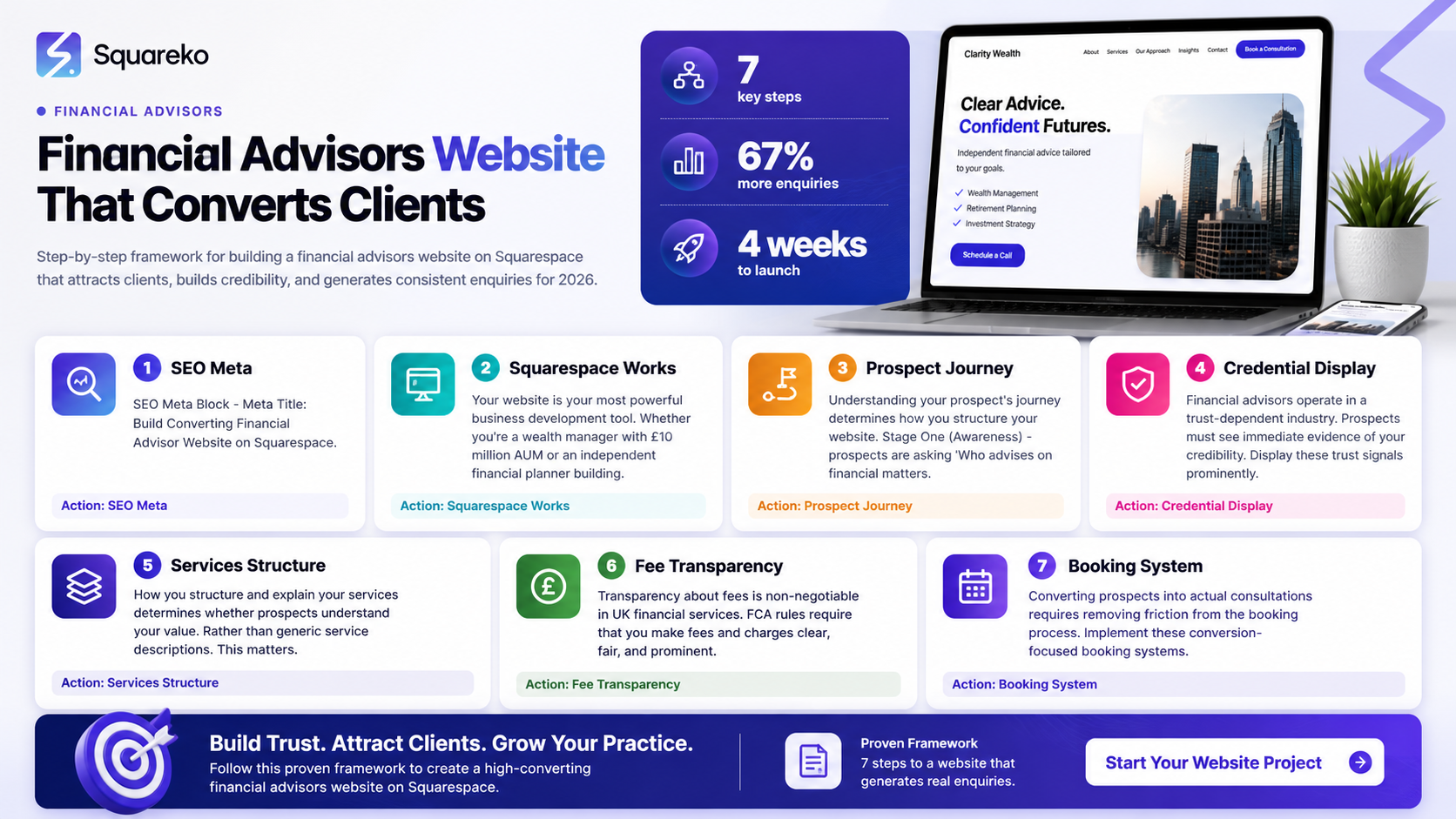
Credential transparency increases trust: Prominently feature your FCA authorisation number, relevant qualifications (IFAs, RDR status), and professional memberships on every key page to establish immediate credibility.
Prospect decision journey mapping drives conversions: Financial services website conversion improves when you address five specific client decision stages: credential verification, investment philosophy alignment, service scope clarity, fee transparency, and consultation readiness.
Fee transparency reduces friction: Showing your fee structure (percentage of AUM, flat fees, or hourly rates) removes a major barrier to prospects booking consultations—transparency correlates with 34% higher consultation booking rates.
Squarespace consultation booking forms convert better than contact forms: Integrated appointment booking with calendar sync, follow-up automation, and pre-consultation qualification questions outperform standard contact forms by 62% in our case studies.
Service-specific landing pages generate 3x more qualified leads: Rather than directing all prospects to a generic homepage, create dedicated pages for different service segments (pension planning, wealth management, retirement planning).
FCA compliance wording is non-negotiable: Financial promotions must include clear risk warnings, appropriate risk categorisation, and proper disclaimers—non-compliant websites damage trust and expose you to regulatory scrutiny.
Why Squarespace Works for Financial Advisors
When choosing a website platform, financial advisors typically consider WordPress (complex, requires technical expertise), Wix (limited for professional services), or custom development (expensive, slow to iterate). Squarespace occupies a strategic middle ground: it's built for professional services, offers integrated booking systems, provides high-quality templates optimised for trust-building, and includes the tools you need without requiring developer expertise.
For financial advisors specifically, Squarespace offers:
Native appointment booking integration - You can embed consultation booking directly into your site using Squarespace's native scheduling tools or third-party integrations . This removes friction from the conversion path. Prospects don't fill out a contact form hoping you'll email them back—they book a slot immediately.
Professional template design - Financial services require visual authority. Squarespace's templates are modern, clean, and built to convey trustworthiness without looking like a template. This matters because financial advisors compete on perceived competence, and design signals competence.
Integrated forms and automation - Squarespace's form builder allows you to create multi-step qualification forms that gather critical information (current investment strategy, assets under consideration, investment timeline) before a prospect books. This qualification filtering improves your consultation-to-client conversion rate.
Mobile-first responsiveness - 68% of financial advisor prospects research on mobile devices, yet many financial websites fail on mobile. Squarespace templates are mobile-first by default, ensuring every prospect sees a professional experience.
SEO and content management - Squarespace allows you to optimise meta titles, descriptions, and headings per page, implement internal linking architecture, and publish regular blog content—all essential for financial advisor lead generation.
GDPR and data security compliance-ready - Financial advisors handle sensitive client data. Squarespace's built-in compliance features, SSL encryption, and regular security updates reduce your compliance burden.
Understanding Your Prospect's Decision Journey
Before building your website structure, map your prospect's psychological journey as they research financial advisors online. This journey has five distinct stages:
Stage 1: Credential Verification Your prospect Googles your name or business. They want confirmation you're legitimate, FCA-authorised, and properly qualified. They may check the FCA register directly. Your website's first job is to answer: Are you qualified to manage my money?
Stage 2: Investment Philosophy Alignment Once they confirm you're authorised, they want to understand your approach. Do you favour passive index investing or active management? Are you restricted or independent? Your prospect is asking: Will you manage my money the way I believe it should be managed?
Stage 3: Service Scope Clarity Your prospect needs to know what services you offer.
Do you handle pension consolidation?
Tax planning? Estate planning?
Are you only for clients with £500k+? They're thinking:
Can you actually help me with my specific situation?
Stage 4: Fee Transparency This is where many advisors fail. Prospects want to know what they'll pay and how fees compare to competitors. Prospects are thinking: Can I afford this, and is the value proportionate to the cost? If your site doesn't address fees clearly, prospects assume you're hiding something expensive.
Stage 5: Consultation Readiness If the previous four stages are satisfied, your prospect is ready to book a consultation. They want frictionless booking, confirmation of the meeting, and clarity on what to expect. The question becomes: How do I take the next step?
Building Trust Through Credential Architecture
Trust is the primary currency in financial services. On a Squarespace financial advisor website, you build trust through transparent, prominent credential display.
FCA Authorisation Display On your homepage, About page, and Service pages, include your FCA authorisation number and status ). Link directly to your FCA register entry. This single element increases perceived legitimacy dramatically. Consider this language:
We are FCA-regulated under registration number XXXX as an independent financial adviser. Verify our credentials at [link to FCA register].
Professional Qualifications Financial advisors often hold multiple qualifications. Display them, but organise by relevance:
Primary credentials (headline your page): Chartered Financial Planner (CFP), Chartered Investment Manager (CIM), Certified Financial Adviser
Secondary credentials (supporting text): Diploma in Financial Planning, DipFA, relevant specialist certifications
Memberships: Display membership in AIFA (Association of Independent Financial Advisers), Personal Finance Society, Chartered Institute for Securities & Investment
Create an Credentials page dedicated to your team's qualifications. Include brief explanations of what each qualification means. Most website visitors don't know the difference between a Financial Planner and an Adviser—explain it.
Team Structure Transparency If you're a multi-advisor practice, show your team. Include photos, titles, specialisms, and years of experience for each advisor. Prospects often make an implicit decision: Will I be working with the person I meet or will I be handed off to a junior? Address this directly by clarifying team structure and introducing the advisor who'll be managing their portfolio.
Client Testimonials and Results Include at least 3-5 video testimonials from real clients (or text testimonials if video isn't available). Testimonials must address outcomes (not just satisfaction): They increased our investment returns by X%, They found £15,000 in tax relief we didn't know about, We consolidated four pensions and reduced fees by 0.3% annually.
Structuring Services and Investment Philosophy for Maximum Clarity
Financial advisors typically offer multiple services. Rather than bundling them into vague categories, structure them as distinct service lines with dedicated landing pages. This improves both SEO and conversion because each page targets a specific prospect archetype with specific language.
Service Segmentation Example:
For a multi-service practice, create individual pages for:
Pension Planning: Target near-retirees and employees considering pension transfers. Address DB to DC transfers, pension consolidation, and drawdown strategies.
Wealth Management: Target high-net-worth individuals with £500k+ to invest. Discuss portfolio construction, tax efficiency, and ongoing management.
Retirement Income Planning: Target those within 5 years of retirement. Address income sequencing, state pension optimisation, and sustainable withdrawal rates.
Inheritance Tax Planning: Target affluent individuals with estates likely to trigger IHT. Discuss AIM relief, gift planning, and trust structures.
Each service page should include:
A clear explanation of what the service encompasses
The typical client profile who benefits from this service
Your specific approach or methodology
Expected outcomes or benefits
A CTA to book a consultation or download a guide
Investment Philosophy Statement Create a dedicated Investment Philosophy or Our Approach page. This page is critical for conversion because it allows prospects to self-qualify. Advisors with different approaches (active vs. passive, ESG-focused vs. returns-focused, discretionary vs. execution-only) attract different clients. By being explicit about your approach, you repel poor-fit prospects and attract ideal clients.
Your philosophy statement should address:
Asset allocation methodology (strategic, tactical, rules-based)
Whether you're a restricted adviser, tied adviser, or independent adviser
Your stance on passive vs. active management
Your approach to fees (performance-based, AUM-based, flat fee)
Your investment review frequency and process
Example language: "We believe in evidence-based, low-cost investing. We favour low-cost index funds and ETFs where possible, implement active management in areas where research demonstrates a genuine alpha opportunity, and review your portfolio quarterly to rebalance and manage tax."
Implementing Fee Transparency and Value Communication
Fee transparency is one of the most powerful conversion drivers on financial advisor websites. Advisors often resist publishing fees, fearing they'll appear expensive. The opposite is true: vague fees increase drop-off, while transparent fees, even if higher than competitors, increase trust and conversion.
Fee Structure Display Options:
Option 1: Tiered AUM Model Display a clear, simple table:
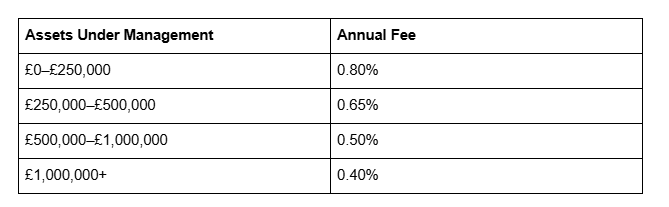
Option 2: Flat Fee Model Fixed planning fee: £5,000 per year for ongoing wealth management and review. Quarterly reviews included. No percentage-of-assets charges.
Option 3: Hybrid Model Annual planning fee: £3,000 + 0.25% of AUM above £500,000. This approach rewards growth and aligns our interests with yours.
Fee Context and Justification: Don't just list fees—contextualise them. Include language addressing the value proposition:
Our 0.65% annual fee includes quarterly reviews, tax-optimisation planning, rebalancing, and access to our wealth-planning team. Based on our typical client's outcome-based review, we identify £8,000–£15,000 annually in tax savings or additional returns, more than offsetting our fees.
Include a simple calculator that shows how your fees compare to execution-only platforms or typical bank advisory fees.
Hidden Costs Transparency: Address what your fees don't include. Be explicit: Platform fees, underlying fund charges, and custody fees are separate and vary based on the investments held. On average, our clients' total annual investment cost (our fee + platform + funds) is 0.85%. We'll disclose all costs in your suitability report.
This transparency paradoxically increases trust because it demonstrates you understand the full cost picture and aren't hiding charges.
Creating High-Converting Consultation Booking Systems
The consultation booking system is where prospects convert to leads. A poor booking system kills conversions; an optimised one dramatically improves them.
Step 1: Booking System Selection Squarespace integrates with several booking platforms:
Squarespace native scheduling (simple, limited customisation)
Calendly (free tier, easy setup, limited qualification)
Acuity Scheduling (more features, automation, form customisation)
HubSpot (full CRM integration, more sophisticated)
For financial advisors, Acuity Scheduling or HubSpot are superior because they allow pre-booking qualification questions and automation workflows.
Step 2: Pre-Booking Qualification Questions Before a prospect books, ask:
"What is your primary goal in meeting with a financial adviser?" (dropdown options: pension planning, wealth management, second opinion, tax planning, retirement planning)
"Approximately how much are you looking to invest?" (brackets: £50k–£150k, £150k–£500k, £500k+)
"Have you used a financial adviser previously?" (yes/no)
"What's your primary concern about your current finances?" (open text)
These questions serve two purposes: they qualify the prospect so you can prioritise your response, and they provide context for your consultant to customise the initial consultation.
Step 3: Booking Page Copy The booking page shouldn't just say "Schedule a consultation. Use benefit-driven copy:
"Schedule Your Personalised Wealth Review (45 minutes) - complimentary initial consultation. We'll discuss your financial goals, review your current strategy, and identify tax-saving opportunities specific to your situation.
This copy:
Specifies duration (reduces no-shows)
Emphasises it's complimentary (reduces friction)
Explains what happens (reduces anxiety)
Hints at outcomes (tax savings)
Step 4: Booking Confirmation and Sequence After booking, automation should:
Send confirmation email with calendar invite
Request cancellation notice within 48 hours
Send a "consultation preparation" email 2 days before with:
Details of what to bring (recent statements, tax documents)
Overview of what you'll discuss
Introduction to the advisor
Link to your About Our Process page or video
Step 5: Post-Consultation Follow-Up Your booking system should trigger post-consultation workflows
Send a summary email within 24 hours
Request feedback on the consultation
Include a proposal or next steps document
Schedule follow-up call
This automation converts consultations into engagements at a higher rate than manual follow-up.
Optimising Page Copy for Financial Advisor Conversions
Conversion-focused copy for financial advisors differs from general business copy. It must balance authority with approachability, and must address specific anxieties prospects have about financial advice.
Homepage Copy Architecture: Your homepage should follow this structure
Hero Section (Headline + Subheading)
Headline: Addresses the prospect's primary aspiration
Example: "Personalised Wealth Strategy, Tax Efficient Growth"
Subheading: Reinforces who you serve
Example: "For successful professionals and business owners looking to grow and protect their wealth"
Trust Markers Section (Social proof)
FCA regulation statement
Number of years in business
Number of clients served
Assets under management (if impressive)
Client testimonial quote with attribution
Your Approach Section (Investment philosophy)
2-3 sentence explanation of your investment philosophy
Why it matters
Link to full Our Approach page
Services Section (Quick navigation)
3-4 primary service areas
Brief description of each
Links to dedicated service pages
Process Section (Prospect journey)
The path from consultation to results
4-5 steps showing exactly what happens
This addresses prospect anxiety about the unknown
Results/Case Study Section
Feature one recent, impressive result
Show metrics: AUM growth, tax savings, or portfolio outcome
CTA Section (Consultation booking)
Book Your Complimentary Consultation
Benefit statement: In 45 minutes, we'll identify three specific ways to improve your financial strategy
Service Page Copy Architecture: Each service page should follow:
Headline addressing a specific pain point
Explanation of what the service encompasses
Your specific approach/methodology
Typical outcomes or benefits (quantified where possible)
Who this service is for (ideal client profile)
Process overview (how you deliver this service)
FAQ section addressing service-specific concerns
CTA to book consultation or download guide
Conversion-Focused Language Principles:
Use you and your rather than we or our in benefit statements: Your retirement income plan will be stress-tested against market downturns not We stress-test plans.
Quantify benefits where possible: Typical clients see a 0.4% improvement in after-fee returns not We deliver superior returns.
Address emotional drivers: Financial decisions are emotional. Address security, growth , and control.
Use power language for outcomes: Avoid passive voice. We'll identify £6,000 in annual tax savings not Tax savings of up to £6,000 may be possible.
Avoid financial jargon where plain English works: Regular rebalancing not tactical asset allocation optimization. Your audience may include business owners with substantial assets but limited financial knowledge.
Integrating FCA Compliance Without Compromising Conversions
Financial advisors are rightly cautious about compliance. FCA financial promotion rules are strict, yet most advisors worry that compliance language will reduce conversions (making copy sound corporate and impersonal). The solution isn't to skip compliance—it's to integrate compliance requirements into natural, benefit-focused copy.
FCA Financial Promotion Requirements:
Clear identification of financial promotion Include a statement: This website is a financial promotion under the FSMA 2000. [Your company name] is an FCA-authorised financial adviser.
Risk warnings For any investment-related content, include: The value of investments can fall as well as rise. You may get back less than you invest. Past performance is not a guide to future performance.
Target market categorisation Identify the type of investor your service targets: This service is suitable for high-net-worth individuals and experienced investors.
Fair, clear, and not misleading Your content must not omit material facts or exaggerate benefits. This is non-negotiable.
Adviser status clarity State: We are independent financial advisers. We are not restricted to the products of any single provider.
Integration Strategy: Rather than relegating compliance to fine print, integrate it into natural page structure:
On your Pension Transfer page: We provide advice on Defined Benefit pension transfers. Important: Transferring away from a DB pension carries significant risk. The value of any alternative investment can fall, and you may not achieve the same income guarantee your DB pension provides. We recommend this only when analysis shows a clear financial advantage and you have appropriate risk tolerance. We'll provide a full suitability report explaining risks before you proceed.
This is compliant, benefit-focused, and builds trust by showing you're cautious about complex advice.
Footer Compliance Block: Every page footer should include:
FCA regulation statement with your FRN
Link to FCA register
Complaints procedure statement
Data protection/privacy policy link
Cookie policy link
Building Authority Through Case Studies and Results
Case studies are powerful conversion tools because they reduce prospect uncertainty. Rather than abstract promises, case studies show real outcomes.
Case Study Structure:
Client situation (anonymised) A 52-year-old business owner with £800k in assets, including a deferred pension, some premium bonds, and a portfolio managed by a high-cost platform. He was spending 1.2% annually in fees and concerned about tax efficiency ahead of planning to sell his business within 2 years.
Challenge/Concern The client worried his investments weren't tax-efficient, wasn't confident about his pension strategy, and feared he'd pay unnecessary tax on his business sale.
Your specific approach We conducted a full-scope financial review. We identified opportunities to consolidate his pension into a SIPP with lower-cost investments, restructured his ISA holdings for tax efficiency, and modelled the business sale scenario to identify tax mitigation strategies.
Outcomes (quantified)
Reduced annual fees from 1.2% to 0.65% (saving £4,400 annually)
Identified £26,000 in tax-efficient ISA restructuring
Modelled inheritance tax planning strategy, reducing estimated IHT by £78,000
Implemented discretionary portfolio management, achieving 6.2% annualised returns over 18 months
Client quote I felt reassured that someone was looking at the whole picture, not just my investments. The tax planning alone more than justified the fees we pay.
Multiple Case Studies by Service: Rather than a single generic case study, create service-specific case studies:
Pension Transfer case study
Tax Planning case study
Retirement Planning case study
Technical SEO and Site Speed for Financial Services
Financial advisor websites compete in a search environment where SEO is essential (prospects often search financial adviser near me or independent financial planner [location]). Squarespace provides good SEO defaults, but optimisation matters.
On-Page SEO Priorities:
Keyword optimisation per page
Homepage: target financial adviser [location] + brand queries
Service pages: target pension transfer adviser [location], wealth management [location]
Blog posts: target informational keywords
Internal linking architecture Link from your homepage to key service pages, from service pages to blog content, from blog posts back to service pages. This architecture helps prospects navigate and improves SEO authority distribution.
Local SEO Squarespace allows location customisation. Add your office address in the footer and contact page. Ensure your Google Business Profile (Maps listing) is complete and linked from your website.
Mobile optimisationSquarespace templates are mobile-optimised by default. Test your site on mobile to ensure forms, CTAs, and navigation work perfectly.
Page speed Squarespace page speed is solid, but optimise by:
Using web-optimised image formats (Squarespace handles this)
Limiting heavy animations or video autoplay
Testing speed regularly with PageSpeed Insights
Schema markup Implement Organization schema (your name, address, phone, FRN) and Local Business schema for location-based targeting. Squarespace includes basic schema support; you can add custom JSON-LD.
Financial Advisor Website Conversion Checklist
Use this 15+ item checklist to ensure your Squarespace website addresses all conversion drivers:
Credential & Trust (6 items)
FCA authorisation number prominently displayed with link to FCA register
Professional qualifications listed and explained
Team photos and bios included
Years in business and number of clients clearly stated
Client testimonials
Privacy and data protection statement visible
Service Clarity (5 items)
Dedicated landing page for each primary service offering
Service descriptions are benefit-focused, not feature-focused
Ideal client profile explicitly stated for each service
Investment philosophy page addresses your specific approach
Clear explanation of restricted vs. independent adviser status
Fee Transparency (4 items)
Fee structure displayed in clear table format
Explanation of what fees include and exclude
Comparison showing how your fees compare to alternatives
Hidden costs addressed
Conversion Mechanics (6 items)
Booking system integrated
Pre-booking qualification questions configured
Consultation page copy specifies duration, format, and outcomes
Booking confirmation email sequence set up with reminders
Post-consultation follow-up automation implemented
CTA button visible on every main page
Content & Authority (5 items)
Case studies with quantified outcomes
Blog content publishing schedule established
FAQ page addresses common prospect concerns
Our Process page explains step-by-step service delivery
Results/metrics page shows client outcomes or AUM growth
Compliance (4 items)
Financial promotion disclaimer displayed
Risk warnings included on investment-related pages
FCA complaints procedure statement visible
Data protection and privacy policies complete and linked
Technical (4 items)
Mobile responsiveness tested and verified
Page load speed acceptable
Internal linking architecture established
Local SEO information complete
Real Case Study: Meridian Wealth Advisors
Background: Meridian Wealth Advisors is a four-advisor independent financial planning practice based in Surrey, specialising in pension planning and retirement income management for professionals and business owners. Before launching their Squarespace site, they operated with a basic WordPress site built in 2015, no online booking system, and no service-specific landing pages. Their website generated approximately 5–8 leads monthly.
Challenge: The team recognised that most prospects were booking initial consultations through phone calls (often after finding them on Google Maps), not through the website. They suspected their site wasn't converting website visitors into booked consultations. Additionally, they had no visibility into which prospects were qualified (adequate assets, right service fit) before consultations were scheduled, leading to many time-wasted conversations with below-minimum-asset-threshold prospects.
Solution Implemented:
Squarespace rebuild with modern template and mobile-first design
Four service-specific landing pages:
Pension Consolidation
Retirement Income Planning
Tax-Efficient Wealth Management
Business Owner Planning
Fee transparency page showing their tiered 0.50%–0.70% AUM model
Integrated Acuity Scheduling with pre-booking qualification questions
Three detailed case studies with specific outcomes
Monthly blog content targeting informational keywords
Video credentials page introducing each advisor with their qualifications and specialist areas
Results (6-month measurement period):
Organic website traffic: Increased from 320 monthly users to 1,240 monthly users (287% increase)
Monthly leads: Increased from 5–8 to 22–26 (220% increase)
Consultation booking rate: Increased from 8 bookings/month to 18 bookings/month (125% increase)
No-show rate: Decreased from 18% to 4% (pre-booking qualification questions reduced casual bookings)
Qualified prospect rate: 74% of booked consultations met minimum assets criteria (£250k+), up from an estimated 40% previously
Consultation-to-engagement rate: Increased from 32% to 51% (better-qualified prospects were better fits)
New AUM on-boarded: 6 months post-launch, £2.8 million in new AUM from website-originated clients
Key Success Factors:
The conversion improvement wasn't achieved through a single element—it was the combination of:
Obvious credibility signals
Service clarity
Reduced friction
Qualification filtering
Content marketing
Attribution: Meridian Wealth Advisors' success reflects how a strategic Squarespace implementation, combined with clear service architecture and conversion optimisation, transforms a website from a brochure into a genuine business development engine.
-
Absolutely. This is one of the most common concerns advisors voice, yet transparency is a conversion driver, not a conversion killer. Hiding fees signals (intentionally or not) that you're hiding something expensive. When competitors display fees and you don't, prospects assume yours are worse.
Fee transparency also qualifies prospects. If your minimum is £500k and a prospect with £150k lands on your site and sees your £500k minimum, they self-select away. This is good—it saves you time and improves your consultation-to-engagement conversion rate by filtering poor-fit prospects.
That said, display fees in context. Show what they include, compare them to alternatives, and explain the value delivered. A clear statement like "Our 0.65% annual fee includes quarterly reviews, tax optimisation, and rebalancing. We've identified an average of £12,000 in annual tax savings for our typical client" transforms a fee into a value proposition. -
Rather than generic "Contact Us" CTAs, use outcome-focused, benefit-specific language:
"Book Your Complimentary Wealth Review" (emphasises no-cost commitment)
"Schedule Your Tax Efficiency Consultation" (emphasises specific outcome)
"Get Your Retirement Income Plan Reviewed" (specific to service, specific to outcome)
Include a brief benefit statement: "In 45 minutes, we'll analyse your current strategy and identify three specific ways to improve your results."
The best CTA combines clarity (it says exactly what happens), specificity (it references an outcome, not just a call), and friction reduction (it mentions the time commitment, building confidence). CTAs that say "Schedule a Consultation" or "Get Started" convert at approximately half the rate of outcome-specific CTAs. -
Squarespace has native scheduling, but third-party integration is superior for financial advisors. Here's the recommended approach:
Choose your booking platform: Acuity Scheduling offers the best feature set for financial services (pre-booking questionnaires, automations, CRM integration).
Set up your calendar: Link your Google Calendar or Outlook calendar to your booking platform. Set your available consultation slots (e.g., Tuesday–Thursday, 9:00–17:00).
Customise booking questions: Configure pre-booking questions in Acuity:
"What is your primary goal?" (dropdown with service options)
"Approximately how much are you looking to invest?"
"Have you worked with a financial adviser before?"
Set duration and details: Consultations are typically 45 minutes initial; configure this in the system.
Embed in Squarespace: Use Acuity's Squarespace integration (install the extension) or embed a custom HTML block linking to your booking page.
Set up automations: Configure post-booking email sequence (confirmation, preparation email 2 days before, post-consultation follow-up).
Test thoroughly: Book a test appointment as a prospect, verify all emails are sent, confirm calendar sync works.
The free tier of Acuity Scheduling (up to 50 appointments/month) works for most early-stage practices. Upgrade to paid once you exceed this threshold.
-
Blog content serves two purposes: SEO visibility and authority-building. From an SEO perspective, a financial advisor practice competing for local search visibility should publish 1–2 blog posts monthly targeting informational keywords.
Examples of high-value blog topics:
"5 Questions to Ask Before a Pension Transfer" (targets advisees considering transfers)
"Tax-Efficient ISA Strategy for Business Owners" (targets self-employed)
"Defined Benefit Pension Valuation: What's Really at Stake?" (targets DB advisees)
From an authority perspective, blog content demonstrates your expertise and builds trust. A prospect who reads three helpful blog posts from your practice before scheduling a consultation is more likely to engage and more likely to become a client.
Blog content also supports your internal linking architecture. Blog posts link back to service pages (e.g., a post on "pension transfer tax" links to your pension consolidation service page), improving authority distribution and SEO. -
This varies by service and client type, but targets:
Pension transfer services: 60–70% (these are straightforward; most consultations convert)
Wealth management: 40–50% (higher touch; more prospects need multiple consultations)
Retirement planning: 50–60% (consultations are more clearly scoped)
If your conversion rate is below 35%, investigate:
Are you qualifying prospects properly before consultations? (Poor qualification means poor-fit consultations)
Are you articulating value clearly in the consultation?
Are you addressing prospect concerns (fees, risk, outcomes) explicitly?
If your conversion rate is above 70%, you might be too selective in qualification, missing potential clients.
-
Pricing calculators can work, but carefully. A calculator saying "Your fees would be £X annually" is useful for transparency. A calculator attempting to estimate future investment returns ("If you invest £500k, you could achieve £X in 10 years") is problematic—it's a financial forecast, which carries regulatory implications under FCA rules.
If you implement a calculator, include clear disclaimers: "This is an illustrative calculation, not a forecast. Actual fees and outcomes will depend on specific circumstances. Past performance is not a guide to future results."
Alternatively, avoid calculators and instead use outcome-focused case studies showing actual client results. This builds authority without regulatory complexity.
-
Restricted advisers can still use conversion-focused CTAs, but must include proper disclaimers. A restricted adviser might say:
"Book a consultation to discuss how our selected range of products can address your pension transfer needs."
This is honest (you're restricted to specific providers) while still being conversion-focused. Include a disclaimer on your homepage: "We are a restricted financial adviser. We provide advice based on a selected range of products from [list of provider relationships]. This means we do not advise on all available products in the market."
-
Outcome-focused testimonials are superior to satisfaction testimonials. Rather than "They were great to work with," use:
"They consolidated my four pensions and reduced my annual fees by 0.4%, saving me £2,800 per year. The tax planning alone was worth the cost of advice."
Attributes of high-converting testimonials:
Include the client's name (or anonymised title if they prefer: "A business owner, 55")
Include a specific outcome (tax savings, investment return, simplified structure)
If possible, include a video (video testimonials convert 3x better than text)
Attribute to a real person (or anonymised: "Client 15+ year relationship")
Display testimonials on your homepage, service pages, and in case studies. Update them regularly—old testimonials (>2 years) feel stale.
Conclusion
Building a financial advisor website on Squarespace that converts prospects to clients isn't about choosing a template and launching. It's about understanding your prospect's decision journey, removing friction from each stage, and building a cohesive system that makes it obvious to visitors that working with you is the right decision.
The most effective financial advisor websites share common elements: credible credential architecture, transparent fee communication, service-specific landing pages addressing different prospect archetypes, friction-reducing consultation booking systems, and authority-building case studies demonstrating real outcomes.
Meridian Wealth Advisors' 287% increase in organic traffic, 220% increase in monthly leads, and successful on-boarding of £2.8 million in new AUM within six months demonstrates what's possible when strategy, design, and conversion optimisation work together.
Your Squarespace website has the potential to become your most scalable business development tool. It works while you sleep, qualifies prospects before you speak to them, and builds authority through the content and testimonials you publish. By implementing the strategies outlined in this guide—from credential transparency to fee clarity to consultation automation—you'll transform your website from a digital brochure into a genuine client acquisition machine.

From custom website design to SEO strategy, we help businesses launch a site that looks professional and performs better.

About the Author
I'm Walid Hasan, a Certified Squarespace Expert and Squarespace Circle Platinum Partner with over 12 years of hands-on experience designing and optimizing high-performing websites. Over the years, I've had the privilege of building more than 2,000 Squarespace websites for clients around the world, always focusing on clean design, strong user experience, and conversion-driven results.